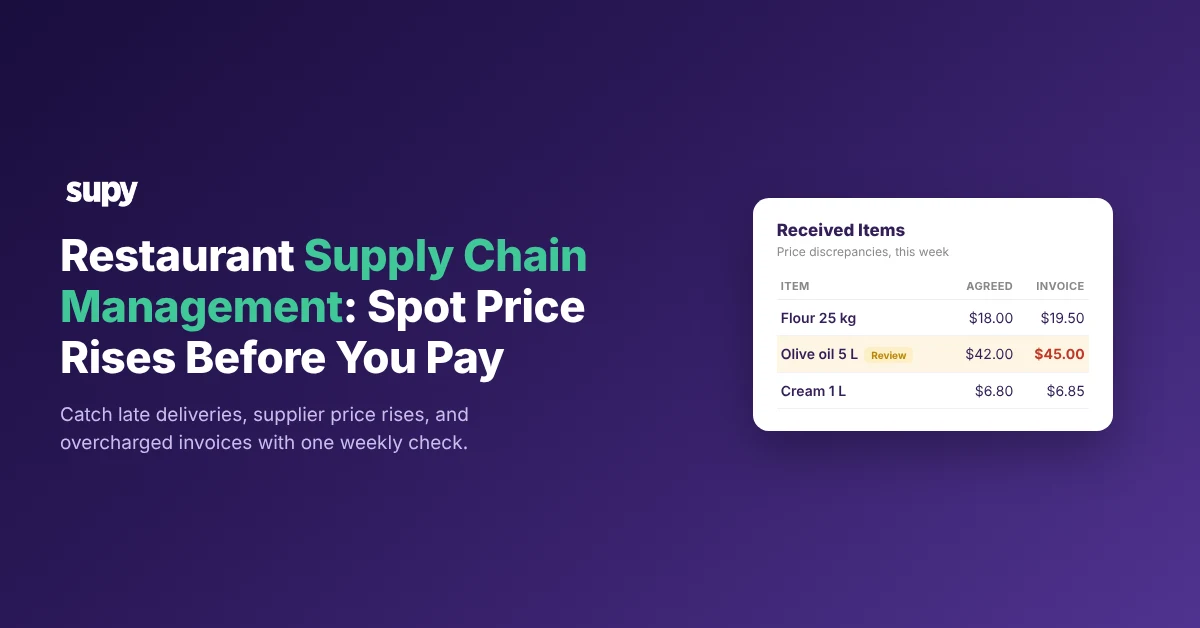
Restaurant Supply Chain Management: Spot Price Rises Before You Pay
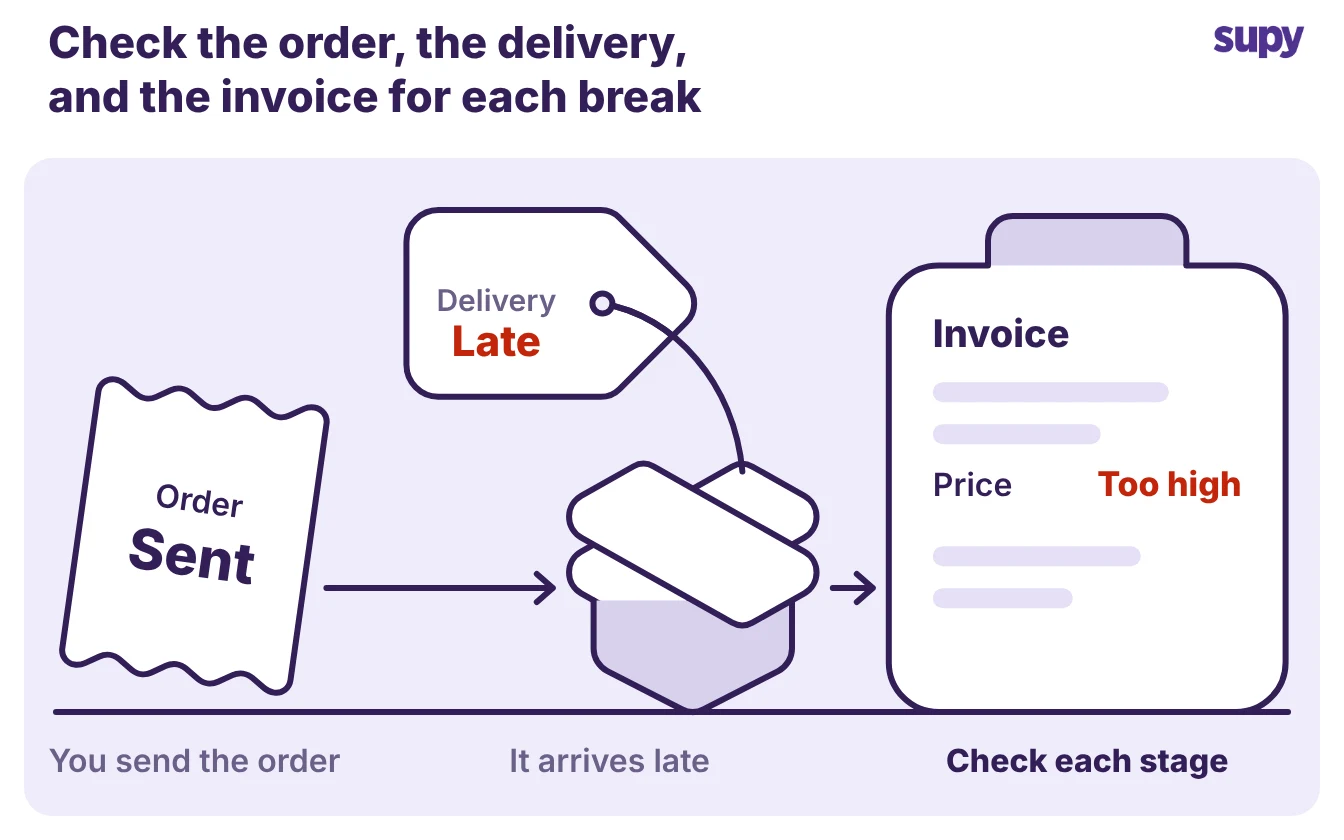
Where a restaurant supply chain breaks
A restaurant supply chain is how food moves from your suppliers to your plates: you order it, they deliver it, and you pay for it. It breaks in three ordinary places: late deliveries, supplier price rises between orders, and invoices paid before the charge is checked. This article gives the weekly check that catches each one before the money leaves.
Most groups manage the supply chain one order at a time, so each failure stays small and nobody adds them up:
- A late delivery. It costs a few dollars in substitutes this week.
- A new supplier price. It costs a little margin on every dish that uses the item.
- An overcharged invoice. Nobody questions it, because the person approving it never saw the agreed price.
Each one looks minor on its own, and together they decide your food cost.
The fix is not a bigger system. It is a short weekly routine that catches each failure where it happens. You check the delivery at the door, the invoice before it is paid, and the moved prices on one screen.
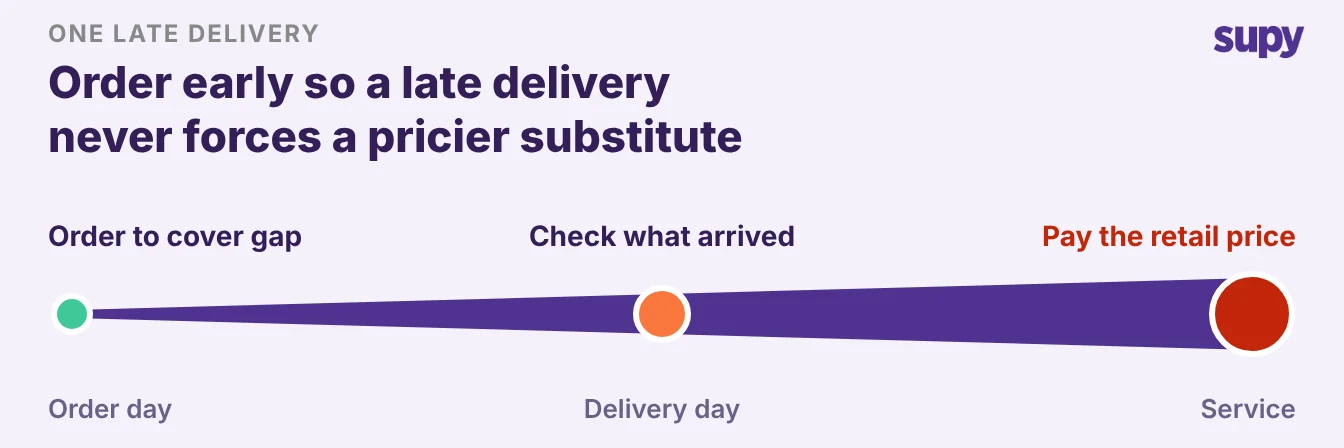
Late deliveries and the substitutes bought at a higher price
Late deliveries cost more than a gap on the shelf. One fine dining group found about half its supplier deliveries arrived late.
When one slipped, staff bought a substitute at a higher price rather than drop the dish. The substitute is rarely on contract, so it carries the retail price. The cost never gets questioned, because the kitchen was solving a service problem, not a buying one.
- The supplier promise. You cannot stop a supplier running late, but you can stop the panic buy. The first move is to write down what each supplier promises. Note the days they deliver to each branch, and the cut-off for the next run.
- Supy's delivery schedule. Supy holds those delivery days and cut-offs per supplier per branch, and lines each purchase order up with them. An order then goes out in time to arrive before you run short. When a chef can see the next delivery is Thursday, they order enough on Tuesday to cover Wednesday, instead of a run to the cash and carry.
The same record tells you which supplier was late and how often. A supplier who misses one delivery in two is not a problem you can plan around.
The delivery history is the evidence you take into the next conversation with them. For more on building that supplier record, see restaurant supplier management, and Supy's supplier management holds the schedules and cut-offs in one place.
Price rises that only show up after payment
A supplier price rise is the quietest cost in the chain. One operator found a key ingredient had moved from $10/kg to $13/kg, and only noticed after the invoices were paid, because nothing flagged the new price at the door.
By the time the rise showed up in the month-end P&L, the kitchen had been selling the dish at the old margin for weeks.
- Prices keep moving. Price changes do not sit still either. Across 66 million supplier price records, once a supplier price changes it changes again within 19 days about half the time, so a price you checked last month is often already wrong. A monthly review of supplier costs is too slow to keep up with a supplier who reprices every few weeks.
- Check at receiving. The fix is to check the price where it first appears. That is the invoice at receiving, not the P&L a month later. Set a variance threshold, so any line more than a set percentage above the agreed price is flagged before it posts.
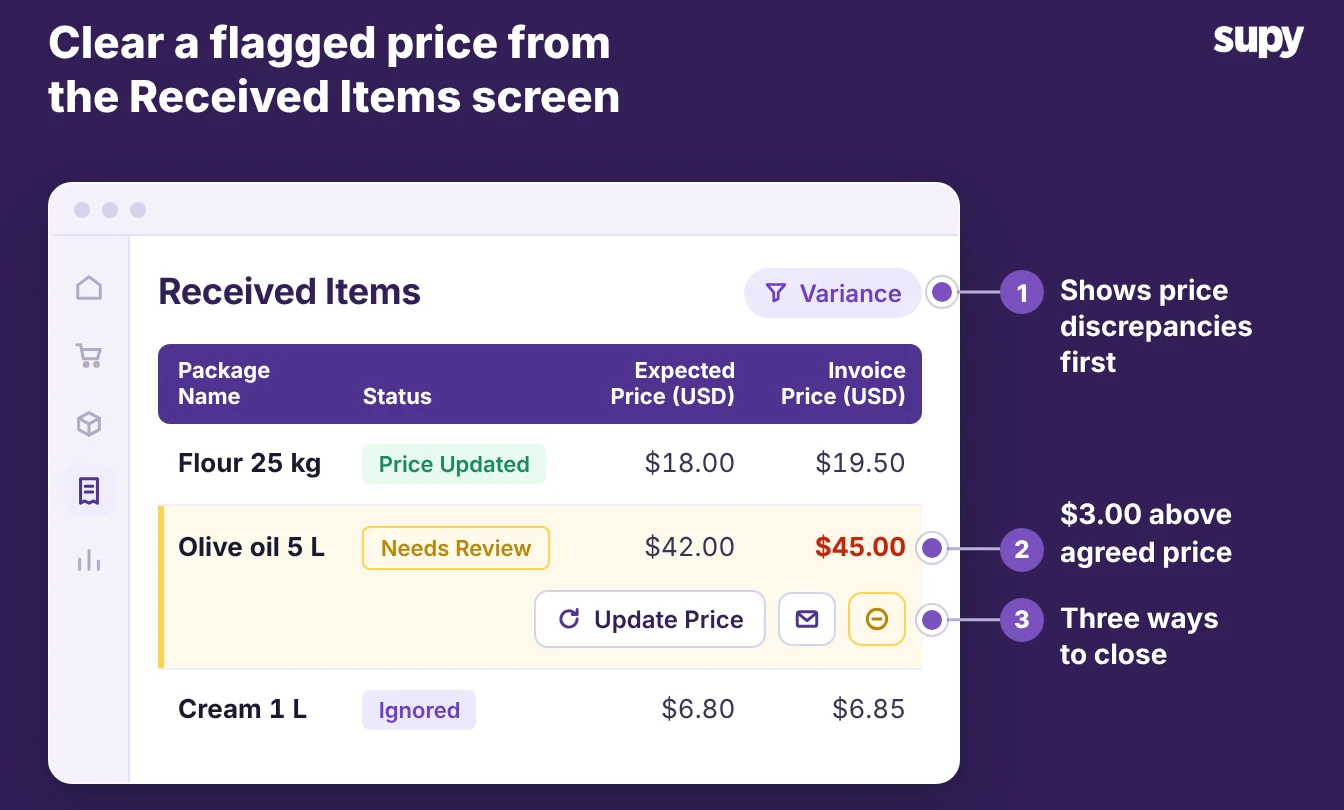
Supy applies that threshold at invoice receiving and lists every moved price on one screen, the Received Items page. It opens on a price-discrepancy filter, so you only see the rows that changed.
You accept the new price, which updates the recipe cost. Or you query it, in minutes, the week it happens.
Invoices paid before anyone checks them
The worst version of a price rise is one you pay without ever seeing it. A multi-site catering business told us its main supplier auto-charged the company card on every invoice, with no check in between. $150 was charged for $100 of goods, and nobody saw it until the money had gone.
Put a person between the invoice and the payment, and Supy does the matching for them:
- Read the invoice. Supy pulls out the line items and prices, and matches them to the purchase order.
- Flag the gap. A charge that differs from the agreed price is flagged before the invoice posts to stock and accounts.
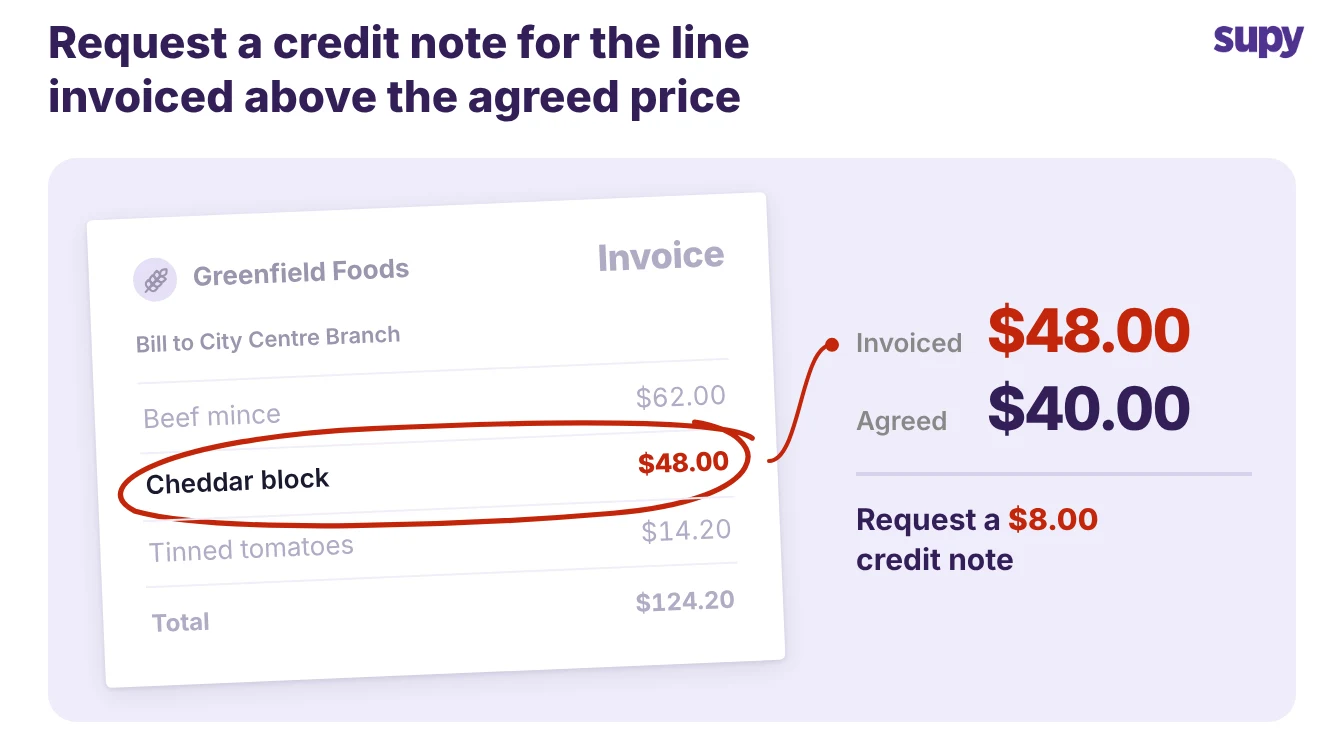
- Approve or query. The person approving sees the two numbers side by side and decides to approve, query, or request a credit note.
Across 6.43 million invoice lines, nearly half of the lines invoiced above the agreed price run 20% or more over it. An invoice nobody checks against the order is the easiest place in the chain to overpay a supplier. For how that receiving and credit flow works, see Supy's invoices and credit notes.
The weekly checks that keep supplier costs in line
Three failures, three checks, and none takes more than a few minutes a week. Run them on a fixed day, and you catch each failure in the week it happens, not at month-end. The table below sets out the check for each failure and the sign that it is slipping.
| Weekly check | What you do | A sign it is slipping |
|---|---|---|
| Deliveries against the schedule | Read which deliveries arrived late and which forced a substitute buy | A supplier late more often than not |
| Price-discrepancy screen | Accept each moved price so recipe cost updates, or query it | The list is never empty by week end |
| Invoice against the agreed price | Approve only after seeing the charged price next to the agreed price | An invoice paid before anyone read it |
To tell whether these failures are costing you now, pick your last four weeks of invoices. Ask one question of each: did anyone compare the charged price to the agreed price before paying?
If the answer is no, start there, because it is the check that protects the most money for the least effort. The deliveries and the price screen can follow once the invoice check is in place.