.jpg)


Restaurant Supplier Price Benchmarking: How Multi-Site Groups Catch Overpayment Before It Compounds
What Supplier Price Benchmarking Means When Every Price Is a Moving Target
Restaurant supplier price benchmarking is the practice of measuring each price you pay against a reference point, so you can tell whether it is high, low or drifting, rather than accepting it in isolation. The reference can be your own purchase history for that item, the price a sister branch or an alternative supplier pays, or the price you actually agreed on the purchase order. Without a reference, a price is just a number on an invoice, and a number with nothing to compare it to always looks acceptable.
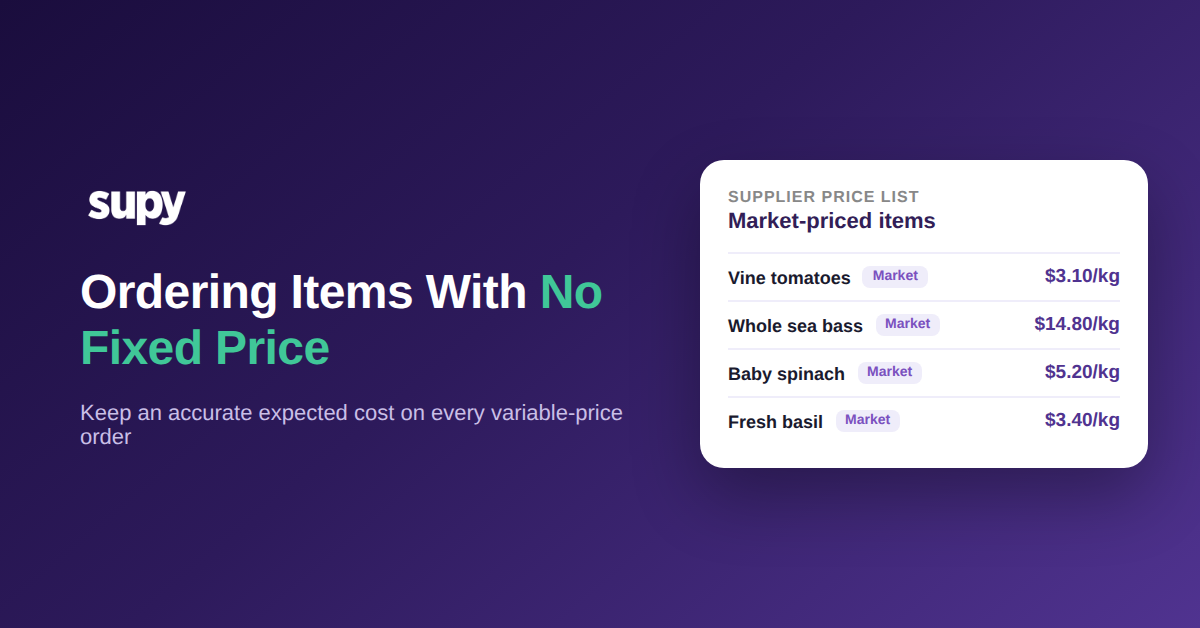
The reason this matters more than it used to is that prices do not hold still. A supplier catalogue price is a snapshot, not a contract. Volatile fresh items can move every one to two weeks, and by the time a par level or a budget is set against last month's rate, a meaningful share of items have already repriced with nobody flagging it. Benchmarking is not a once-a-year negotiation exercise; it is a continuous comparison, because the thing you are comparing against keeps moving.
Why Spot-Checking a Few Invoices Misses Systematic Overpayment
The instinct when margins tighten is to have someone eyeball a few invoices. It feels like diligence, but it is the wrong tool for a systematic problem, and it is worth being honest about why. Spot-checking samples a handful of lines out of thousands, catches only errors large enough to notice by eye, and happens too rarely to see prices that drift a few cents at a time. The overpayment that actually compounds is small, spread across many lines, and steady, which is exactly what a manual check is built to miss.
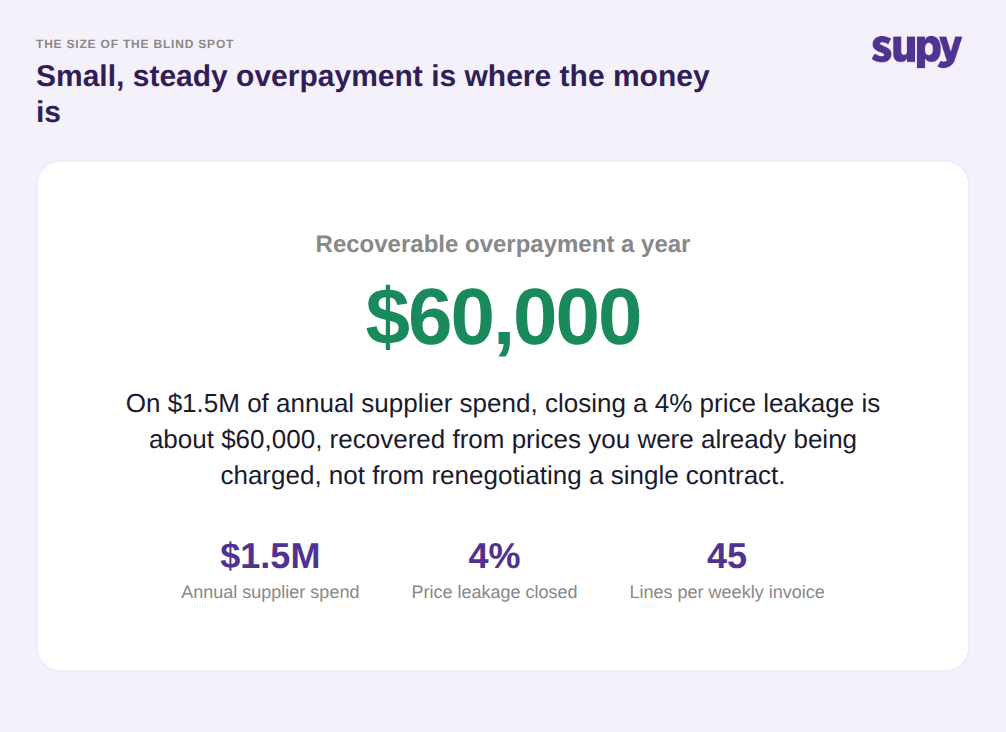
A systematic benchmark inverts each of those weaknesses: it compares every line, every cycle, against a defined reference, and surfaces the exceptions for a human instead of asking a human to find them. On $1.5 million of annual supplier spend, closing even a 4% leakage is around $60,000 a year, and that is money recovered from prices you were already being charged, not from renegotiating a single contract. The published data backs the pattern too: search results for these queries are dominated by generic "how to negotiate with suppliers" advice, not by any method for catching the overpayment already sitting in your invoices, which is where the recoverable money actually is.
A sampling tool cannot solve a systematic problem
| What matters | Manual spot-check | Systematic benchmark |
|---|---|---|
| Lines compared | A handful | Every line |
| How often | Occasional | Every cycle |
| Catches small drift | No | Yes |
| Effort per check | High, manual | Low, automated |
| Shows who to call | No | Yes |
Comparing the Same Item Across Branches and Suppliers
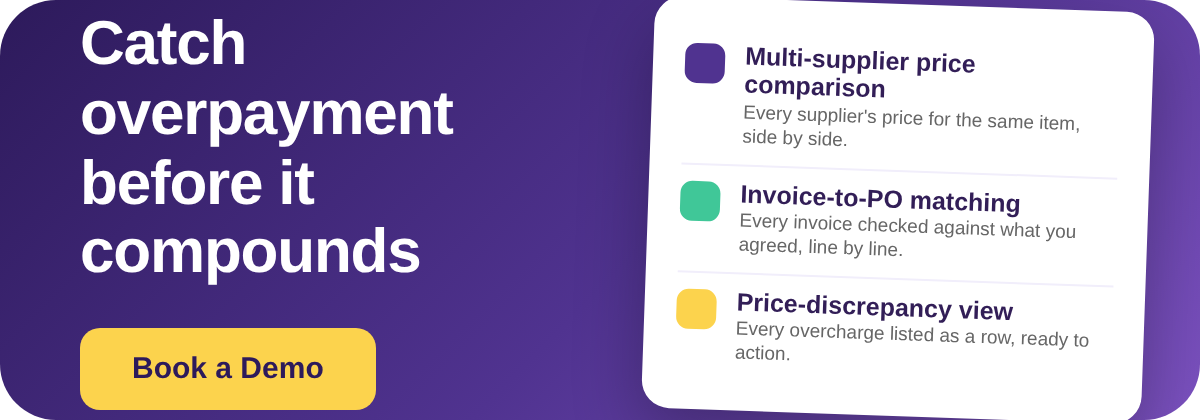
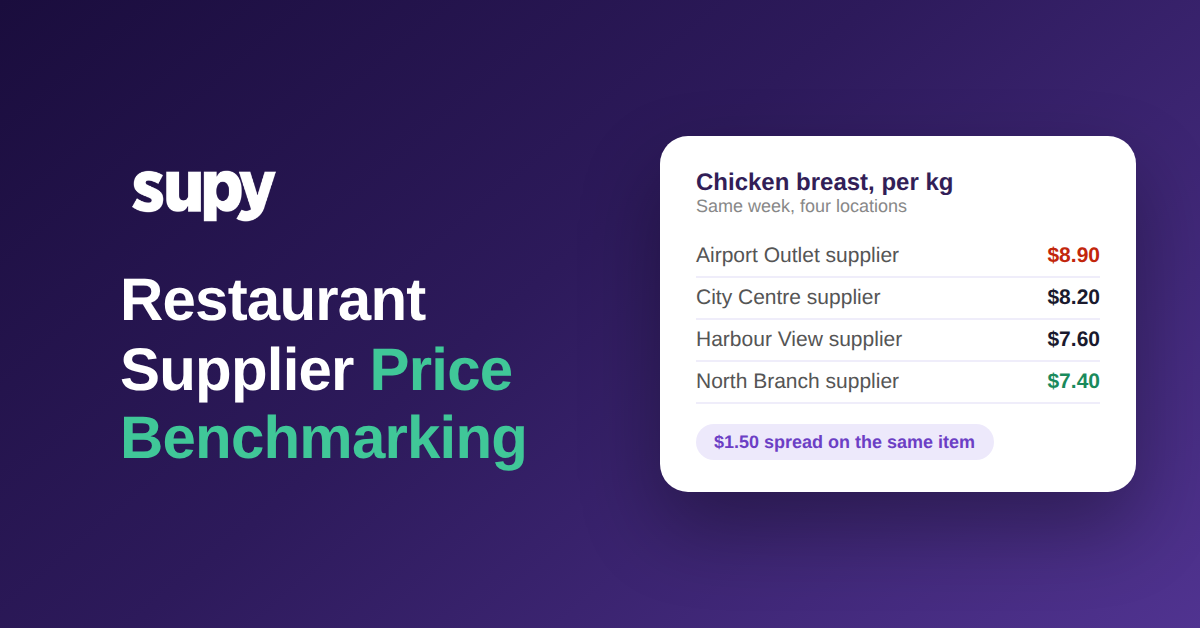
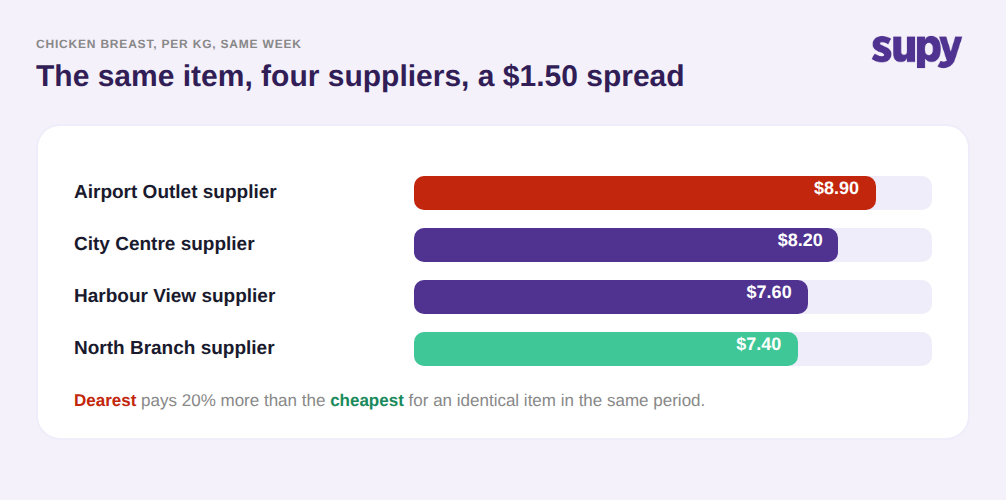
The first reference point you control completely is your own group. When the same base item is bought by several branches, or from more than one supplier, the price should be comparable, and where it is not, you have found a lever. The same chicken breast running from $7.40 to $8.90 per kilogram across four locations is not a market mystery; it is a purchasing decision waiting to be standardised. Supy's multi-supplier price comparison lines up every supplier's price for the same ingredient, and because purchase prices are tracked per item over time, you can also benchmark a price against its own history and see the drift before it becomes the new normal.
This is where the group structure becomes an advantage instead of a complication. A single-site operator has only its own history to compare against; a multi-site group carries a live internal benchmark in its own data, one branch against another, one supplier against the next. Consolidating that buying view is also what restaurant procurement software is for, so the comparison is a report you read rather than a spreadsheet you assemble by hand.
Comparing Invoice to Agreement: The Gap Between the Price You Negotiated and the Price You Pay
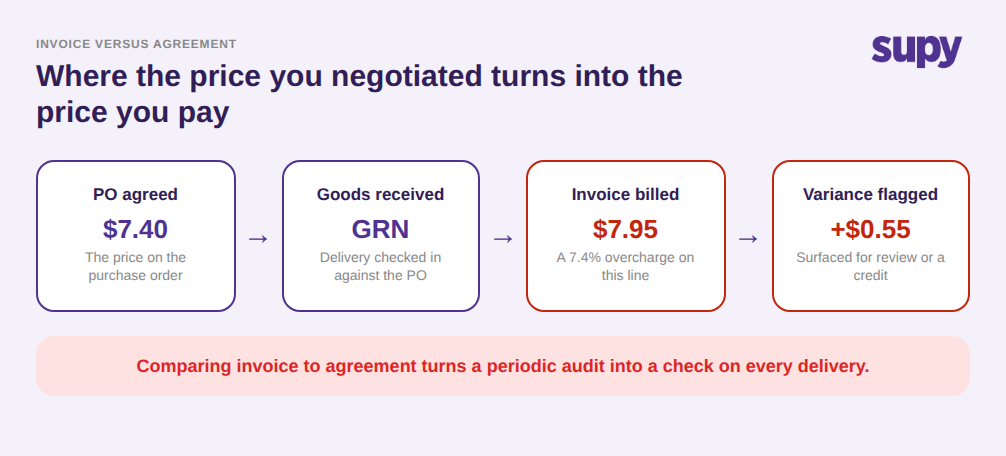
The highest-value benchmark is often the quietest one: the price you agreed versus the price you were billed. A meaningful share of supplier invoices carry at least one line billed at a price different from what was actually agreed on the purchase order. It is rarely fraud; it is drift, stale price files and human error, and most of it goes unrecovered because no one is comparing the invoice back to the agreement line by line. A case agreed at $7.40 per kilogram that arrives billed at $7.95 is a 7.4% overcharge that no spot-check will catch on a 45-line invoice.
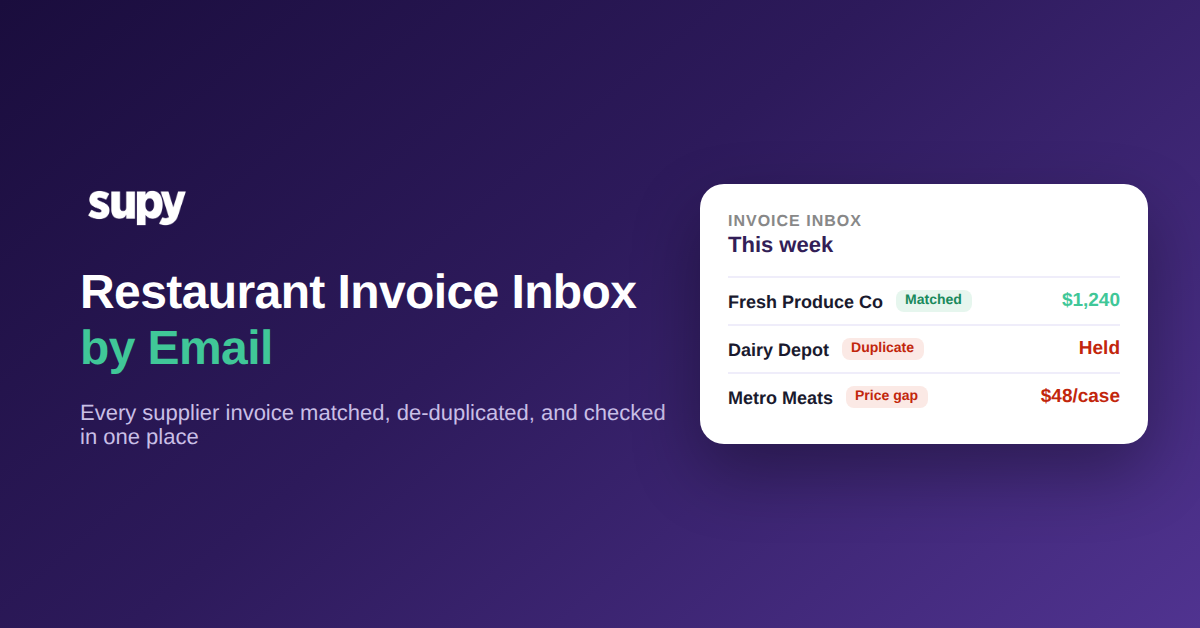
This is the benchmark software closes most cleanly, because it is a pure data match. Supy's invoice receiving matches each supplier invoice back to its purchase order, extracts the line items and prices, and flags any price or quantity conflict before it updates stock and accounts. A received-items view then lists every discrepancy as a row, defaulting to a price-discrepancy filter, so a buyer can update the expected price, raise a credit, or email the supplier from the same screen. Comparing what you paid to what you agreed stops being a periodic audit and becomes something that happens on every delivery. If overpayment is the symptom you are chasing, our guide to supplier overcharging goes deeper on where it hides.
You do not need all three benchmarks live on day one, and the order matters. Start with invoice-versus-agreed, because it recovers money you have already negotiated and needs no new data beyond your own POs and invoices. Add your own price-history benchmark next, so drift on your most-bought items surfaces on its own. Layer cross-branch and cross-supplier comparison last, once the first two are running, to standardise buying across the group. Pick your ten highest-spend items, compare this month's billed prices against what you agreed and against each other, and the first overpayments will show up before you finish the list. The prices were never going to flag themselves; a benchmark is simply the reference that makes them visible.