.jpg)


Supplier Overcharging Restaurants: How Undetected Invoice Errors Drain Food Cost Margin
Supplier overcharging rarely looks like overcharging. It looks like a normal invoice, and the margin leak comes from contracted rates that quietly drift on delivery.
How Supplier Overcharging Hides: Contracted Rates That Slip Through
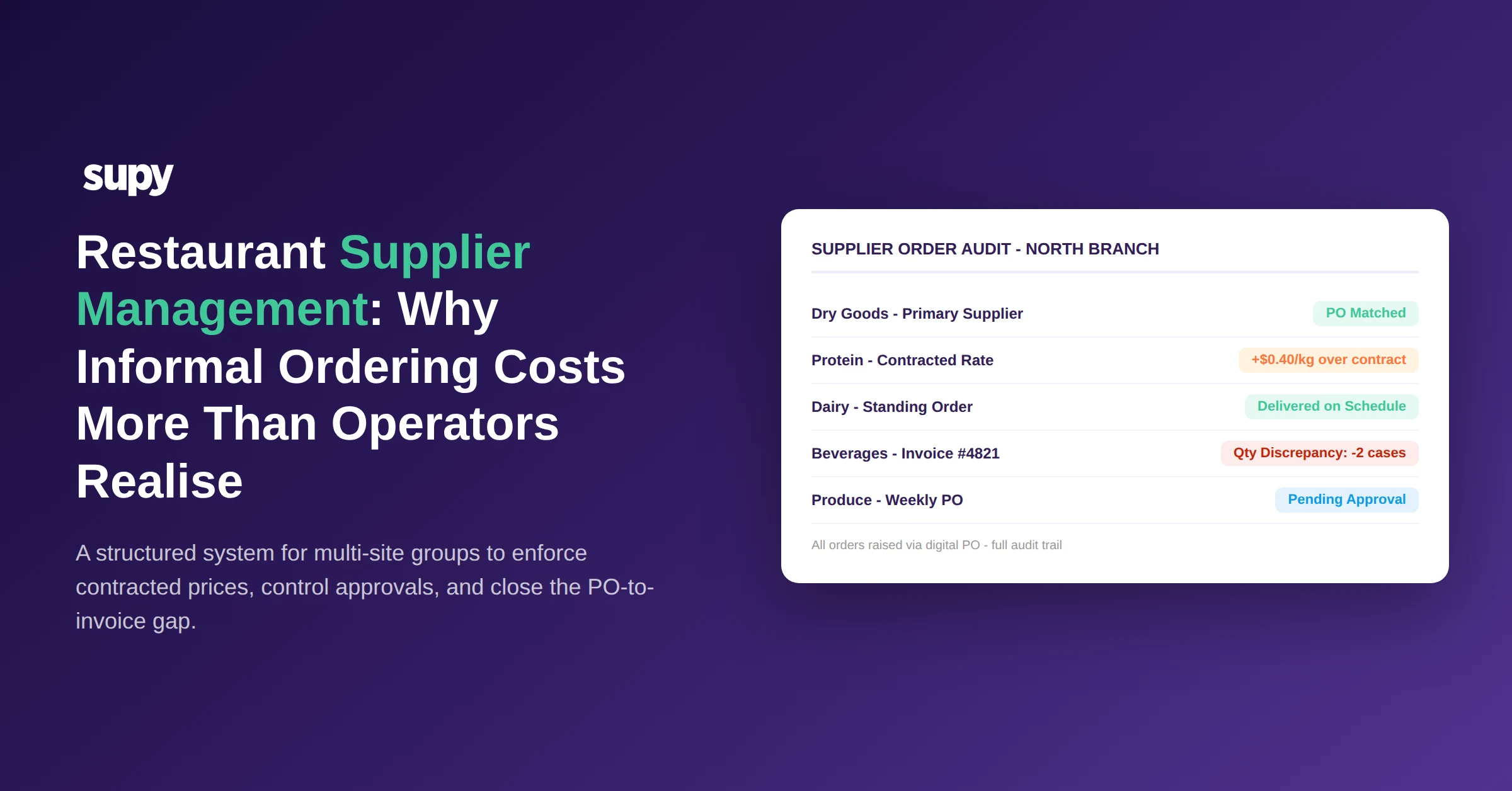
The most common form of supplier overcharging restaurants is not fraud - it is drift. A supplier updates their price list, the change flows through to the invoice, and the receiving team has no immediate way to know whether the new rate matches the contracted agreement or not.
Contracted rates are typically agreed during onboarding or at periodic price reviews and recorded in supplier agreements that most operations staff never access. The invoice arrives as a PDF. The receiving team compares it against the delivery note to verify quantities, but there is no routine check against the contracted rate because that information lives in a different system - or in a spreadsheet that was last updated three months ago.
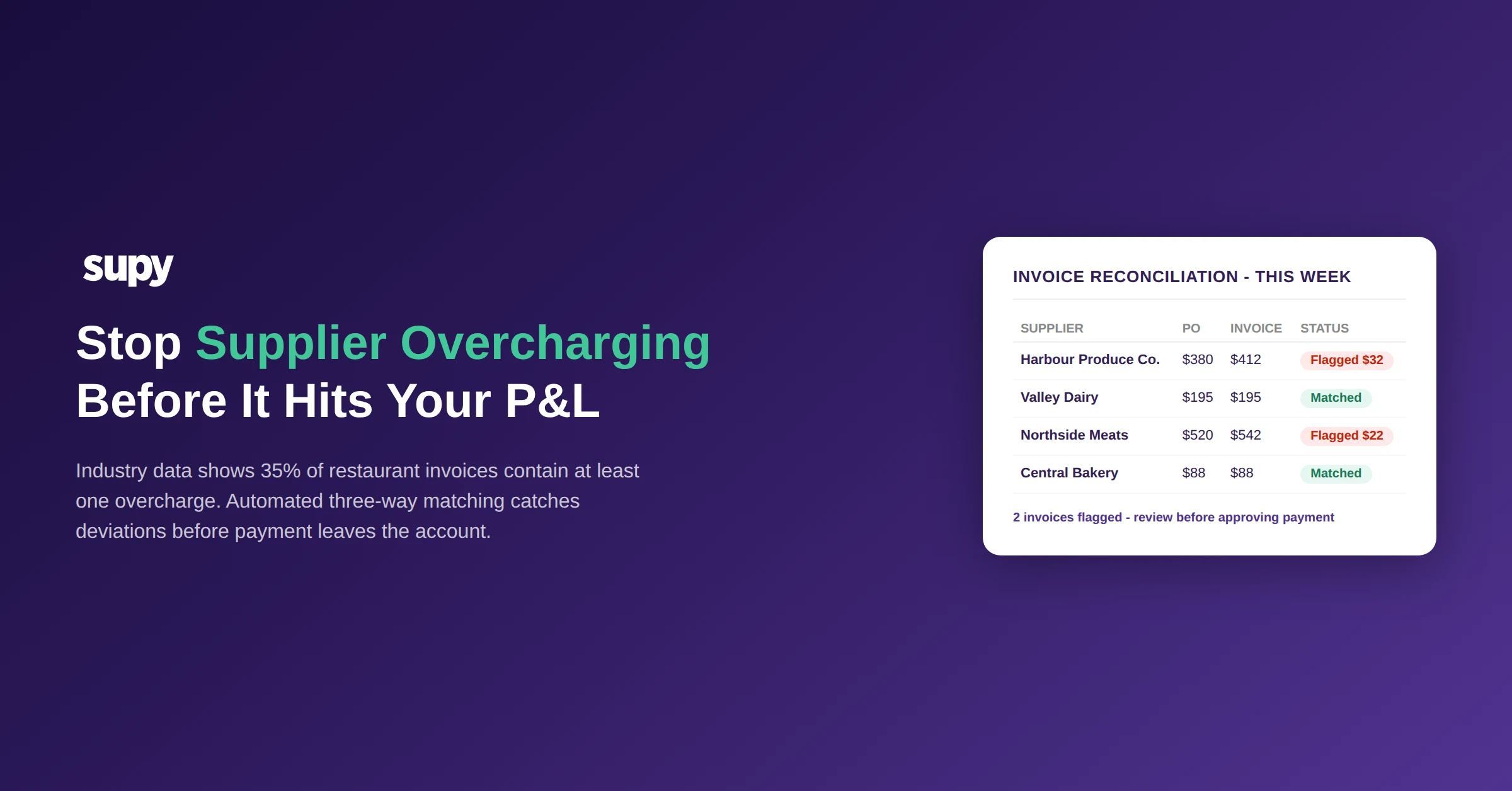
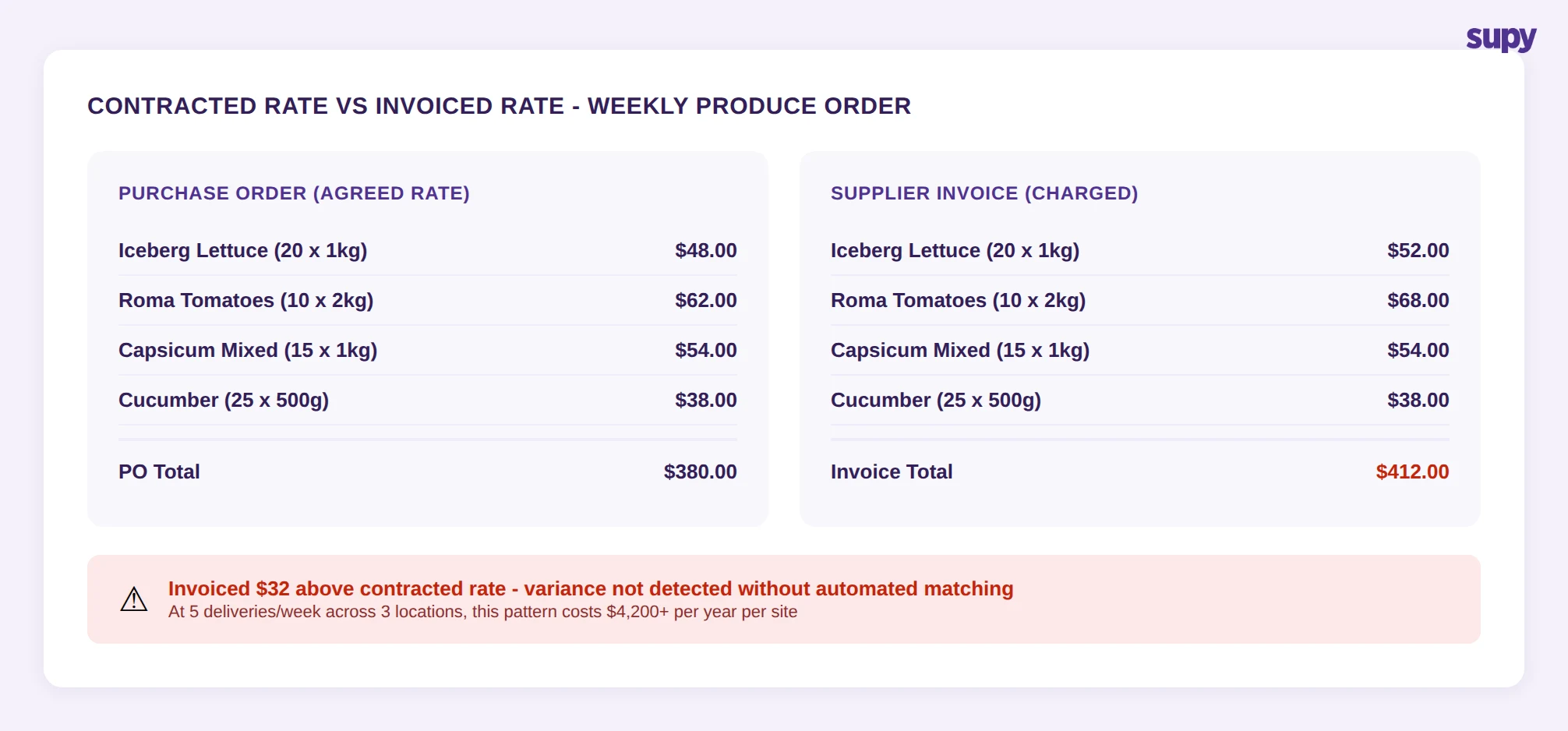
For a single weekly produce order where the agreed rate is $380 and the invoice reads $412, the $32 discrepancy disappears into the weekly food cost variance. Over a year, that one supplier relationship at one location can represent $1,600+ in unrecovered charges - and most groups are running the same gap across multiple suppliers at every site.
The compounding effect is what catches operators off guard. A 3-location group running 40 invoices per week does not have the staff to manually audit every line. Without a system that flags the deviation automatically, the contracted rate problem compounds silently until it surfaces in a monthly P&L review - by which point the variance has already moved food cost 8-12% above budget.
Quantity Discrepancies: The Billing Error Staff Never See
Price rate deviations are one problem. Quantity discrepancies are another, and they are structurally harder to catch because they happen at the point of delivery.
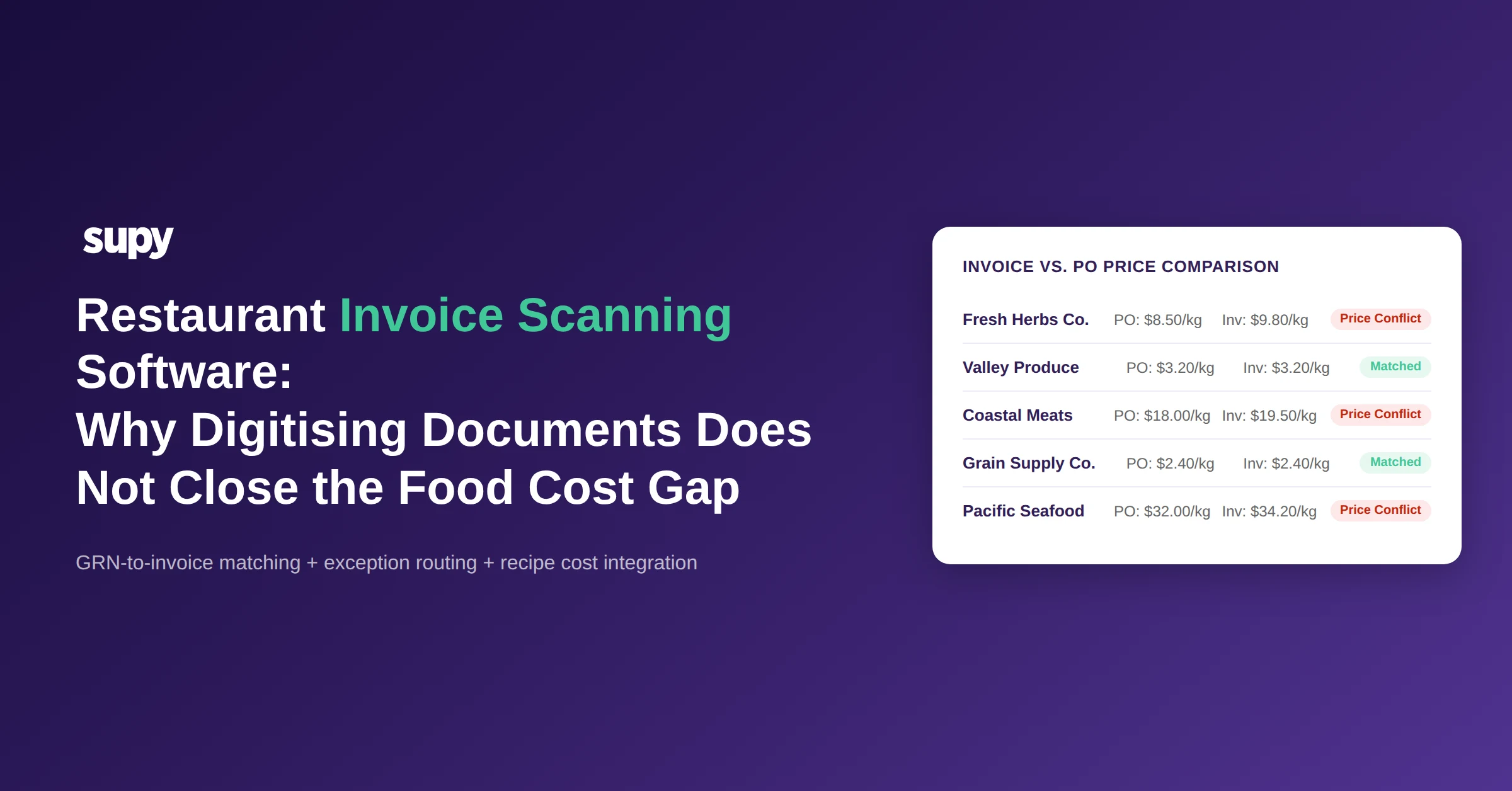
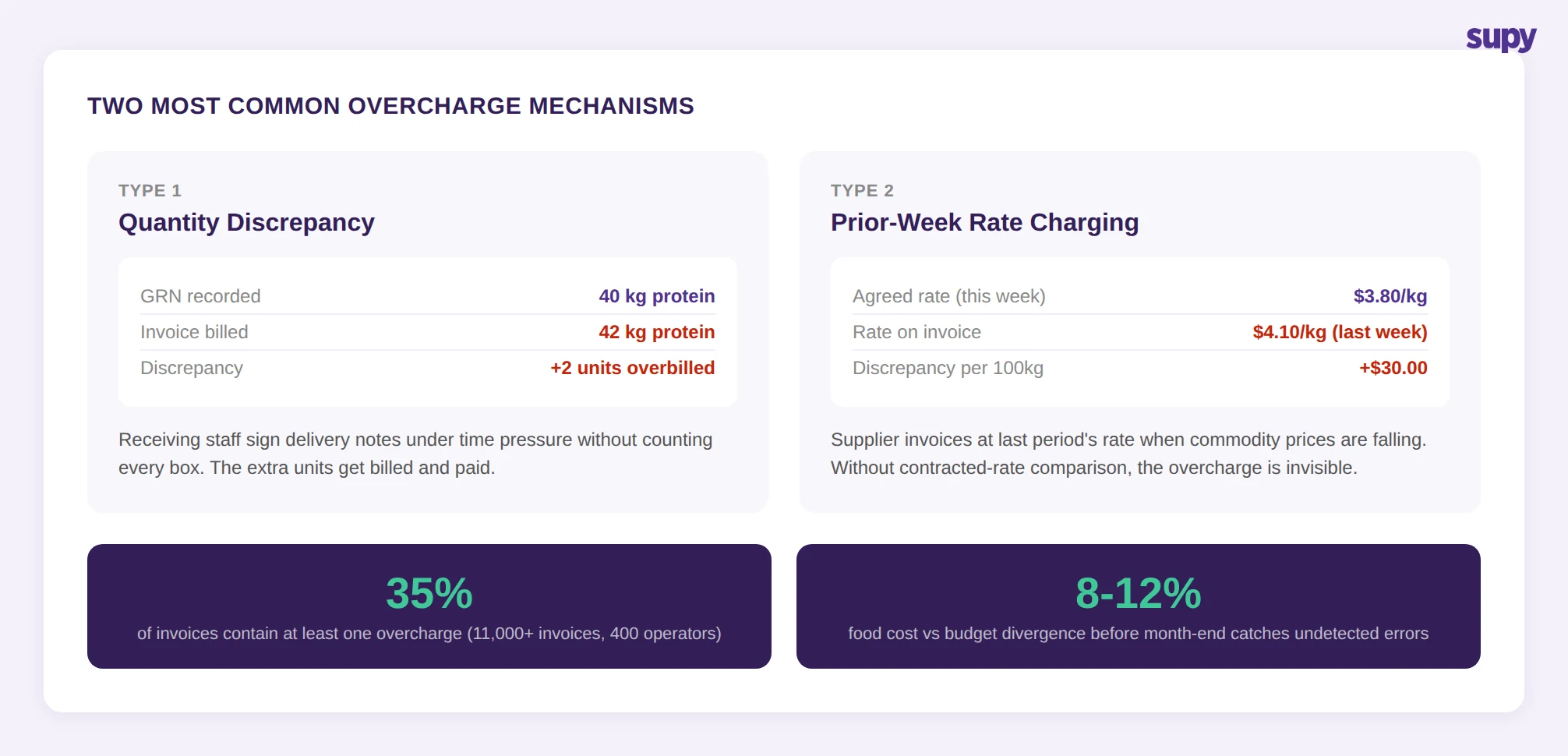
A quantity discrepancy occurs when the invoice bills for more units than were physically received. The delivery note may show 40 kg of protein, the invoice charges for 42 kg, and the receiving staff member - working against the clock before service - signs the delivery note without counting every box. The 2-unit discrepancy gets processed, the supplier gets paid, and the kitchen is short on stock relative to what the system records.
Industry data identifies quantity discrepancies as one of the two most common overcharge mechanisms, alongside prior-week rate charging - where a supplier invoices at last week's price rather than the current agreed rate in a period when commodity prices are falling. Both happen repeatedly, on the same suppliers, across the same delivery routes, because there is no automated check at the point of reconciliation.
For multi-site operators, the exposure compounds across every location and every delivery cycle. The same quantity error on a protein order does not just hit one branch - it hits every branch that uses that supplier, every week, until someone manually audits the invoices. Industry analysis of more than 11,000 invoices across 400 restaurants found at least one overcharge in 35% of cases - not an edge case, but the baseline operating condition for any group relying on manual invoice entry.
The Three-Way Match Gap in Manual Invoice Processes
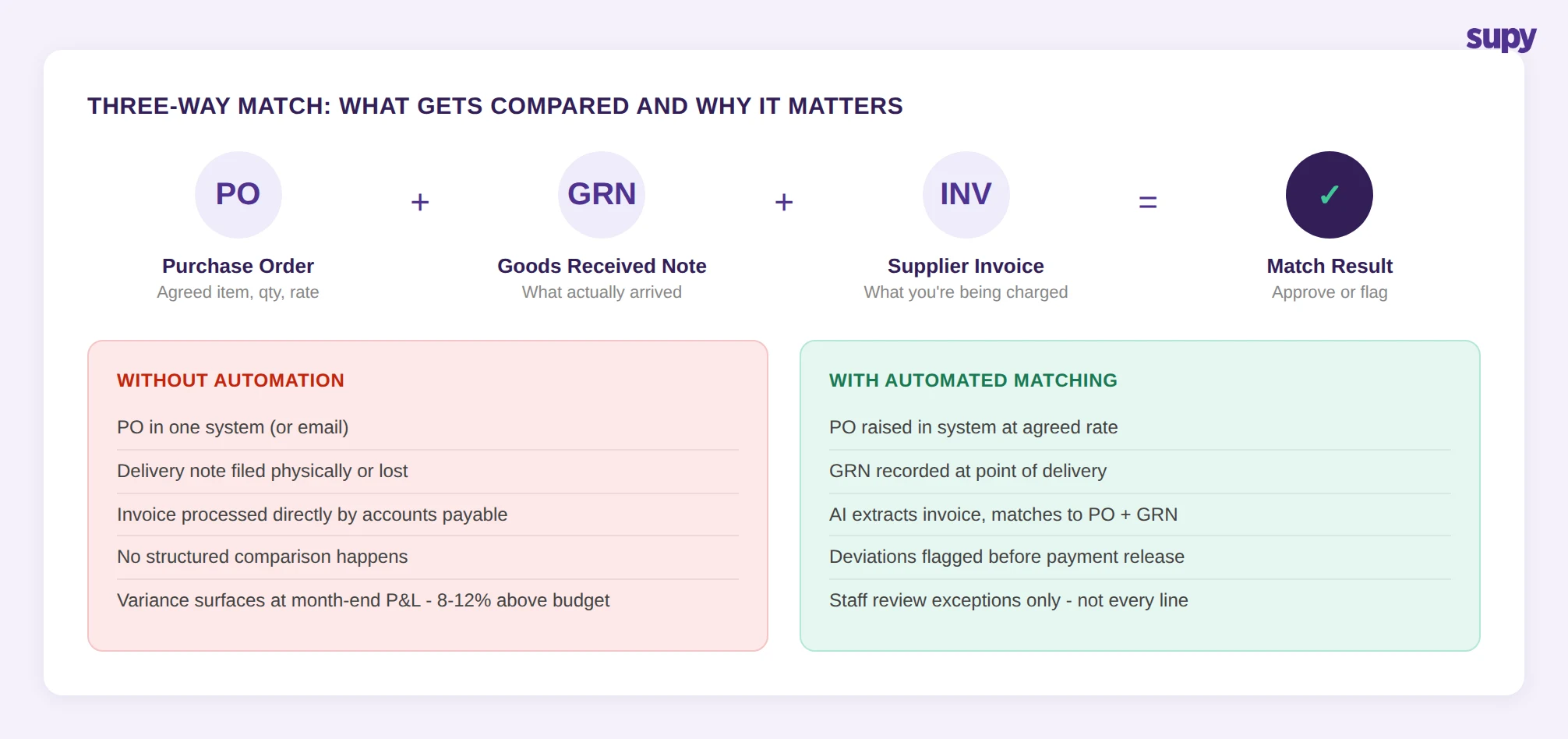
Three-way matching - comparing the purchase order, the goods received note (GRN), and the supplier invoice - is the procurement control that closes the overcharge loop. When a PO is raised for $380 of produce, the GRN records what was actually received, and the invoice is reconciled against both before payment is approved, any deviation surfaces immediately.
In manual processes, this match does not happen. The PO lives in one place, the delivery note gets filed physically or never filed at all, and the invoice is processed directly by whoever handles accounts payable. There is no structured comparison of the three documents, no automatic flag when numbers diverge, and no audit trail connecting the payment back to what was ordered and what arrived.
Operators who have moved to automated three-way matching describe a consistent pattern: the first month after going live, the system flags variances on invoices they had been processing without question for years. Not occasionally - routinely. The same suppliers, the same line items, the same rate deviations that had been building quietly in food cost for every prior period.
What changes with automated matching is that the variance becomes visible at the point it occurs - before the payment leaves the account - rather than surfacing as an aggregate number at month-end with no actionable breakdown.
When a Supplier Invoices Without a PO Reference
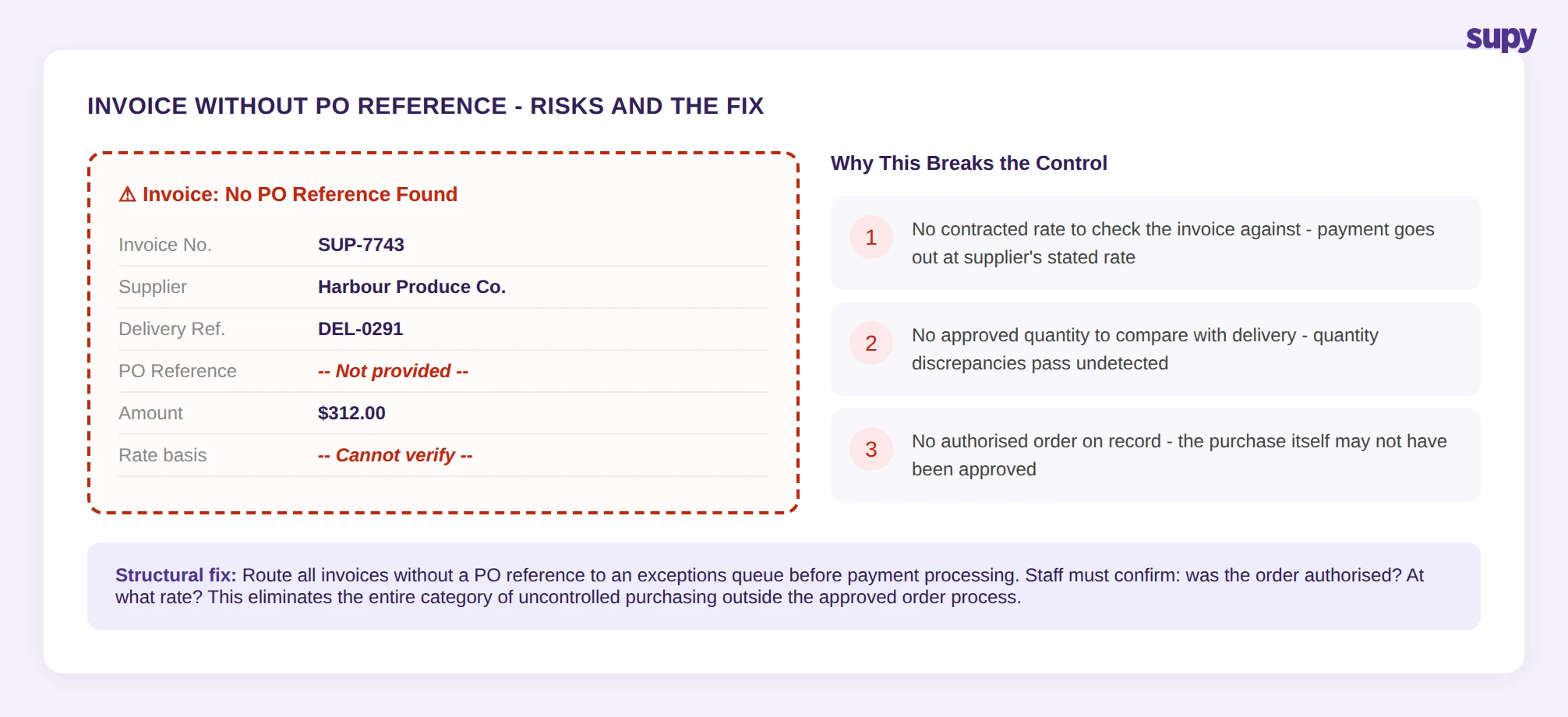
One failure mode that rarely appears in generic procurement content is the invoice that arrives without a PO reference. A supplier delivers goods, raises an invoice with a job number or delivery reference rather than a PO number, and the operations team processes it because the delivery did happen - they just cannot tie the payment back to an approved order.
This breaks the three-way match entirely. Without a PO reference, there is no contracted rate to check the invoice against. There is no approved quantity to compare with the delivery. The invoice gets paid because it is plausible, not because it has been verified.
Multi-site groups are particularly exposed here because purchasing volume is distributed across many locations and many staff members. An operations manager at one branch raises a verbal order during a supply shortage, the supplier delivers and invoices at their standard rate rather than the contracted rate, and no one at head office knows a non-PO order was placed at all.
The structural fix is requiring a PO reference on every invoice before it enters the payment queue. Invoices without a PO get routed to an exceptions workflow for manual review - which forces the question of whether the order was properly authorised and at what rate. For groups running this policy consistently, it eliminates the category of overcharge that comes from uncontrolled purchasing outside the approved order process.
How Automated Invoice Reconciliation Closes the Gap
The operational pattern across groups that have successfully reduced supplier overcharging restaurants is consistent: they have replaced the manual invoice entry step with a system that automatically extracts invoice data, matches it against the corresponding PO and GRN, and surfaces exceptions for human review before payment is released.
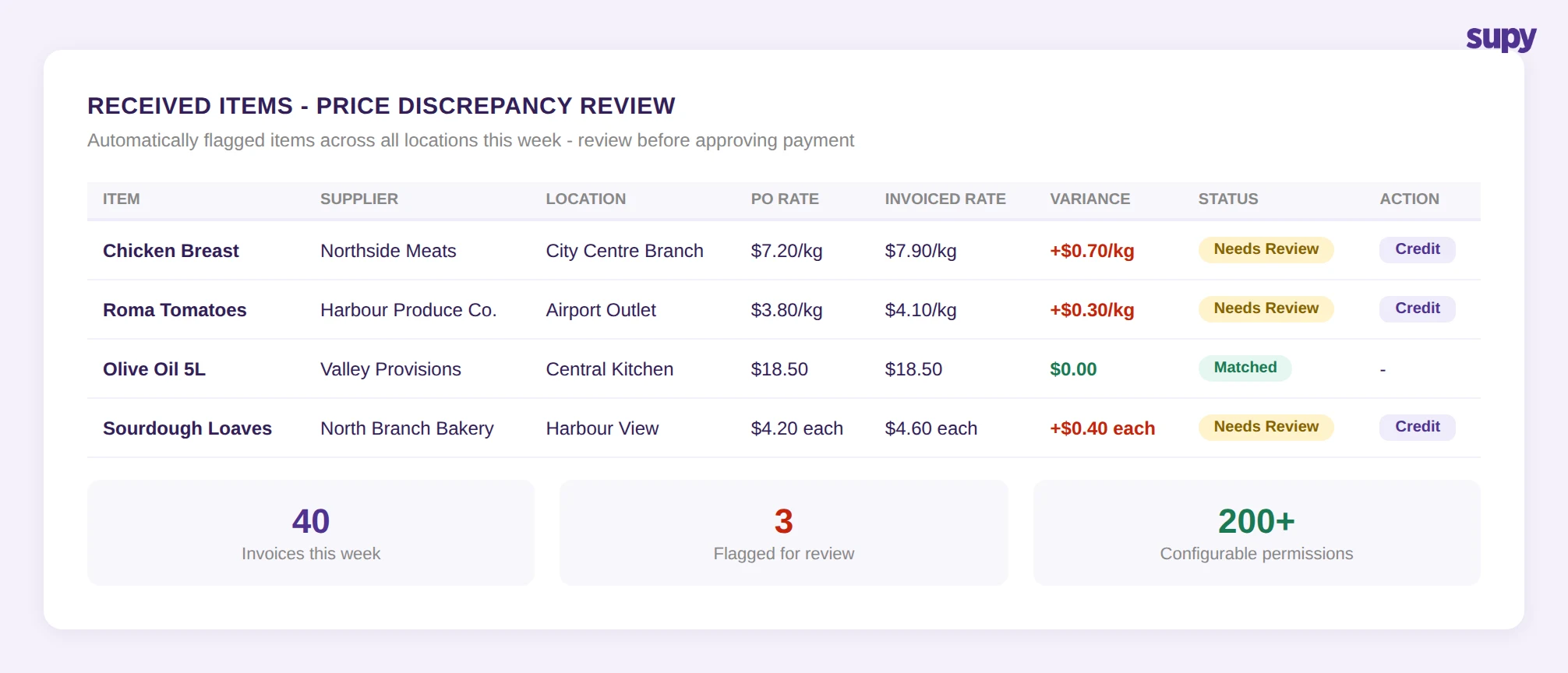
Supy's AI Invoice Receiving and Scanning feature handles this end-to-end. Suppliers send invoices directly to a per-restaurant inbox. The AI extracts line items, prices, quantities, and totals across different invoice formats, matches the invoice to the corresponding PO, and flags any price or quantity conflicts before the receiving team completes the GRN. Staff review only the flagged exceptions - they are not reading every invoice line manually. The Received Items page then shows every flagged item across all locations with statuses and action options: update the expected price, issue a credit note, or escalate to the supplier.
The credit note workflow is part of the same system. When an overcharge is confirmed, the credit note is raised and linked back to the original invoice with a full audit trail. The supplier receives a documented dispute rather than an informal complaint, which significantly reduces the back-and-forth that makes manual dispute resolution slow and inconsistent.
Spending controls work in parallel. Supy's Permissions and Limits feature supports invoice-receiving variance thresholds - configurable acceptable deviation ranges below which no exception is raised, and above which the invoice is automatically routed for approval before stock and accounts are updated. With 200+ customisable permissions, groups with multiple branches can set thresholds per location, per supplier category, or per order value band. The system connects to 75+ POS, accounting and ERP integrations, so reconciled invoice data flows directly into food cost reporting without a separate export step.
See also: How AI Detects Supplier Price Spikes and Automates Procurement Decisions in Restaurants
Supplier overcharging restaurants is a structural problem with a structural fix. The condition that makes overcharges invisible - manual invoice processing with no cross-reference to contracted rates, GRNs, or approved purchase orders - is exactly what automated three-way matching is designed to remove. Groups running this process consistently report catching variances that had been building undetected for months, not as an occasional audit finding, but as a routine output of every delivery cycle.