.jpg)

How AI Detects Supplier Price Spikes & Automates Procurement Decisions In Restaurants
.jpg)
Restaurants don’t lose margin just because suppliers raise prices. They lose margin when those changes slip by quietly and only show up weeks later. Sometimes an increase is fair. Other times it’s a smaller box, a different unit, a substituted product, or a simple billing mistake. The problem is that in many operations, these details surface after invoices are paid, and the higher costs have already made their way into recipes and menus.
In an industry where food and labor each account for roughly a third of every revenue dollar, timing matters. With average profit margins hovering around 5%, even modest cost leaks can add up faster than most teams realise.
This is where AI actually earns its place. Not by replacing buyers or chefs, but by spotting price changes early and routing them into clear, structured decisions before small issues become permanent margin loss.
Why supplier price spikes are easy to miss
Most restaurant groups have some controls in place:
- approved suppliers and price lists
- monthly variance reviews
- spot invoice checks
The gaps appear because procurement data is fragmented:
- Invoices arrive in different formats
- item descriptions vary by supplier
- pack sizes change quietly
- Substitutions happen mid-service
- Reviews happen after payment
By the time a spike is noticed, margin damage has already occurred. AI shifts procurement from post-mortem analysis to exception-based control.
The foundation: invoice data at the line-item level
Supplier price spikes cannot be detected reliably without detailed invoice data. Digitised, line-item invoices allow systems to continuously check:
- unit price changes
- pack-size changes
- unit-of-measure mismatches
- unexpected substitutions
- repeated overcharges
This is why invoice automation is not just an accounting upgrade. It is a procurement control layer. Supy frames this clearly in its own content: invoice digitisation enables real-time validation and margin protection across purchasing and costing workflows.
What AI actually does in procurement

In practical terms, AI supports procurement in four ways.
1) Detects price changes in context: AI compares each invoice line against historical pricing, approved ranges, and recent trends. Only meaningful deviations are flagged.
2) Normalises messy supplier data: Different item names, units, and pack formats are standardised so prices are compared accurately.
3) Routes exceptions to the right people: Finance, procurement, and kitchen teams see only the issues relevant to them, instead of reviewing every invoice manually.
4) Triggers consistent actions: Approved workflows handle credits, approvals, supplier switches, or cost updates without ad-hoc decision-making.
The value is not alerts. The value is a faster, repeatable response.
Why timing matters more than magnitude
Most procurement teams focus on the size of an increase. In practice, the bigger issue is how long it takes to notice.
Menu pricing can’t be updated every time a supplier tweaks a case price. Even when menu prices move, they tend to move slowly and cautiously. Meanwhile, input costs can change in days, not quarters. The result is a timing mismatch: costs rise immediately, but corrective actions lag.
The data backs up that reality. BLS CPI shows food away from home rose 3.8% year over year (May 2025 vs May 2024). Bureau of Labor Statistics National Restaurant Association reporting shows menu prices are still rising, but at moderated rates across segments, not in a way that keeps pace with every supplier shift.
So the procurement goal is not to perfectly predict prices. It’s to detect meaningful changes early enough to respond before they become baked into your run-rate.
Illustrative example: Early detection vs Late discovery
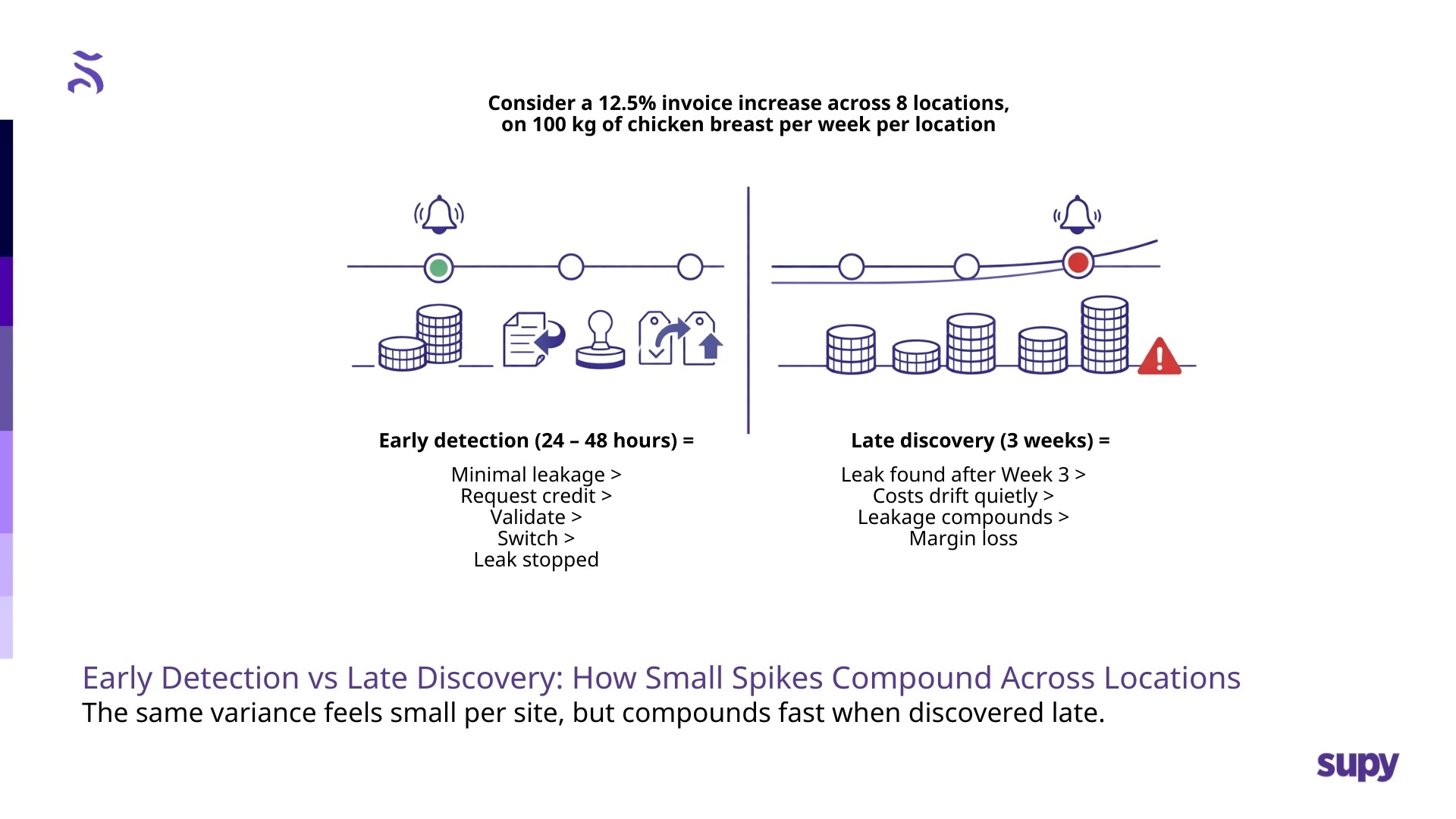
Take this is a theoretical example to show mechanics:
- 8 locations
- 200 kg of chicken breast per week per location
- Approved price: $6.00/kg
- Invoiced price: $6.75/kg (12.5% increase)
Weekly impact
- $150 extra per location
- $1,200 per week across the group
Three weeks unnoticed
- $3,600 in avoidable margin loss
Here’s what this illustrates in real operational terms: procurement leakage compounds quietly. No one “feels” $150 in a busy week, especially across multiple sites. But left unchecked, the same pattern spreads across a handful of top-spend SKUs, and suddenly your month looks worse even though nothing obvious happened operationally.
Early detection changes the decision tree. If you catch it within a day or two, you can validate whether it’s a contracted change, dispute an error, request a credit, or switch to an alternate spec before you pay the price repeatedly.
Many “price spikes” are actually pack-size changes in disguise
Not all spikes are inflation-driven. Some are packaging and unit economics drifting under the radar.
Common examples:
- cartons shrinking while the case price stays similar
- unit shifts (kg to lb)
- higher-grade substitutions
- undocumented spec changes
This is why detection has to focus on effective unit cost, not invoice totals. If your system can’t normalise units and pack sizes, you will keep missing the changes that matter most because they look harmless at first glance.
Why timing matters more than magnitude
Procurement can’t be separated from waste and inventory control. Even perfect price detection does not fully protect the margin if waste and variance are uncontrolled. If you are losing product through over-portioning, poor yield, receiving errors, or storage issues, supplier pricing becomes only one part of the story.
USDA estimates 30 - 40% of the food supply is wasted in the U.S. While that is a system-wide figure, it’s a useful reminder of the same truth inside restaurants: the gap between what you buy and what you sell is where margin quietly disappears.
That’s why the strongest procurement approach connects:
- supplier pricing and discrepancies
- ordering rules and approvals
- inventory usage and transfers
- waste, yield, and variance tracking
When these are connected, you can tell whether a margin problem is primarily supplier-driven, kitchen-driven, or both.
What “automated procurement decisions” really mean
Automation does not mean uncontrolled buying. It means structured rules that reduce noise and make decisions faster.
Humans define
- approved suppliers
- acceptable price bands
- substitution rules
- approval thresholds
AI enforces
- price variance detection
- unit and pack checks
- exception routing
- evidence for negotiation and dispute
This is how procurement becomes scalable. The team spends less time scanning everything and more time resolving the few issues that actually move the margin.
A simple operating cadence that works
Daily
- capture invoices
- flag exceptions
- resolve urgent issues within 24–48 hours
Weekly
- review top variance suppliers
- Monitor top spend SKUs for effective unit-cost drift
Monthly
- supplier performance review based on discrepancy patterns
- renegotiation and supplier changes backed by evidence, not anecdotes
This cadence keeps procurement proactive without adding admin burden.
Evidence and where Supy fits
This is where AI-driven procurement earns its place. Not by auto-buying on your behalf, but by turning procurement into an exception-driven workflow with clear controls.
Supy supports that loop by digitising invoices at the line-item level, detecting price, quantity, unit, and pack-size discrepancies, and routing exceptions into structured resolution workflows.
Two data points from Supy content are especially relevant here:
- Across Supy’s network in 2025–2026, over 80% of overcharges caught by AI were completely missed manually. That’s exactly the kind of leakage that doesn’t show up until month-end, when it’s too late to prevent.
- In Supy’s Black Bear Burger case study, the team reports 48 hours saved per month and a 3 - 4% wastage reduction, alongside improved margin visibility.
The practical takeaway is that detection alone is not enough. The value comes when detection is tied to execution: approvals, credit requests, supplier follow-ups, and cost updates that flow into the rest of your cost stack.
Final Thoughts
Supplier price spikes are inevitable. Margin leakage is optional.
In 2026, the teams that protect profitability are not the ones with the most meetings about costs. They are the ones with systems that surface cost changes early, translate them into clear actions, and keep procurement connected to inventory, waste, and recipe costing.
AI makes procurement faster and more disciplined because it shortens the gap between price change and decision. In a margin environment where small leaks add up quickly, that timing advantage is often the difference between control and drift.