.jpg)

Restaurant Procurement: A Complete Guide for Multi-Location Operators
Restaurant procurement is one of the largest controllable cost drivers in your operation. For a group running multiple locations, the gap between disciplined, data-driven purchasing and ad hoc ordering can represent several percentage points of COGS - often the difference between a profitable period and one that falls short of targets.
This guide covers the full restaurant procurement lifecycle: what it involves, how the process works across a multi-location group, where operators typically lose control, and what technology requirements look like when you need to scale. For a focused set of practical tips on day-to-day procurement efficiency, see our guide to restaurant procurement best practices.
What Is Restaurant Procurement?
Restaurant procurement - sometimes called restaurant purchasing or food service procurement - refers to the full process by which a restaurant or hospitality group acquires the goods it needs to operate. This includes food and beverage ingredients, packaging, cleaning supplies, and non-food consumables such as uniforms and smallwares.
Procurement is broader than simply placing orders. It encompasses supplier selection and relationship management, price negotiation, purchase authorisation, delivery receiving, invoice verification, and payment processing. In a single-site operation, these activities might be handled informally by one person. In a multi-location group, they become a structured function that touches finance, operations, and supply chain.
Food and beverage procurement - the direct purchasing of ingredients and drinks - typically represents the highest-volume and most time-sensitive part of the function. Non-food procurement (facilities, uniforms, equipment consumables) follows different cadences but requires the same governance controls.
The 6-Step Restaurant Procurement Cycle
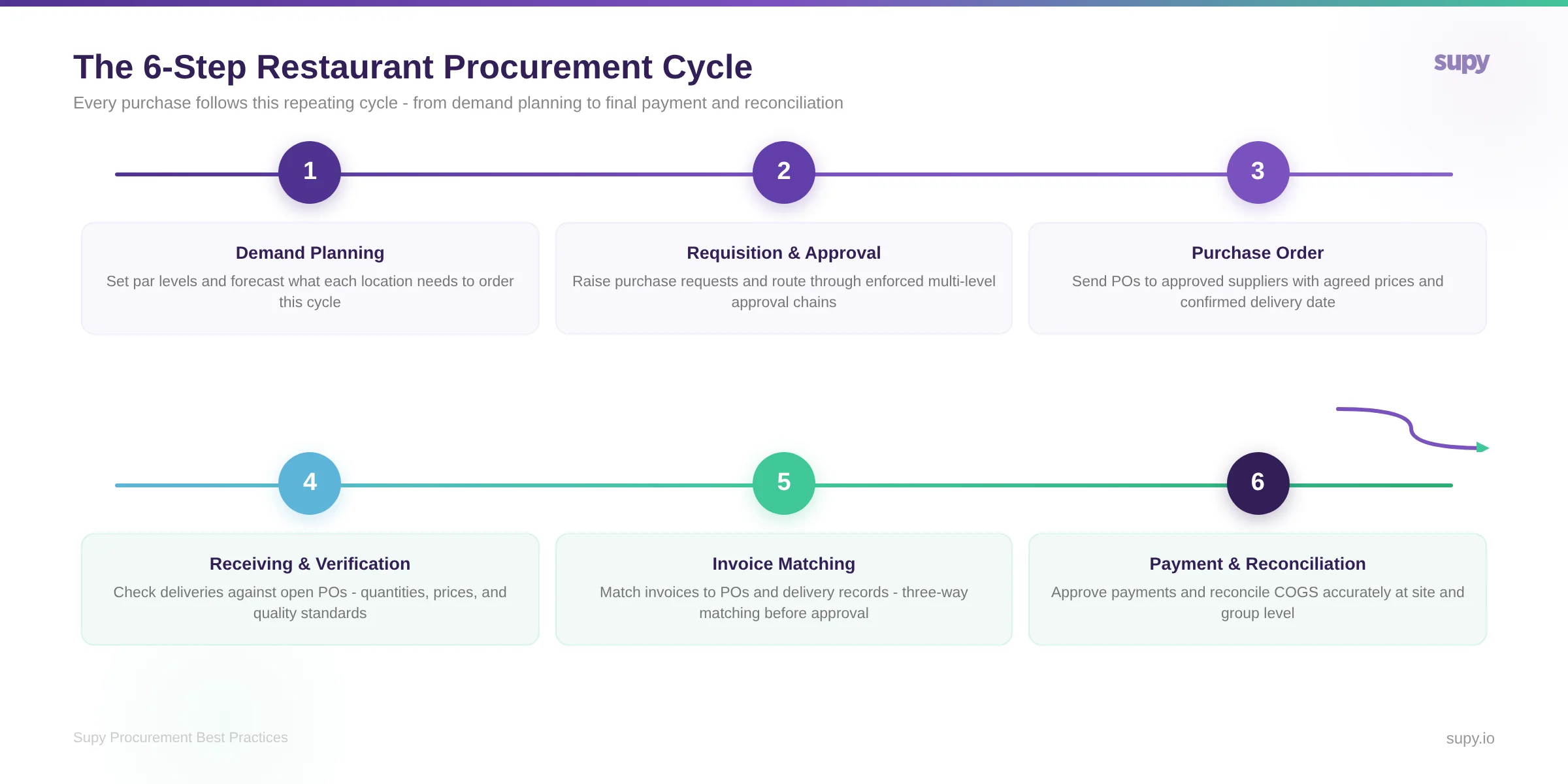
Effective procurement is not a single transaction - it is a repeating cycle that runs continuously across your operation. Understanding each stage is the first step toward controlling costs and eliminating the manual chaos that plagues growing restaurant groups.
Step 1: Demand Planning
Before anything is ordered, someone needs to determine what is actually needed. In a well-run operation, demand planning is driven by par levels - minimum stock thresholds that trigger reorders - combined with sales forecasts and planned menus. In practice, many operators still rely on chef judgment and habit, which leads to over-ordering and waste, or under-ordering and service gaps.
Multi-location groups face an added layer of complexity: demand varies by site, day-part, and season. A centralised demand planning process - even a basic one using historical purchase data - consistently outperforms site-by-site guesswork.
Step 2: Requisition and Approval
Once demand is established, a purchase request (requisition) is raised. The requisition documents what is needed, from which supplier, at what estimated cost, and for which cost centre. In a governed procurement environment, this request must be approved before an order is placed - typically by a manager, department head, or finance controller depending on the value.
Approval workflows are where many growing groups lose control. Without a structured system, orders are placed by whoever has the authority (or simply the habit) of calling suppliers directly. This bypasses budget controls, makes spend visibility nearly impossible, and creates audit trail gaps that surface during finance reviews.
Operators running multi-site groups with formal governance requirements increasingly need enforced multi-level approval sequencing - the ability to define approval chains that cannot be skipped or overridden. The absence of this capability is one of the most commonly cited procurement pain points among enterprise hospitality groups.
Step 3: Purchase Order Creation
An approved requisition becomes a purchase order (PO). The PO is the formal document sent to the supplier specifying item quantities, agreed prices, delivery date, and delivery location. For finance and compliance purposes, the PO serves as the source document that later gets matched against the supplier invoice.
In regulated procurement environments, some operators require a Request for Quotation (RFQ) before a PO is issued - collecting multiple supplier quotes for high-value purchases before committing to a supplier. This is particularly common in hotel F&B, catering operations, and public-sector hospitality.
Maintaining direct traceability between requisitions and the orders they generate (and vice versa) is an important audit control. When a cost overrun or supplier dispute arises, being able to navigate from the originating request through to the delivered order and invoice is significantly faster than reconstructing the chain manually.
Step 4: Receiving and Delivery Verification
When goods arrive, the receiving process verifies that what was delivered matches what was ordered. This means checking quantities, weights, quality standards, and - critically - whether the items correspond to an open PO. Receiving against a PO rather than a verbal agreement is the foundation of three-way invoice matching.
In multi-location operations, receiving is often delegated to kitchen staff who may not be trained in systematic verification. Discrepancies that are not caught at receiving - short deliveries, substituted items, incorrect weights - typically surface later as unexplained variance in stock counts or food cost reports. By then, the window to dispute them with the supplier has often closed.
Step 5: Invoice Processing and Matching
The supplier invoice arrives (by email, PDF, or EDI) after delivery. In a controlled procurement environment, the invoice is matched against the original PO and the receiving record - this is called three-way matching. The payment is only approved when all three documents agree.
Invoice processing is consistently one of the highest-friction activities in restaurant procurement. Operators describe having to verify every line of incoming invoices manually - a process that is both time-consuming and error-prone when supplier documents do not include PO references or when the same ingredient exists across multiple locations with different cost centre assignments. When invoices arrive without corresponding PO numbers, the matching process breaks down and invoices end up in a review queue that creates accounts payable backlogs.
Step 6: Payment, Reconciliation, and Supplier Management
Once an invoice is approved, payment is scheduled according to the agreed terms with the supplier (typically net 30-60 days in food service). Reconciliation involves confirming that payments match approved invoices and that COGS is recorded correctly for the period.
Beyond individual transactions, ongoing supplier management includes reviewing supplier performance (on-time delivery rates, substitution frequency, pricing accuracy), renegotiating terms at contract renewal, and managing the supplier master data that underpins the entire procurement cycle.
Centralised vs Decentralised Procurement: Key Trade-Offs
One of the defining structural decisions for multi-location restaurant groups is how much procurement authority to centralise. There is no single right answer - the optimal model depends on group size, concept diversity, and operational maturity.
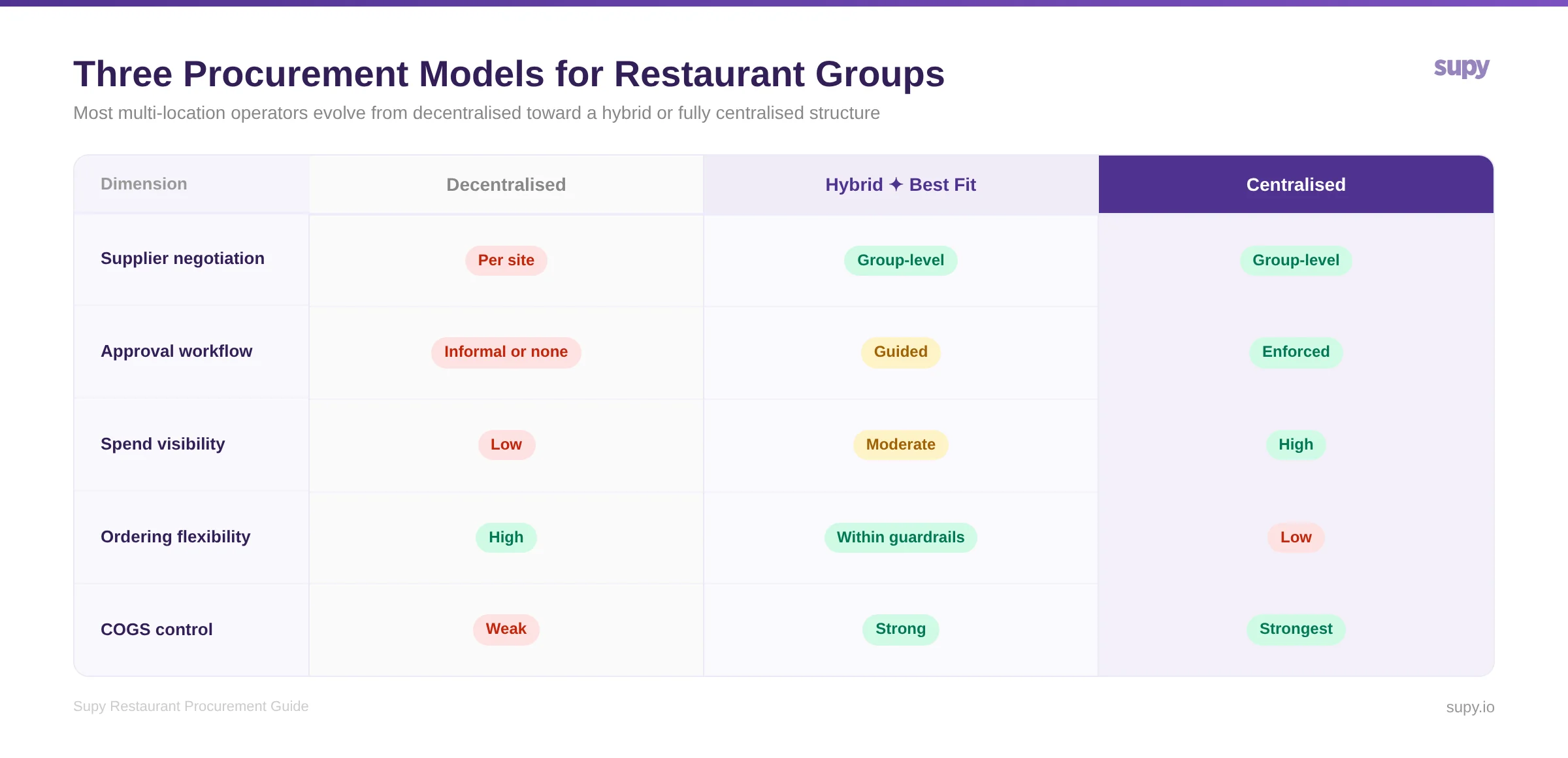
Centralised procurement routes all purchasing through a central function - typically a procurement manager or team. Suppliers are negotiated at group level, approved supplier lists are maintained centrally, and site-level ordering happens within defined parameters. The benefits are significant: consolidated spend volumes drive better pricing, governance controls are consistent across sites, and reporting is far cleaner. The challenge is responsiveness - centralised models can struggle with the high-cadence, perishable-heavy nature of fresh food purchasing.
Decentralised procurement gives site managers or head chefs direct purchasing authority. It is faster and more flexible, and it works well for small groups where inter-site consistency is less critical. The cost is control: spend visibility is poor, supplier terms vary by site, and consolidating invoices for finance is a significant manual effort.
Most growing multi-site groups evolve toward a hybrid model: centralised supplier agreements and approved supplier lists, with site-level ordering within those guardrails. Procurement software is what makes this hybrid model operationally viable at scale - it provides the structure of centralised governance without removing the flexibility that kitchens need.
Key Procurement Metrics to Track
Procurement performance is measurable. These are the key metrics that give operations and finance teams a clear view of procurement health:
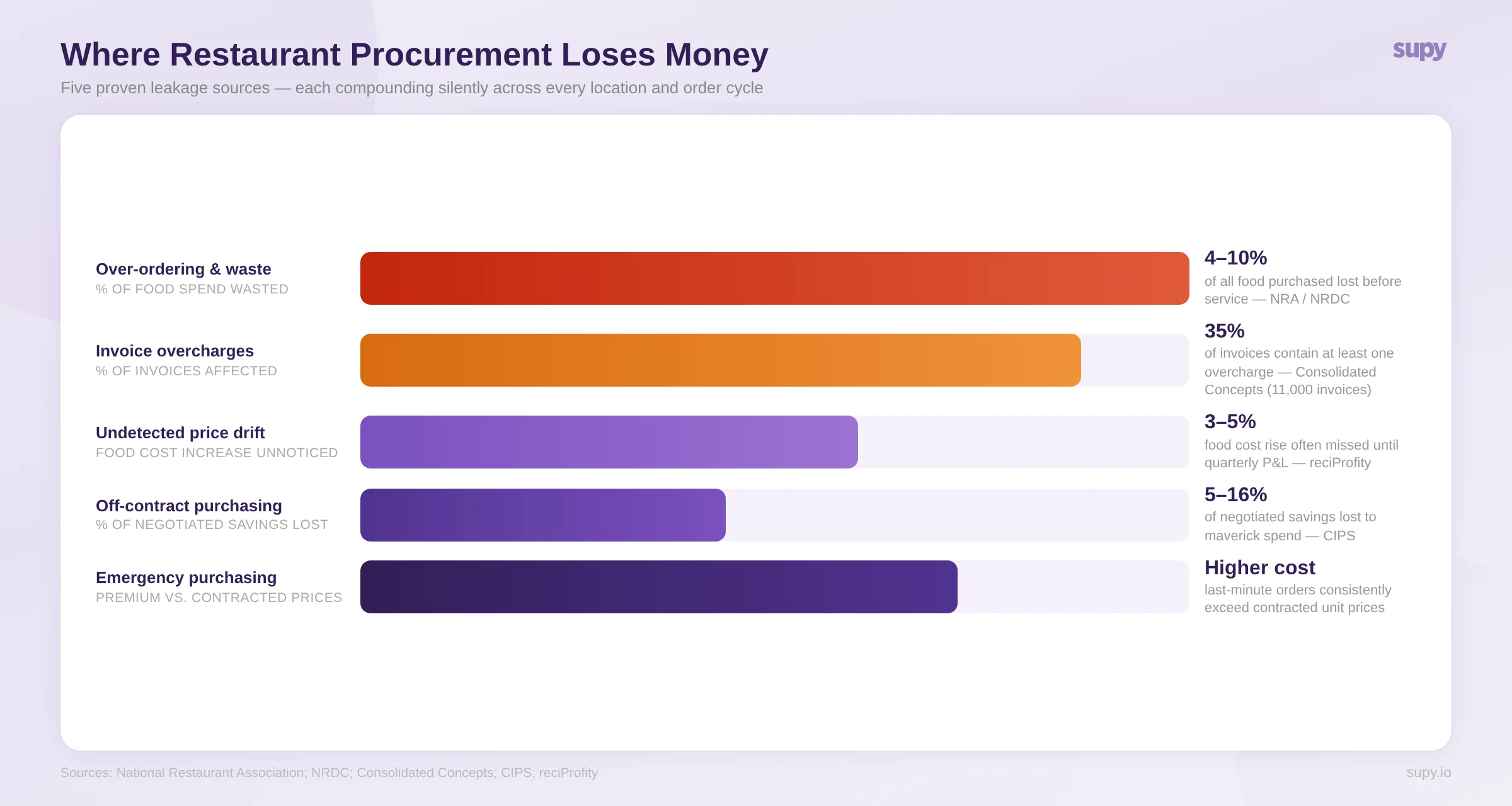
Cost of Goods Sold (COGS) as a percentage of revenue is the primary procurement output metric. The target varies by concept: quick-service operations typically aim for 25-35%, full-service restaurants for 28-35%, and fine dining for 30-38%. A sustained gap between theoretical COGS (what you should have spent based on recipes) and actual COGS (what you did spend) is the clearest signal that procurement controls need attention.
Purchase price variance (PPV) measures the difference between the price paid and the expected or budgeted price. Systematic positive variance - paying more than expected - often indicates supplier price drift, unauthorised supplier substitutions, or a failure to enforce negotiated terms.
Supplier on-time delivery rate reflects how reliably suppliers deliver within the agreed window. Low on-time rates create emergency purchasing situations where operators buy at spot prices or from secondary suppliers, usually at a premium.
Invoice discrepancy rate measures the percentage of invoices that require manual review or correction before payment. A high discrepancy rate is both a cost (time spent resolving disputes) and a risk (incorrect costs flowing into COGS).
Food waste and variance is the gap between what was received and what was recorded as used or sold. While not purely a procurement metric, waste that stems from over-ordering or poor par level management is a procurement problem as much as an inventory problem.
Multi-Location Procurement Challenges
Scale amplifies every procurement challenge. These are the friction points that surface most consistently as restaurant groups add sites:
Stock transfers between locations create a procurement-inventory boundary that many systems handle poorly. When one site has surplus stock and another is running short, the transfer needs to be logged accurately - both to maintain inventory accuracy and to ensure COGS is assigned to the correct cost centre. Groups tracking this manually describe it as "just writing it down in the log" - which creates reconciliation headaches at month-end.
Multi-entity and multi-currency complexity is a particular challenge for groups operating across geographies or with separate legal entities under one brand. Supplier account numbers often differ by entity, payment terms may be negotiated separately, and reporting needs to consolidate across different currencies and tax regimes.
Approval visibility across sites is a common gap. Operations teams need a single view of all pending approvals across all locations - not a site-by-site process that requires logging into multiple portals or chasing managers by phone.
Rogue spending - purchasing outside approved supplier lists or without a PO - is both a cost and a compliance risk. Without enforcement controls at the point of purchase, it is effectively impossible to prevent.
Technology Requirements for Procurement at Scale
A well-designed restaurant inventory management software platform that includes procurement capability changes what is operationally achievable at multi-location scale.
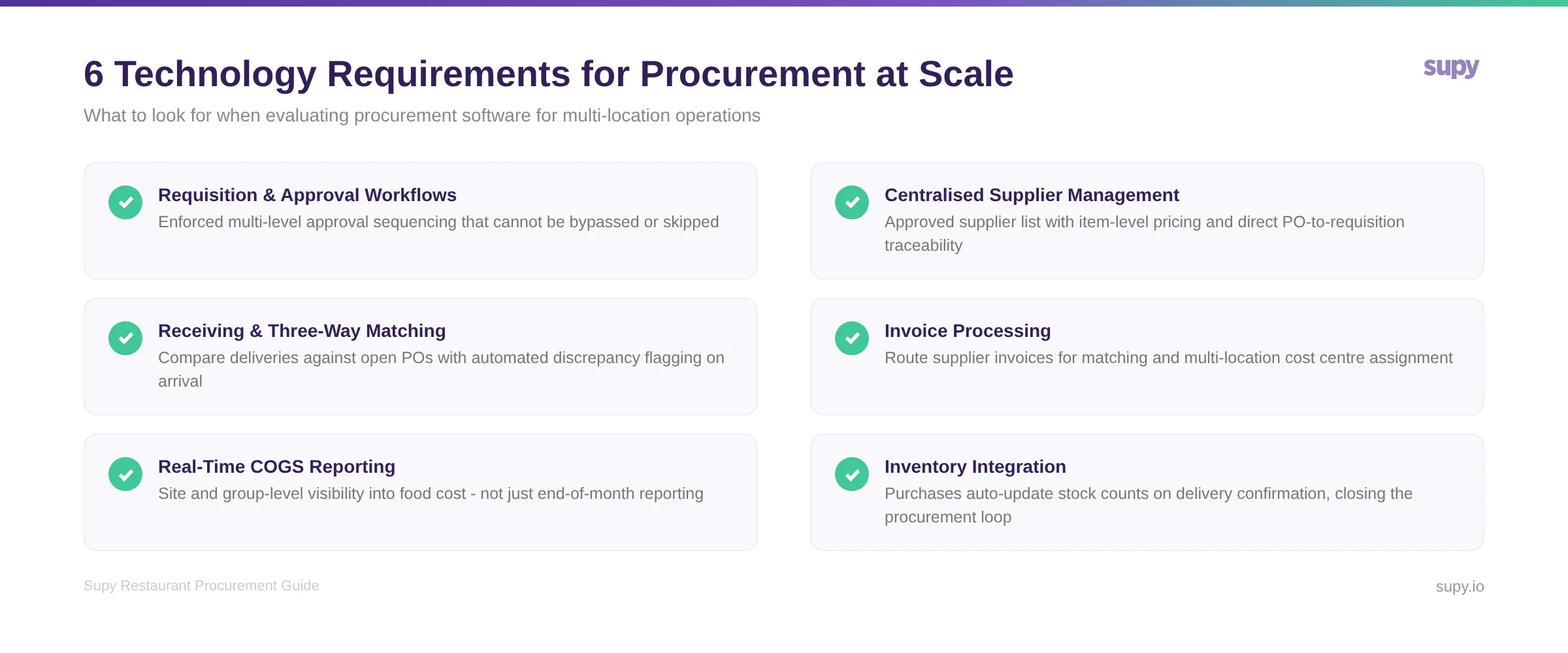
The core requirements for procurement software in a multi-site operation:
Requisition and approval workflows that enforce defined approval sequences, with no ability to skip or override approval levels. Requisitions that can be duplicated from previous orders reduce the manual effort of regular procurement cycles.
Supplier management with a centralised approved supplier list, item-level pricing by supplier, and direct traceability between requisitions and the purchase orders they generate.
Receiving and three-way matching that compares delivered quantities and prices against open POs. Automated discrepancy flagging reduces the manual checking burden on receiving staff.
Invoice processing that routes supplier invoices against open POs for matching and approval. The ability to handle multi-location cost centre assignment - particularly when the same ingredient exists across multiple sites - is a specific capability requirement for larger groups.
Reporting and COGS visibility at both site and group level. Real-time COGS visibility (not end-of-month reporting) is what allows operations teams to identify and address cost drift before it compounds.
Integration with inventory management is what ties the procurement loop closed. Purchase data should update inventory automatically on receiving confirmation, and recipe costing should draw on current ingredient prices to maintain accurate theoretical margins.
For groups with formal governance requirements - hotel F&B operations, franchise networks, or regulated catering - features like multi-level enforced approval sequencing and RFQ workflows (collecting and comparing multiple supplier quotes before committing to a purchase) represent a meaningful step up in procurement governance capability.
A useful starting point for any group building out its procurement process manually is to establish baseline visibility with a restaurant inventory template before moving to a software-driven approach.
How Supy Supports Restaurant Procurement
Supy's back-of-house platform is built to handle procurement as part of a unified operational system - not as a standalone module disconnected from inventory and food cost data.
The platform supports the full procurement cycle: requisitions with enforced approval sequencing (including multi-level chains that cannot be bypassed), direct traceability from requisition to purchase order to received delivery, invoice processing with three-way matching, and real-time COGS reporting at site and group level. Repeat requisitions allow teams to duplicate regular procurement cycles without rebuilding them from scratch, reducing the manual overhead of routine purchasing.
For operations teams at multi-site groups, procurement data flows directly into inventory - deliveries update stock counts automatically on receiving confirmation, and actual ingredient costs are reflected in recipe costing in real time. The result is that the theoretical margin your finance team calculates and the actual margin your kitchens deliver become far closer to each other.
Supy is a back-of-house operations platform built for multi-location restaurant groups. It covers procurement, inventory management, recipe costing, and business intelligence in a single unified system - giving operators the data they need to manage costs, suppliers, and stock across every site.