.jpg)


Restaurant Supplier Management: How Multi-Site Operators Build Reliable Supply Chains Without Operational Chaos
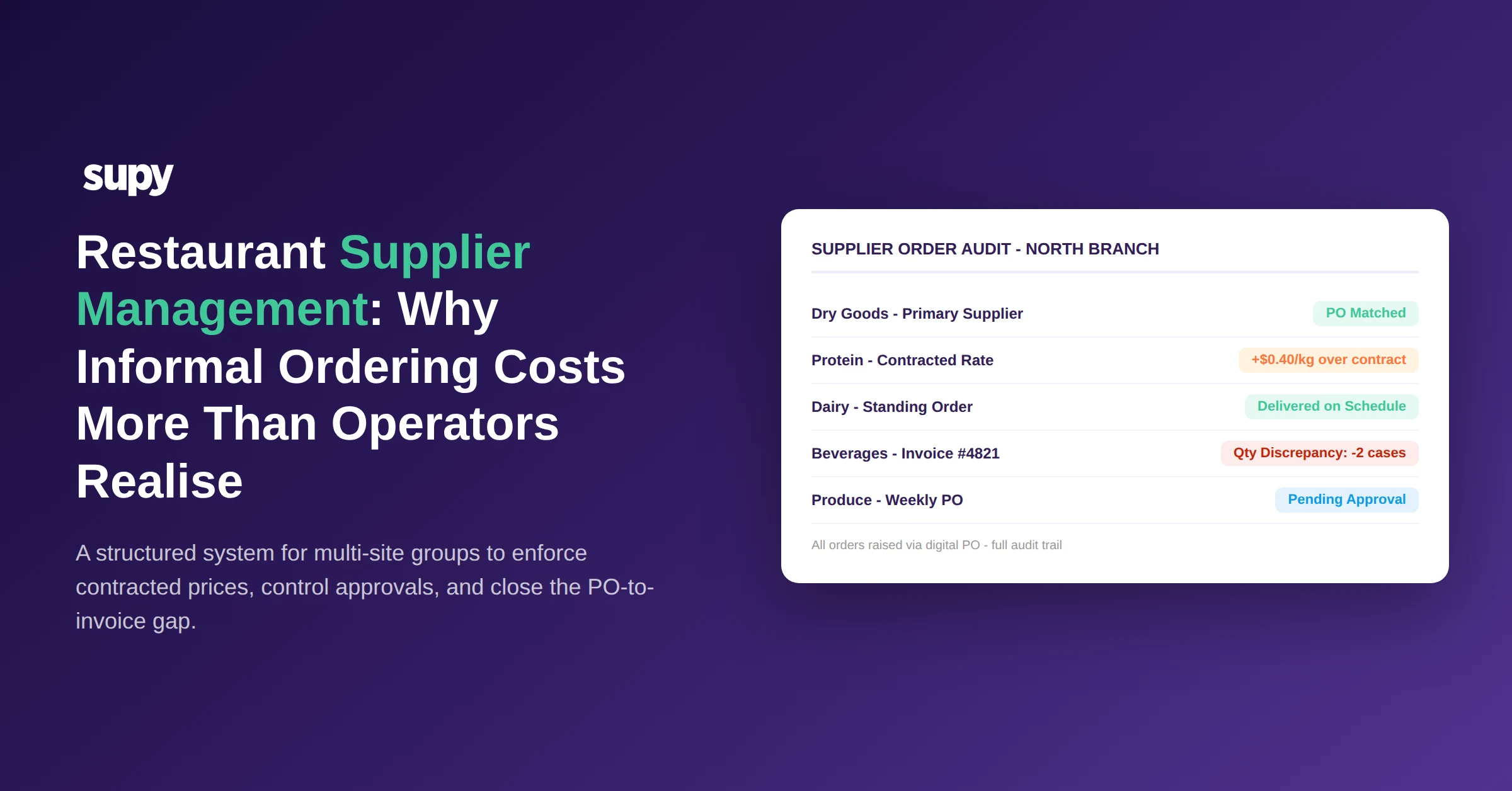
Reliable supply chains rarely break all at once - they erode one informal order at a time. For a multi-site restaurant group, supplier management is where cost control and consistency are won or lost, and the first crack usually shows up in the ordering channel itself.
Where Supplier Management Breaks First: Informal Ordering Channels
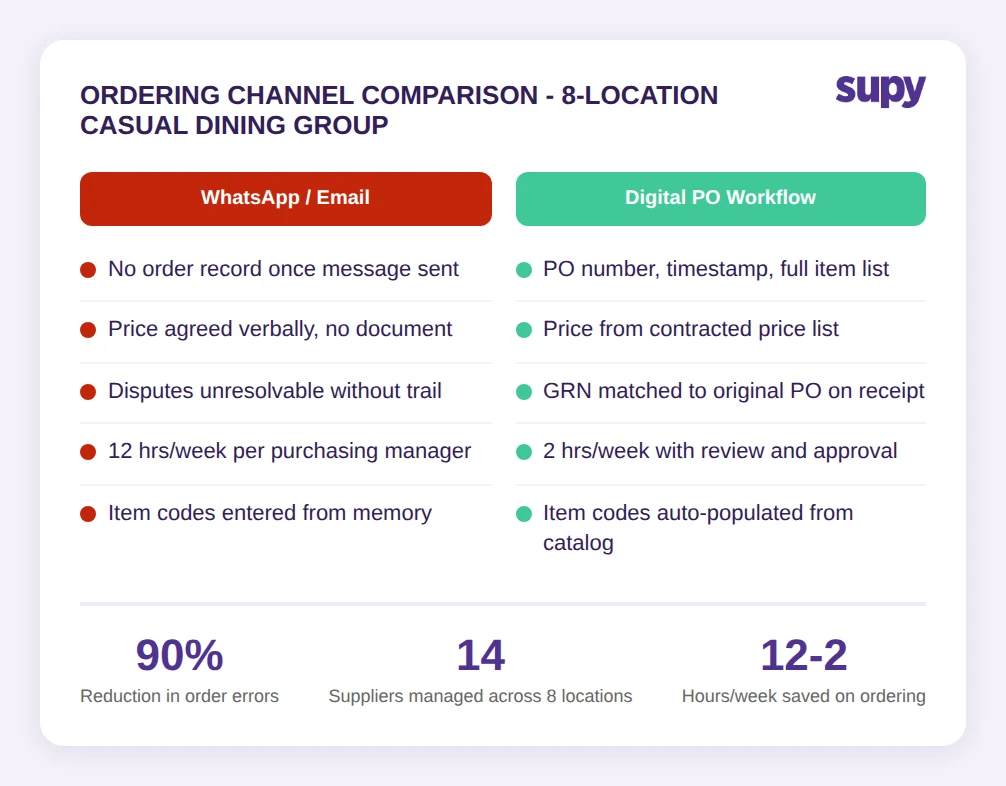
For a purchasing manager covering 8 locations and 14 suppliers, placing orders manually means approximately 12 hours per week of WhatsApp messages, phone calls, and email threads. That time cost is visible and quantifiable. The invisible cost is more damaging.
When orders are placed through informal channels, there is no record of what was requested, at what quantity, or at what agreed price. Suppliers receive WhatsApp messages with item names and approximate quantities. Confirmation happens verbally or not at all. When the delivery arrives short, or priced differently, or with substituted items, there is no original order record to dispute against. The restaurant absorbs the discrepancy because proving otherwise is impossible.
Multi-branch operations compound this problem. Each branch manager places orders directly with suppliers using their own contact, their own approach, and sometimes different account numbers than the one on file. One hospitality group found that location-specific supplier account numbers were not printing correctly on outbound PO emails - causing suppliers to route deliveries to the wrong account and creating billing disputes that took weeks to resolve.
Digital PO workflows eliminate the ambiguity. Every order is raised on the system, assigned a PO number, and sent through a confirmed channel with a timestamped record. The supplier receives exactly what was ordered, at the price on the current price list. When the delivery arrives, the goods received note matches or flags a discrepancy. The audit trail exists from requisition to receipt.
Groups that switch from informal to structured ordering report order quantity and item-code errors falling by 90% within the first quarter - not because their suppliers changed, but because the communication channel became unambiguous.
Why Contracted Prices Are Not the Prices Operators Pay
Signing a supplier contract is not the same as enforcing it. For a restaurant group without automated PO-to-invoice price matching, contracted rates are a reference document, not an operational control.
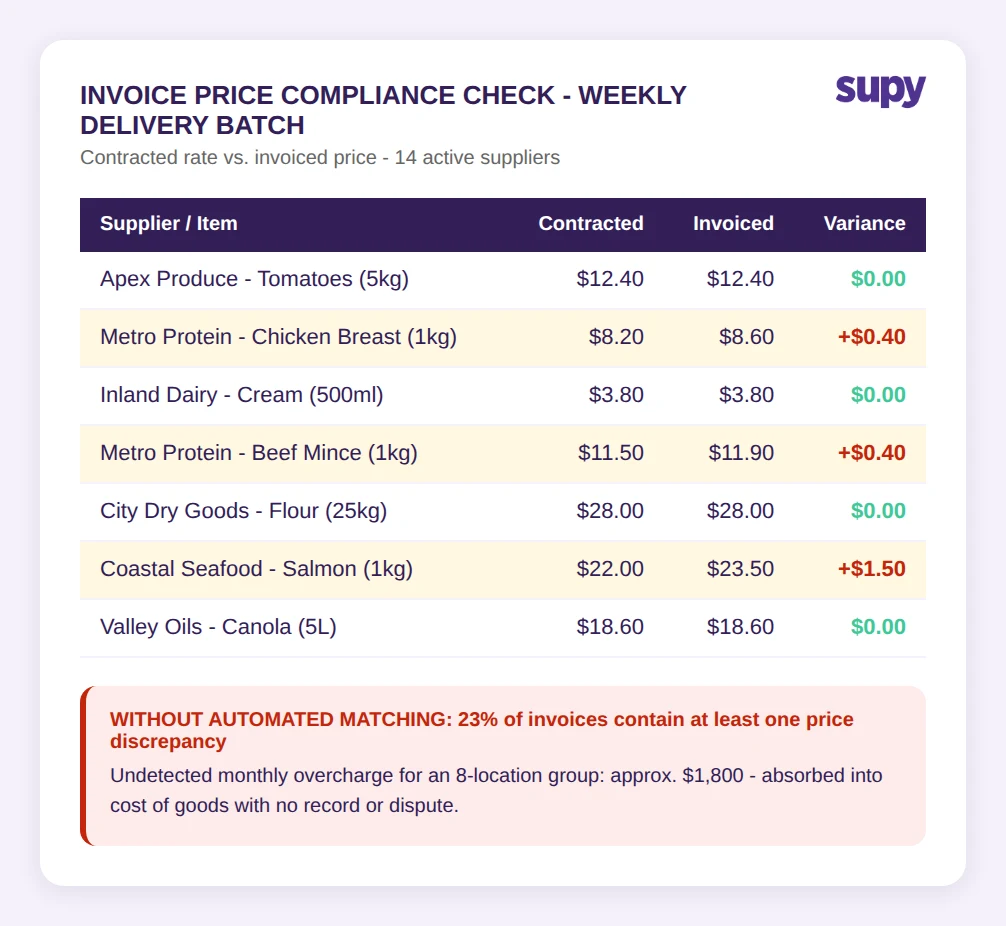
A supplier invoices 14 SKUs per delivery. Across 8 locations and 14 suppliers, a purchasing manager receives hundreds of invoice line items per week. Manually checking each line against the contracted rate is not realistic. In practice, invoices are approved based on whether the delivery arrived and the total looks roughly correct. Systematic price drift - small uplifts applied to one or two SKUs per invoice - accumulates over months without triggering any review.
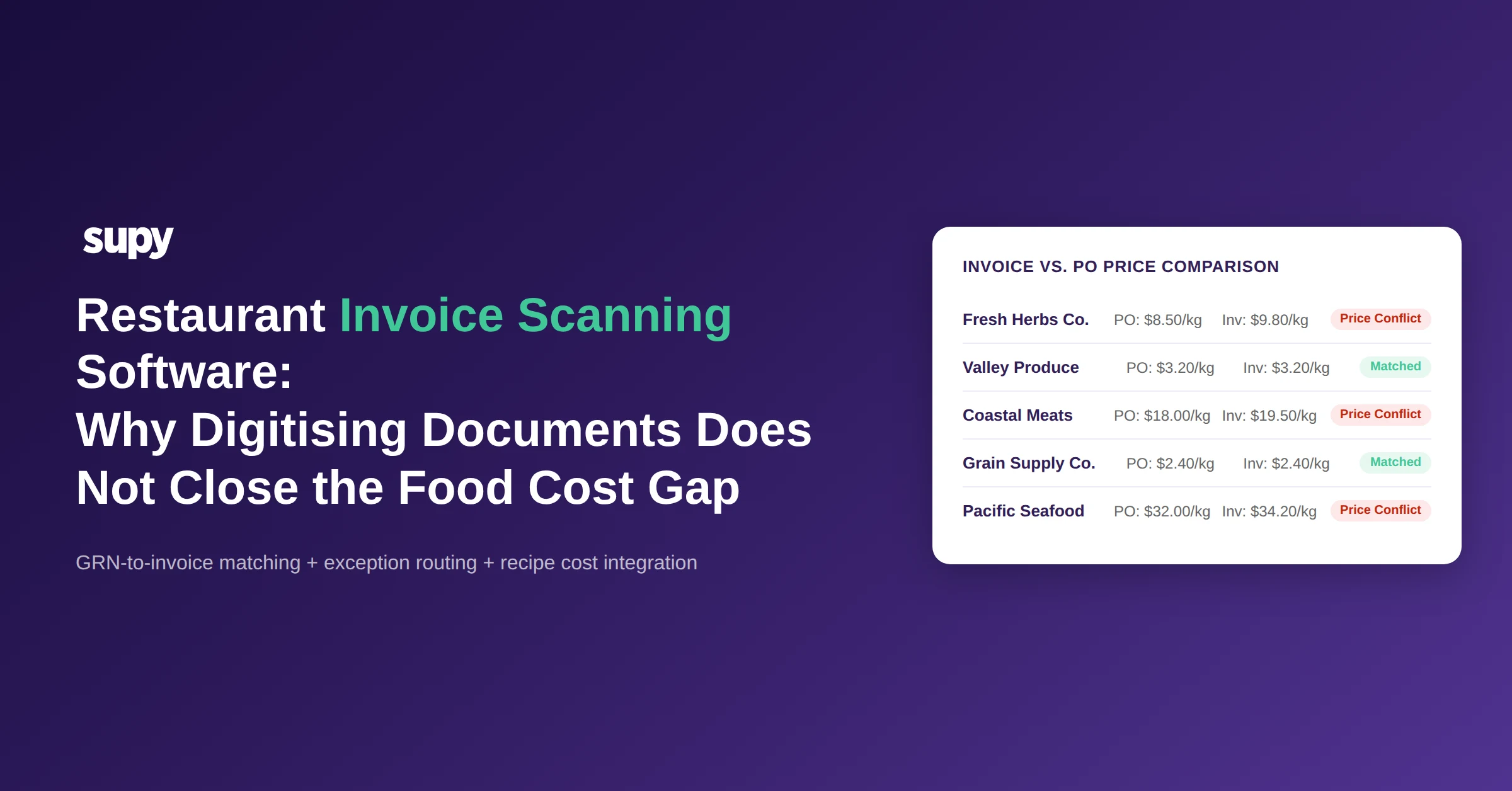
The scale of this problem is larger than most operators realise. Groups relying on manual receipt checking find that approximately 23% of invoices contain at least one line-item price discrepancy versus the contracted rate. Across a full month, the cumulative undetected overcharge for an 8-location group can reach $1,800 or more - real margin loss that is structurally invisible until a formal price audit is conducted.
AI-powered invoice matching eliminates this blind spot. Suppliers can email invoices directly to a per-restaurant inbox. AI extracts every line item - supplier code, quantity, unit price, taxes, totals - and matches each line against the active PO. Where the invoice price exceeds the PO price by more than the configured variance threshold, the system flags the exception before stock or accounts are updated. The exception goes to a reviewer; the supplier is notified; the charge is either justified or credited.
The operational result is not just cost recovery - it is supplier relationship clarity. Suppliers know that every invoice line is matched against the contracted price. The implicit signal changes the default behaviour: price drift becomes harder to sustain when operators can prove every discrepancy.
Setting Approval Limits That Actually Prevent Overspend
Procurement controls exist on paper in most restaurant groups. In practice, they fail because they rely on the willingness of individuals to follow a process rather than on a system that enforces it.
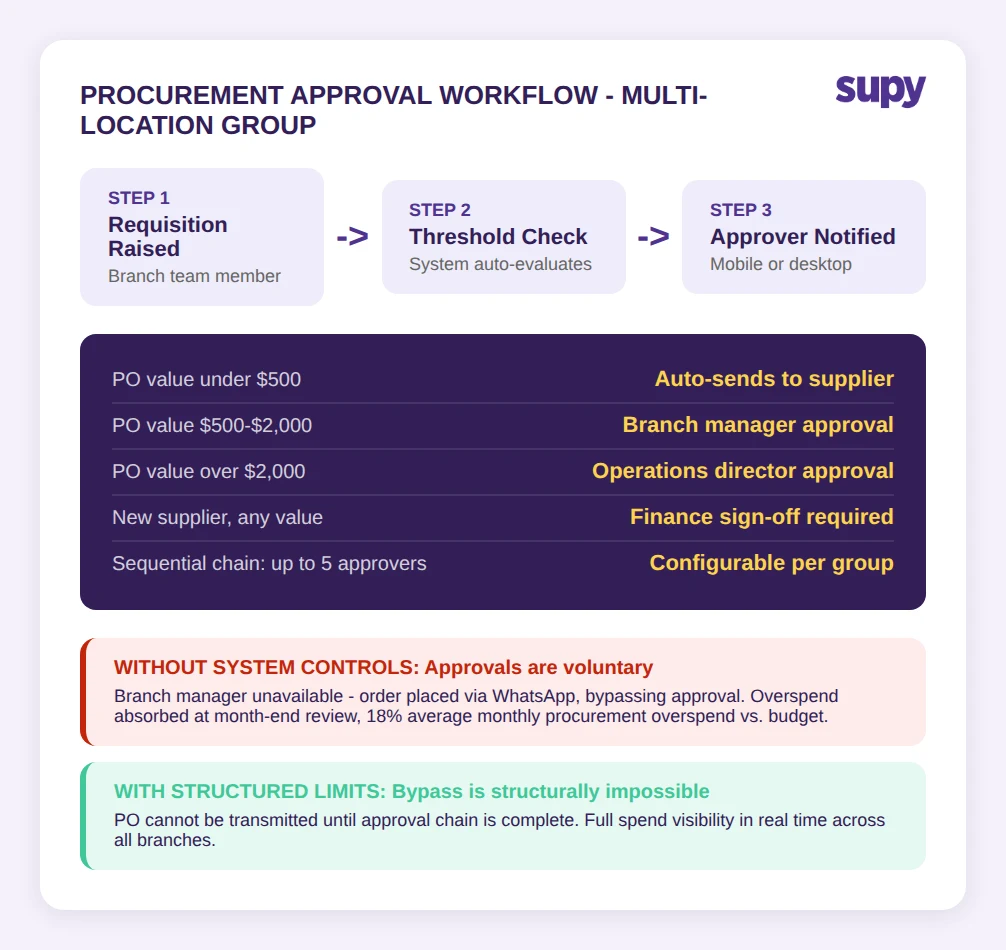
The pattern is consistent: a branch manager needs an urgent order. The formal approval process requires a manager sign-off for any PO over $500. The manager is unavailable. The branch manager places the order directly with the supplier on WhatsApp, bypassing the approval step. The order is fulfilled. The invoice arrives and is approved because the delivery was received. The overspend is buried in the cost of goods for that period.
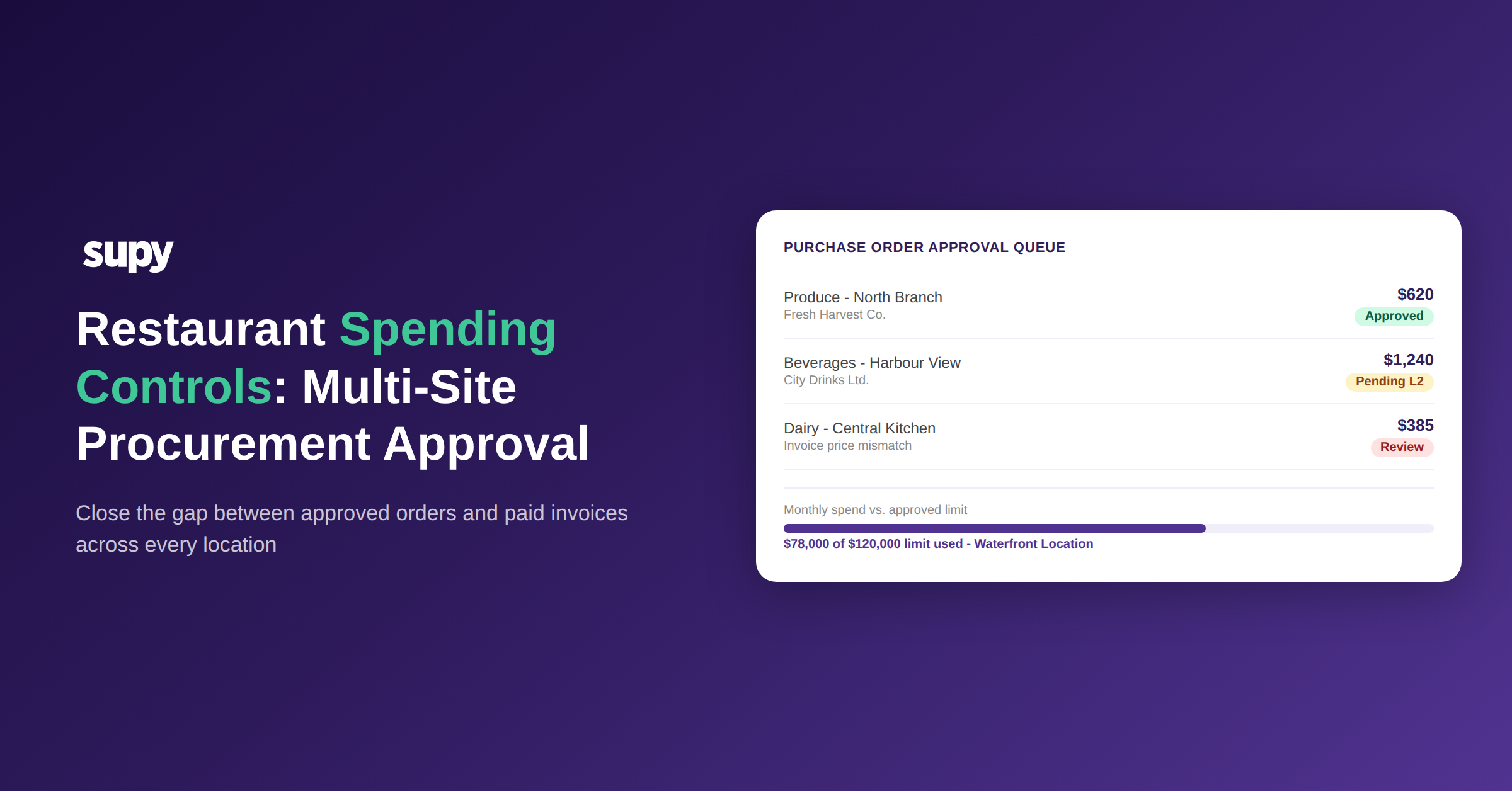
Effective supplier management replaces voluntary compliance with structural controls. Approval chains are configured in the system: any PO above a defined threshold - by value, by supplier, by branch, or by category - requires approval from one or more specified individuals before the order is sent. The system supports sequential approval chains of up to 5 approvers, triggered automatically based on the order parameters. A junior team member cannot route around the approval step because the PO cannot be sent until the chain is completed.
This structure does more than prevent overspend on individual orders. It creates visibility. An operations director covering multiple branches can see every pending order across the group, approve or query it from their phone, and identify which suppliers or branches are generating requests that fall outside normal patterns. Budget management shifts from retrospective reconciliation to live operational control.
Real-time budget tracking extends this visibility further. Groups with forecast-integrated procurement can see, at the point of raising an order, how the spend compares to the projected budget for the period. When a manager is approaching the month's allocation for a particular supplier or category, the system flags it before the PO is submitted - not after the invoice arrives.
Centralising Supplier Records Across Locations
Multi-site restaurant groups typically inherit a fragmented supplier landscape. Each location built its own supplier relationships before the group standardised. The result is that the same food category - dry goods, fresh produce, protein - might be sourced from different suppliers across locations, at different prices, under different delivery schedules, with different account numbers and contact arrangements.
Without a centralised supplier record, managing this complexity is manual and error-prone. Price lists live in email threads or on paper. Delivery cut-off times are remembered by whichever manager handles that supplier. When a member of staff changes, the institutional knowledge about a supplier relationship often leaves with them.
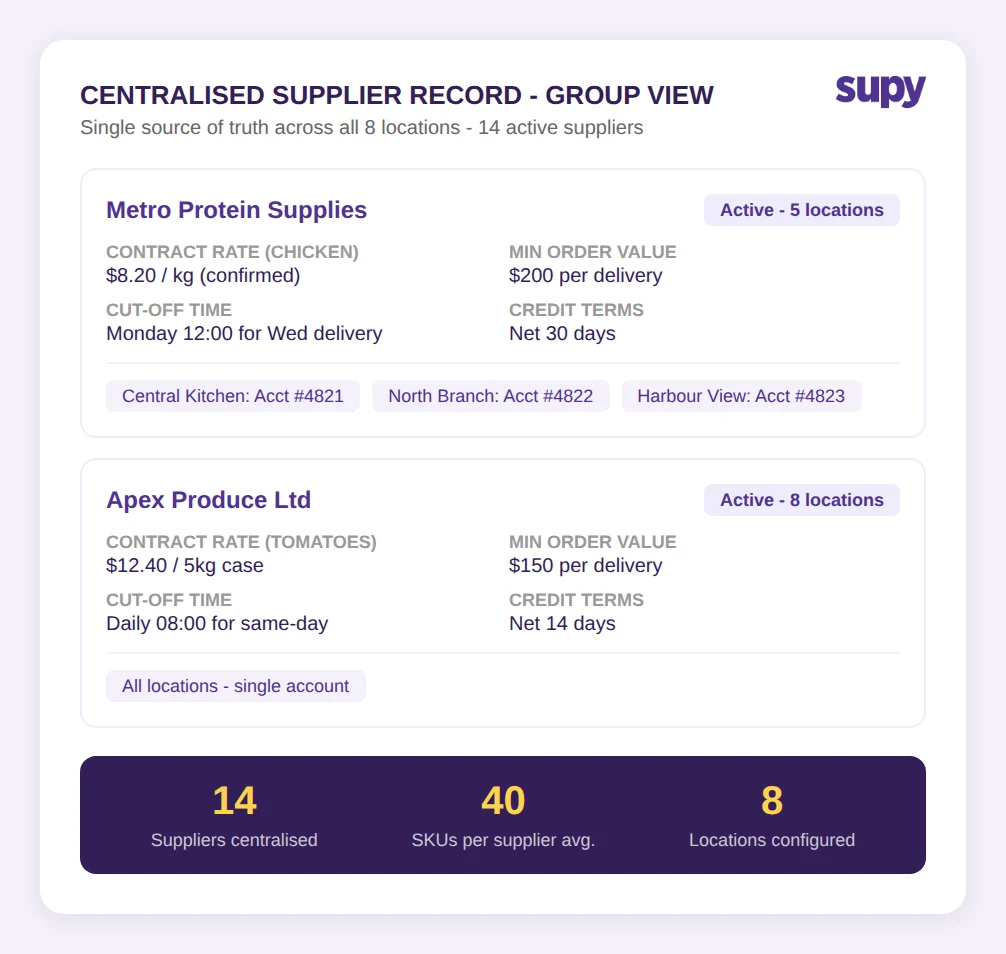
Centralised supplier management means every supplier record - contacts, per-branch delivery schedules, contracted prices, minimum order values, credit terms, and cut-off times - lives in one system accessible to the whole group. Per-branch supplier contacts can be configured independently, so the correct contact receives orders for each location. Delivery schedules auto-align with order days, so POs are never raised on a day the supplier cannot fulfil.
The operational benefit is staff-independence. A new purchasing manager can see the full supplier relationship history, the current price list, and the delivery terms for every supplier without needing a handover document. The supplier knowledge is owned by the organisation, not by an individual.
For groups managing 40 SKUs per supplier across 14 suppliers, the ability to bulk-edit contracted prices - updating rates after a seasonal price negotiation across the entire supplier base in a single operation - removes what would otherwise be a multi-hour manual update process per quarter.
Building a Supplier Performance Feedback Loop
Supplier management is not static. Delivery adherence changes. Prices drift. Quality varies by season or by location. Without a structured data trail from every order, delivery, and invoice, a group has no objective basis for supplier performance conversations - or for deciding which suppliers to renegotiate with, consolidate onto, or replace.
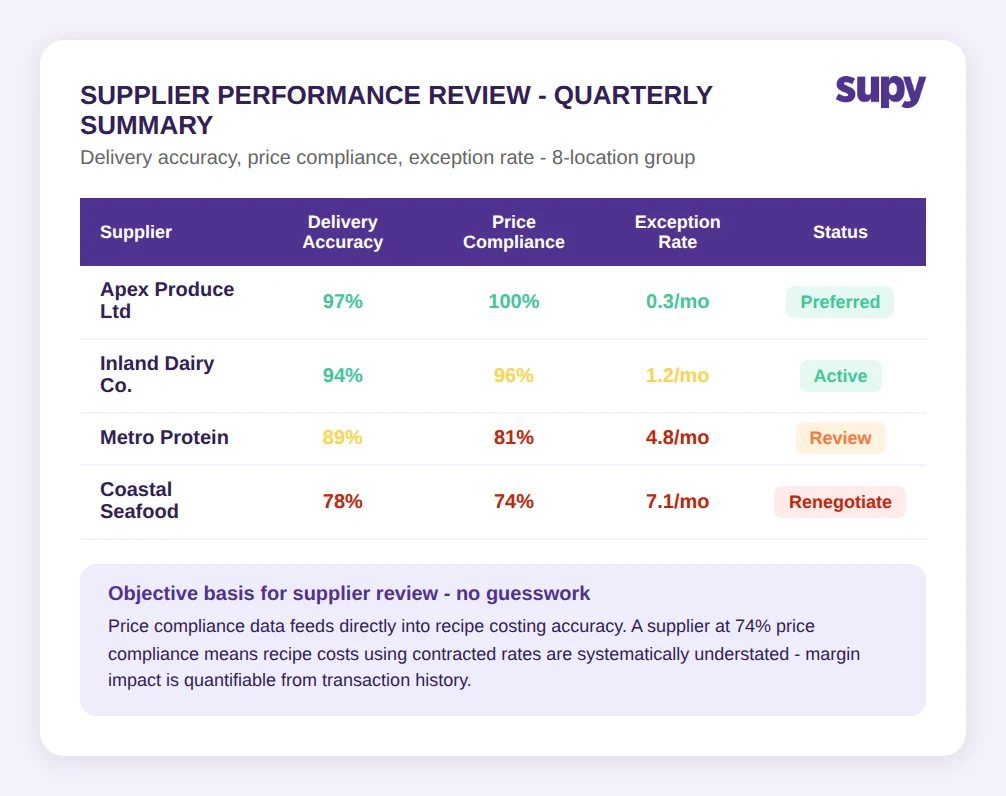
The data required to evaluate supplier performance is generated by every transaction in the procurement workflow. Every PO records what was ordered and when. Every goods received note records what was delivered, at what price, versus what was expected. Invoice exceptions record where prices diverged from contracted rates and how often. Over time, this creates a factual performance record: delivery accuracy by supplier, price compliance by supplier, frequency of exceptions by supplier.
This data feeds directly into food cost accuracy. If a supplier's actual delivery prices consistently exceed PO prices, the cost of goods calculations for recipes sourced from that supplier are systematically understated. Recipe costing accuracy requires that the price used in the costing model reflects the price actually paid - not the contracted rate that was negotiated six months ago and has since been quietly eroded.
Multi-site groups with 75+ integrations across POS, accounting, and ERP systems can close this loop: supplier performance data flows into food cost tracking, which flows into recipe costing, which flows into menu engineering. The profit and loss impact of supplier management decisions becomes visible and measurable.
The starting point is making sure every supplier interaction generates a data record. A WhatsApp message generates no data. A raised PO, matched to a goods received note, reconciled against an invoice, generates a complete transaction record that supports supplier review, food cost tracking, and operational improvement.
Restaurant supplier management breaks down predictably: informal channels create no record, manual invoice checking misses price drift, and approval processes without system enforcement are routinely bypassed. For multi-site groups, the cost accumulates across every location and every supplier interaction - but it accumulates invisibly, buried in cost of goods variances with no clear attribution.
The fix is structural, not procedural. Digital PO workflows, automated invoice matching, configurable approval chains, and centralised supplier records transform supplier management from a set of informal practices into a system that enforces the terms operators agreed to. The supplier relationship stays the same; the ability to hold it to account changes entirely.
Supy's procurement module covers the full supplier management workflow - orders and requisitions, AI invoice matching, permissions and approval limits, and supplier records with per-branch configuration - across 75+ integrations with the systems restaurant groups already use. Groups managing supplier relationships across multiple locations can find out how the platform handles their specific setup at supy.io/book-a-demo.