.jpeg)
Le rôle du logiciel de gestion des stocks dans les opérations de restaurants multi-sites
Selon cet article de Restaurant365, l'un des défis courants auxquels font face tous les restaurants en expansion semble être de savoir comment maintenir la qualité et la cohérence de leurs services au fur et à mesure de leur croissance. Cela peut être difficile à réaliser sans procédures standardisées pour maintenir les niveaux de stock et un système de communication efficace à tous les niveaux.
Chaque établissement d'un restaurant aura des besoins en stock uniques en fonction des préférences régionales spécifiques de sa clientèle et de la disponibilité de ses fournisseurs, ce qui complique le processus d'approvisionnement. De plus, le suivi des stocks en temps réel peut être un processus fastidieux s'il n'existe pas de système centralisé. Cela conduit à des surstockages ou des ruptures de stock, qui peuvent tous deux éroder les marges bénéficiaires d'un restaurant.
- La complexité de la gestion des stocks dans plusieurs établissements
- Contrôle centralisé des stocks sur plusieurs sites
- Approvisionnement et réapprovisionnement des stocks
- Précision des données et reporting améliorés
- Étude de cas client réussie
- Réduction des coûts et minimisation des pertes
- Standardisation des processus et cohérence du service
- Conformité multi-sites et traçabilité alimentaire
- Évolutivité et flexibilité pour les chaînes en croissance
- Conclusion
- À propos de Supy
Avec un système centralisé de gestion des stocks, vous pouvez maintenir la cohérence, réduire les pertes et optimiser les coûts des opérations de restaurants multi-sites. En mettant en place un système unifié, les restaurants peuvent standardiser leurs recettes et procédures, garantissant ainsi la même expérience client dans chacun de leurs établissements. Un tel système facilite également des prévisions précises et la planification de la demande, minimisant le risque de surcommandes ou de sous-stockage en ingrédients. De plus, le contrôle centralisé améliore la communication et la coordination entre les établissements, rationalisant les opérations et réduisant la probabilité d'erreurs.
Le logiciel de gestion des stocks de restaurant de Supy a été conçu pour répondre directement à chacun de ces défis. Dans cet article, nous allons explorer certaines des fonctionnalités logicielles clés qui font de Supy un excellent outil pour les restaurants multi-sites.
1. Naviguer dans la complexité de la gestion des restaurants multi-sites
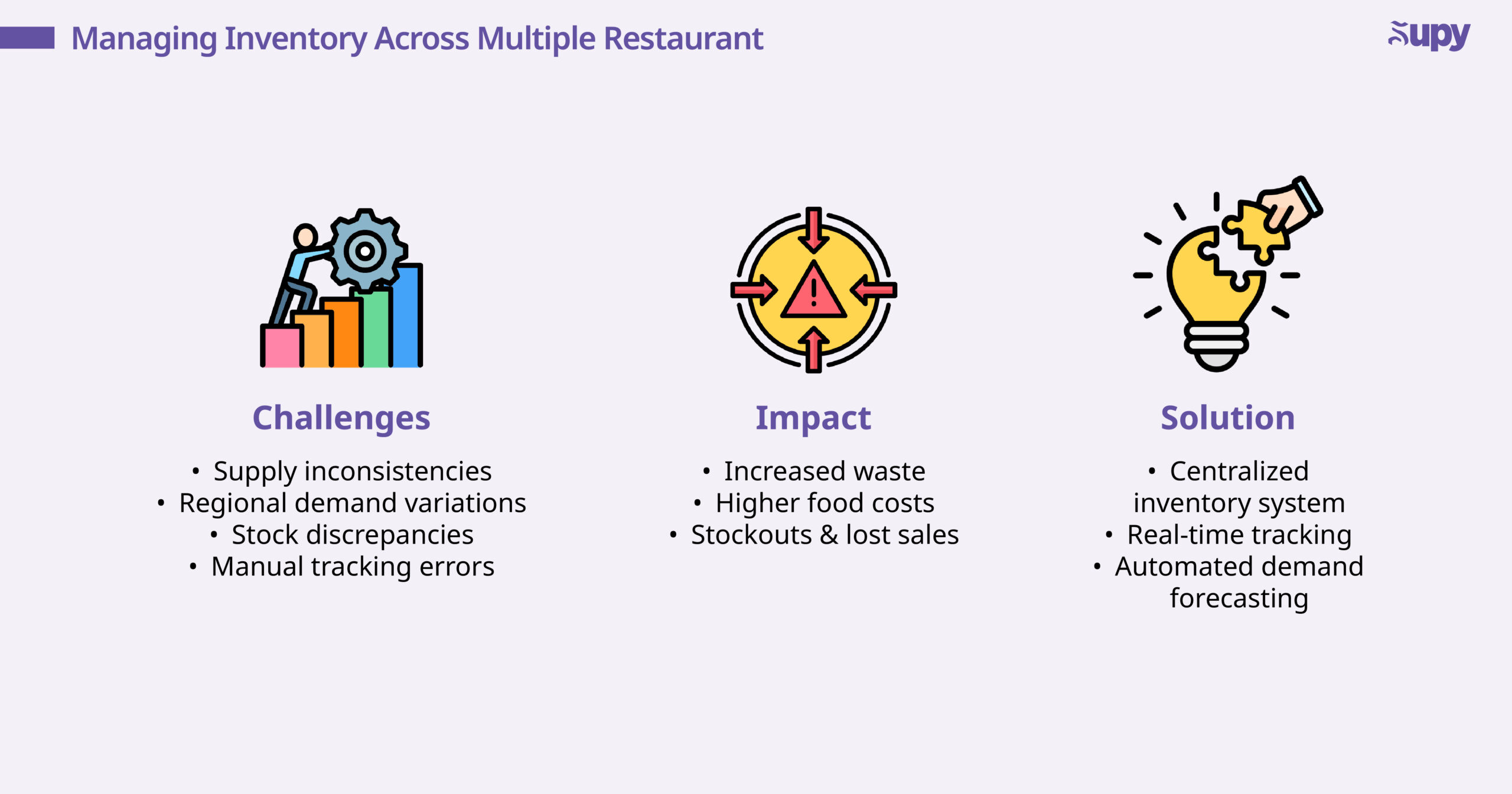
Gérer les stocks dans plusieurs établissements de restaurant peut souvent présenter plusieurs défis uniques qui peuvent avoir un impact significatif sur l'efficacité et la rentabilité de votre entreprise. Par exemple, il n'est pas rare que des incohérences d'approvisionnement surviennent en raison de niveaux variables de fiabilité des fournisseurs. Les différences régionales de demande peuvent également entraîner des excédents ou des pénuries de stocks. Des écarts de stock de ce type peuvent devenir encore plus fréquents si chaque établissement décide de tenir ses propres registres de stock séparés. Il n'est pas non plus un secret que les systèmes manuels de suivi peuvent aggraver ces problèmes, car ils sont chronophages et sujets aux erreurs humaines. Cela rend la surveillance des stocks en temps réel presque impossible.
L'impact d'un mauvais suivi des stocks est considérable, affectant directement le coût matière, les pertes et la rentabilité globale. Par exemple, les surcommandes dues à des erreurs de comptage ou à des prévisions de demande inexactes peuvent entraîner un excédent de stocks qui se gâte avant d'être utilisé. Cela peut engendrer des pertes importantes. D'autre part, des commandes insuffisantes peuvent provoquer des ruptures de stock, ce qui nuit à la capacité de votre entreprise à répondre à la demande des clients et peut même les faire fuir ! De plus, de mauvais systèmes de gestion des stocks peuvent contribuer aux pertes. Collectivement, ces facteurs érodent les marges bénéficiaires de votre entreprise et peuvent compromettre la santé financière d'un restaurant !
Clairement, les méthodes traditionnelles de gestion des stocks, comme les comptages manuels et les enregistrements sur papier, ne suffisent tout simplement pas. Elles manquent d'évolutivité et de données en temps réel dont ont besoin les chaînes de restaurants multi-sites pour gérer efficacement leurs établissements. La mise en place d'un système centralisé de gestion des stocks est la réponse à toutes ces questions.
2. Contrôle centralisé des stocks sur plusieurs sites
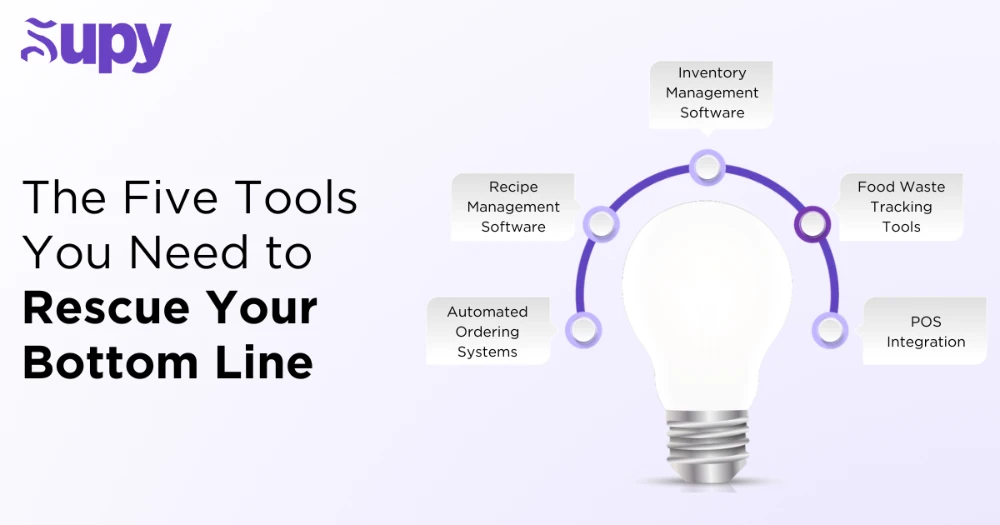
Les tableaux de bord centralisés de Supy jouent un rôle clé pour aider les restaurants multi-sites à suivre leurs niveaux de stock en temps réel. Nos fonctionnalités de rapports en temps réel et d'analyses prévisionnelles sont conçues pour utiliser des données historiques afin de prédire les besoins futurs de votre restaurant, vous aidant à planifier vos opérations et à commander les ingrédients plus précisément. En analysant les modèles de ventes et de consommation passés, ces outils peuvent estimer la quantité de chaque ingrédient nécessaire pour une période donnée. Cette anticipation permet aux restaurants d'ajuster préemptivement leurs commandes, réduisant ainsi la probabilité de ruptures de stock ou de surplus qui pourraient devenir des pertes.
Voici pourquoi vous devriez mettre en place le système centralisé de gestion des stocks de Supy :
- Éviter les ruptures de stock et les surcommandes : Grâce aux fonctionnalités de suivi en temps réel, Supy surveille continuellement vos niveaux de stock, réduisant le risque de manquer d'articles essentiels ou de surcommander des denrées périssables.
- Cohérence entre les établissements : L'installation d'un système unifié comme le nôtre garantit que chaque établissement de restaurant respecte les mêmes pratiques de gestion des stocks standardisées. Cela vous permet de maintenir la disponibilité et la qualité des produits dans toute la chaîne de restauration.
Prise de décision améliorée : L'accès à des données de stock précises et à jour permet aux gestionnaires de prendre des décisions d'achat éclairées et de mettre en œuvre des stratégies efficaces de réduction des coûts.
3. Approvisionnement et réapprovisionnement des stocks
Avec le système de réapprovisionnement des stocks alimenté par l'IA de Supy, les restaurants peuvent commander au niveau de référence et ne jamais se retrouver en situation de surstockage ou de rupture de stock. En analysant leurs données de ventes actuelles et historiques, Supy peut vous aider à prévoir avec précision la demande future, garantissant ainsi des niveaux de stock optimaux dans chacun de vos établissements.
Une fonctionnalité clé du système d'approvisionnement de Supy est l'établissement de points de réapprovisionnement automatiques. En évaluant votre demande quotidienne moyenne et les délais de livraison des fournisseurs, Supy peut calculer des seuils de réapprovisionnement précis pour chacun de vos articles. Lorsque les niveaux de stock atteignent ces points prédéfinis, Supy génère automatiquement des bons de commande, rationalisant ainsi le processus d'approvisionnement. Vous pouvez même configurer des alertes personnalisées de stock bas qui vous notifient lorsque des articles passent en dessous du niveau de référence, tout cela en un seul clic !
Supy vous facilite également la commande d'ingrédients en regroupant les articles provenant de différents fournisseurs sous leurs catégories. Si vous achetez régulièrement des articles auprès du même fournisseur, Supy vous permet même de le définir comme fournisseur préféré pour accélérer le processus d'achat ! Idéal pour une supply chain plus fluide !
4. Précision des données et reporting améliorés
Un système centralisé de collecte de données et de reporting est devenu un élément essentiel de la gestion des restaurants multi-sites. Ces systèmes permettent à la direction de suivre facilement les habitudes de consommation, les pertes et les tendances des coûts dans chaque établissement. En consolidant les données dans une seule plateforme, les gestionnaires de restaurant peuvent prendre des décisions éclairées pour améliorer l'efficacité opérationnelle et la rentabilité.
Grâce au tableau de bord d'analyses en temps réel de Supy, les gestionnaires peuvent accéder immédiatement à leurs niveaux de stock, aux modèles de ventes et aux résultats financiers pour aider à la planification stratégique.
5. Étude de cas client réussie
Nous pouvons voir l'impact positif des fonctionnalités de reporting et d'analyses de Supy sur la prise de décision à travers l'exemple d'un de ses clients, FIYA. Le propriétaire de FIYA, Hattem Mattar, faisait face à un défi majeur — il a constaté que son personnel passait trop de temps sur des tâches manuelles sans avoir une vision claire des performances des fournisseurs ou des habitudes d'achat du restaurant. Son équipe était débordée, passant plus de 100 heures chaque mois à la facturation, au comptage des stocks et au suivi des pertes.
En centralisant la supply chain de FIYA et en donnant à l'équipe accès à des données précises en temps réel, Supy a réussi à transformer cette entreprise. En mettant en place le système centralisé de gestion des stocks de Supy, FIYA a réussi à atteindre une réduction de 24 % de son coût des marchandises vendues (COGS) grâce à des contrats, des recettes et une gestion des fournisseurs optimisés. Grâce à une fonctionnalité de facturation quotidienne et d'enregistrement des pertes, Supy a également fait économiser au restaurant plus de 100 heures par mois de travail manuel tout en maintenant un écart de stock de 3 %.
Cet exemple illustre comment les fonctionnalités de reporting centralisé et d'analyses en temps réel de Supy peuvent apporter des améliorations significatives à la gestion physique des stocks de votre restaurant. « Nous avons identifié des écarts dès que nous avons activé Supy », a déclaré Hattem. « C'était comme par magie ! »
6. Réduction des coûts et minimisation des pertes
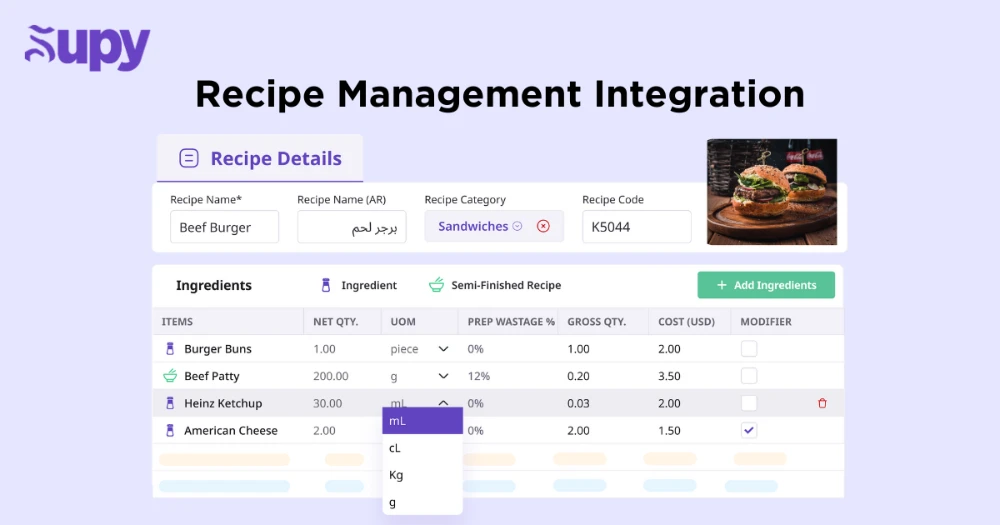
Selon cet Restaurant.orgarticle, de plus en plus de restaurateurs se tournent aujourd'hui vers la technologie pour gérer leurs stocks et réduire les coûts d'exploitation. Chez Supy, nous pensons que l'intégration de notre processus de gestion des stocks avec des outils d'ingénierie des menus est la meilleure façon d'optimiser votre tarification et d'améliorer la rentabilité. En analysant leurs ingrédients, les restaurants peuvent prendre des décisions éclairées concernant leurs offres de menu, leurs stratégies de tarification et le contrôle des coûts.
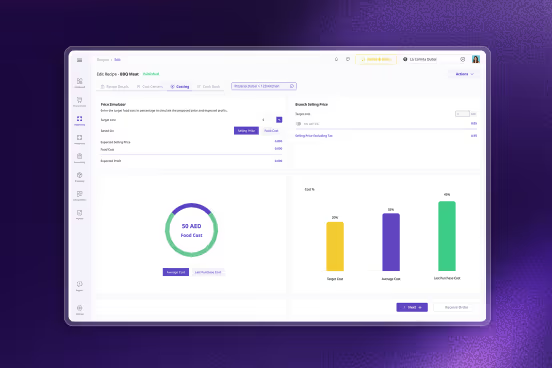
Le processus intelligent de gestion des stocks de Supy comprend un outil de suivi des coûts des ingrédients en temps réel qui facilite le calcul d'un pourcentage de coût matière précis plus que jamais ! Cette vision détaillée permet aux restaurateurs d'ajuster leurs prix en fonction de leur coût de production réel. Avec l'outil d'ingénierie des menus de Supy, assurez-vous que chaque plat contribue à vos marges bénéficiaires globales.
L'une des façons d'y parvenir est d'identifier vos articles à haute et basse marge. En catégorisant les articles du menu en fonction de leur rentabilité et de leur popularité, les restaurants peuvent classer les plats comme des « Stars » (haute rentabilité et haute popularité) et des « Dogs » (faible rentabilité et faible popularité). Cette classification guide les décisions sur les articles à promouvoir, à repositionner ou à retirer potentiellement du menu. Par exemple, si un plat particulier est populaire mais présente une faible marge bénéficiaire, le système de Supy peut vous inviter à revoir vos coûts d'ingrédients et/ou vos tailles de portions pour améliorer la rentabilité. À l'inverse, les articles à haute marge qui sont moins populaires peuvent être stratégiquement promus pour augmenter les ventes.
7. Standardisation des processus et cohérence du service
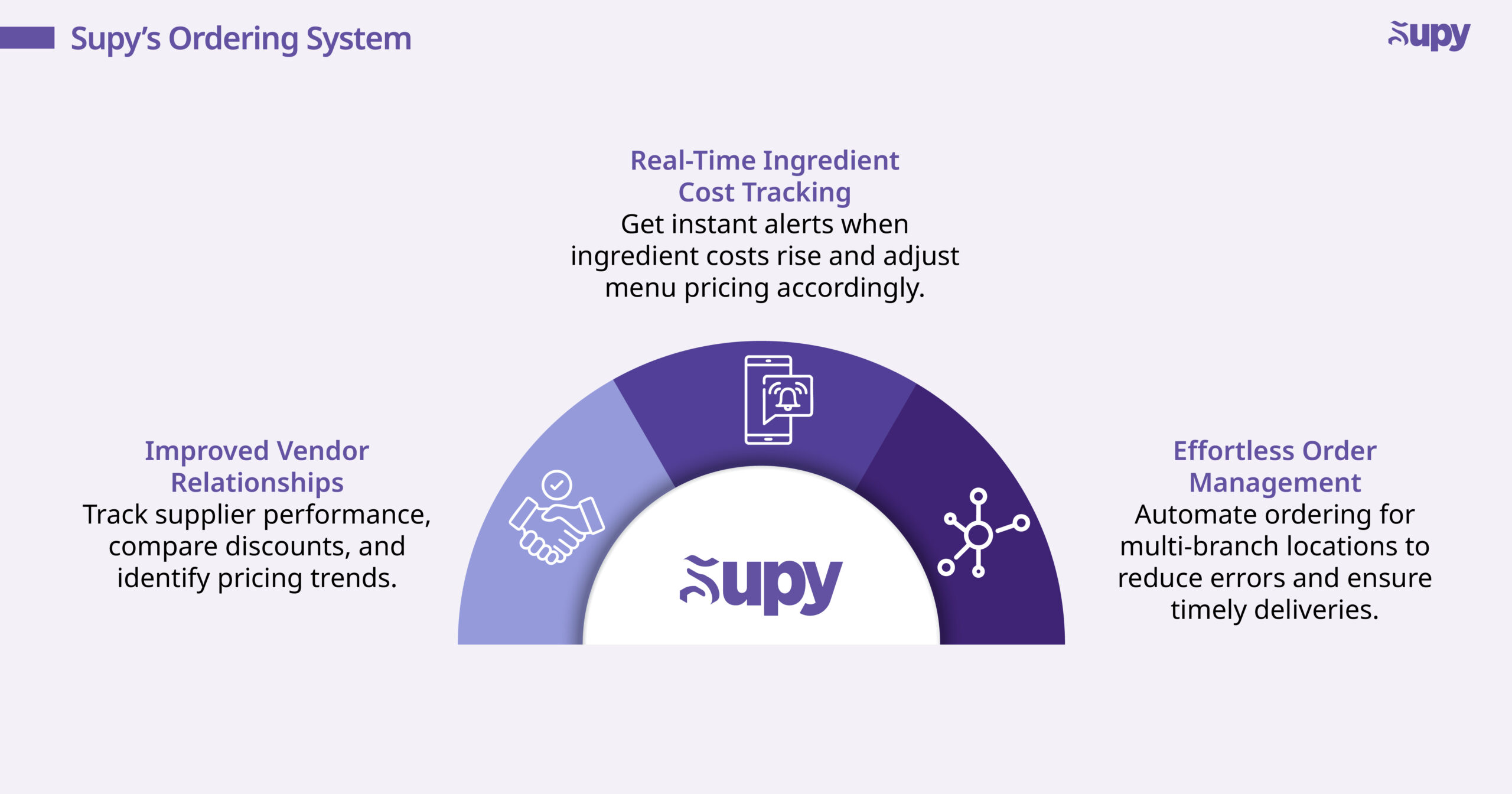
L'application Supy fournit une plateforme centralisée permettant aux propriétaires et aux gestionnaires de restaurant de gérer les commandes auprès de plusieurs fournisseurs. Cela peut aider à standardiser le processus d'approvisionnement de votre restaurant pour réduire les erreurs et améliorer l'efficacité. En automatisant ces tâches répétitives, Supy garantit la livraison ponctuelle et précise des commandes dans chacun de vos établissements multi-sites. Voici quelques-uns des avantages du système de commande automatisé de Supy :
- Relations fournisseurs améliorées : L'un des aspects sous-estimés mais essentiels de la construction d'une entreprise est le développement des relations ! Supy facilite le suivi de la façon dont chacun de vos fournisseurs vous traite. L'un vous offre-t-il une remise plus élevée qu'un autre ? Maintenant, vous pouvez vérifier quels fournisseurs augmentent leurs prix ou vous offrent un avantage de temps en temps pour trouver le meilleur fournisseur pour votre argent !
- Surveiller la rentabilité des recettes grâce au suivi des coûts des ingrédients en temps réel : En liant et en mettant régulièrement à jour le coût de vos ingrédients pour chaque recette, Supy envoie instantanément des alertes aux gestionnaires de restaurant si les prix augmentent et affectent la rentabilité de votre menu. En un seul clic, les responsables de restaurant peuvent identifier les recettes qui nécessitent leur attention et s'assurer de ne jamais vendre à perte !
8. Conformité multi-sites et traçabilité alimentaire
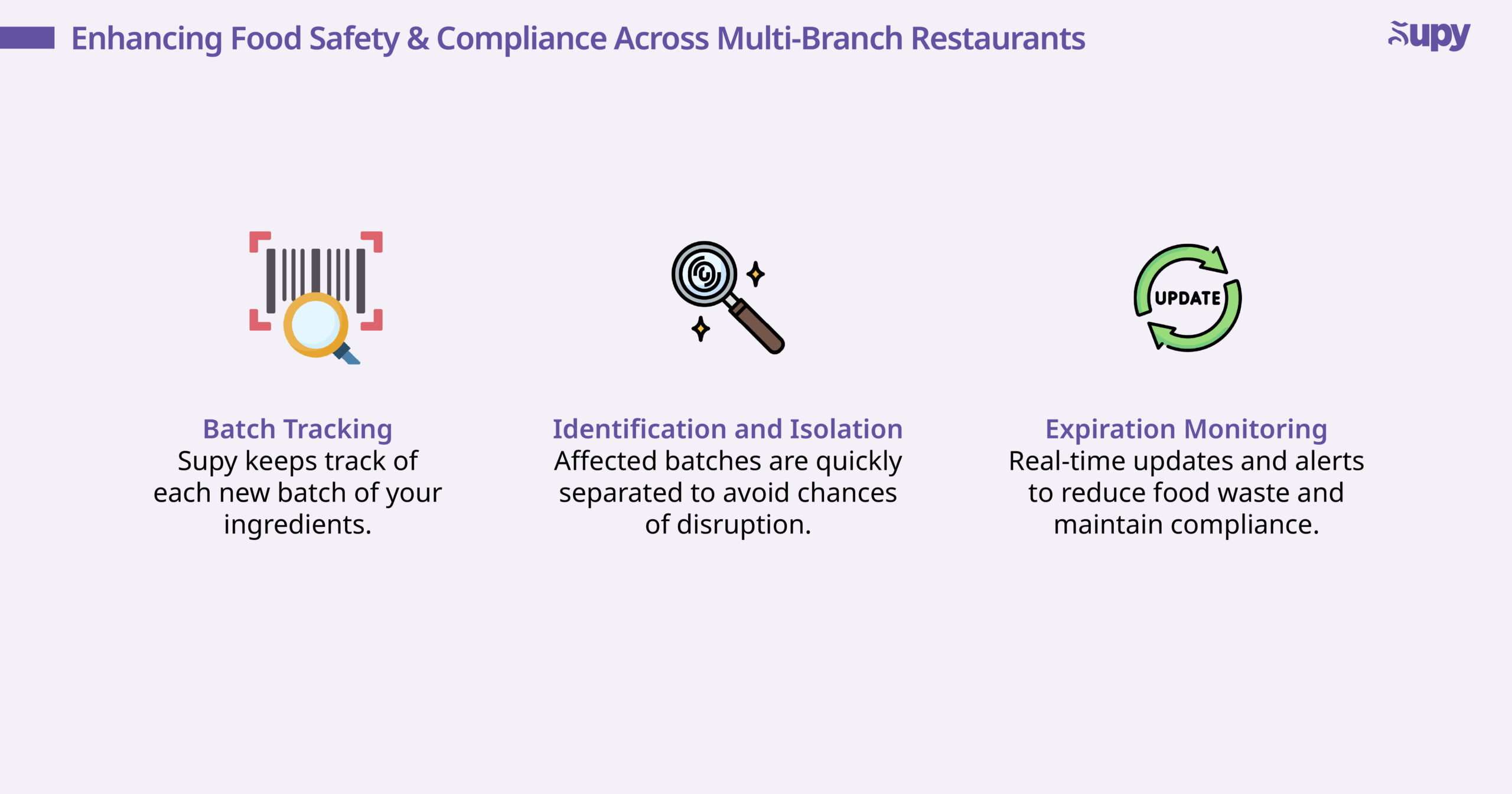
Pour maintenir l'intégrité de la marque et la confiance des clients, il est important de garantir la sécurité alimentaire et la conformité réglementaire dans plusieurs établissements de restaurant. Avec la traçabilité en temps réel, les restaurants peuvent surveiller le parcours de leurs ingrédients du fournisseur au client. Cette surveillance approfondie permet des réponses rapides en cas de problèmes de sécurité potentiels.
Voici comment Supy peut améliorer la sécurité alimentaire et la conformité dans les opérations multi-sites :
- Suivi par lot : Supy suit chaque nouveau lot de vos ingrédients. Cette capacité garantit qu'en cas de problème de qualité, les lots affectés peuvent être rapidement identifiés et isolés, minimisant le risque de perturbation potentielle.
Surveillance des dates d'expiration : Le logiciel de gestion des stocks de Supy fournit constamment des mises à jour en temps réel sur les niveaux de stock et les dates d'expiration, permettant ainsi au personnel de prioriser l'utilisation des stocks plus anciens et de réduire les pertes alimentaires. Des alertes automatiques avertissent les gestionnaires des dates d'expiration imminentes, garantissant ainsi que les articles périssables sont utilisés à temps.
9. Évolutivité et flexibilité pour les chaînes en croissance
Un autre avantage de l'installation de Supy est son intégration transparente avec plusieurs grands systèmes de point de vente (PDV) et logiciels de comptabilité. Cette intégration facile permet la synchronisation des données en temps réel dans divers aspects de l'entreprise, rendant la montée en charge aussi simple que 1, 2, 3 !
- Intégration avec les systèmes PDV : En se connectant aux systèmes PDV, Supy peut automatiquement ajuster vos niveaux de stock en fonction de vos données de ventes et de transactions. Ce suivi en temps réel garantit une gestion précise des stocks, prévenant les pénuries et les surstockages. Il facilite également le processus de calcul des coûts de recettes en décomposant chaque article du menu en ses coûts composants, permettant un suivi détaillé des ingrédients.
- Intégration avec les logiciels de comptabilité : L'intégration de Supy avec plusieurs grands systèmes de comptabilité est conçue pour automatiser le flux de vos données financières, réduisant les erreurs associées à la saisie manuelle des données. Ce type d'automatisation conduit souvent à une amélioration des rapports financiers, offrant une vue complète des dépenses et des bénéfices. Il rationalise également le processus d'enregistrement des factures, améliorant la précision de la gestion des stocks et des paiements aux fournisseurs.
Les capacités d'intégration complètes de Supy offrent ainsi aux chaînes de restaurant les outils nécessaires pour optimiser leurs opérations, maintenir la précision financière et atteindre une croissance durable.
10. Conclusion
Le logiciel automatisé de gestion des stocks de Supy offre une puissante suite de Solutions intégrées pour les chaînes de restaurant souhaitant rationaliser leurs stocks dans plusieurs établissements. Avec un accent sur le contrôle centralisé, l'automatisation et les analyses en temps réel, Supy peut vous aider à résoudre certains des défis opérationnels les plus courants auxquels font face les restaurants multi-sites.
Si vous êtes prêt à voir comment Supy peut transformer vos opérations de restaurant en direct, nous vous invitons à réserver une démo gratuite avec nous dès aujourd'hui. Découvrez comment le logiciel de gestion des stocks de restaurant de Supy peut générer des économies importantes, améliorer la précision des stocks et améliorer l'efficacité opérationnelle dans tous vos établissements. Inscrivez-vous à notre newsletter pour en savoir plus !
Vous pouvez également cliquer ici pour en savoir plus sur les logiciels de gestion des stocks de restaurant.
11. À propos de Supy
Supy est la meilleure plateforme de logiciel de gestion des stocks de restaurant adaptée aux restaurants multi-sites et aux franchises. Avec des fonctionnalités comme le suivi des stocks en temps réel, des systèmes d'approvisionnement intelligents et des analyses avancées, Supy aide les restaurants à gérer efficacement leurs diverses exigences et fournit les outils dont les restaurants ont besoin pour prospérer dans un secteur dynamique.
Pour les derniers Insights d'experts, téléchargez l'ebook de Supy : Le guide ultime pour réduire le coût matière dans les restaurants multi-sites et entreprises.
Prêt à en savoir plus ? Planifiez une démo avec Supy dès aujourd'hui et franchissez le premier pas vers un avenir rationalisé et rentable.