.jpeg)
10 Effective Strategies to Reduce Restaurant Food Costs in 2025

With food costs accounting for an average of 30% of a restaurant's expenses, controlling them is critical to maintaining profitability—especially in 2025, where inflation, supply chain disruptions, and changing consumer preferences are adding new challenges. Reducing food costs isn’t just about cutting spending; it's about adopting smarter strategies and leveraging technology to optimize operations without compromising quality. But cutting food costs can be tricky—success lies in tracking the right data and making informed decisions. So, what are the most effective strategies, and how can technology support them? In this guide, we’ll explore proven techniques to reduce food costs, from accurate tracking methods and waste reduction tactics to leveraging restaurant inventory management software to drive efficiency and profitability. Want to take control of your restaurant's bottom line? Let's dive in.
Table of Contents
- Why Managing Restaurant Food Cost Is Key
- How To Calculate Your Food Cost
- 10 Ways To Reduce Restaurant Food Cost
- How To Track Your Food Cost
- Think Further: Reduce Food Cost With A Proactive, Digital, Data-Driven Strategy
- Conclusion
- About Supy
1. Why Managing Restaurant Food Cost Is Key
Margins are smaller than ever in the hospitality industry. Cutting costs has become the no.1 priority for many - if not all - restaurant businesses. Ingredient costs have been going up due to economical factors, namely inflation and supply chain issues, and trends show that prices are likely to continue going up.
But cutting costs shouldn’t come at the cost of quality, and finding the right balance is a tricky, but perfectly doable task. If these costs are not tracked and controlled, a restaurant owner may end up in the undesirable case of selling dishes at a loss.
This is why calculating, tracking, and improving costs is key to the success of your restaurant.
2. How To Calculate Your Food Cost
Calculating your food cost is a task you’ll be doing on a regular basis throughout your career in hospitality. You may opt to do it manually whereby you’ll list the amount of ingredient you bought and its price. You’ll then divide this cost for the quantity needed for your recipe. Once done for each ingredient, you’ll add up these costs and ta-da! You now know the cost of your recipe.
You could accelerate this process using our Food Cost Calculator.
Food Cost Calculator
Measure The Cost Distribution Of Your Dishes
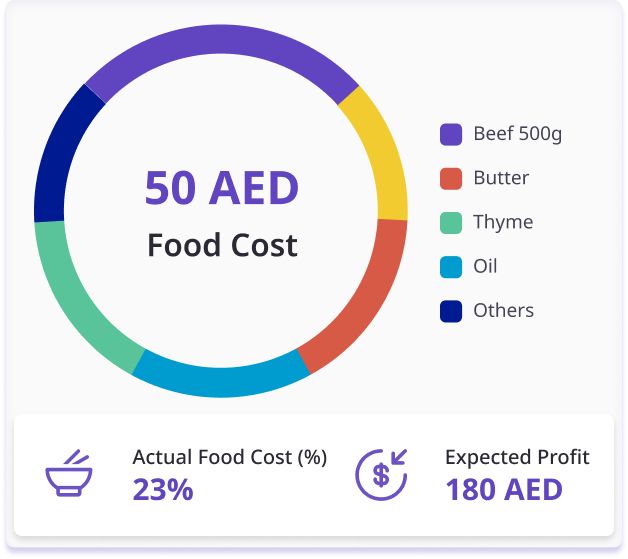

You could eliminate it completely by automating it using a restaurant inventory management software.
Once you have calculated your food costs, the next step would be to reduce these food costs to maximize your profitability. The following steps take you through the different techniques you can use to reduce your food costs.
3. 10 Ways To Reduce Restaurant Food Cost
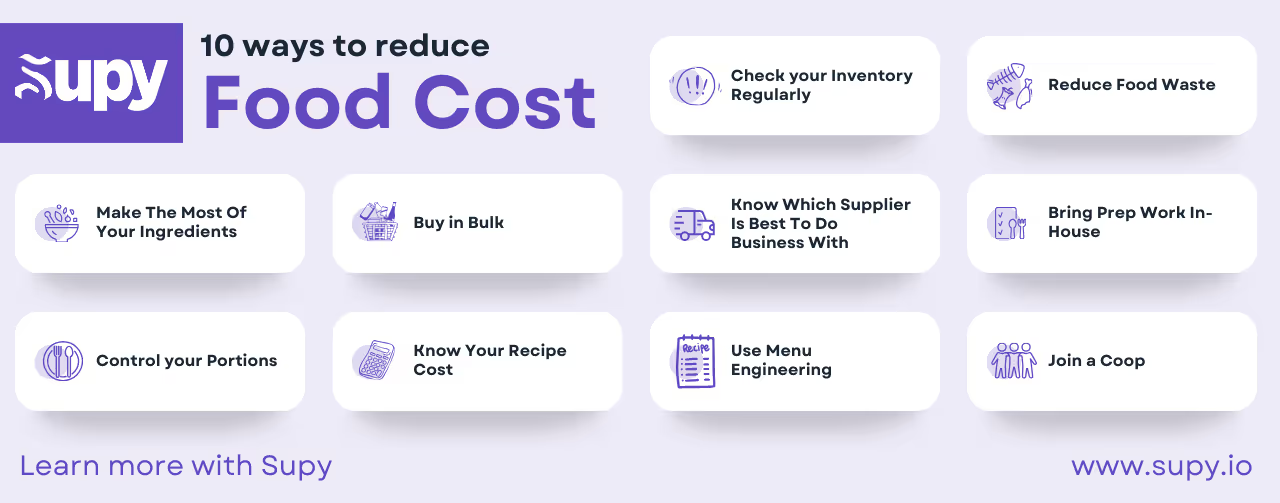
Food costs represent 25% to 35% of a hospitality business’s overall cost, and can often reach 40% in casual dining restaurants. Reducing that cost will certainly boost profitability, and thankfully, several techniques and strategies can be employed to help you achieve your goals.
Supy Webinar
The Food Cost Reduction Strategies Of Successful Multi-Branch Businesses
1. Perform Routine Inventory Audits Utilizing Advanced Technology
Manual inventory tracking is obsolete. In 2025, the most successful restaurants utilize restaurant inventory management software for real-time stock tracking. This facilitates the identification of consumption trends, lowers food waste, and enhances ordering efficiency. Employ predictive analytics to anticipate demand and maintain optimal inventory levels—neither excessive nor insufficient.
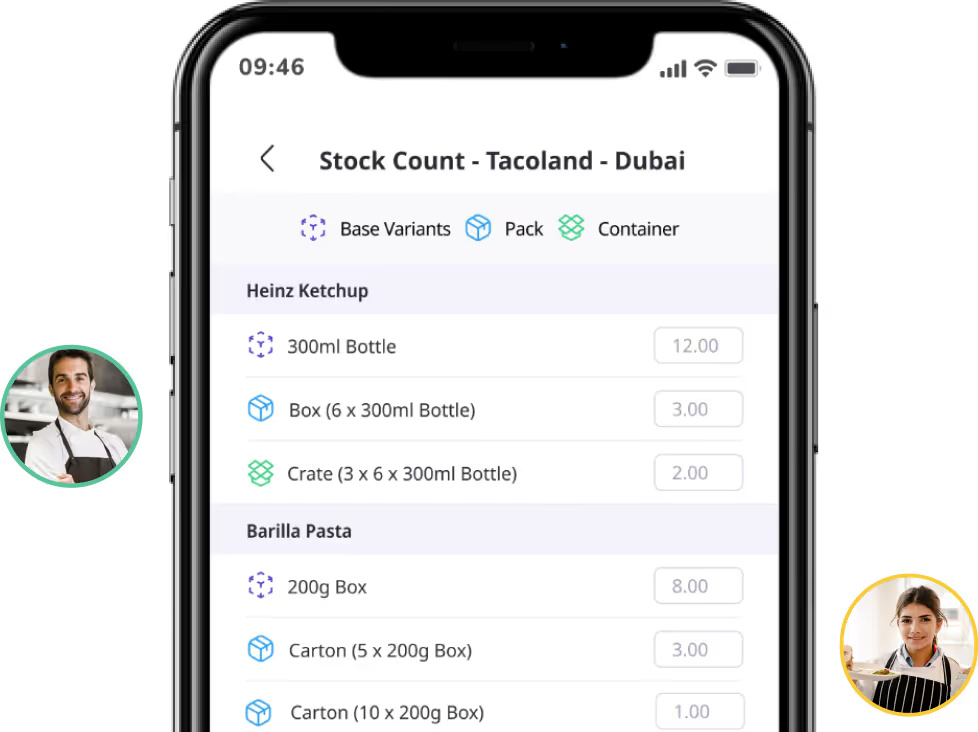
Parallel Stock Count
Count your stock 2X faster, and 3X more accurately

2. Leverage AI for Accurate Demand Forecasting
AI-powered demand forecasting helps restaurants accurately predict inventory needs based on past sales data, local trends, and upcoming events. Studies show that over 38% of fruits and vegetables and 21% of dairy products and eggs are wasted due to inaccurate demand planning. To prevent overstocking or understocking, restaurants can implement AI-driven solutions that provide actionable insights, including:
- Tracking historical sales data to identify patterns and forecast future demand.
- Factoring in local events to adjust stock levels based on expected foot traffic.
- Automated inventory alerts to optimize ordering and reduce waste.
- Employee training programs to align stock management with data-driven insights.
By integrating AI-driven demand forecasting, restaurants can optimize inventory, cut costs, and support sustainability efforts.

Want To Learn More About Food Waste Reduction?
Top 10 Tips To Reduce Restaurant Food Waste
3. Reducing Food Waste Through Smart Redistribution Channels
Even with accurate demand forecasting, some level of food waste is inevitable. The key to minimizing its impact lies in finding effective channels to redistribute surplus food and ensure it doesn’t go to waste. In 2025, sustainability and profitability go hand in hand, and restaurants can leverage innovative strategies such as:
- Partnering with food donation programs to redirect surplus ingredients to those in need.
- Collaborating with food waste reduction apps to offer discounted surplus meals to customers.
- Repurposing surplus creatively by transforming excess ingredients into new menu items, such as using vegetable scraps for broths or turning leftover bread into croutons.
By implementing smart redistribution strategies, restaurants can cut costs, align with eco-conscious consumer values, and contribute to a more sustainable food ecosystem.
https://www.youtube.com/watch?v=mBHQihkLqwQ
4. Enhance Bulk Procurement through Supplier Cooperation
Upon comprehending your ingredient turnover, procuring in bulk is a prudent strategy. Collaborate directly with your suppliers to negotiate improved agreements and utilize data-driven insights from your inventory software to monitor consumption patterns and place orders efficiently. Automation facilitates the monitoring of supplier performance and pricing variations, guaranteeing optimal procurement conditions.
Recommended Reading
PAR Level And How To Calculate It
5. Choosing the Right Suppliers with Data-Driven Insights
Not all suppliers offer the same level of quality and reliability. Leveraging supplier performance tracking tools allows restaurants to assess key factors such as fulfillment rates, pricing accuracy, and delivery consistency. In 2025, data-driven decision-making empowers restaurants to:
- Analyze supplier performance metrics to ensure reliability and consistency.
- Negotiate better pricing based on historical purchasing trends and data insights.
- Detect invoicing discrepancies automatically to avoid unexpected costs and errors.
Partnering with the right suppliers can significantly enhance operational efficiency and profitability.
Track The Performance Of Your Suppliers
Monitor discounts, delivery dates, FOCs, & price fluctuations In real-time

6. Automating In-House Preparation for Cost Savings
While outsourcing pre-prepped ingredients can save time, it often comes at a high cost. By bringing preparation tasks in-house with the help of automation and effective staff training, restaurants can:
- Reduce costs associated with purchasing pre-prepared ingredients.
- Improve quality control by maintaining consistency across all locations.
- Optimize staff productivity with smart scheduling and workflow automation.
Embracing in-house preparation with automation helps restaurants achieve better cost efficiency and operational control.
7. Standardizing Portion Control with Digital Solutions
Maintaining consistent portion sizes is essential to minimizing food costs and ensuring quality, especially as your restaurant scales. High variance in portioning often signals the need for ongoing staff training and monitoring. By leveraging recipe management software and digital tools, restaurants can:
- Pre-portion ingredients using digital scales to ensure accuracy before service.
- Regularly train staff with detailed portioning guides to maintain consistency and reduce waste.
- Monitor portion variances with reporting tools to quickly identify discrepancies and adjust accordingly.
Implementing standardized portion control measures helps maintain profitability, reduces food waste, and ensures a consistent dining experience across all locations.
8. Evaluate Recipe Expenses in Real Time
Ingredient prices vary continuously. Utilizing a real-time food cost tracking system enables businesses to modify prices and portion sizes accordingly. In 2025, intelligent operators will: - Assess cost fluctuations and their effects on profitability - Establish explicit food cost objectives to maintain margin compliance - Utilize tools to automate notifications when expenses surpass designated limits Possessing precise recipe cost data facilitates informed decision-making and enhances profitability.
All About Recipes
Discover how to set up, track, and optimize recipes with a recipe management software
9. Execute Data-Driven Menu Engineering
Your menu serves as a significant catalyst for profit generation. Menu engineering tools evaluate sales data and food expenses to discern high-performing and underperforming meals. In 2025, successful operators will optimize menus according to popularity and profitability.
- Promote high-margin products through smart positioning
- Remove "menu dogs" that adversely affect profitability
Data-informed menu design enhances income and consumer satisfaction.
10. Enroll in a Group Purchasing Organization (GPO) for Enhanced Discounts
If bulk purchasing isn’t an option, consider joining a Group Purchasing Organization (GPO), which leverages collective buying power to secure better pricing. However, it’s important to weigh the pros and cons:
Pros:
- Lower ingredient costs through bulk pricing
- Access to a wider network of suppliers
Cons:
- Less control over product quality
- Fixed delivery schedules with limited flexibility
Evaluate whether a GPO aligns with your business needs before making a commitment.
By employing these validated food cost management strategies, restaurants can maintain competitiveness in 2025 while enhancing profitability and efficiency. Desire to enhance the efficiency of your operations further? Investigate the potential benefits of Supy’s inventory management solutions by scheduling a demonstration today
4. How To Track Your Food Cost
As the saying goes: you can’t improve what you can’t measure!
Tracking your food cost over time may seem daunting, but it doesn’t have to be. With the right tools, restaurant operators can be supported with automation and data to make decisions, save hours of manual work, and cut costs. But… it is key not to leave all the work to machines. Human input is still key to maximize accuracy.
View this post on Instagram A post shared by Supy (@supy.io)
Keep in mind that restaurant operations are quite complex, and the reality may not follow what’s on the paper. Wastage is sometimes not accounted for. Invoices are not always registered accurately. This all leads to Food Cost Variance. Variance is further increased when opting to manage your operations on spreadsheets.
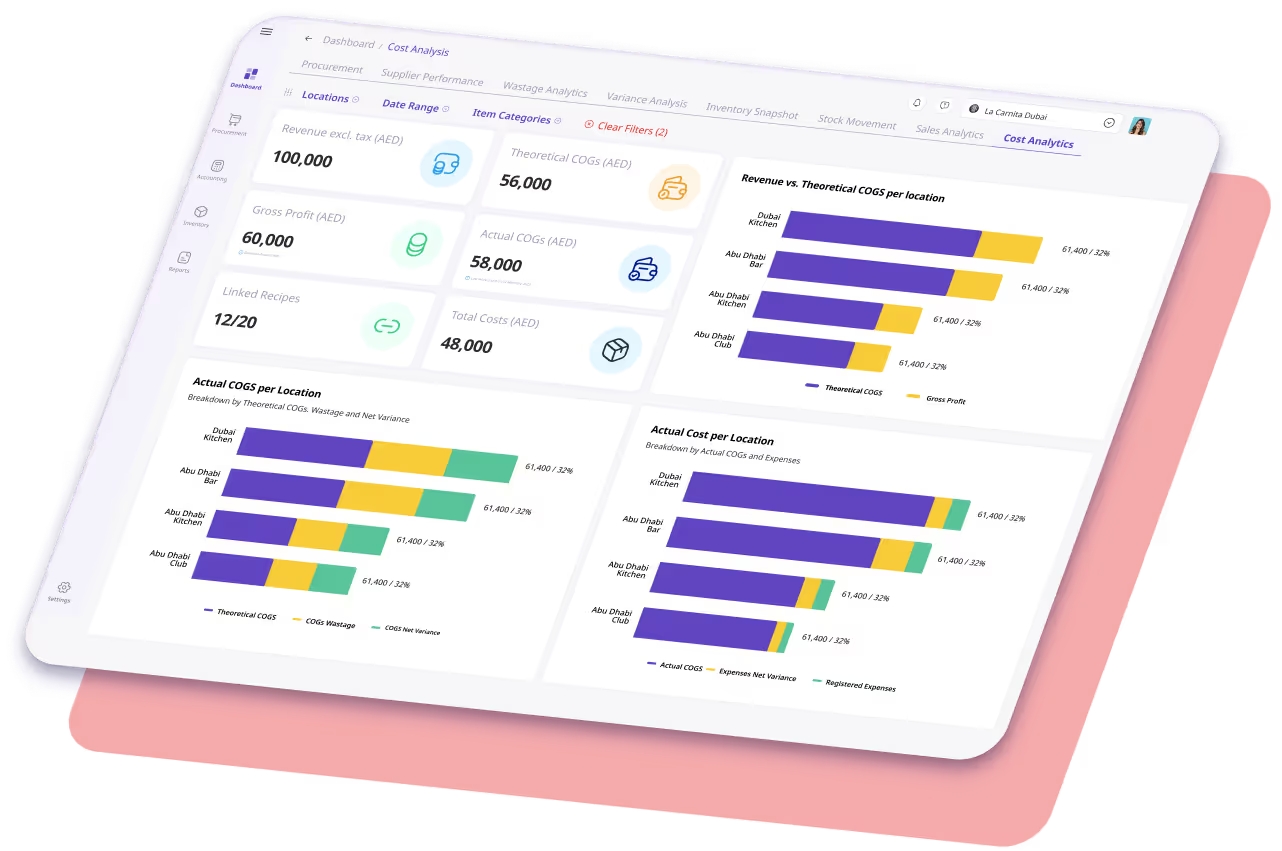
This is why opting for a specialized back-of-house software can be a game-changer to your business. Software like Supy provides you with not just the digital tool to input data accurately and regularly, but to also track your costs in real time using built-in dashboards.
Built-In Cost Analysis Dashboard
Monitor your costs across branches, in real time
5. Think Further: Reduce Food Cost With A Proactive, Digital, Data-Driven Strategy
We’ve established that cutting food costs is hard and that there are several ways to reduce them. But cutting food costs doesn’t need to be reactive, and could instead be proactive.
Opting for a digital, data-driven strategy opens the doors to numerous automation, workflow, and alerts & notification systems. Subscribing to a restaurant inventory management system would help restaurant operators not only save hours of manual work, but stay on top of their business by gaining real-time insights into the health of their operations, and especially when food costs, ingredient price fluctuations, and recipe profitability.
To act proactively, it is imperative that restaurant owners ensure they have the following covered in their digital strategy:
- A Unified Data Architecture
- A Democratized Data Entry
- Real-Time, Data-Driven Decision-Making
- A Unified Data Architecture
Standardizing the way your items, ingredients, and suppliers are named across your branches is key to aggregating data related to food cost across your business, and to analyze it on different levels (groups vs branch).
Opting for a restaurant inventory management software that enables you to compare the price fluctuation of a bottle of ketchup across suppliers and over time can help you in making clearer and more impactful decisions to cut costs.
This eliminates the need for a middleman hired to manually bring the data together, which in turn eliminates the waiting time for executives to access clean data.
- A Democratized Data Entry
Having a regular entry of accurate, reliable, up to date data is immensely valuable to your business. Empowering each member of your staff to enter data feeds your system with real time information that in turn empowers decision-makers with actionable, reliable insights.
This can be done with a mobile inventory application that’s easy to use by all. By adding an in-depth user permissions software with drafter and approver roles, you also ensure that the data input is reliable.
By opting for a restaurant inventory management solution built for the modern user, meaning with ease of access and ease of use, the obstacle of data entry is taken away, thus enabling any member of your team to enter wastage, invoices, and stock counts on the spot.
Democratizing the data entry across your business ensures reliable, up to date information about your food costs, which in turn enables decision makers to identify and address discrepancies faster.
- Real-Time, Data-Driven Decision-Making
Having clear, actionable insights at your fingertip is key to driving your business forward. With built-in alerts, notifications, and restaurant performance dashboards included in your restaurant inventory management software, monitoring and taking action on food costs can be done in real time.
6. Conclusion
Costs are going up and margins are going down. To survive in the hospitality business, restaurant owners must be in control of their costs, especially food costs, which account for 30% of their expenses.
But cutting food costs is hard. Thankfully, there are several techniques at their disposal, namely portion control, reducing waste, and setting clear recipe guidelines, which you can apply to cut costs, without sacrificing quality.
You should, however, embrace technology to help you support your goals through data and automation. Technology should be part of a digital strategy to help you embrace a proactive approach to food cost cutting, namely by ensuring a unified data architecture, a democratized data entry, and instant decision-making capabilities.
7. About Supy
Supy is the data-driven restaurant inventory management platform built to help multi-branch hospitality businesses cut costs. With a suite of 6 interconnected modules covering all aspects of a restaurant’s back-of-house operations, Supy ensures a fluid and constant flow of data within your business, thus empowering restaurant operators with data-driven decision-making.
Related Resources