.jpeg)

Checklist des opérations en cuisine : les points de contrôle back-of-house qu'une liste papier ne vérifie jamais
Ce qu'une checklist des opérations en cuisine doit vraiment couvrir
Presque tous les groupes multi-sites disposent déjà d'une checklist des opérations en cuisine. Elle est imprimée, plastifiée, affichée sur la porte d'une chambre froide ou enregistrée dans un dossier partagé. Le problème n'est pas l'absence de checklist. Le problème, c'est que personne ne peut prouver qu'elle a été exécutée aujourd'hui, dans chaque établissement, selon le même standard. Une case cochée sur papier est une affirmation, pas une preuve.
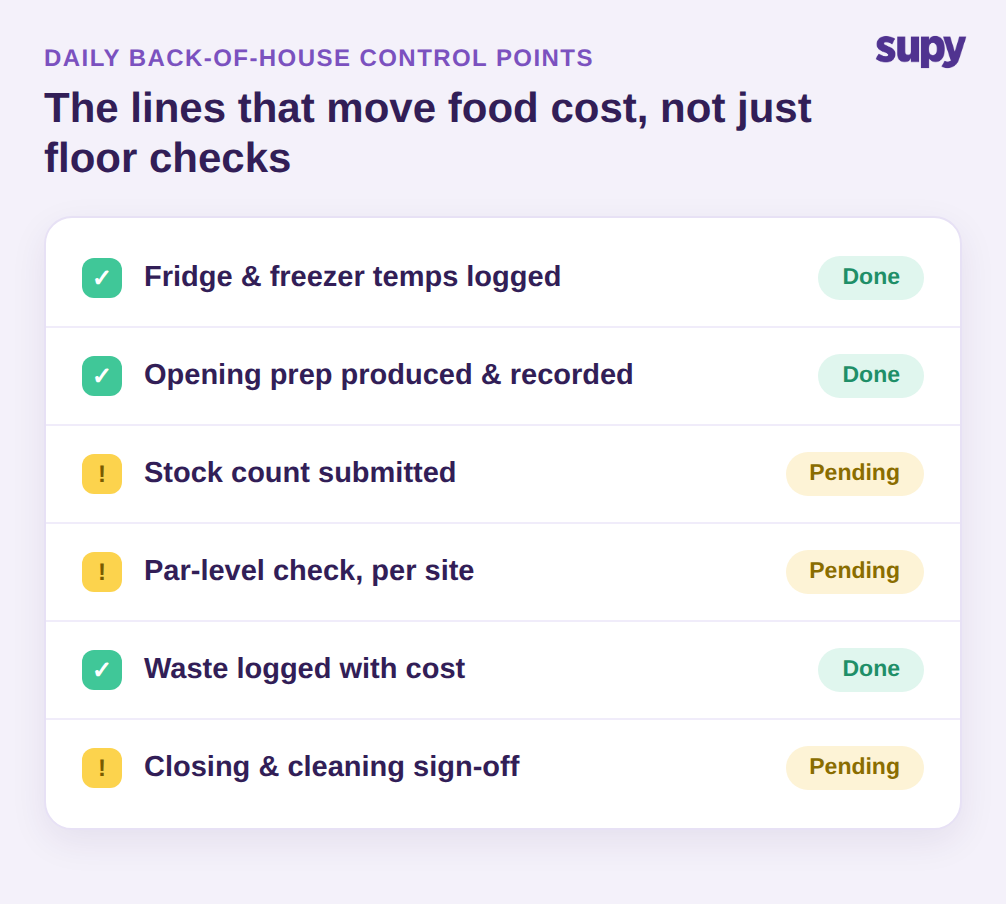
Une checklist complète des opérations en cuisine couvre l'ouverture jusqu'à la fermeture, aussi bien le service que le back-of-house : protocoles de température et de sécurité alimentaire, préparation à l'ouverture, contrôles de mi-service, nettoyage et clôture. Mais les lignes qui influencent silencieusement votre coût matière sont presque toutes des points de contrôle back-of-house : l'inventaire, la vérification des niveaux de commande, la préparation et la production, et le suivi des pertes. Ce sont ces lignes qu'une liste papier enregistre sans jamais vérifier. Pour le modèle opérationnel global dans lequel ces lignes s'inscrivent, consultez notre guide sur la gestion des opérations de restaurant.
Si vous ne souhaitez pas calculer les niveaux de commande à la main, le calculateur de niveau de commande gratuit s'en charge pour chaque article de votre liste en fonction de votre consommation, de vos jours de livraison et des délais fournisseur.
La distinction est importante, car les deux moitiés échouent différemment. Les lignes de service et de nettoyage sont largement observables : un responsable qui fait le tour des opérations peut voir si les tables sont dressées ou si la zone de sortie est propre. Les points de contrôle back-of-house ne s'observent pas de cette façon. On ne peut pas voir d'un coup d'œil si l'inventaire a été bien réalisé, si les niveaux de commande ont été respectés ou si les pertes ont vraiment été enregistrées. Ces lignes n'existent qu'en tant que données — sur une checklist papier des opérations en cuisine, elles sont donc les plus faciles à falsifier et les plus coûteuses en cas d'erreur. Une feuille signée indiquant « inventaire terminé » dissimule aussi bien un inventaire inexact qu'il en atteste un bon.
La question utile n'est donc pas : « Avons-nous une checklist ? » Mais : « Parmi les lignes de notre checklist, lesquelles produisent un chiffre vérifiable, et lesquelles ne sont que des cases cochées dont nous espérons qu'elles reflètent la réalité ? »
Pourquoi la plupart des checklists de cuisine échouent au niveau de l'exécution
Les exploitants multi-sites signalent systématiquement la même défaillance : le standard existe sur papier, mais s'effondre au niveau de l'exécution. Les procédures se trouvent dans le bureau du responsable, dans un classeur ou un dossier partagé, et n'atteignent jamais la personne en cuisine pendant le service — il n'existe aucun mécanisme pour confirmer que le standard a été respecté. L'écart se situe entre Documenté et Fait.
Deux facteurs aggravent le problème sur plusieurs sites. Le premier est la dérive. Sans application centralisée, chaque site développe progressivement sa propre version de la procédure : un changement de préparation ou un nouvel article de menu communiqué par le siège n'est pas mis en œuvre de la même façon partout — et la différence n'apparaît que lors d'un audit ou d'une réclamation. Le second facteur est l'incohérence de la formation : la qualité varie selon le formateur, l'onboarding est imprévisible, et une amélioration communiquée oralement par un directeur régional disparaît en quelques semaines, car rien ne relie la procédure à une tâche et à une preuve de réalisation.
Au fond, la fragmentation des outils est en cause. La planification des équipes est gérée dans une application, la maintenance par messages, le stock dans un tableau partagé, et la checklist elle-même dans un classeur ou un PDF. Il n'existe aucune source opérationnelle unique de vérité, et les procédures back-of-house sont généralement la couche la moins connectée. Le résultat est un angle mort qui s'auto-amplifie : parce que personne ne peut voir la réalisation en temps réel, les problèmes ne sont découverts qu'après avoir déjà coûté de l'argent. Un inventaire raté devient un point de blocage en plein service ; une perte non enregistrée devient un écart inexplicable en fin de mois. La checklist était censée prévenir exactement cela — mais une liste papier ne peut pas lever la main lorsqu'une étape est sautée.
Posez-vous une question plus précise avant de réécrire la checklist : pouvez-vous voir en ce moment quels sites ont terminé l'inventaire du jour et lesquels ne l'ont pas fait — sans les appeler ? Si la réponse honnête est Non, le problème ne réside pas dans la formulation de la liste. Il réside dans l'absence de niveau d'exécution sous la checklist des opérations en cuisine.
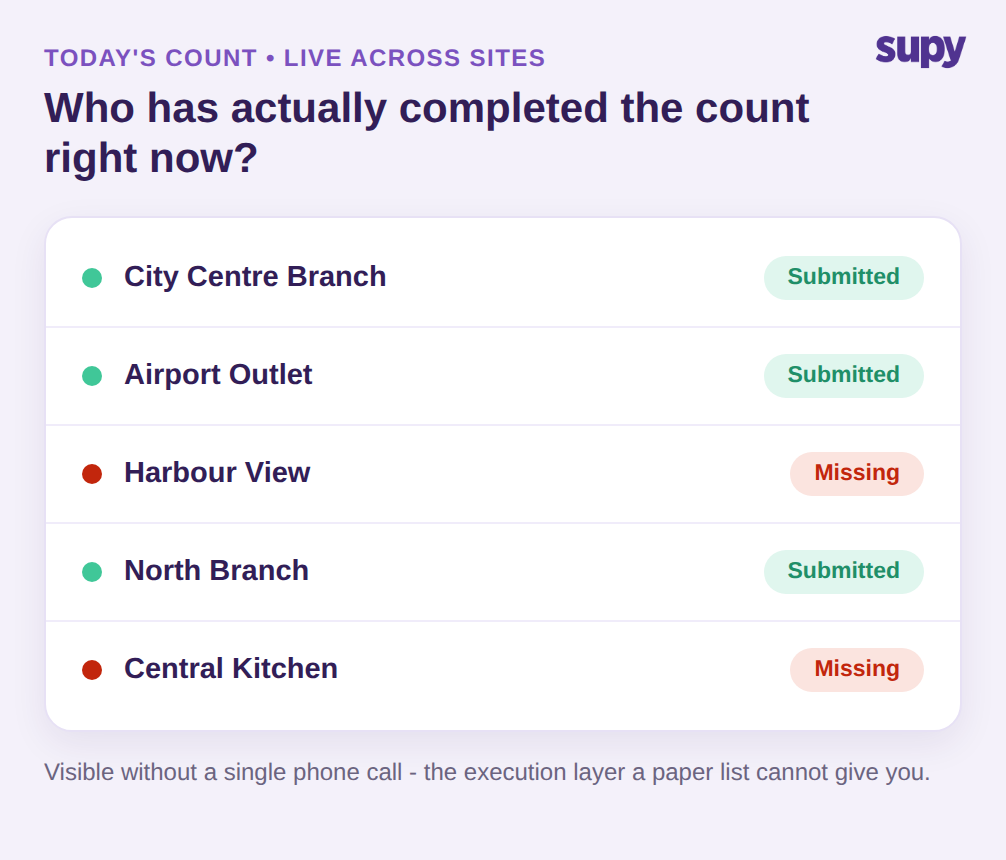
L'inventaire et les niveaux de commande : là où la checklist rencontre les chiffres réels
Deux lignes de la checklist dépendent entièrement de données qu'une feuille papier ne peut pas contenir — c'est précisément pour cela qu'elles échouent si souvent. La première est l'inventaire. Les responsables dans les groupes multi-sites passent régulièrement 5 à 10 heures par semaine à réaliser des inventaires manuels, et les résultats reviennent quand même incorrects, faute de modèle d'ordre de rayonnage et d'erreurs humaines qui s'infiltrent dans chaque feuille. Un inventaire à la fois lent et imprécis n'est pas un contrôle — c'est une corvée qui produit un chiffre auquel personne ne fait confiance.
La deuxième ligne est la vérification des niveaux de commande. Un niveau de commande unique pour tous les sites est le mauvais chiffre pour presque tous. Un site proche d'un quartier d'affaires animé peut avoir besoin d'environ 3 fois le niveau de commande d'un site résidentiel calme pour le même ingrédient, si bien qu'un chiffre uniforme entraîne des commandes excessives sur les sites calmes et des ruptures sur les sites animés. La ligne de checklist « vérifier le stock par rapport au niveau de commande » n'a aucun sens si le niveau de commande n'est pas défini par article et par site. Notre guide sur la gestion des niveaux de commande explique comment établir ces seuils, et le guide sur les benchmarks de fréquence d'inventaire indique à quelle fréquence chaque catégorie doit être comptée.
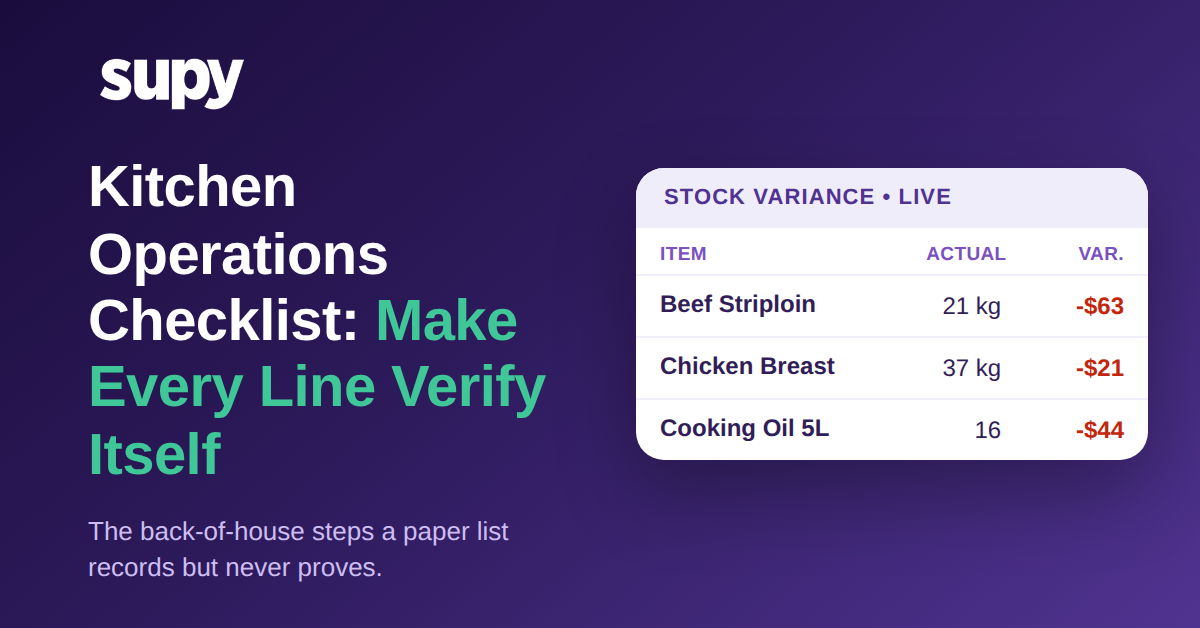
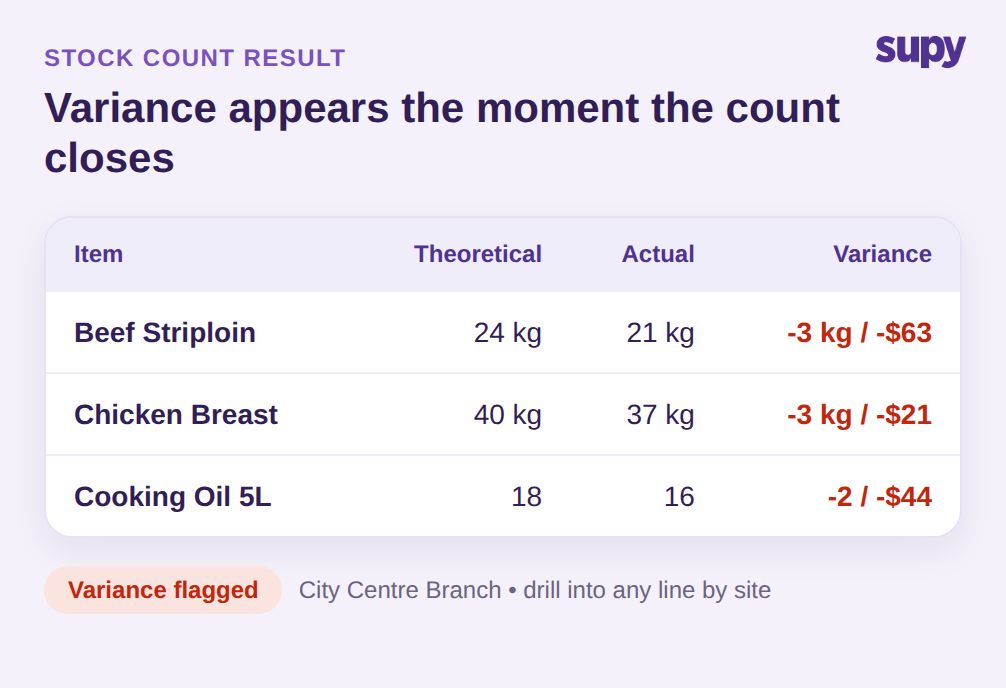
Lorsqu'un inventaire est soumis, le chiffre décisif est l'écart : stock théorique par rapport au stock réellement compté, en quantité et en valeur. Une checklist qui se termine à « inventaire terminé » sans jamais révéler l'écart a sauté la seule partie qui protège la marge. Demandez-vous : combien de temps faut-il, après la réalisation d'un inventaire, pour voir l'écart — et pouvez-vous déterminer quel article, dans quel site, en est la cause ?
Les lignes de préparation et de pertes : des étapes qui ne comptent que si elles sont enregistrées
La préparation et les pertes sont les deux lignes de checklist les plus souvent cochées sans qu'aucun chiffre ne change — et c'est précisément là que l'argent s'échappe. Lorsqu'une recette de préparation ou de désossage est produite (un poisson entier est découpé en filets, une préparation en lot est réalisée pour la semaine), la case cochée dans la checklist ne signifie rien en soi. Si cette production n'est pas enregistrée, calculée et reflétée dans le stock, vos niveaux de stock sont inexacts dès le début de la préparation — et chaque inventaire et commande suivants héritent de l'erreur.
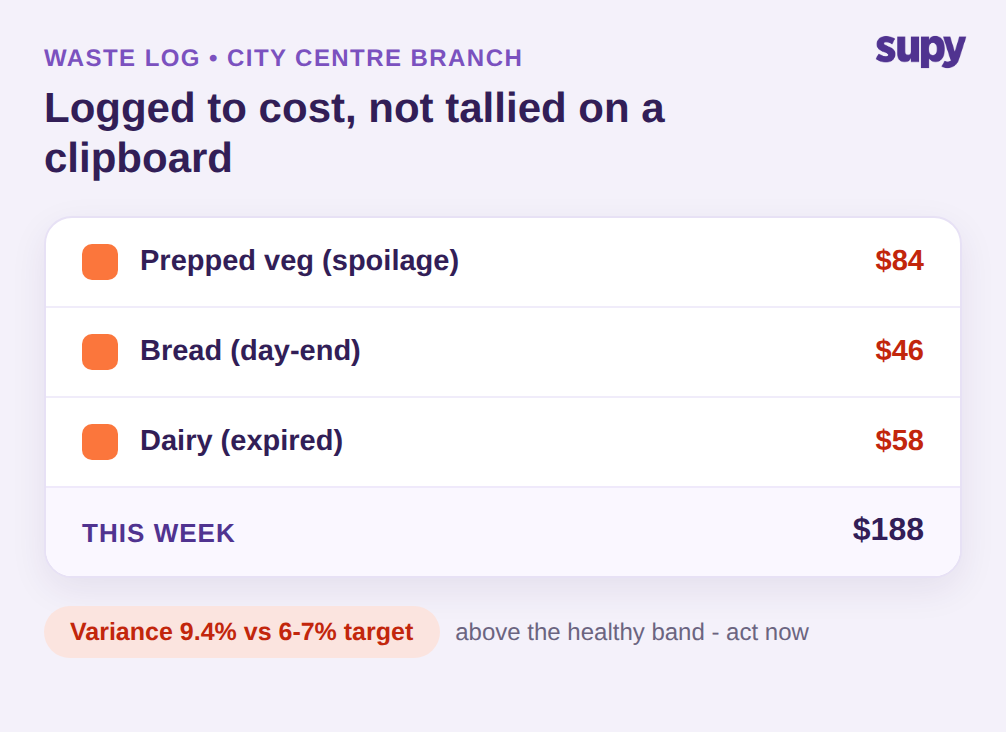
Pour les pertes, c'est identique. Un établissement sain maintient l'écart de gaspillage alimentaire dans une fourchette d'environ 6 à 7 %, et les groupes sans véritable processus de suivi des pertes dérivent bien au-delà. Mais une ligne de checklist indiquant « enregistrer les pertes » ne fonctionne que si chaque entrée comporte un article, une quantité, une raison et une valeur de coût — et réduit le stock. Un journal de contenants sur une planchette vous dit que du gaspillage a eu lieu ; il ne vous dit pas quelle catégorie, quel site ni combien cela a coûté en marge — donc rien ne change la semaine suivante. La méthode complète est présentée dans notre guide sur le suivi du gaspillage alimentaire.
Il existe un effet de second ordre qui rend ces deux lignes particulièrement importantes à corriger en premier. La préparation et les pertes sont le point où les côtés théorique et réel de votre coût matière commencent à diverger. Si la préparation n'est pas intégrée au stock et les pertes ne sont pas déduites, la consommation théorique et la consommation réelle s'écartent — et lorsque vous calculez le coût matière en fin de période, vous ne pouvez plus déterminer si l'écart provient d'un sur-dosage, d'un gaspillage, d'un vol ou simplement d'un mauvais comptage. La ligne de checklist qui semblait la plus simple alimente en réalité votre rapport le plus important.
Le schéma est identique pour ces deux lignes : une étape enregistrée comme donnée devient un contrôle que vous pouvez piloter ; une étape simplement cochée n'est que du théâtre. Pour chaque ligne de préparation et de pertes, posez-vous la question : le fait de compléter cette ligne modifie-t-il mes chiffres de stock et de coûts — ou ne fait-il qu'ajouter une coche ?
Rendre la checklist auto-vérifiante : un système connecté
La solution n'est pas un meilleur classeur. Il s'agit de faire passer les lignes back-of-house du papier à un système où l'exécution d'une étape produit le chiffre que cette étape est censée protéger. C'est là qu'intervient Supy. Sa gestion des stocks est conçue pour que la checklist se vérifie d'elle-même au fur et à mesure que le personnel l'exécute.
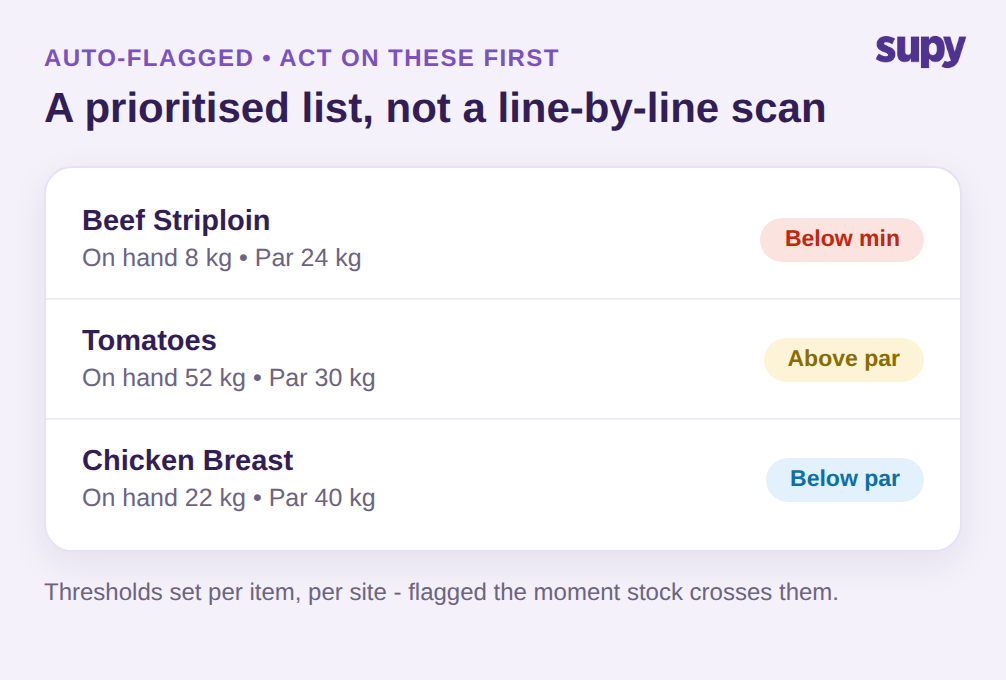
La ligne d'inventaire utilise des modèles de comptage réutilisables dans l'ordre des rayonnages et un comptage en parallèle, permettant à plusieurs personnes de compter simultanément leurs propres sections ; Supy fusionne les résultats avec attribution par personne, et l'écart par rapport au système apparaît au moment où l'inventaire est soumis. Le temps de comptage est ainsi réduit de plus de 50 %, tandis que le résultat devient fiable plutôt que lent. La ligne des niveaux de commande repose sur des niveaux de commande et des minimums définis par article et par site : tout article passant sous son minimum ou dépassant son niveau de commande est automatiquement signalé — le responsable reçoit une liste d'actions prioritaires plutôt que de devoir scanner manuellement chaque ligne.
La ligne de préparation enregistre les productions en lot et les recettes de désossage sur web ou mobile, et chaque production est automatiquement journalisée, calculée et reflétée dans le stock. La ligne de pertes enregistre chaque événement en quelques secondes sur mobile, avec l'article, la quantité et la raison, le déduit du stock et rend compte de l'impact coût par site et par période. Chacune de ces fonctionnalités est une capacité en direct vérifiée par rapport au registre produit de Supy — et chacune transforme une case cochée en résultat opérationnel : un chiffre sur lequel vous pouvez agir à l'échelle des sites, pas une affirmation à laquelle vous devez faire confiance.
Effectuez l'auto-évaluation en quatre points avant de réimprimer quoi que ce soit. Premièrement : pouvez-vous voir quels sites ont terminé l'inventaire du jour sans décrocher le téléphone ? Deuxièmement : chaque site a-t-il son propre niveau de commande par article, ou un seul chiffre est-il appliqué à tous ? Troisièmement : vos entrées de préparation et de pertes modifient-elles réellement vos chiffres de stock et de coûts — ou ne font-elles que s'ajouter à la liste ? Quatrièmement : votre écart de gaspillage se situe-t-il dans la fourchette de 6 à 7 % ? Chaque « Non » ou « seulement une coche » signifie que cette ligne de votre checklist des opérations en cuisine est décorative, pas un contrôle. La première étape est peu coûteuse : choisissez la seule ligne back-of-house qui vous coûte le plus actuellement et faites en sorte qu'elle produise un chiffre vérifiable cette semaine — plutôt qu'une signature.