.jpg)


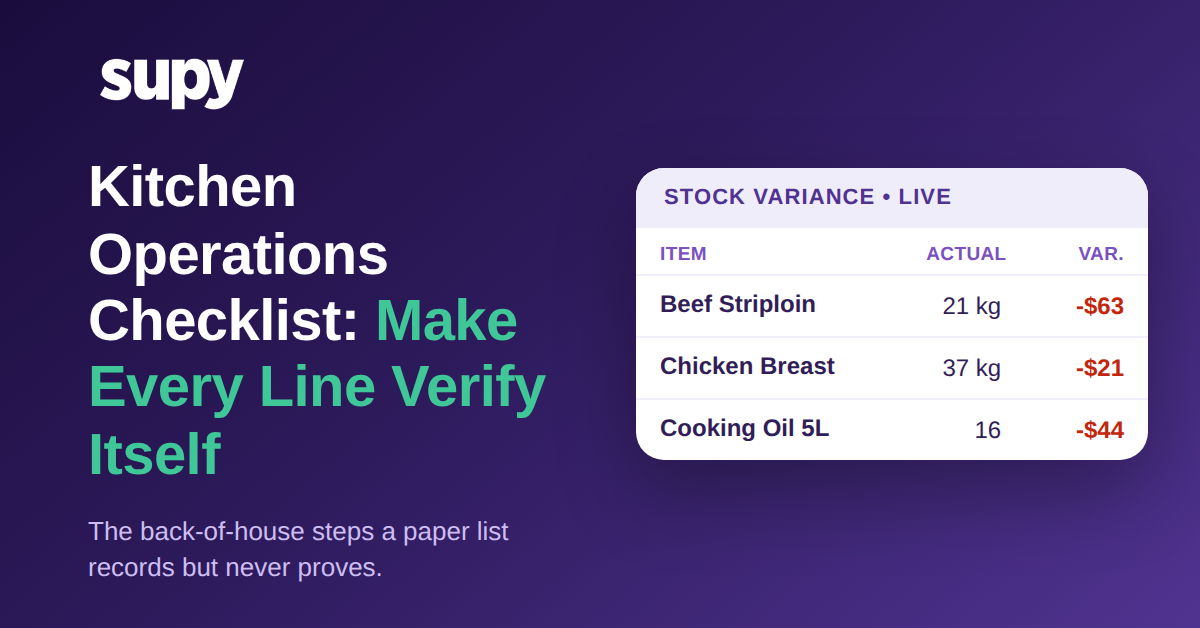
Kitchen Operations Checklist: The Back-of-House Lines a Paper List Never Verifies
What a Kitchen Operations Checklist Really Has to Cover
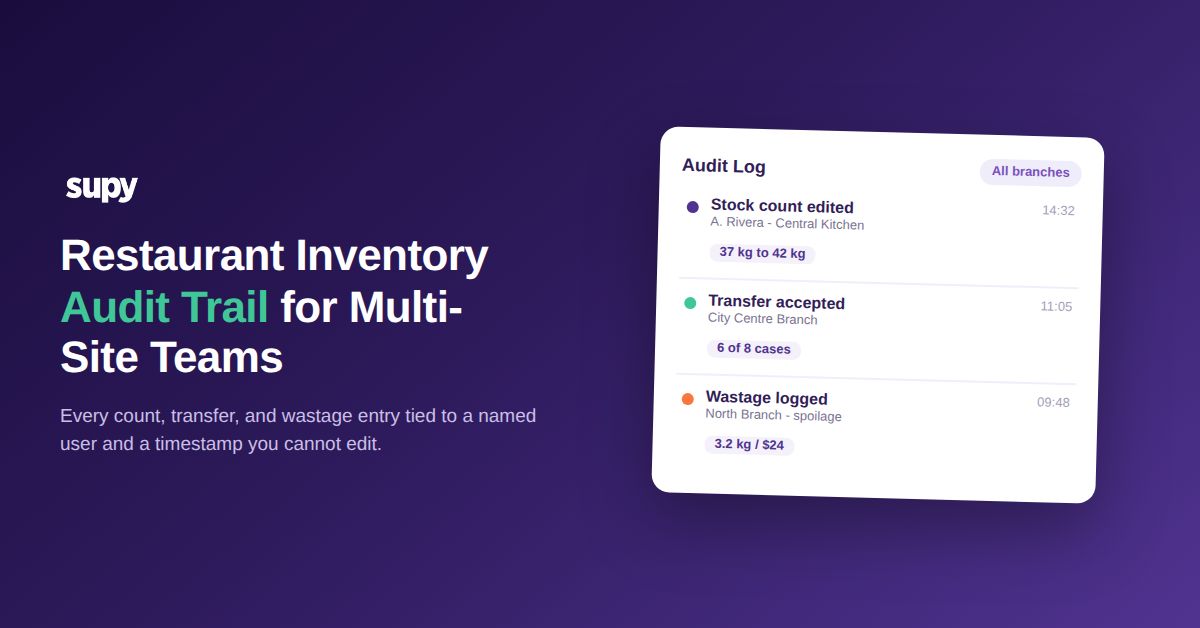
Almost every multi-site group already has a kitchen operations checklist. It is printed, laminated, taped inside a walk-in door, or sitting in a shared drive. The problem is not that the checklist does not exist. The problem is that no one can prove it was actually done today, at every site, to the same standard. A tick on paper is a claim, not evidence.
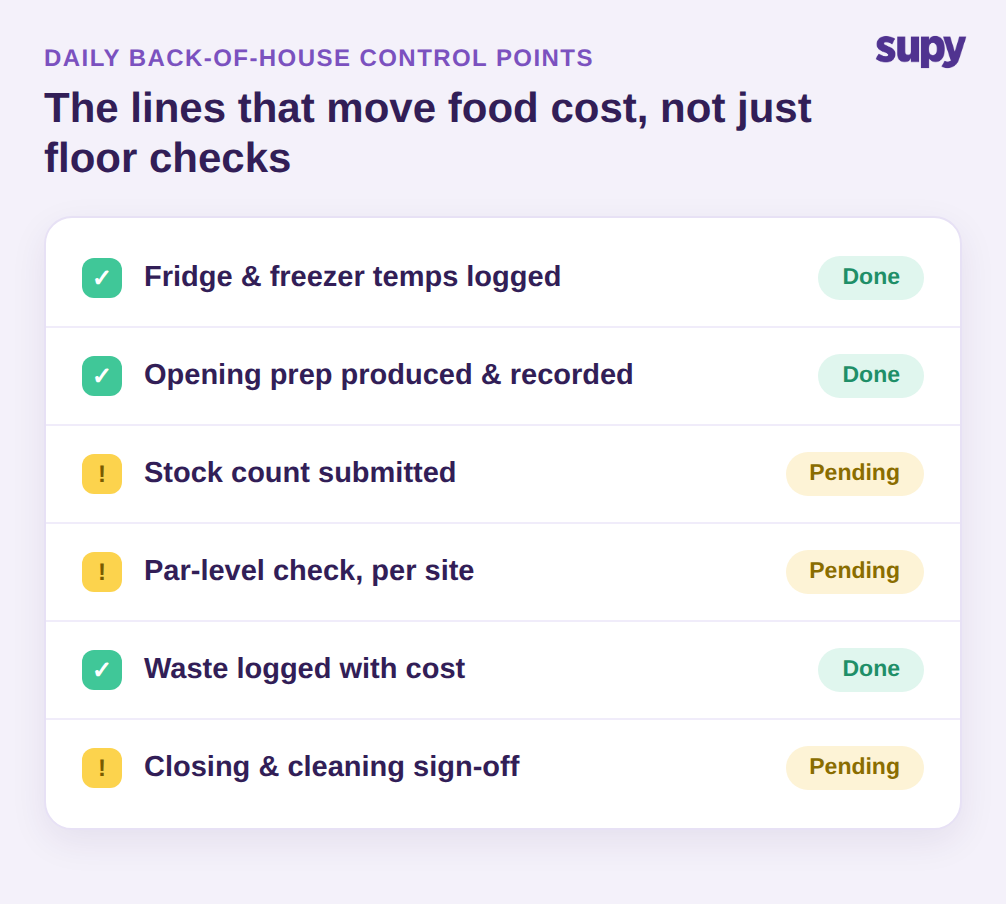
A complete kitchen operations checklist runs from open to close and covers both front and back of house: temperature and food-safety logs, opening prep, mid-service line checks, cleaning, and closing. But the lines that quietly move your food cost are almost all back-of-house control points: the stock count, the par-level check, prep and production, and waste logging. Those are the lines a paper list records but never verifies. For the wider operating model these lines sit inside, see our guide to restaurant operations management.
If you'd rather not work par out by hand, the free par level calculator does it for every item on your sheet from your usage, delivery days and supplier lead times.
The distinction matters because the two halves fail differently. The front-of-house and cleaning lines are largely observable: a manager walking the floor can see whether tables are set or the pass is clean. The back-of-house control points are not observable that way. You cannot tell by looking whether the count was accurate, whether par was respected, or whether waste was really logged. Those lines only exist as data, so on a paper kitchen operations checklist they are the easiest to fake and the most expensive to get wrong. A signed sheet that says "count complete" hides an inaccurate count just as well as it records a good one.
So the useful question is not "do we have a checklist?" It is "which lines on our checklist produce a number we can check, and which are just ticks we hope are true?"
Why Most Kitchen Checklists Fail at the Execution Layer
Multi-site operators report the same failure again and again: the standard exists on paper but breaks down at the execution layer. Procedures live in a manager's office, a binder, or a shared drive and never reach the person on the line during the shift, and there is no mechanism to confirm the standard was met. The gap is between documented and done.
Two forces make it worse across sites. The first is drift. When nothing is enforced centrally, each location slowly builds its own version of the routine, so a prep change or a new menu item issued from head office is not implemented the same way everywhere, and the difference only surfaces during an audit or a complaint. The second is training inconsistency: quality varies by trainer, onboarding is unpredictable, and an improvement an area manager communicates verbally disappears within weeks because nothing links the procedure to a task with proof of completion.
Underneath all of it is tool fragmentation. Scheduling lives in one app, maintenance runs over text, inventory sits on a shared spreadsheet, and the checklist itself is a binder or a PDF. There is no single operational source of truth, and back-of-house procedures are usually the least-connected layer of all. The result is a compounding blind spot: because no one can see completion in real time, problems are only discovered after they have already cost money. A missed count becomes a stockout mid-service; an unlogged waste run becomes an unexplained variance at month end. The checklist was supposed to prevent exactly these, but a paper checklist has no way to raise its hand when a step is skipped.
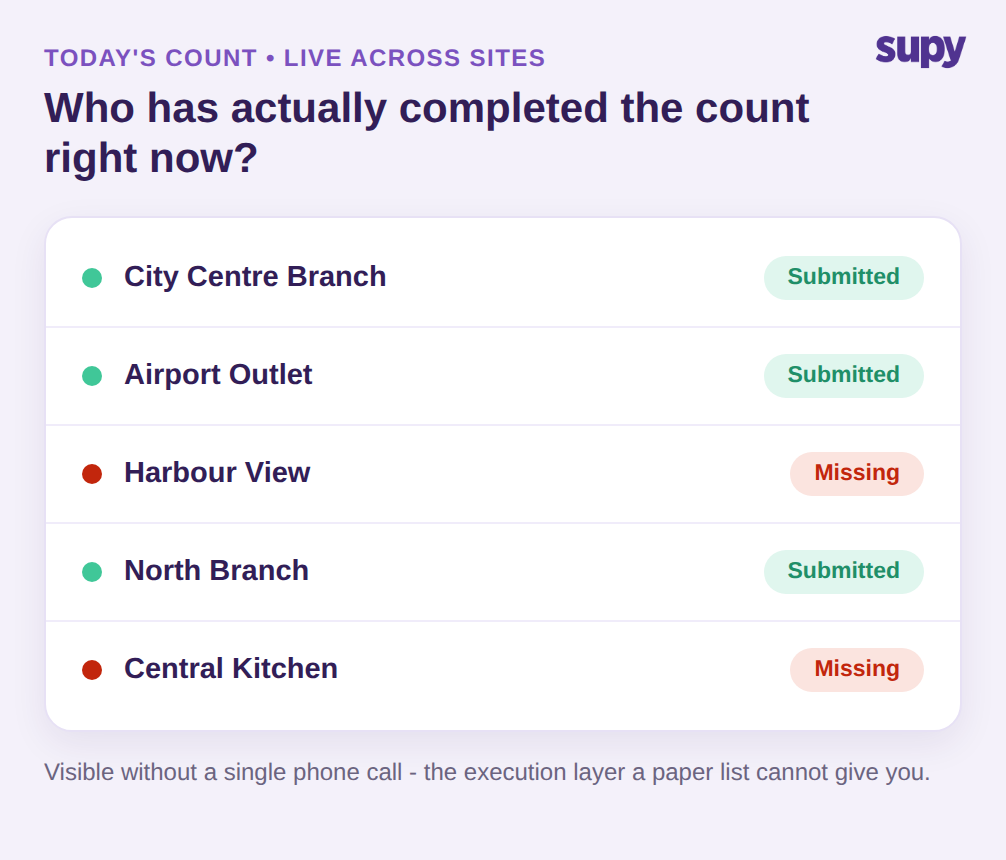
Before you rewrite the checklist, ask a sharper question: can you see, right now, which of your sites completed today's count and which did not, without calling them? If the honest answer is no, the issue is not the wording of the list. It is that the kitchen operations checklist has no execution layer underneath it.
The Stock Count and Par Lines: Where the Checklist Meets Real Numbers
Two lines on the checklist depend entirely on data that paper cannot hold, which is exactly why they fail so often. The first is the stock count. Managers at multi-site groups routinely spend 5-10 hours a week on manual counts, and the counts still come back wrong because there is no shelf-order template and human error creeps in on every sheet. A count that is slow and inaccurate is not a control, it is a chore that produces a number nobody trusts.
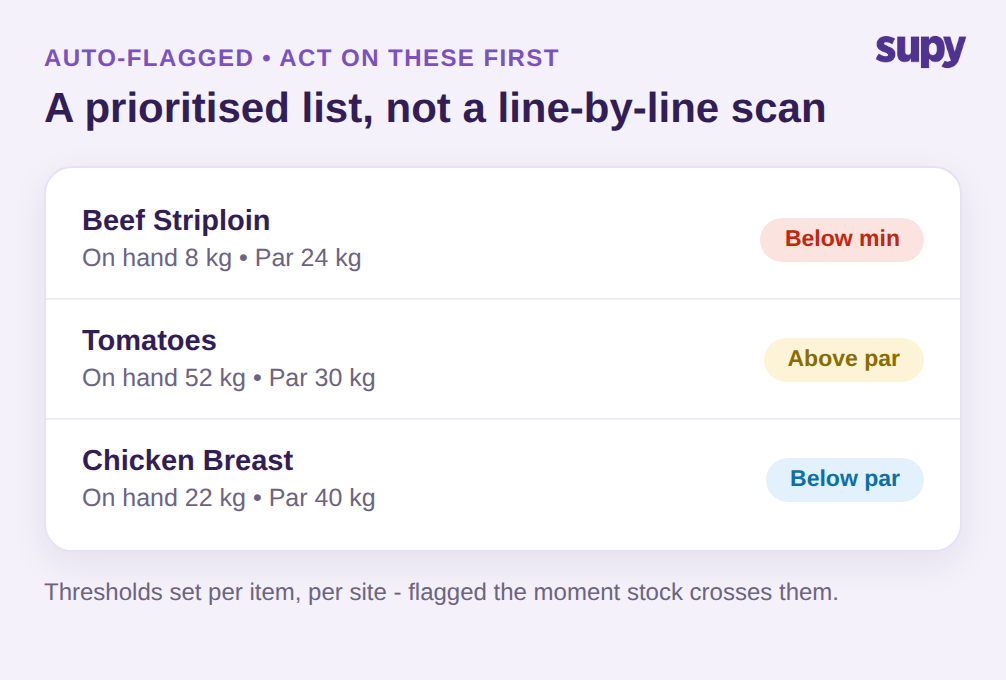
The second is the par-level check. A single par number applied across every site is the wrong number for almost all of them. A location next to a busy business district can need roughly 3x the par stock of a quiet residential site for the same ingredient, so one blanket figure over-orders for the slow sites and stocks out at the busy ones. The checklist line "check stock against par" is meaningless if par itself is not set per item, per site. Our guide to restaurant par level management works through how to set those thresholds, and the stock count frequency benchmarks guide covers how often each category should be counted.
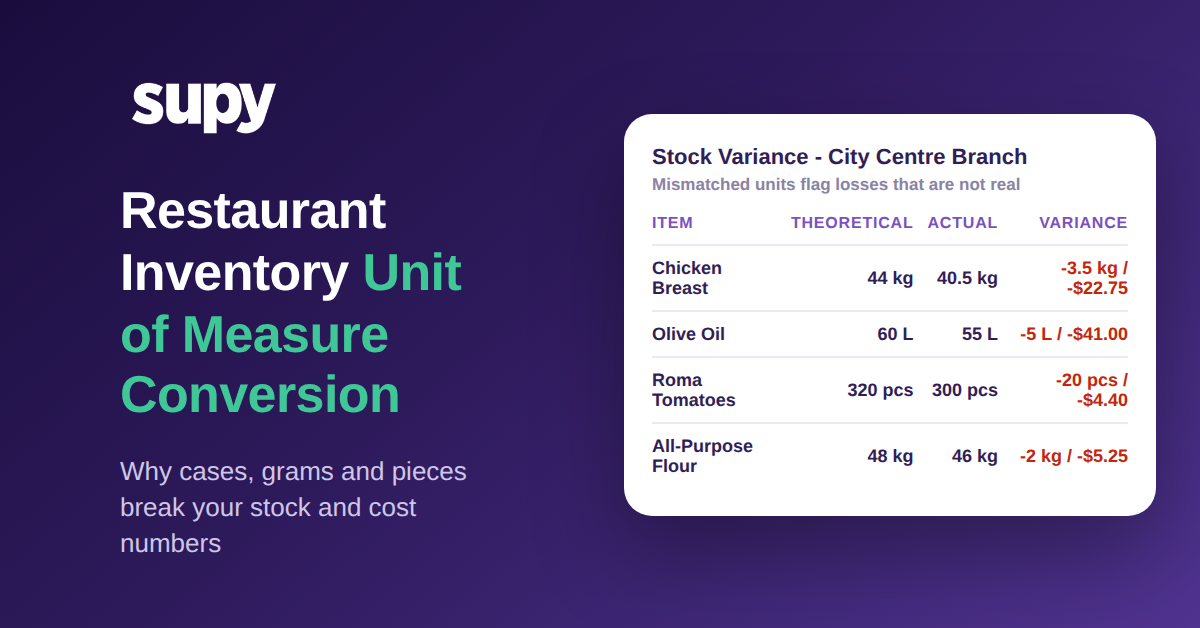
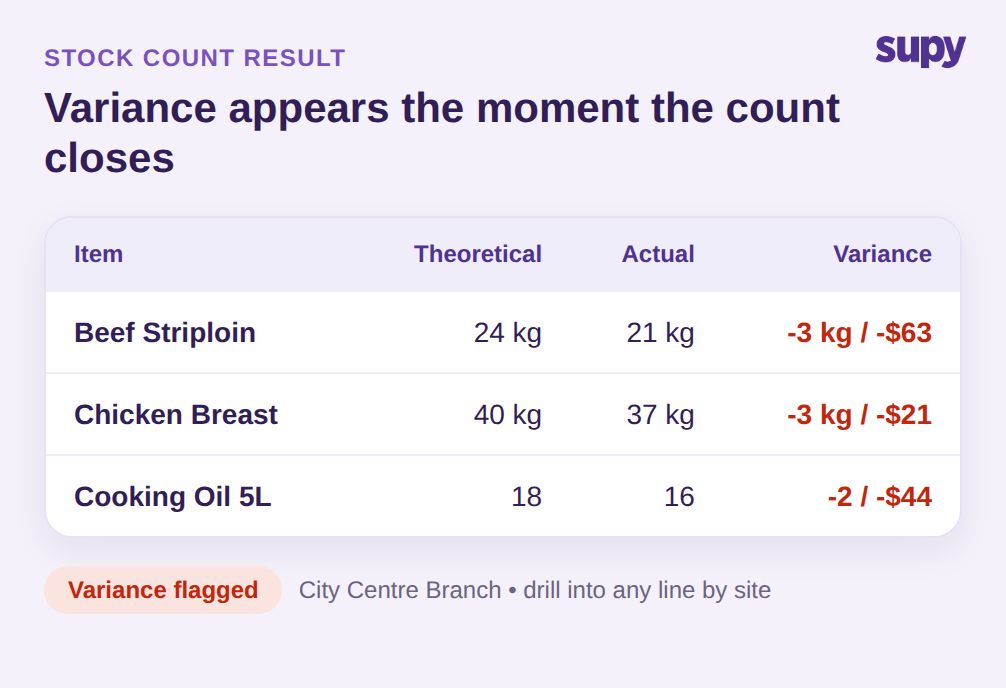
When the count is submitted, the number that matters is variance: theoretical stock against what was actually counted, in both quantity and money. A checklist that ends at "count done" and never surfaces variance has skipped the only part that protects margin. Ask: after a count closes, how long does it take you to see the variance, and can you drill into which item and which site caused it?
The Prep and Waste Lines: Steps That Only Count If They Are Recorded
Prep and waste are the two checklist lines most likely to be ticked without ever changing a number, and that is precisely where money leaks. When a prep or breakdown recipe is produced (a whole fish portioned into fillets, a batch of sauce made for the week) the checklist tick means nothing on its own. If that production run is not logged, costed, and reflected in stock, your on-hand figures are wrong the moment prep starts, and every downstream count and order inherits the error.
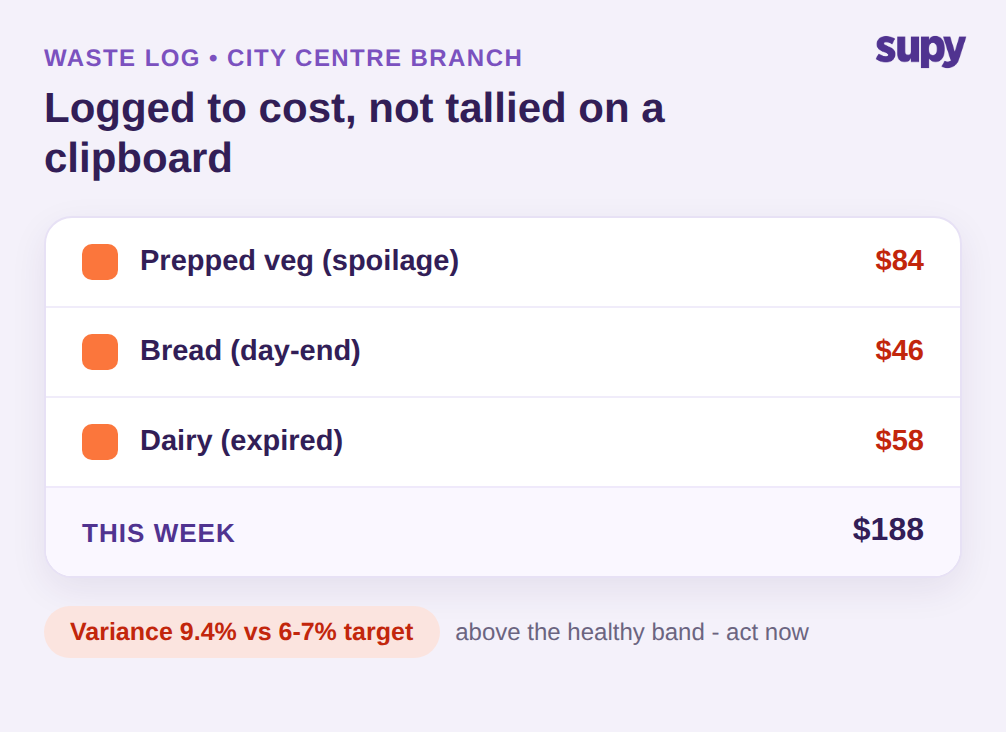
Waste is the same story. A healthy operation keeps food waste variance inside a band of about 6-7%, and groups without a real waste process drift well above it. But a checklist line that says "log waste" only works if each entry carries an item, a quantity, a reason, and a cost, and then reduces stock. A bin tally on a clipboard tells you waste happened; it does not tell you which category, which site, or how much margin it cost, so nothing changes next week. For the full method, see our guide to restaurant food waste tracking.
There is a second-order effect that makes these two lines worth fixing first. Prep and waste are where the theoretical and actual sides of your food cost diverge. If prep is not costed into stock and waste is not deducted from it, your theoretical usage and your actual usage drift apart, and by the time you calculate food cost at period end you cannot tell whether the gap came from over-portioning, spoilage, theft, or simple miscounting. The checklist line that felt like the most junior task on the list is actually the one feeding your most senior report.
The pattern across both lines is identical: a step that is recorded as data becomes a control you can manage; a step that is only ticked is theatre. Ask of every prep and waste line: does completing it change my stock and cost figures, or does it just get a tick?
Making the Checklist Self-Verifying: One Connected System
The fix is not a better binder. It is moving the back-of-house lines off paper and into one system where completing a step produces the number the step was supposed to protect. This is where Supy fits. Its inventory management is built so the checklist verifies itself as staff work through it.
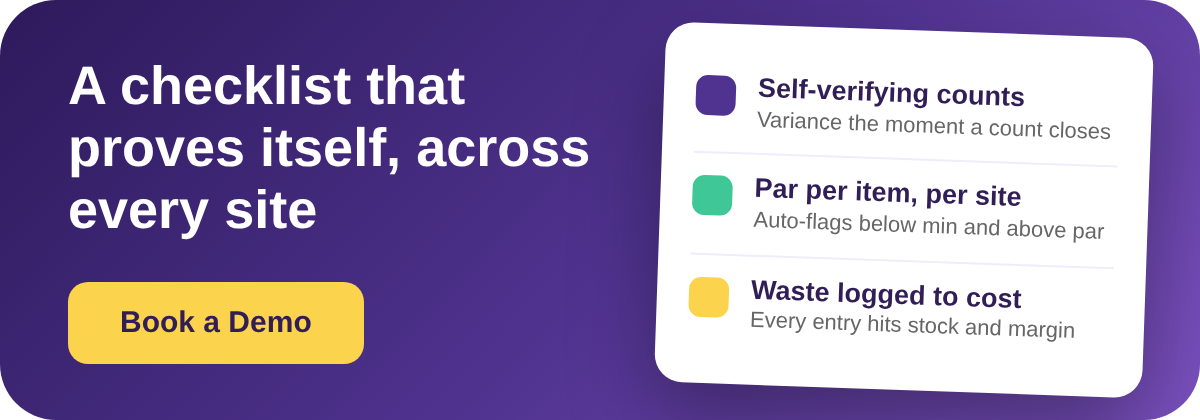
The stock count line uses reusable count templates in shelf order and parallel counting, so several people count their own sections at once, Supy merges the results with per-person attribution, and variance against the system appears the moment the count is submitted. That is how counting time drops by more than 50% while the result becomes trustworthy instead of slower. The par-level line runs on par and minimum thresholds set per item, per site: any item that falls below its minimum or climbs above par is flagged automatically, so the manager gets a prioritised action list instead of scanning every line by hand.
The prep line records batch prep and breakdown-recipe production on web or mobile, and every run is logged, costed, and reflected in stock automatically. The waste line captures each event in seconds on mobile with item, quantity, and reason, deducts it from stock, and reports cost impact by branch and period. Every one of these is a live capability verified against Supy's product record, and each turns a checklist tick into an operator outcome: a number you can act on across sites, not a claim you have to trust.
So run the four-point self-check before you reprint anything. First, can you see which sites finished today's count without picking up the phone? Second, does each site have its own par per item, or is one number stretched across all of them? Third, do your prep and waste entries actually change your stock and cost figures, or do they just get ticked? Fourth, is your waste variance sitting inside the 6-7% band? Any "no" or "just a tick" means that line of your kitchen operations checklist is decorative, not a control. The first move is cheap: pick the single back-of-house line that costs you the most right now, and make it produce a checkable number this week rather than a signature.