.jpg)


Restaurant Stock Count Frequency: How Often Multi-Site Groups Should Count
A multi-location restaurant group's operations director kept hitting the same wall: the figure the system said should be on the shelf and the figure actually on the shelf never matched. The gap was not random. It widened in the days between counts and shrank the moment someone finally counted. So the team stopped treating counting as a monthly chore and started running it daily, weekly, and monthly against different parts of the inventory, with an action plan attached to each level. The variance that had been invisible became something they could see and close.
That is the real question behind restaurant stock count frequency. Not "should we count," but how often each category needs counting before the gap between theoretical and actual stock grows large enough to cost real money. Most operators search for how often should a restaurant do inventory and find advice that treats every item the same and every site the same. The better answer is a category-tiered cadence: count the items that move fast and cost the most far more often than the dry goods that sit still.
This guide lays out that cadence, why a single blanket frequency both wastes time and hides risk, and how multi-site groups make a higher frequency sustainable instead of abandoning it after two weeks.
Why Count Frequency Is a Benchmark, Not a Habit
Counting frequency is usually inherited rather than decided. A group counts monthly because it always counted monthly, or it counts "when there is time," which in a busy kitchen means rarely. One restaurant group's head of operations ran no formal inventory system at all: stock counts happened on an ad hoc basis, with no structured purchase order approval behind them either. The counting was not wrong when it happened. The problem was the silence between counts.
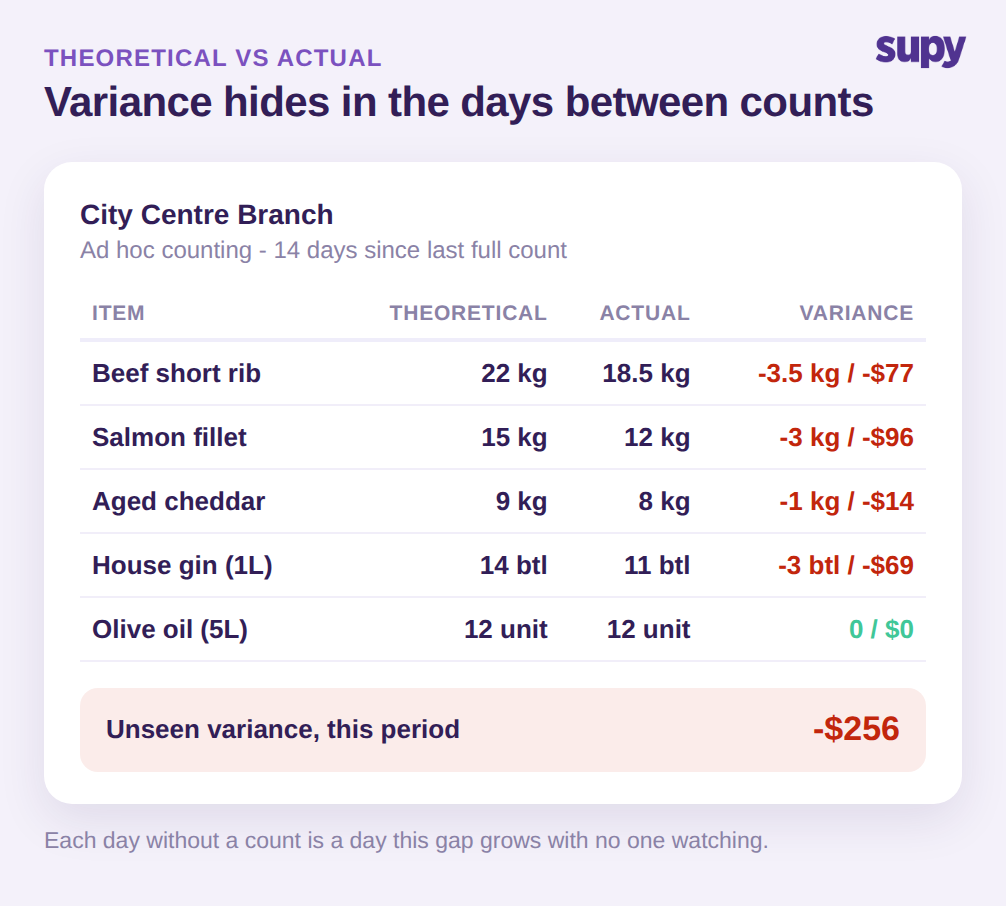
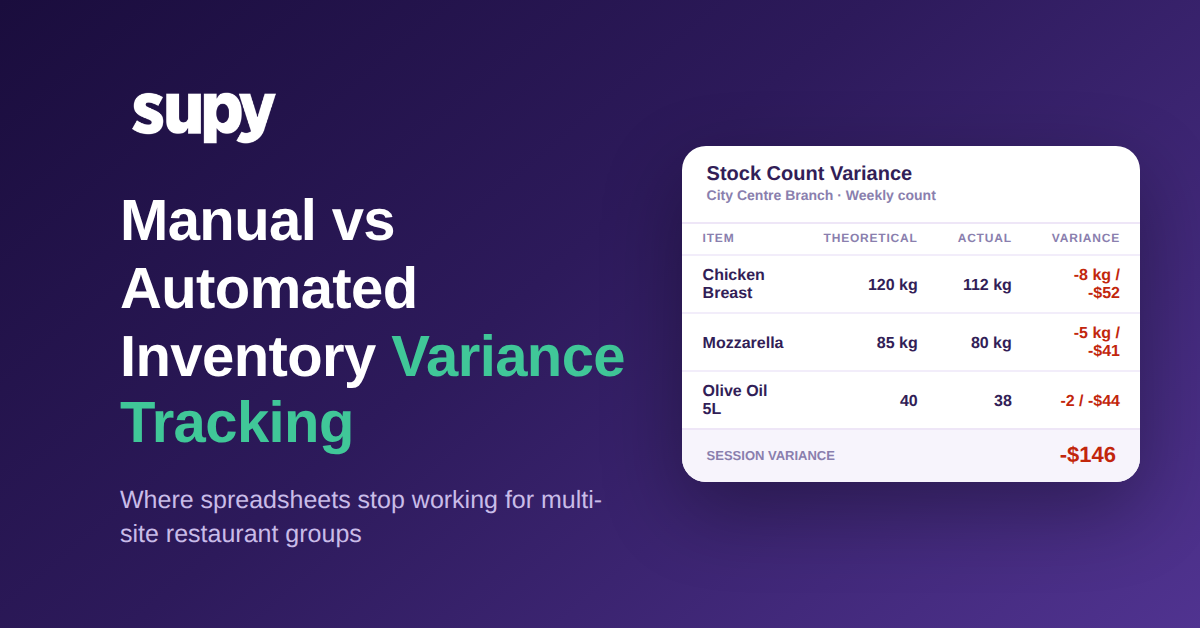
Theoretical stock is what your system expects to be on hand after sales, deliveries, transfers, and recipe usage. Actual stock is what a person physically finds. The difference is variance, and variance is where theft, over-portioning, spoilage, miskeyed deliveries, and recipe drift all hide. Every day you do not count is a day variance accumulates with no one watching. By the time a monthly count surfaces a shortfall, the cause is weeks old and the trail has gone cold. You can see the number but you can no longer act on it.
That is why frequency behaves like a benchmark, not a personal habit. The interval between counts sets a ceiling on how much undetected variance you are willing to carry. A single-site restaurant's operations manager named stock counting, reconciliation, and overall inventory visibility as the core problems driving a software search, which tells you this is the operator's felt pain, not a vendor talking point. The right frequency is the one that keeps accumulated variance small enough to investigate while the cause is still fresh.
Before you set a cadence, ask: for each category, how much variance in dollars are we comfortable letting build before someone counts and acts on it?
A Category-Tiered Count Cadence: Daily, Weekly, Monthly
The operations director who fixed the theoretical-versus-actual gap did not count everything every day. That would be impossible. The team counted by tier, matching the count interval to how fast an item moves and how much its variance costs.
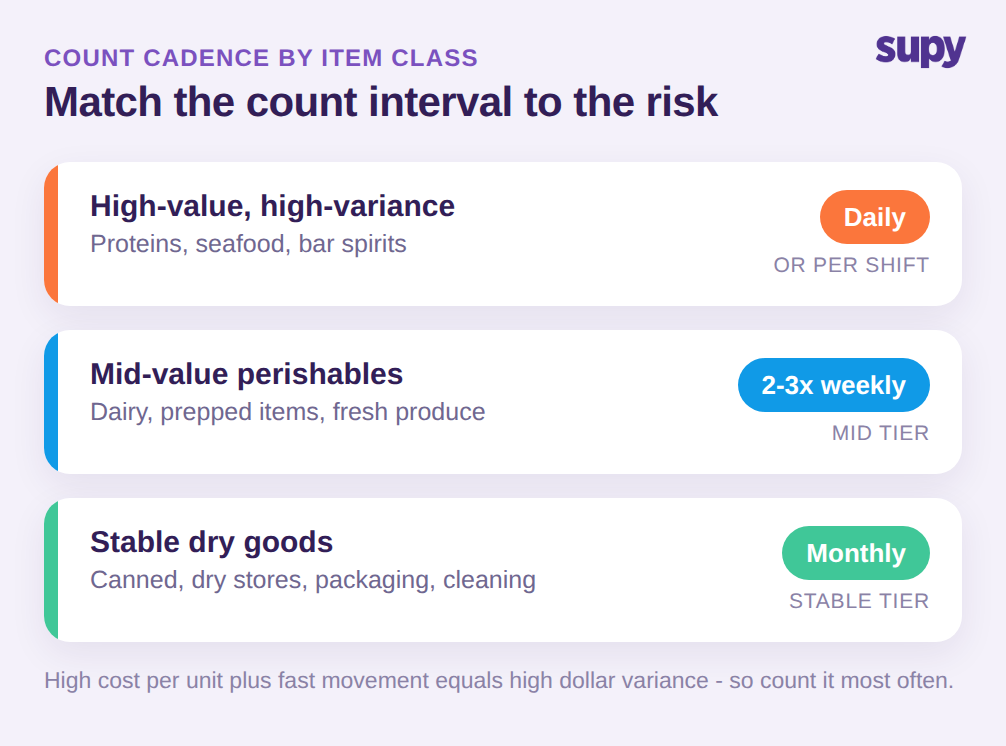
High-value, high-variance items belong at the top tier: proteins, seafood, and bar spirits. These move every service, spoil quickly, are easy to over-portion, and carry the highest cost per unit, so a small percentage variance is a large dollar variance. Count these daily or once per shift. Mid-value perishables, such as dairy, prepped items, and fresh produce, sit in the middle tier and earn a count two to three times a week. Stable dry goods, including canned stock, dry stores, packaging, and cleaning supplies, change slowly and rarely surprise anyone. A monthly count is enough.
This tiering is what turns frequency from a guess into a benchmark you can defend. A bottle of premium spirit that walks out of one branch is a far bigger problem, far faster, than a slow drift in flour. The cadence should reflect that. It also makes the workload realistic: counting a short list of high-value items daily takes minutes, while the long tail of dry goods only needs attention once a month.
The same tiers should apply identically across every location, so a regional manager can compare branches on equal terms. When one site counts proteins daily and another counts them "sometimes," the variance numbers are not comparable and a problem branch hides in the average.
When you build your tiers, ask: which items, if their variance went unseen for a month, would cost us the most, and are those exactly the items we count most often?
Why One Blanket Frequency Wastes Hours and Hides Risk
The most common counting mistake is not counting too little. It is counting everything at one frequency. A single blanket cadence fails in both directions at once.
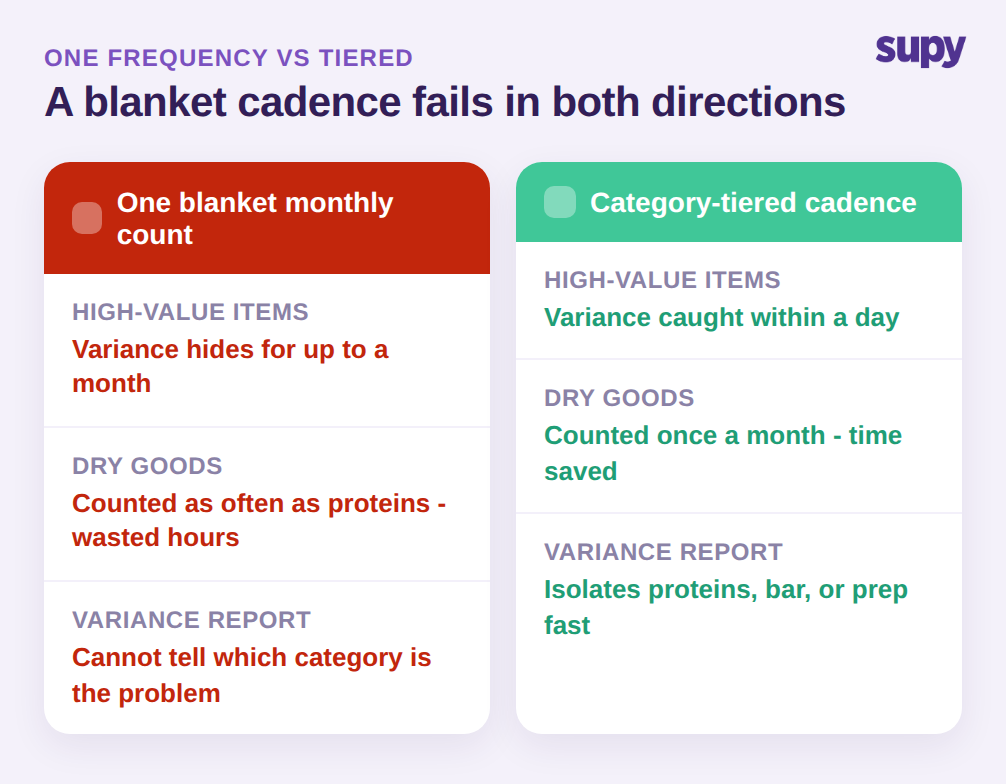
Set that one frequency low, say a monthly full count, and your highest-risk items go unwatched for up to a month. A protein variance that started on day two is not caught until day thirty, long after the shift, the delivery, or the portioning habit that caused it. Set the blanket frequency high instead, counting everything weekly or daily, and you spend the same effort on shelf-stable cleaning supplies as on fresh seafood. A four-location group's owner who handled all inventory, weekly counts, goods receipt, and cost calculations by hand described exactly this trap: the routine was slow and hard to sustain, because uniform effort was being spent on items that did not need it.
A blanket cadence also flattens the signal. When every category is counted on the same day at the same interval, the variance report cannot tell you whether your problem is concentrated in proteins, in the bar, or in prep. A tiered cadence separates the noise. Daily protein counts isolate protein variance fast; monthly dry-goods counts confirm the stable categories are still stable without burning daily labor on them.
The fix is to stop asking "how often should we count" as one question and start asking it per category. The goods that cost the most and move the fastest set their own pace; the stable goods set a much slower one.
Ask of your current process: are we spending the same counting time on dry goods as on proteins, and is that why the cadence keeps slipping?
Why a Higher Cadence Stalls, and How to Make It Stick
Most groups know they should count high-value items more often. The cadence stalls anyway, and the reason is almost always the method, not the intent. The four-location owner counting in custom spreadsheets could not sustain frequent counts because every count meant rebuilding the list, walking the storeroom out of order, and reconciling by hand afterward. When a single count is that much work, a daily count is a fantasy, so the group quietly drops back to whatever it can manage, which is less than it should.
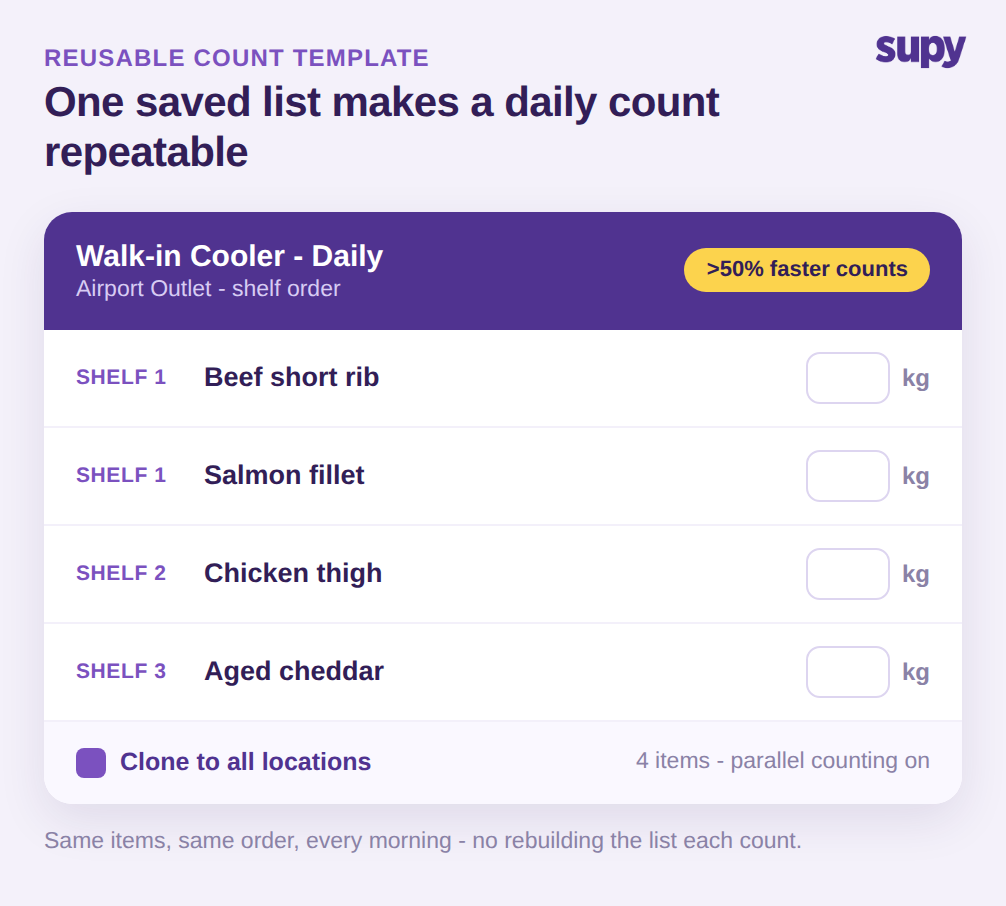
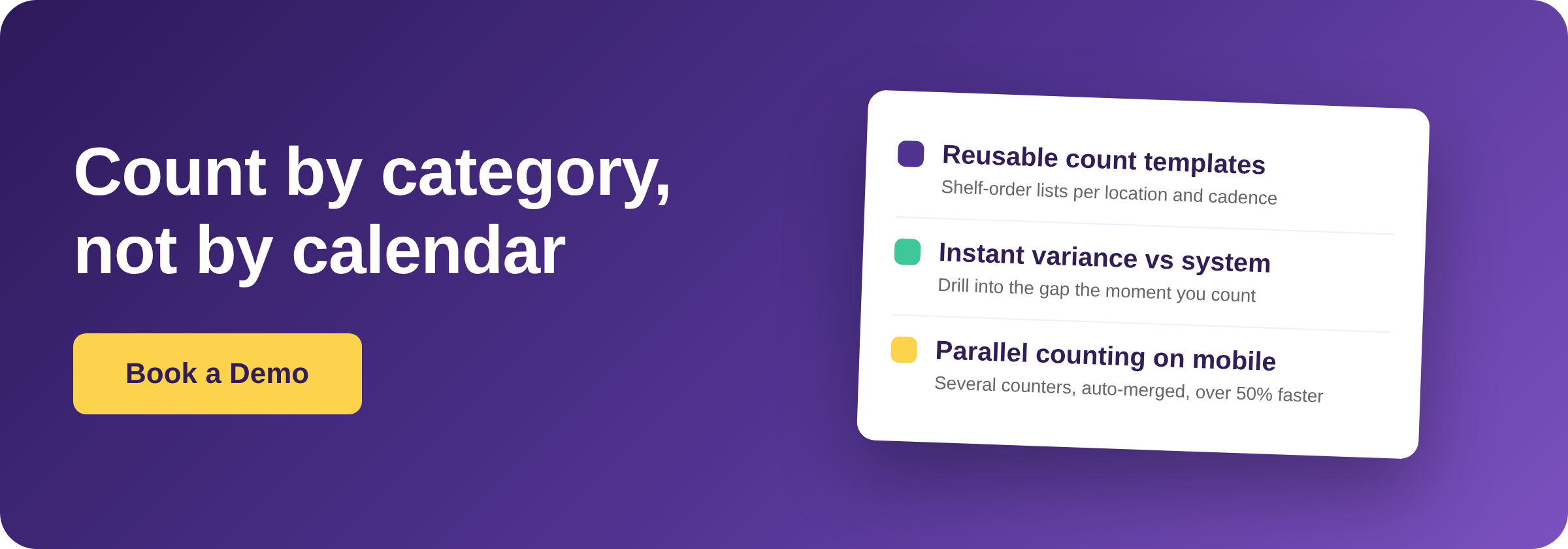
A higher cadence only sticks when each count is fast and identical every time. The mechanism operators use is a reusable count template: a saved list that defines exactly which items and recipes to count, in shelf order, for a given location and a given cadence. A "walk-in cooler, daily" template counts the same proteins in the same order every morning; a separate monthly template covers the dry store. Because the list is saved, no one rebuilds it, and because it follows shelf order, the count walks the room in one pass.
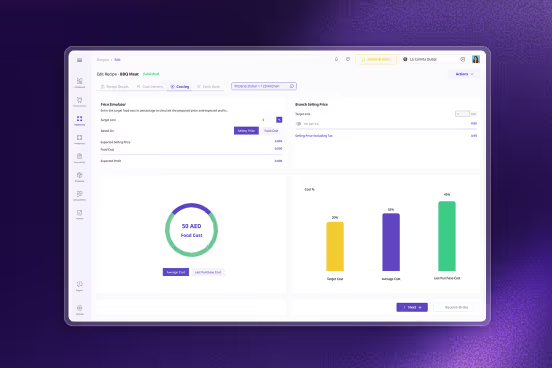
This is where Supy fits. Supy's stock counting gives multi-site groups reusable custom count templates in shelf order, parallel counting where several people count at once and entries auto-merge with attribution, and instant variance against the system with drill-down, all on mobile or tablet even in low-connectivity storerooms, with a stated time reduction of more than 50 percent per count. Templates clone across sites, so every branch counts the same items in the same format and the results are comparable. Supy's live stock visibility then holds the other half: real-time stock on hand by location and category, with theoretical-versus-actual usage updating automatically from goods receipts and recipe usage, so the variance a count surfaces is already explained. Together they make a daily high-value count a few-minute task rather than a project, which is the only way a higher frequency survives a busy week.
Before you commit to a cadence, ask the practical question: can our current method run a five-minute daily count in shelf order at every branch, or are we relying on willpower to do something the tools make slow?
Where Your Cadence Should Be, and the First Move If It Is Not
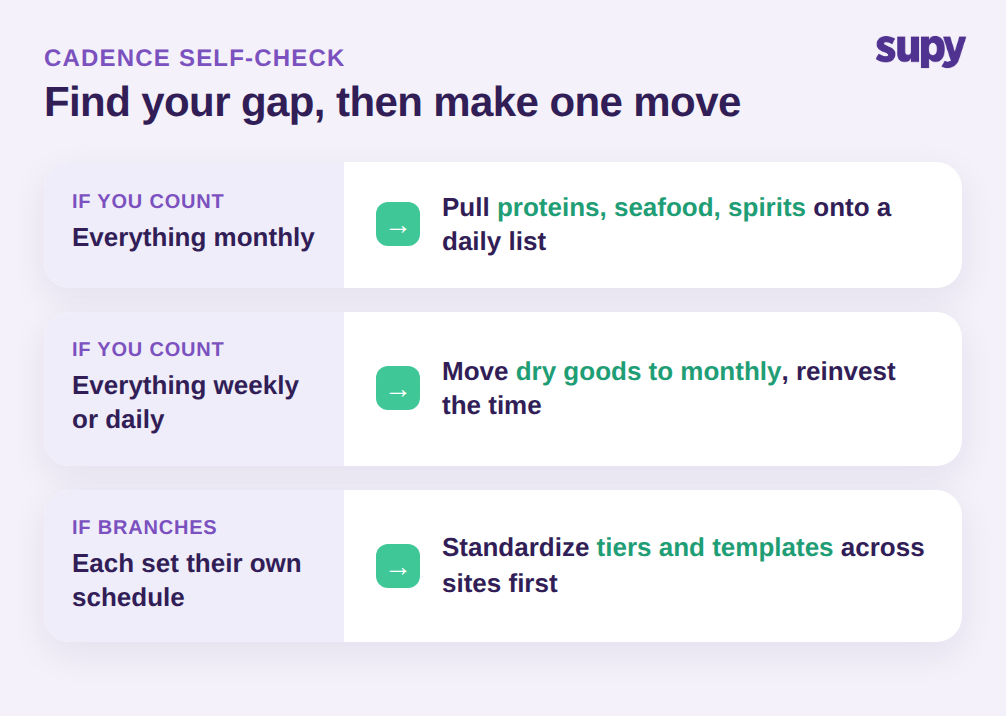
Run a quick self-check against the tiered benchmark. If you count everything monthly, your high-value items are carrying up to a month of unseen variance, and that is the first thing to fix: pull proteins, seafood, and spirits out of the monthly count and put them on a daily or per-shift list. If you count everything weekly or daily, you are spending labor you do not have on dry goods, so move canned stock, packaging, and cleaning to monthly and reinvest that time in the high-value tier. If your branches each count on their own schedule, standardize the tiers and the templates first, because comparable numbers matter more than any single branch's diligence.
The benchmark is not a fixed number of counts per week. It is a rule: count each category often enough that the dollar value of variance you let accumulate stays small enough to investigate while the cause is still fresh. Match the cadence to the risk, make each count fast enough to repeat, and the gap between what your system says and what is on the shelf stops being a monthly surprise.