.jpeg)

Allocation des coûts par recette de décomposition : pourquoi les cuisines centrales chiffrent mal leurs co-produits à partir d'une seule matière première

Pourquoi un coût moyen unique masque vos meilleurs et vos pires co-produits
L'allocation des coûts par recette de décomposition est la méthode qui permet à une cuisine de répartir le coût d'achat d'une matière première entre les plusieurs produits qu'elle génère, de sorte qu'une pièce de choix, une parure secondaire et un sous-produit de faible valeur supportent chacun une part équitable du coût, au lieu de partager une même moyenne identique. Bien appliquée, elle transforme une matière première pesée en plusieurs produits correctement tarifés sur lesquels vous pouvez réellement prendre des décisions de marge.
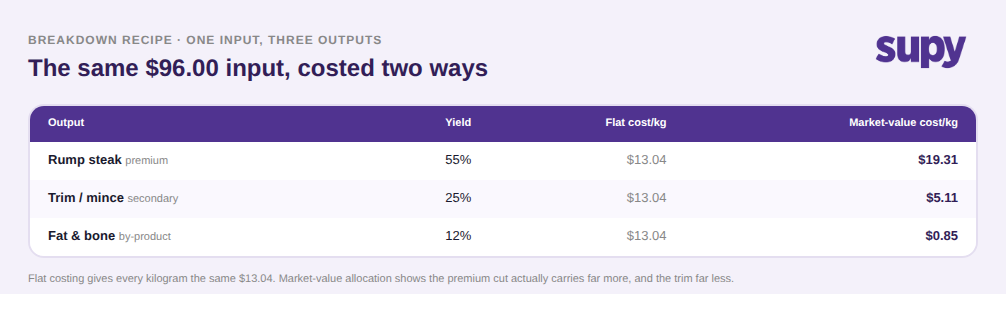
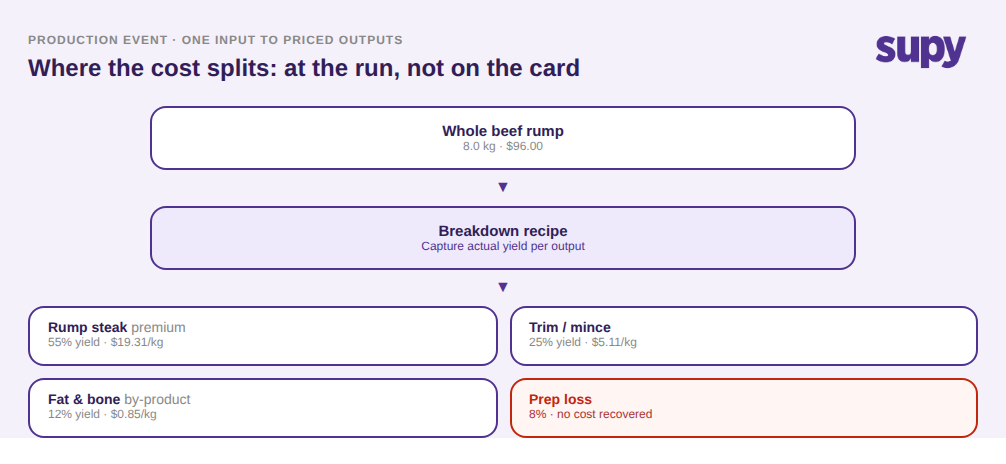
La plupart des cuisines centrales construites sur des tableurs n'y arrivent jamais. Lorsqu'une matière à 12,00 $ le kg est décomposée, la feuille de calcul prend le coût total et le répartit uniformément entre tous les produits obtenus. Achetez un rumsteck entier de 8,0 kg à 96,00 $, décomposez-le en un steak premium, une parure et de la graisse et des os, et chaque kilogramme repart avec le même 13,04 $. La pièce de choix et les parures semblent identiques sur le rapport de marge — or c'est précisément la seule chose dont vous êtes certain qu'elle est fausse.
Allouez ces 96,00 $ selon la valeur marchande de chaque produit et le tableau se clarifie. Le steak premium absorbe 19,31 $ le kg, la parure 5,11 $, le sous-produit 0,85 $. La moyenne uniforme sous-évaluait votre meilleur produit de 6,27 $ le kilo et surévaluait la parure de 7,93 $. Ainsi, les décisions de carte prises sur cette base — quel plat mettre en avant, lequel retarifé, lequel supprimer — lisaient tous les chiffres à l'envers.
Là où le rendement théorique et le rendement réel de production divergent
Même un coût correctement alloué n'est honnête que si le rendement sur lequel il repose l'est aussi. Une fiche recette indique un rendement théorique ; le morceau sur l'établi ce jour-là fait autre chose. Fixez le rendement de la pièce de choix à 55 % et le food cost paraît propre — jusqu'à ce qu'une production revienne à 48 % parce que la matière de ce jour-là contenait plus de gras et de tendons.
Cet écart de 7 points n'est pas une erreur d'arrondi. Sur une matière de 8,0 kg, un rendement de 55 % suppose 4,4 kg de produit de choix, et 48 % en livre 3,84 kg. Les 0,56 kg de différence représentent du produit sur lequel votre coût était calculé, mais qui n'a jamais quitté le bloc. Chaque chiffre en aval — le coût à l'assiette, le bénéfice brut, la quantité à réapprovisionner — hérite de l'erreur. C'est exactement le cas où le coût de rendement des recettes doit passer d'un champ statique sur une fiche à une donnée capturée lors de la production réelle, car le seul rendement qui coûte quelque chose est celui que vous avez vraiment obtenu. Une cuisine centrale qui surveille également le food cost théorique par rapport au food cost réel au niveau du site peut voir la même divergence remonter dans le rapport d'écart plutôt que de se cacher à l'intérieur d'une seule recette.

L'article de préparation à fort volume que personne n'a jamais réellement chiffré
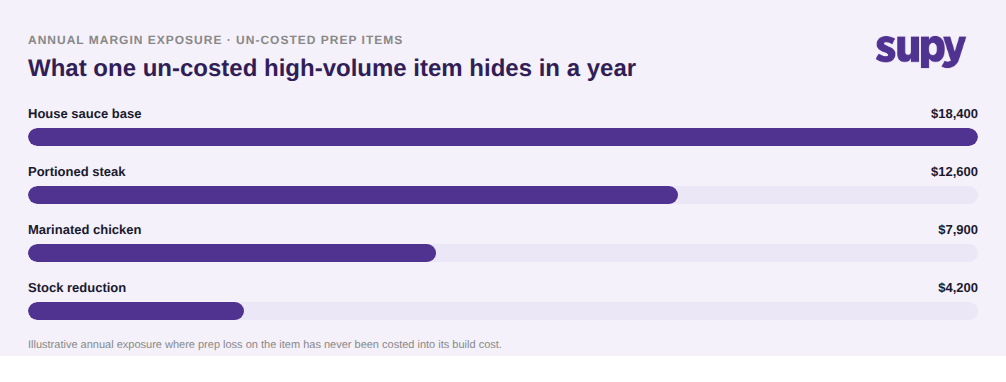
Le produit qui pèse le plus est souvent celui qui se vend le plus. Un article de préparation à fort volume — une base de sauce, une protéine portionnée, une marinade — se vend des milliers de fois par semaine, et son prix de vente est connu au centime près. Son coût de fabrication réel — ingrédients plus pertes de préparation — n'est souvent jamais calculé. La tarification et la marge de l'article générant le plus grand volume sont effectivement fixées à l'aveugle.
L'exposition est proportionnelle au volume. Une base de sauce maison dont les pertes de préparation n'ont jamais été chiffrées peut discrètement porter 18 400 $ de risque annuel sur la marge à elle seule ; un steak portionné 12 600 $ ; une préparation de poulet mariné 7 900 $ ; une réduction de fond 4 200 $. Aucun de ces articles n'est exotique. Ce sont les produits de préparation du quotidien qu'une cuisine centrale produit en grande quantité, et le coût de se tromper sur leur coût de fabrication s'accumule à chaque lot. Bien maîtriser les rendements des recettes de préparation et le suivi de production par lot sur ces quelques articles, c'est là que se concentre la marge récupérable la plus importante.
Comment le coût se répartit entre les produits lors de l'événement de production
La solution est structurelle, pas une après-midi plus laborieuse avec la calculatrice. Une matière première pesée entre dans une recette de décomposition. Chaque produit est défini avec son propre rendement et ses propres pertes de préparation, de sorte que la parure est un produit de préparation stockable à part entière, et non la même matière première enregistrée deux fois. Lors de l'événement de production, le système capture ce qui a réellement été produit par rapport aux prévisions de la recette, et le coût de la matière première est alloué à chaque produit selon la méthode d'allocation choisie, plutôt qu'être réparti uniformément.
C'est là que la matière brute et le produit fini se séparent enfin. Lorsqu'une cuisine centrale conserve les matières premières et les co-produits finis dans une même vue de stock mixte, les cycles de production ne peuvent pas être planifiés ou comptabilisés proprement, et chaque inventaire hérite de la confusion. Modéliser chaque produit comme sa propre recette de préparation, avec son propre rendement, sépare cette vue : les matières premières d'un côté, les co-produits finis de l'autre, chacun compté et chiffré selon ses propres critères. Dans Supy, les recettes de préparation et les sous-recettes sont configurées avec des rendements, un rétrécissement et des pertes de préparation et suivies via la production par lot, et le coût des recettes et des préparations comporte un coût cible avec une alerte lorsqu'une production s'en écarte, de sorte que l'écart entre le prévu et le réel apparaît à l'établi plutôt qu'en fin de mois.
Choisir une méthode d'allocation : valeur marchande, crédit primaire ou poids
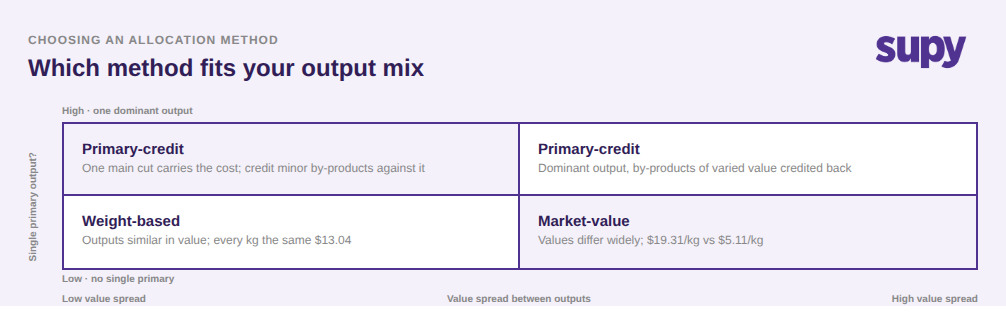
Il n'existe pas une seule manière correcte de répartir le coût d'une matière première ; il existe une manière correcte pour un mix de produits donné. Trois méthodes couvrent presque tous les cas, et la bonne dépend de la relation entre les produits.
L'allocation basée sur le poids attribue le même coût à chaque kilogramme. C'est juste et simple lorsque les produits sont réellement similaires en valeur, et incorrect dès qu'ils ne le sont pas — ce qui correspond au piège de la moyenne uniforme de la première section. L'allocation à la valeur marchande répartit le coût proportionnellement à ce que chaque produit vaut, de sorte qu'un co-produit premium supporte plus du coût que la parure ; utilisez-la lorsque les produits diffèrent largement en valeur et qu'aucun ne domine clairement. L'allocation par crédit primaire traite un produit comme le produit principal et crédite la valeur des sous-produits mineurs sur son coût ; utilisez-la lorsqu'un seul produit est l'objet de toute la décomposition et que les autres sont véritablement secondaires. Choisissez la méthode une fois par décomposition, appliquez-la de façon cohérente, et le coût par produit cesse d'être une question d'opinion.
Quelle que soit la méthode choisie, maintenez la devise et les règles de chiffrage stables sur chaque site, afin que le même article de préparation ne soit jamais chiffré de deux façons différentes dans deux établissements.
Vérifiez si cela se produit dans votre cuisine
Prenez votre article de préparation à plus fort volume et examinez ses produits. Si chaque produit issu d'une matière première supporte le même coût par kilogramme, vous êtes sur un chiffrage uniforme et vos produits premium sont mal tarifés d'environ l'écart que vous venez de voir entre 13,04 $ et 19,31 $. La première étape n'est pas une nouvelle formule de tableur. C'est de consigner les rendements réels d'une vraie production par rapport aux rendements théoriques de la recette ; l'écart — du même type que 55 % tombant à 48 % — est votre premier chiffre honnête. Décidez ensuite, pour cet article, si ses produits appellent une allocation par poids, par valeur marchande ou par crédit primaire, et appliquez-la. C'est dans cet article unique que se cache généralement la marge récupérable la plus importante.
Supy donne aux équipes de cuisine centrale le coût des recettes et des préparations, le suivi de la production par lot et la visibilité théorique/réel pour appliquer le chiffrage des co-produits de cette façon sur chaque site. Découvrez où dérivent vos coûts de co-produits.