.jpg)


Prep Recipe Yields and Batch Production Tracking: Where Multi-Site Food Cost Leaks Between Purchase and Plate
The Prep Stage Nobody Counts, and What It Costs
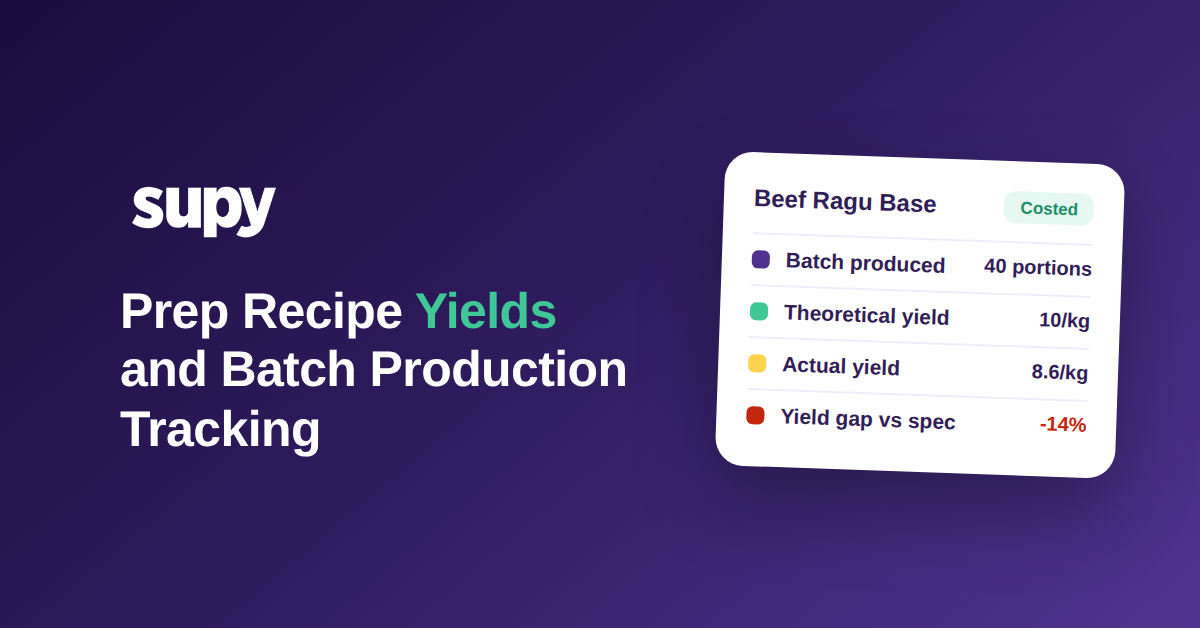
The prep stage is every step between a raw ingredient arriving and a sellable item existing: trimming, portioning, cooking down, batching. It has its own cost, its own yields and its own waste, and in most groups none of it is measured. Costing stops at the finished plate, so the loss between the invoice and the semi-finished item stays invisible. A prep-heavy multi-site group can leak on the order of $38,000 a year to yield drift and prep wastage that no report ever attributes, because the numbers only exist in a chef's head.
Supy closes that gap by costing recipes at the production stage, per location and per date, using average cost or last purchase price, so the food cost percentage reflects the real cost of production at each site rather than a group-level average. The first move is to accept that the prep stage is a cost centre, not a black box. Once every semi-finished item is a costed recipe, the leak stops being folklore and becomes a number you can see, compare between sites, and manage. A group that does this finds its biggest surprises are rarely the expensive proteins everyone watches; they are the high-volume prep items nobody thought to cost.
Why Theoretical Yields and Real Kitchen Yields Never Match
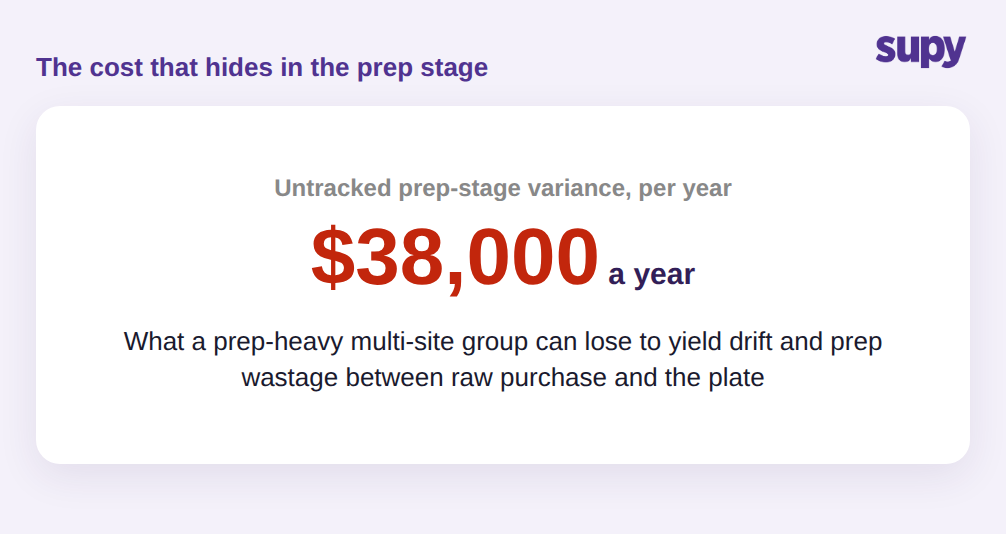
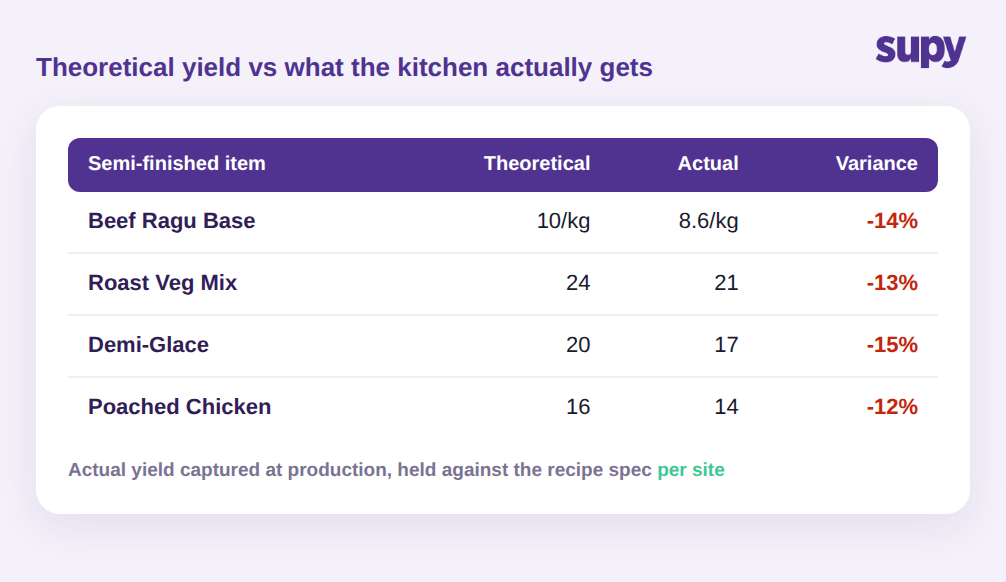
A recipe says one kilogram of trimmed beef gives 10 portions. The kitchen gets 8.6. That 14% gap is not a mistake, it is normal variation from how a given team trims, how a cut behaves on a given day, and how a cook portions under pressure. The problem is that a theoretical yield sitting in a spreadsheet never learns. When operators produce from a recipe, they need to record the actual quantity used and produced during production, not just the theoretical figure, so real consumption can be compared against the recipe spec. Without that, every downstream cost is built on a yield the kitchen has not hit in months.
Supy captures the actual quantity at the point of production, so theoretical and actual yield sit side by side for every semi-finished item. Across a group, that comparison is where the pattern shows up: one site holding recipe yield while another runs consistently short is a training and portioning signal, not a rounding error. The same theoretical-versus-actual discipline that groups already apply to finished food cost variance now runs one stage earlier, on the prep itself, before the cost has a chance to compound into the plate.
Semi-Finished Goods That Show No Inventory Value
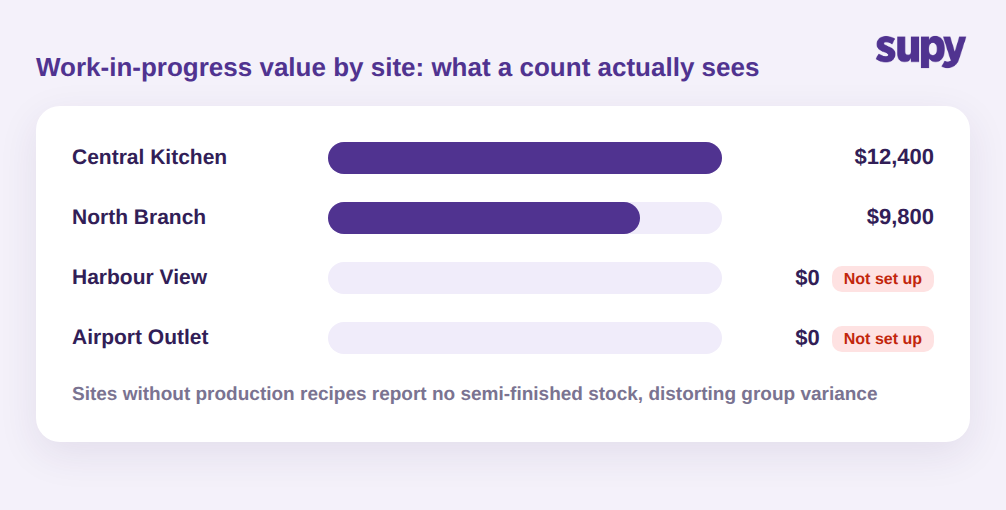
Ask most systems what a batch of prepared sauce or a tray of portioned protein is worth and they return nothing. Work-in-progress items are invisible because the raw material has been consumed but no finished product has been sold, so the value falls into a gap. One multi-site group's head chef flagged exactly this: when batch and production recipes are not set up, production events cannot convert raw materials into semi-finished goods, and those items show zero inventory value. A site that preps heavily can be carrying real money in trays and containers that the stock report simply does not see.
That matters most across a group, where some sites have production configured and others do not. The sites without it under-report their true stock on hand at every count, which quietly distorts variance, ordering and valuation for the whole group, and makes two otherwise-identical branches look nothing alike on paper. Setting up production recipes so semi-finished stock carries its real value is the fix, and it is a configuration decision, not a software limitation. Once it is in place, a count reflects everything the kitchen is actually holding, raw and semi-finished alike.
How Prep Wastage and Shrinkage Quietly Inflate Plate Cost
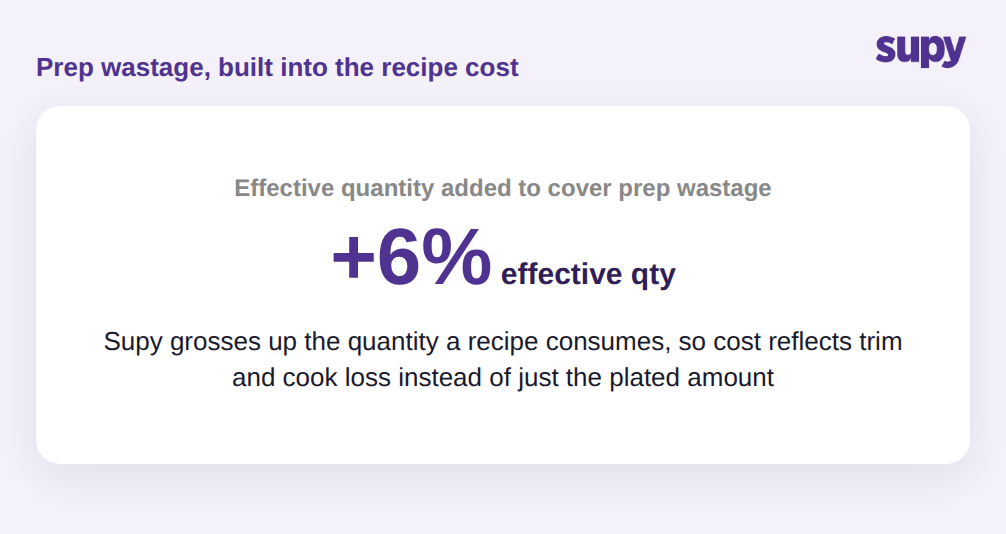
Every recipe consumes more than it appears to. Trim, peel, evaporation and handling loss mean the effective quantity used is higher than the quantity that lands on the plate. If the cost is calculated on the plated amount alone, the recipe is under-costed and the margin looks better than it is. Supy grosses up the effective quantity to cover prep wastage, so a recipe carrying, say, 6% prep wastage is costed on what the kitchen actually consumes, with yield percentage and wastage both factored into the per-location cost. The figure excludes tax, so the food cost percentage is calculated on the net ingredient price.
The practical effect is that shrinkage stops being an end-of-month surprise and becomes a line in the recipe cost itself. A group can compare the same recipe across sites and see where prep wastage is running high, which is usually a training or portioning issue wearing the costume of a cost problem. Fixing it at one site and watching the recipe cost fall is far more convincing to a head chef than a spreadsheet lecture about waste.
Log a Batch Once, and Watch Stock and Cost Update Themselves
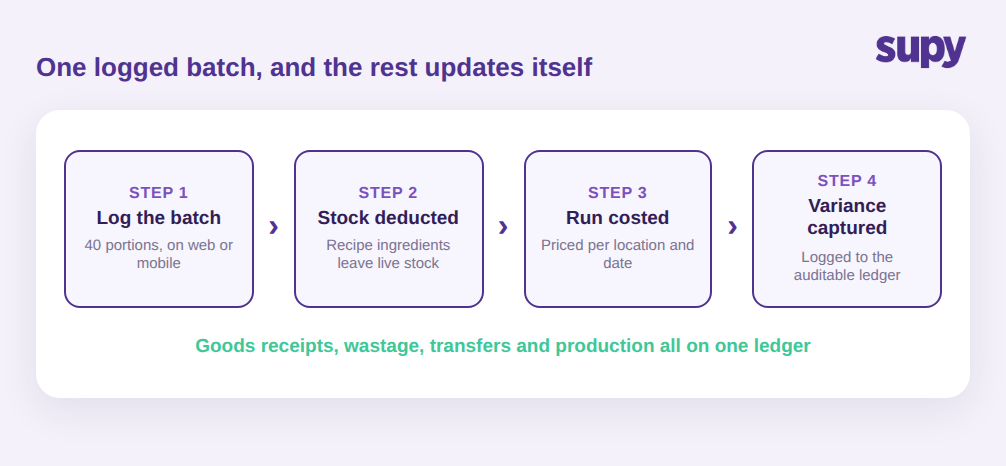
The reason prep tracking gets skipped is friction: nobody wants to key production into a second system after a long shift. Supy removes that by letting kitchen teams log a batch production event on web or mobile, with eligible prep recipes searchable by location and date. Log a batch of 40 portions of a semi-finished sauce and Supy deducts the correct ingredient quantities from live stock at that location, costs the run, and reflects it in stock levels automatically. Every production run lands on the same auditable ledger as goods receipts, wastage and transfers, so a month-end query can show exactly how stock at any site changed and why.
For groups running semi-finished prep recipes, Supy also tracks production quantities automatically when negative inventory is detected, capturing the variance without a separate manual entry from the team. That is the difference between a system that asks the kitchen to do more admin and one that turns a single tap into accurate stock, cost and variance across every site. The lower the friction, the more consistently the data gets captured, and consistency is what makes the cross-site comparison trustworthy in the first place.
One Raw Ingredient, Several Products: Getting Breakdown Yields Right
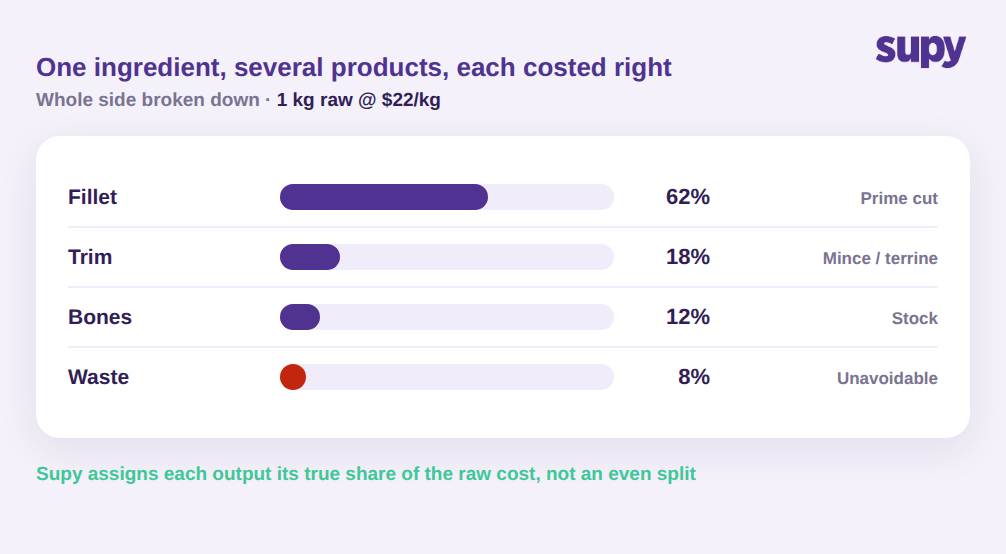
The hardest prep to cost is the one that produces more than one thing. Break down a whole fish and you get a fillet, usable trim, bones for stock and unavoidable waste, each worth a different amount per kilogram. Split the $22-per-kilogram raw cost evenly and every downstream dish is mispriced. Supy supports breakdown recipes, where one raw ingredient is portioned into multiple co-products and by-products: you set a yield percentage for each output, for example 62% fillet, 18% trim, 12% bones and 8% waste, and Supy assigns the correct share of cost to every product automatically. The prime cut carries its true premium and the secondary products carry theirs, so the sellable items built from them are costed honestly.
For a central kitchen supplying several branches, this is what keeps transfer costs and downstream plate costs accurate when a single delivery becomes a dozen different line items. It closes the last gap in recipe and prep costing, the point where one purchase turns into many and an even split would quietly overcharge the cheap dishes and undercharge the expensive ones.
Prep-stage cost accuracy is not a feature you switch on once; it is a habit built on three checks you can run this week. First, pick your highest-volume semi-finished item and ask whether anyone can state its actual yield against its recipe yield. If not, that item is under-costed today. Second, run a stock count and see whether your prep-heavy sites show any work-in-progress value at all. A site reporting no semi-finished stock is a site with production recipes missing. Third, take one raw ingredient you break down into several products and check that each output carries its own cost, not an even split. Fix those three and the leak between purchase and plate stops being a mystery and starts being a managed number, at every site.