Inventory
Food cost

Restaurant POS Voids: Why They Skew Your Waste and Variance
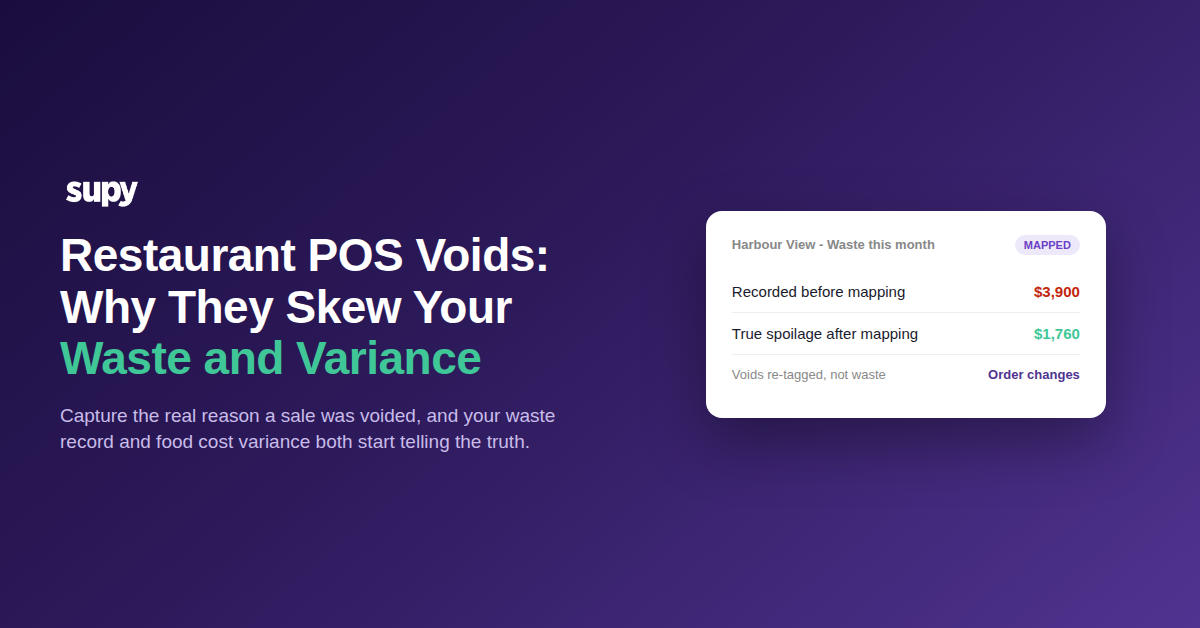
Restaurant POS voids inflating a waste record and food cost variance

Why a Voided Sale Shows Up as Real Waste

When a cashier voids or cancels a POS sale and the reason never reaches inventory, the system does the only thing it can: it treats the whole transaction as waste and deducts the ingredients from stock. Map each void to its real reason first, and voided orders become accurate waste records instead of phantom loss, so your food cost variance finally reflects what actually happened.

A multi-site pubs and bars group hit this head on. Void reasons from their POS never passed through to inventory, so every void landed as waste regardless of the real cause, including an order changed before the kitchen had even started prep, which is not waste at all. The same operator later worked an AUD 28,000 gap between theoretical and actual cost at one venue down to three causes: SKU mismatches, outdated recipes, and a stock count where a 300 kg quantity had been keyed wrong. Voided sales quietly inflating the waste figure sat right alongside those problems, distorting the number before anyone had counted a single shelf.
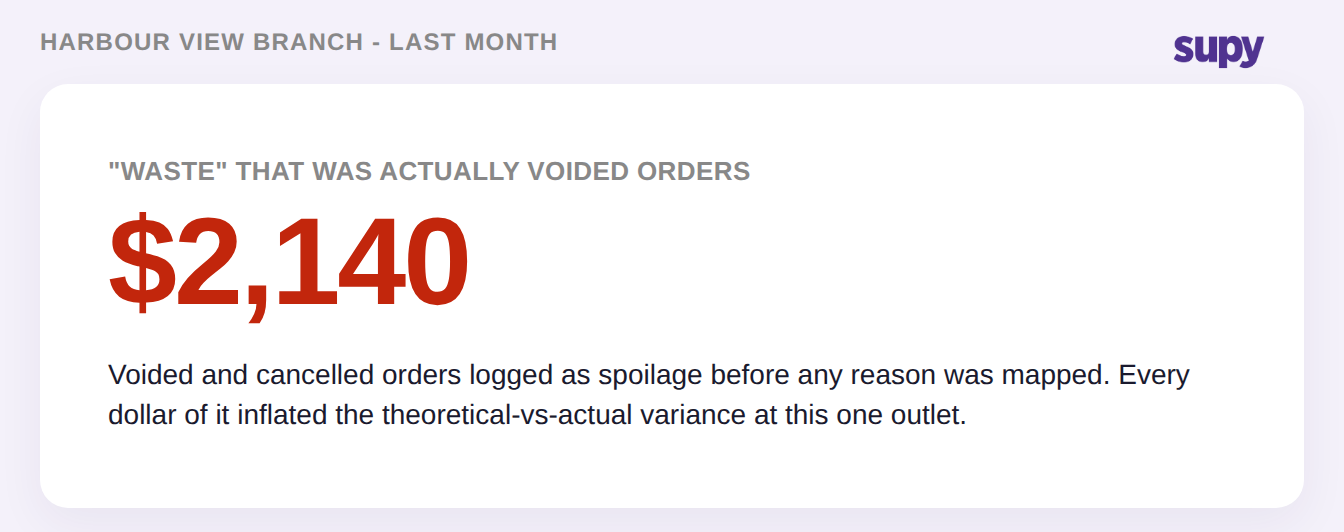
Stat callout showing 2,140 dollars of recorded waste at one outlet that was actually voided orders


Where Voids Break the Theoretical-vs-Actual Number

Most food cost advice assumes the variance figure is already trustworthy and jumps straight to counting stock. In practice the number is usually wrong on the sales side first. The point of sale reads gross while the profit-and-loss statement works on net, some POS items are never mapped to a recipe, and voids and cancellations get counted differently on each side of the reconciliation. In a multi-brand restaurant group's monthly POS-to-inventory reconciliation, void and cancelled transactions counted differently on each side was one of the recurring reasons revenue and usage never matched, outlet after outlet.

That makes voids a data-integrity problem, not a rounding error. Every unmapped void adds phantom usage that no shelf count will ever explain, because the loss never happened in the store room. Before you audit a single shelf, the sales boundary has to be clean.
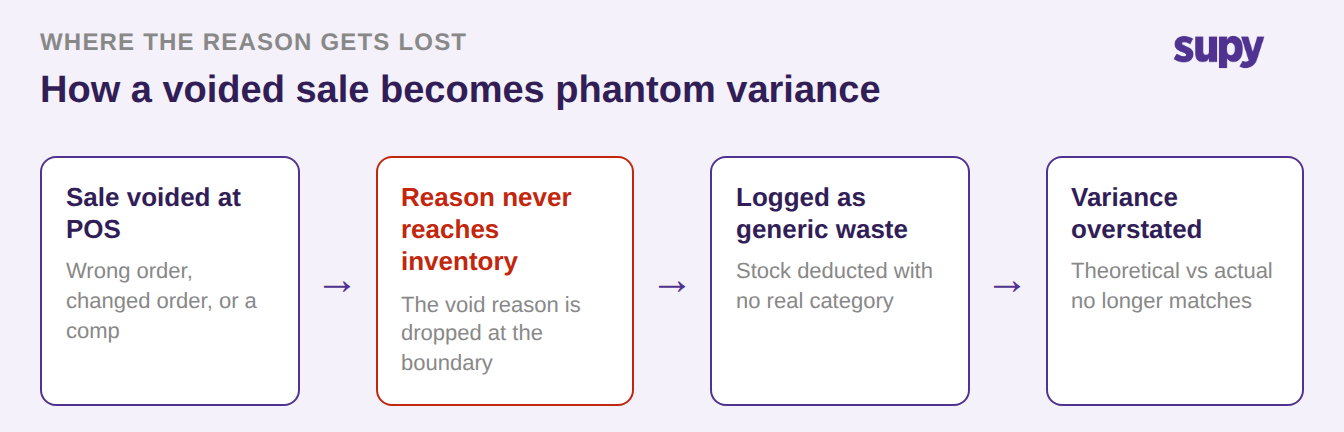
Process flow showing how a voided POS sale becomes overstated variance when the reason is not passed to inventory


How Supy Turns a Void Into an Accurate Waste Record

Supy automatically converts cancelled or voided POS transactions into wastage records and deducts them from stock, with a manual trigger available so a team can decide which voids should convert and which should not. That removes the re-keying step that stops most teams recording voids at all. The lever that makes the number honest is the reason. Operators create custom wastage categories in settings that match their own terminology or cost-centre breakdown, then tag each converted void to a real category. A pre-prep order change gets tagged as exactly that and kept out of spoilage; a dropped tray gets recorded as genuine waste. Genuine loss and non-waste events stop sharing one undifferentiated bucket.
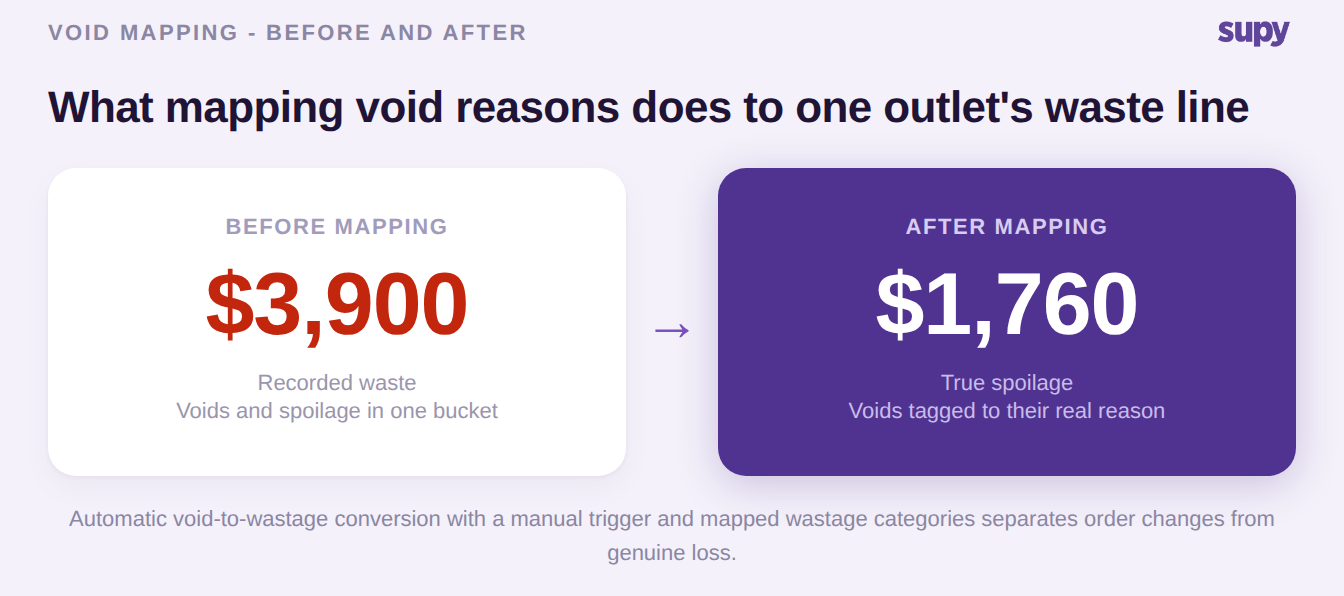
Before and after comparison of one outlet's monthly waste line, dropping from 3,900 dollars to 1,760 dollars once void reasons are mapped


The difference is the gap between a lump of unexplained waste and a waste record an operator can stand behind in a review. If you want the wider view of where these numbers live, our restaurant inventory management platform ties void-driven waste back to live stock, and a quick food cost calculator is a fast way to sanity-check what a distorted waste line is doing to your food cost percentage.

Why Ingredient-Level Waste Makes Your Variance Trustworthy

Recording a void as waste at the dish level is only half the job. When wastage is recorded, Supy decomposes it to the individual ingredients, deducting each in proportion to its share of the recipe, so the variance report shows an accurate ingredient-level picture rather than a single recipe-level write-off. That matters because variance investigations rarely trace back to theft. Across multiple multi-outlet operators, large single-ingredient gaps trace to under-recorded wastage and stale or mis-entered records rather than shrinkage. One casual-dining group's big single-ingredient variance came down to under-recorded wastage plus a stale prep-wastage percentage, not a thief.

ItemTheoreticalActualVariance
Beef short rib38.0 kg39.6 kg-1.6 kg / -$26
Draft lager120 L124 L-4 L / -$18
Buffalo wings26.0 kg26.4 kg-0.4 kg / -$5
Fryer oil20 L21 L-1 L / -$4


Read that way, a variance stops being a mystery to guess at and becomes a short list of explainable movements. It is the same principle behind reconciling POS sales against inventory and behind keeping prep-wastage percentages current: the closer waste is captured to its real cause, the less of the variance is left to argue over.

Where to Start Fixing Your Void-to-Waste Mapping

The quickest way to tell whether this is happening in your operation is to pull last month's waste report for one busy outlet and ask a single question: can you separate voided orders from genuine spoilage? If you cannot, every void is inflating that number and dragging your theoretical-vs-actual variance along with it. The first move is small and does not need a project. Review the void and cancel reasons your POS already captures, create wastage categories in Supy that match them, then turn on void-to-wastage conversion so each void lands in the right category from the start.
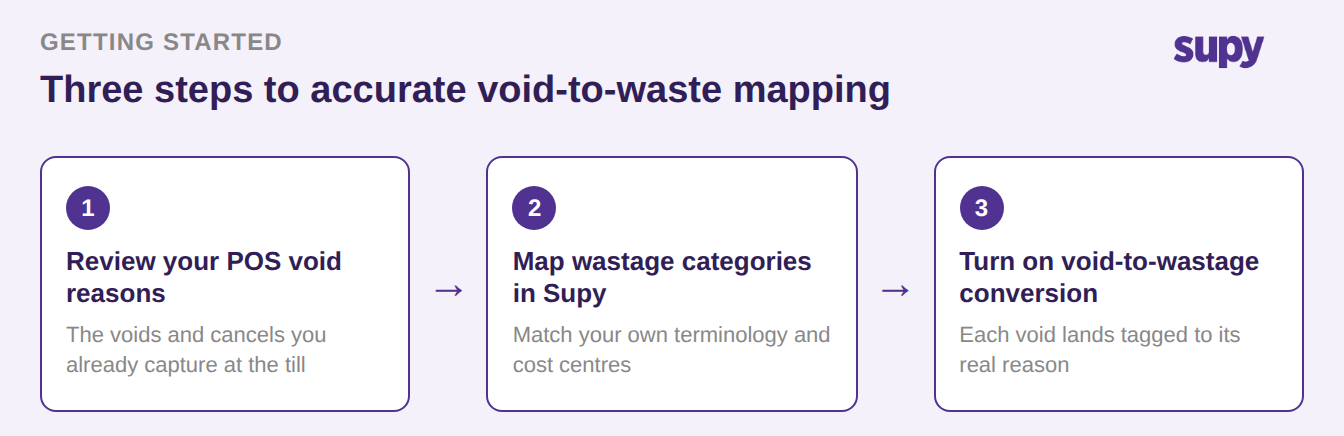
Three step process for setting up accurate void to waste mapping in Supy


Accurate waste is not about logging more, it is about logging the reason. Once a voided sale carries its real cause into inventory, your waste record tells the truth and your food cost variance becomes a number you can act on instead of argue with.

Book a Demo with Supy - accurate void to waste mapping

Ready to optimize your restaurant operations?

Blog

Our operational insights

No items found.

Your questions 
answered

Everything you need to know about Supy — from setup to integrations, pricing, and daily use. If it’s not covered here, just ask.

Why does a voided POS sale show up as waste in my inventory?
+

When a sale is voided or cancelled at the point of sale, the items on that ticket have already been committed against stock. If the void reason never passes through to inventory, the system has no way to know whether the order was real, so it does the safe thing and treats the whole transaction as waste, deducting the ingredients from stock. The result is a waste figure padded with orders that were never actually made or thrown away, which then feeds an overstated theoretical-vs-actual variance. Mapping the reason to a real category is what stops that from happening.

What is the difference between a void and genuine food waste?
+

A void is a sale that was cancelled or changed at the till, for example a mis-rung item or an order a guest adjusted before the kitchen started prep. Genuine food waste is product that was actually prepared, spoiled, or thrown away. The two look identical to inventory unless a reason is attached, because both remove the sale from revenue. Only genuine waste should reduce your usable stock and count toward spoilage. Separating them is the whole point of mapping void reasons to real wastage categories, so a pre-prep order change is never counted as loss and your waste line stays honest.

How does mapping void reasons make my food cost variance more accurate?
+

Your theoretical-vs-actual variance compares the stock a recipe says you should have used against what you actually used. When unmapped voids inflate recorded waste, they add usage that never happened, so the actual side of the equation is wrong before you count a single shelf. Mapping each void to a real reason keeps non-waste events such as order changes out of the waste total, so only genuine loss reduces stock. The variance then reflects real movements you can investigate, rather than a number distorted at the sales boundary, which is where most food cost gaps actually begin.

Can I control which voided sales become waste records?
+

Yes. Supy automatically converts cancelled or voided transactions into wastage records and deducts them from stock, and a manual trigger is also available so a team can decide case by case which voids should convert. That control matters because not every void is loss. An order changed before prep should not reduce stock, while a dropped or spoiled item should. With the manual option, a supervisor can review borderline voids at the end of a shift and convert only the ones that represent real waste, keeping the record accurate without adding a re-keying step for front-of-house staff.

Why do voids and cancellations make POS and inventory disagree?
+

Reconciliation compares what the point of sale recorded against what inventory says was used. Voids and cancellations are a common place the two sides drift, because they are often counted differently on each system: the POS may net them out of revenue while inventory still shows the stock as consumed, or the reverse. In a multi-brand group's monthly reconciliation, void and cancelled transactions counted differently on each side was a recurring reason revenue and usage never matched, outlet after outlet. Aligning how both systems treat voids removes one of the most persistent monthly reconciliation gaps.

How does ingredient-level waste give a truer variance number?
+

When waste is recorded against a dish, Supy decomposes it to the individual ingredients, deducting each one in proportion to its share of the recipe. That turns a single recipe-level write-off into an accurate ingredient-level picture. It matters because variance investigations rarely trace back to theft; more often a large single-ingredient gap comes from under-recorded wastage or a stale prep-wastage percentage. When void-driven waste is captured at the ingredient level, the variance report shows exactly which ingredients moved and by how much, so the team investigates a short list of real movements instead of guessing at a lump figure.

Where should a multi-site operator start fixing void-to-waste mapping?
+

Start with one busy outlet and last month's waste report, then ask whether you can separate voided orders from genuine spoilage. If you cannot, voids are inflating that outlet's waste and its variance. From there the setup is short: review the void and cancel reasons your POS already captures, create matching wastage categories in Supy, and turn on void-to-wastage conversion so each void is tagged from the start. Prove it on one site, confirm the waste report now reads cleanly, then roll the same category mapping out across the group so every outlet reports waste and variance on the same basis.

Ready to transform your operations?

Join 3500+ restaurant operators cutting costs, streamlining operations and making smarter decisions with Supy.