.jpeg)

Logiciel de gestion de franchise restauration : choisir une plateforme de cuisine qui standardise les coûts dans chaque point de vente
Ce qu'une plateforme de cuisine en franchise doit faire et qu'un module POS ne peut pas faire
Les logiciels de gestion de franchise restauration sont généralement présentés comme une solution pour la salle et l'administration : POS, suivi des redevances et des frais, documents de divulgation de franchise et de bail, et un portail d'onboarding des nouveaux franchisés. Cette couche représente un travail réel, mais ce n'est pas là que la marge d'un opérateur multi-sites se gagne ou se perd. La marge se décide en cuisine, dans l'écart entre ce qu'un plat devrait coûter à produire et ce qu'il coûte réellement une fois que chaque point de vente commande, compte et portion à sa manière. Un système POS enregistre ce qui a été vendu. Il ne dit pas au franchiseur si le même article de menu coûte le même prix à produire dans le point de vente trois que dans le point de vente quatorze.
La première décision d'évaluation est donc une décision de catégorie, pas une liste de fonctionnalités. Une plateforme de cuisine s'intègre aux côtés du POS et du système de comptabilité plutôt que de les remplacer, puis standardise les stocks, le coût des recettes et les approvisionnements à travers le réseau et consolide les chiffres pour le groupe. Supy se connecte à 75+ intégrations POS, comptabilité, ERP et Analyses, de sorte que les données du réseau se consolident sans que personne ne change de plateforme ou ne ressaisisse des chiffres entre les outils. Si vous êtes encore en train de cartographier la pile plus large, notre guide sur la gestion de restaurant multi-sites explique comment les couches salle et cuisine s'articulent.
Cela est important parce que les deux couches échouent de différentes manières. Un problème de POS est bruyant : une commande ne passe pas, une carte est refusée, une file d'attente se crée, et quelqu'un le règle au cours de ce service. Un problème de cuisine est silencieux. Le coût d'une recette dérive de quelques centimes, les portions augmentent légèrement, une livraison est reçue en sous-quantité et personne ne s'en aperçoit, et les dégâts n'apparaissent que des semaines plus tard sous la forme d'une ligne de coût matière plus élevée que prévu, sans événement unique à blâmer. Sur un ou deux points de vente, un propriétaire peut garder ce détail en tête. Sur un réseau de franchise, le détail doit vivre dans un système, car aucun franchiseur ne peut personnellement surveiller la cuisine de chaque point de vente à la fois.
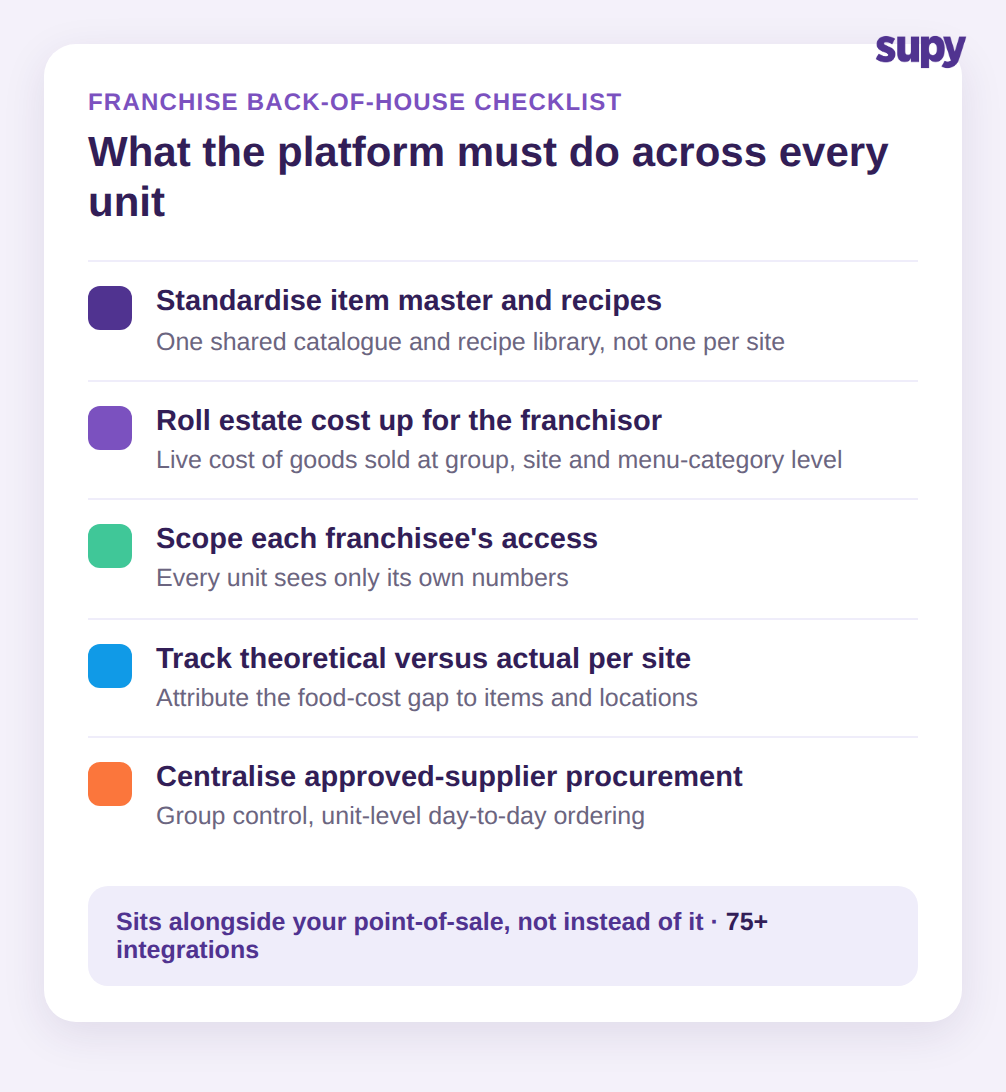
Avant de dresser une liste restreinte, posez à chaque fournisseur une seule question d'orientation : ce système gère-t-il la cuisine sur l'ensemble des points de vente et remonte-t-il les données au groupe, ou est-ce un outil de salle avec un onglet de gestion des stocks ajouté en supplément ? Le reste de ce guide présente les critères qui répondent à cette question lors d'une démonstration.
Standardiser le référentiel articles, les recettes et les stocks minimum dans chaque point de vente
Le responsable des données d'un groupe hôtelier multi-sites a décrit un problème qui corrompt silencieusement le reporting consolidé : le même produit est nommé différemment dans chaque site ou par chaque utilisateur, ce qui fragmente le référentiel et rend les chiffres agrégés sans signification. Quand un site appelle l'article « huile d'olive 5L » et un autre « huile d'olive vierge traiteur », le groupe ne peut pas comparer le coût par unité et par site, parce que la plateforme ne sait pas qu'il s'agit du même article. La standardisation n'est pas de la rigueur. C'est la condition préalable à chaque chiffre au niveau du réseau qu'un franchiseur veut pouvoir faire confiance.
Le critère à tester est de savoir si la plateforme applique une base commune unique à tous les points de vente plutôt que de laisser chaque site garder la sienne. Supy utilise un article de base unique par ingrédient avec tous les conditionnements fournisseurs liés, de sorte que le groupe dispose d'un référentiel unique. Les recettes sont liées aux articles du menu POS, y compris les modificateurs, de sorte qu'une vente diminue les ingrédients corrects automatiquement, et chaque recette comporte un coût cible avec des alertes de dépassement. Les stocks minimum sont définis par article et par site, et les modèles de prises d'inventaire réutilisables dans l'ordre des rayons permettent un comptage en parallèle par plusieurs personnes à la fois, avec une réduction déclarée de plus de 50 % sur le comptage lui-même.
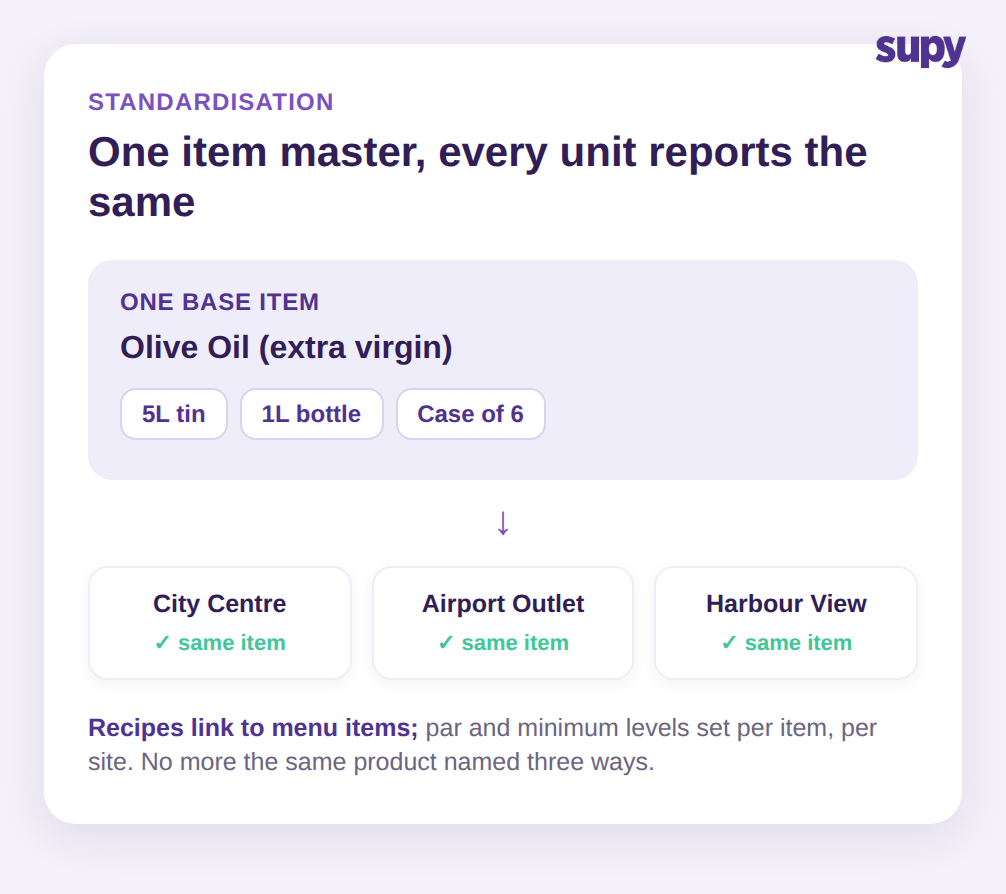
La question à poser lors de la démonstration est concrète : le système peut-il appliquer un référentiel articles unique et une bibliothèque de recettes à l'échelle du groupe, avec des stocks minimum par site superposés, ou la standardisation dépend-elle de chaque point de vente qui saisit les mêmes noms de la même façon ? Si c'est la seconde option, le reporting va dériver, peu importe la qualité des tableaux de bord.
Si vous préférez ne pas calculer les stocks minimum manuellement, le calculateur de stock minimum gratuit le fait pour chaque article de votre liste à partir de votre consommation, de vos délais de livraison et des délais fournisseurs.
Donner au franchiseur une visibilité sur l'ensemble du réseau sans exposer les chiffres de chaque franchisé
C'est l'exigence qui distingue un logiciel de cuisine en franchise d'un outil multi-sites générique. Le responsable des opérations d'un groupe hôtelier franchisé a décrit le besoin d'une visibilité financière restreinte par franchisé, de métriques personnalisées par franchisé, et d'une structure groupe parent-enfant évolutive pour un réseau multi-marques. Chaque franchisé ne doit voir que ses propres chiffres, tandis que le franchiseur a besoin d'une consolidation claire au niveau du groupe sur l'ensemble des sites. Le directeur de la restauration d'un groupe de restauration rapide à quatre sites a clairement exposé le coût de ne pas avoir cela : les groupes multi-sites manquent systématiquement de visibilité centralisée des stocks, de sorte que la direction financière peut voir les problèmes de coût matière et de pertes sur le papier mais ne peut pas agir sans données cross-sites en temps réel.
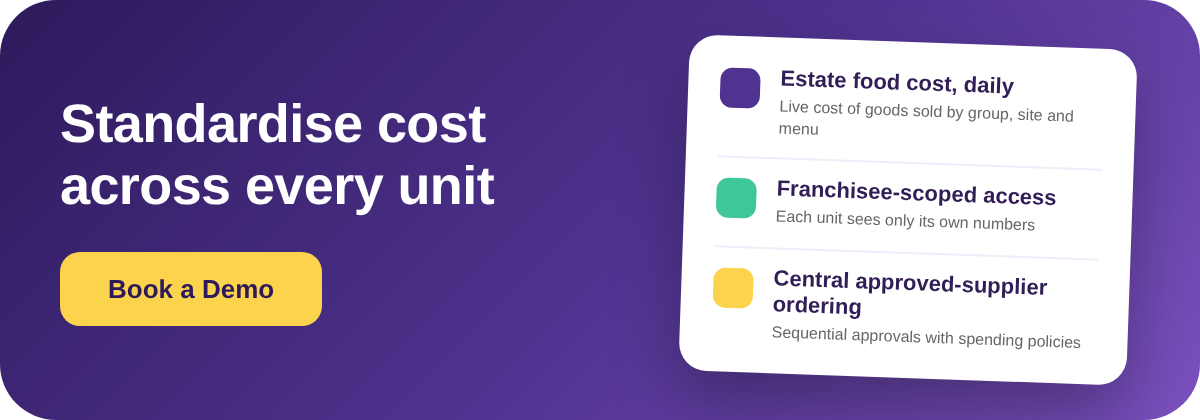
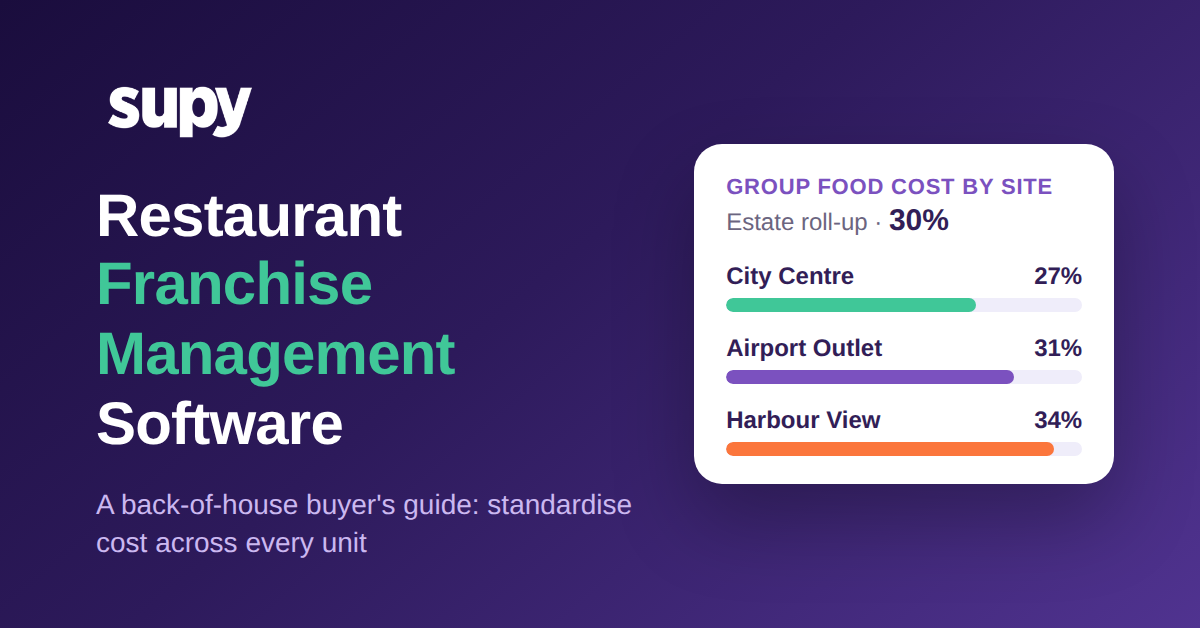
Ce qu'il faut chercher, ce sont deux capacités fonctionnant ensemble. Premièrement, un accès basé sur les rôles par entité, de sorte que les autorisations correspondent à la structure franchiseur-franchisé ; Supy propose 200+ autorisations personnalisables précisément pour cette délimitation. Deuxièmement, une consolidation de groupe qu'un franchiseur peut réellement lire : coût des marchandises vendues en direct et ratio coût matière au niveau du groupe, du site et de la catégorie de menu, avec exploration par niveau et export, de sorte que la personne responsable du réseau voit l'ensemble du tableau pendant que chaque exploitant ne voit que son point de vente.
La structure parent-enfant est la partie que les outils génériques ont tendance à manquer. Dans un vrai réseau, un seul franchisé peut gérer plusieurs points de vente, un franchiseur peut gérer des sites en propre aux côtés de sites franchisés, et un groupe multi-marques peut se trouver au-dessus de tout cela. Les accès doivent s'imbriquer pour correspondre, de sorte qu'un franchisé régional voit son cluster, un exploitant individuel voit un site, et le siège voit tout, à partir du même référentiel et des mêmes définitions. Quand l'accès est plat, les franchiseurs finissent soit par partager trop de données financières sensibles, soit par exporter des chiffres dans des tableurs pour les segmenter manuellement, ce qui vous ramène exactement au reporting fragmenté que la plateforme était censée supprimer.
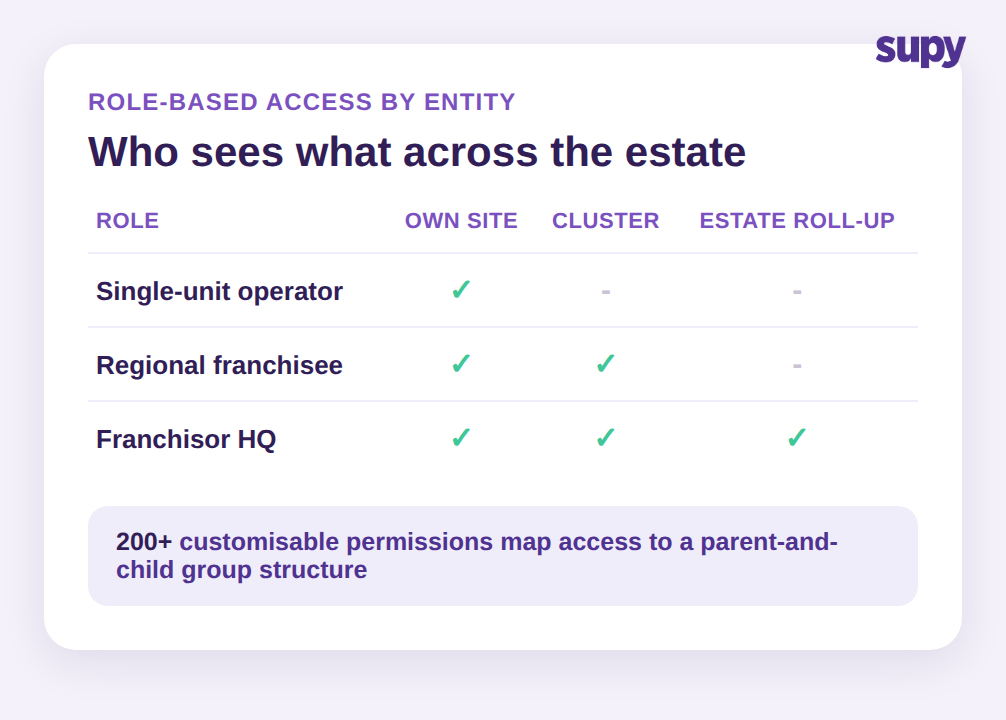
Demandez au fournisseur de montrer deux connexions côte à côte lors de la démonstration : un franchisé individuel qui ne voit que son propre site, et un franchiseur qui voit la consolidation du réseau. Si l'outil ne peut pas séparer ces deux vues clairement, il n'a pas été conçu pour la franchise.
Combler l'écart entre le coût matière théorique et réel par site
Le responsable des opérations d'une chaîne de restauration rapide multi-sites a rapporté que le taux de marge brute théorique, la marge que les recettes indiquent que l'entreprise devrait réaliser, dépassait le chiffre réel apparaissant dans le compte de résultat de 4 à 5 points de pourcentage. Les causes étaient les trois habituelles : des coûts de recettes non mis à jour depuis des mois, des pertes jamais enregistrées, et des dérives de portions de site en site. Le vrai problème n'était pas l'écart lui-même mais qu'il n'y avait aucun moyen de savoir quelle cause dominait quel mois ou quel site, de sorte que personne ne pouvait le corriger.
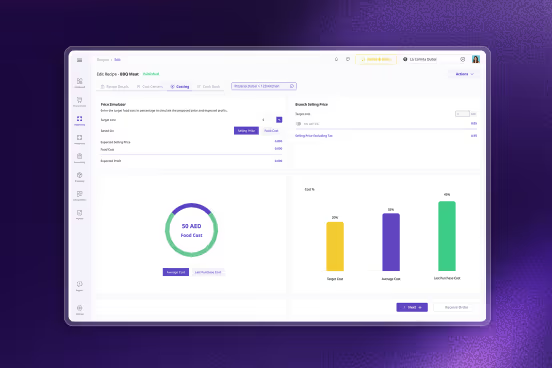
La capacité qui comble cet écart est le reporting théorique par rapport au réel qui fonctionne par site, pas seulement pour le groupe. Supy suit l'utilisation théorique par rapport au réel à partir de la consommation des recettes et des réceptions, affiche l'écart instantané par rapport au système à chaque inventaire avec exploration par niveau, et décompose l'écart et les pertes par type, site et article sur des tableaux de bord en direct. C'est ce qui transforme une intuition de « notre coût matière est à 33 % alors que l'objectif est 28 % quelque part » en une liste nommée d'articles et de sites sur lesquels agir cette semaine.
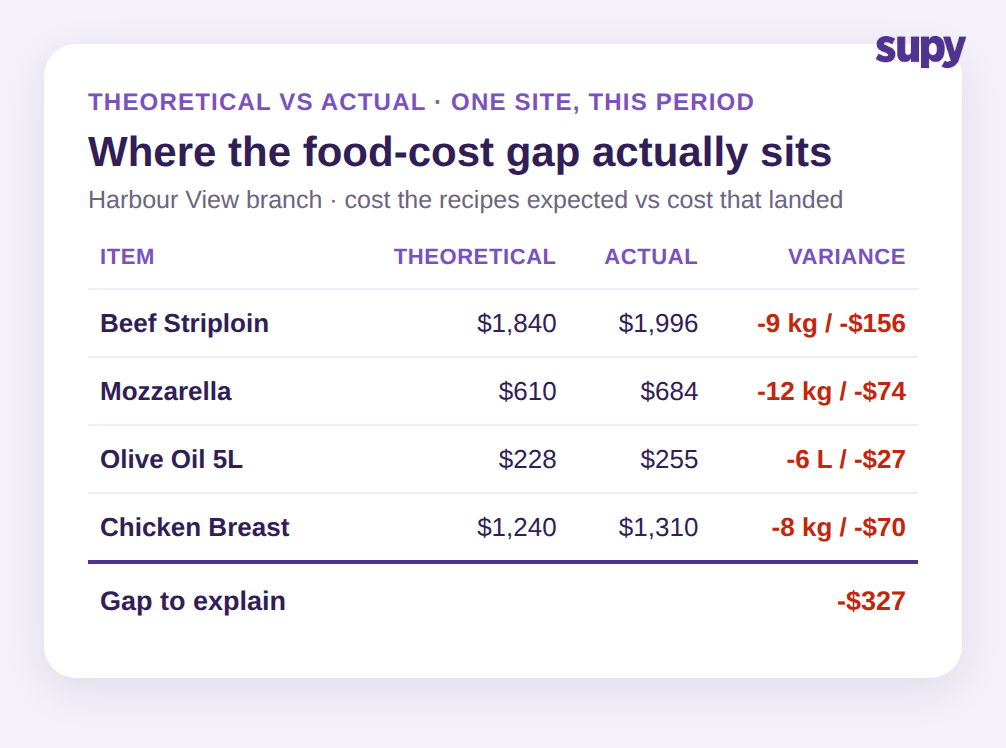
La question à approfondir lors de la démonstration : la plateforme peut-elle montrer le coût matière théorique par rapport au réel pour un site spécifique et attribuer l'écart à des articles, de sorte qu'un responsable sache s'il doit corriger un coût de recette, une habitude de portion ou une fuite de pertes ? Un seul chiffre au niveau du groupe ne suffit pas pour agir.
Centraliser les approvisionnements et le contrôle des fournisseurs approuvés sur tous les points de vente
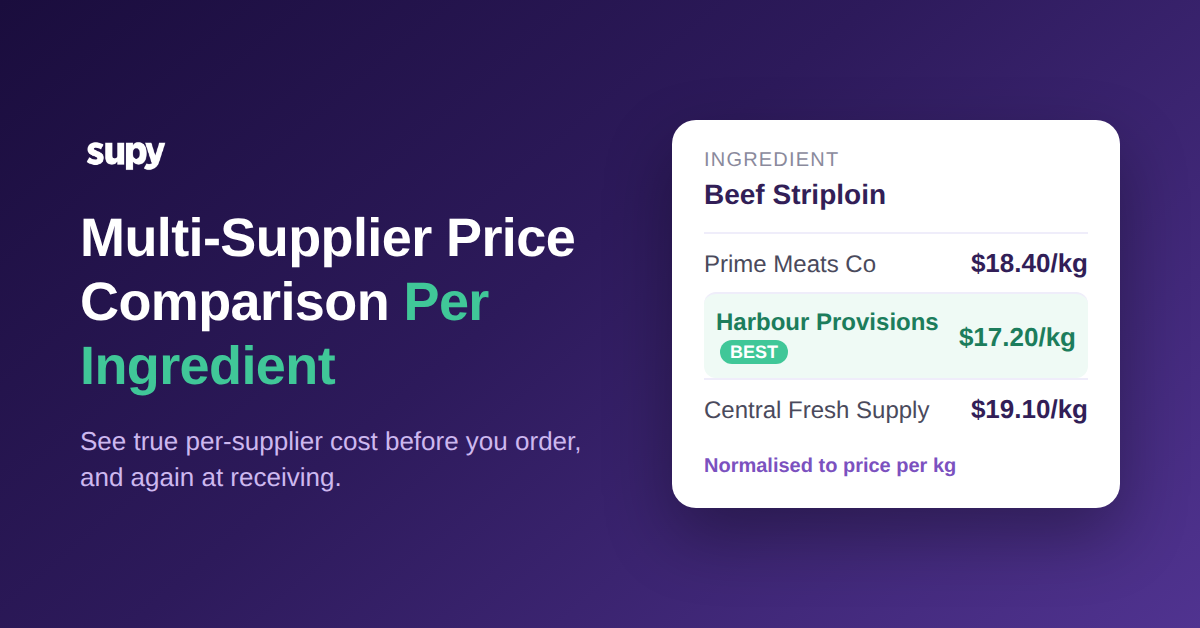
Le dernier critère est celui que les opérateurs ressentent chaque semaine : une pile fragmentée de POS et de tableurs, sans approvisionnement centralisé et approuvé auprès de fournisseurs agréés sur tous les points de vente. Quand chaque site achète auprès de qui il veut au prix qu'il peut obtenir, le groupe perd à la fois son pouvoir de négociation et tout espoir de comparaison propre des coûts. Centraliser les approvisionnements, c'est ainsi qu'un franchiseur protège des coûts cohérents avec la marque sans enlever les commandes quotidiennes aux personnes qui gèrent chaque point de vente.
Supy gère cela comme une couche dédiée. Une cuisine centrale reçoit les bons de commande des sites, consolide la demande inter-sites par article, et peut passer des commandes au nom de n'importe quel site, avec des bons de réception et la facturation intégrés. La gestion des fournisseurs conserve les calendriers de livraison, les délais et les conditions de crédit par site, et aligne les bons de commande sur les jours de livraison automatiquement. Les approbations séquentielles prennent en charge jusqu'à 5 approbateurs déclenchés par site et valeur de commande, et les politiques de dépenses plafonnent la valeur des bons de commande par fournisseur, site ou catégorie, de sorte que les règles sont appliquées par le système plutôt qu'en courant après les personnes. Comme la synchronisation POS fonctionne selon les horaires d'ouverture configurés de chaque site, les ventes alimentent les rapports de coûts quotidiennement, donnant des chiffres de coût matière actuels par site sans intervention manuelle.
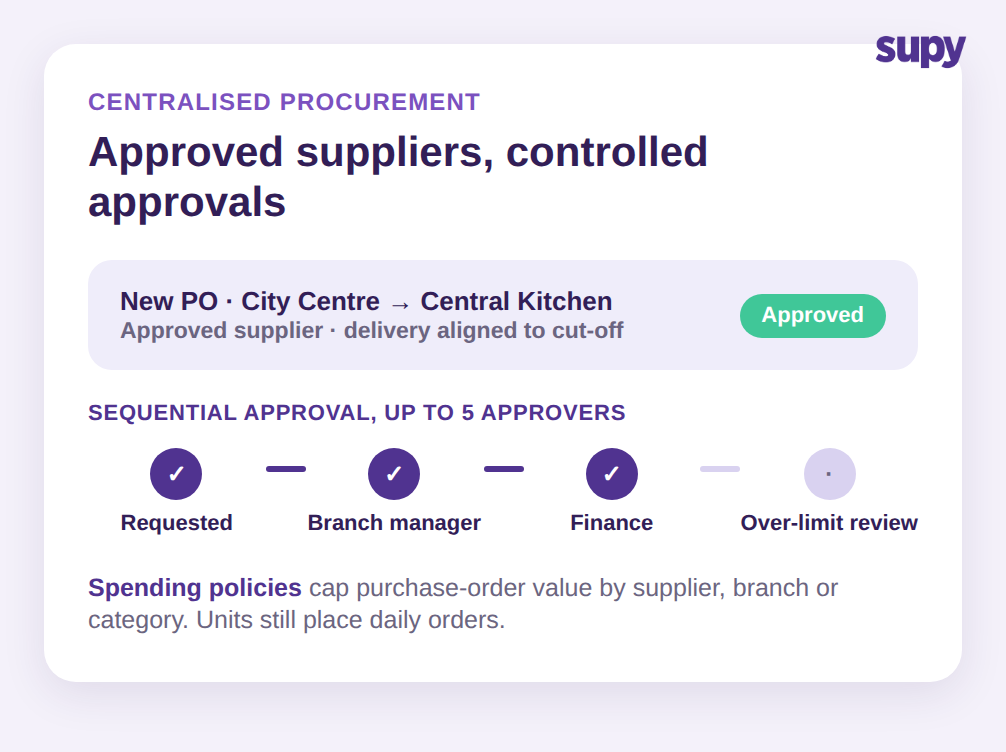
Demandez si la plateforme peut appliquer une liste de fournisseurs approuvés et une chaîne d'approbation sur l'ensemble du réseau tout en laissant chaque point de vente passer ses propres commandes quotidiennes. Contrôle et autonomie ne sont pas des opposés ici ; le bon outil donne au franchiseur le premier sans supprimer le second.
Ensemble, ces cinq critères constituent le test de la liste restreinte. Lorsque vous assistez à une démonstration d'un logiciel de gestion de franchise restauration, orientez-la avec quatre questions et insistez pour voir chacune d'elles fonctionner plutôt que d'être décrite :
- Peut-il maintenir une liste d'articles maîtres, un ensemble de recettes et des stocks minimum de manière centralisée et les diffuser dans chaque point de vente, de sorte qu'aucun franchisé ne puisse redéfinir discrètement une recette ou son coût ?
- Un franchiseur peut-il voir une consolidation des coûts à l'échelle du réseau pendant que chaque franchisé ne voit que son propre site ? Demandez à voir les deux connexions côte à côte lors de la démonstration.
- Peut-il montrer le coût matière théorique par rapport au réel par site, afin que vous puissiez voir quel point de vente perd de la marge et pourquoi, pas seulement une moyenne de groupe ?
- Peut-il appliquer une liste de fournisseurs approuvés et une chaîne d'approbation sur l'ensemble du réseau tout en laissant chaque point de vente passer ses propres commandes quotidiennes ?
Un outil qui répond à ces quatre questions gère votre cuisine sur l'ensemble du réseau. Un outil qui n'y répond pas est un système de salle avec un onglet de reporting, et l'écart de marge entre vos points de vente restera exactement là où il est. Achetez la capacité qui standardise les coûts dans chaque point de vente, pas celle qui se contente de classer les documents plus rapidement.