.jpg)

Central Kitchen Management Software: Why Theoretical vs Actual Tracking Fails at Scale
The Production Visibility Gap: No Theoretical vs Actual at CK Level
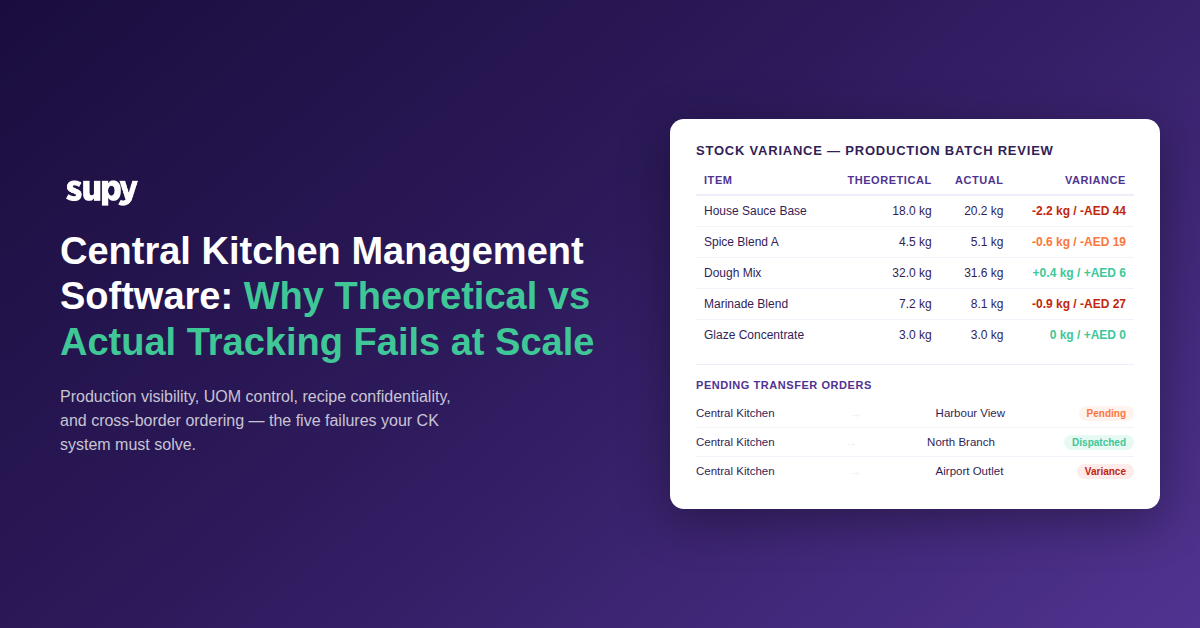
The single most common problem reported when evaluating central kitchen management software is that the software itself does not guarantee cost visibility at the facility level. Groups know what they bought. They know, approximately, what they produced. But most have no way to compare what they should have used against what they actually used - at the central kitchen level, not just at the branches receiving the output.
A UK-based multi-site bakery operator going live on a central kitchen module highlighted exactly this. Their production team was still managing production schedules in an informal personal spreadsheet not connected to procurement or recipe data. The consequence was that production events had no standardised naming convention. Dispatch staff could not identify which batch was which when preparing outlet orders, and the operations team had no view of theoretical vs actual cost variance from the CK facility itself.
This is a structural failure, not a process one. When production planning happens outside the inventory and recipe system, it is impossible to compare standard recipe yield against actual production output. You cannot flag when a batch has consumed 12% more raw material than the recipe specifies without a system that ties production events to recipe standards and actual ingredient consumption.
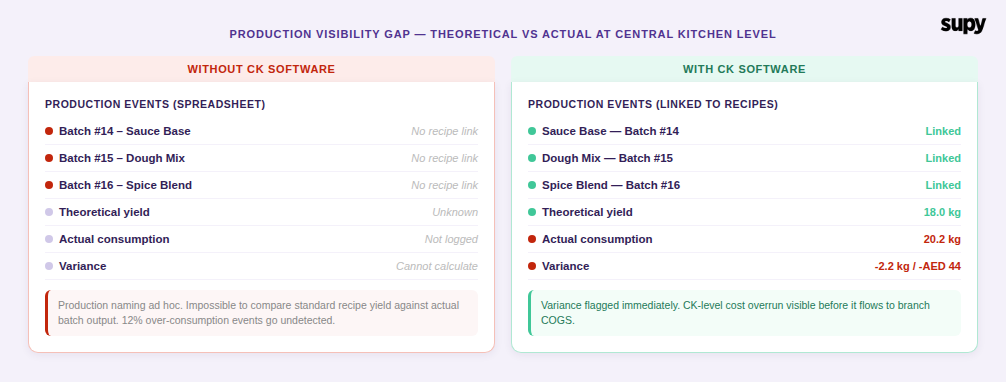
Central kitchen management software must close this loop: production plans created inside the system, linked to recipe specs, with actual usage logged against each production event, and variance reporting that shows theoretical vs actual at the CK facility level - not just at the branches receiving the output.
Transfer Accuracy and UOM Control Across Locations
Stock moving between a central kitchen, a central store, and branch locations is where inventory accuracy most often breaks down. The problem is rarely theft or negligence. It is almost always a unit-of-measure mismatch.
A multi-site GCC operator with a central kitchen and central store structure raised a formal requirements list with their account team after experiencing persistent stock discrepancies. The core issues: staff at branch level were raising requisitions in incorrect units of measure because the system displayed all available UOMs for an item simultaneously rather than restricting to the approved operational UOM for that location and role. A branch requesting 10 litres of stock base when the standard transfer unit is kilograms does not create a small rounding error - it creates a discrepancy that compounds across every subsequent inventory count.
The same group also flagged that they had no location-wise, unit-wise, or date-wise visibility of stock movements between the central kitchen, central store, and branches. When a transfer discrepancy was identified, tracing it back to its origin required cross-referencing multiple spreadsheets.
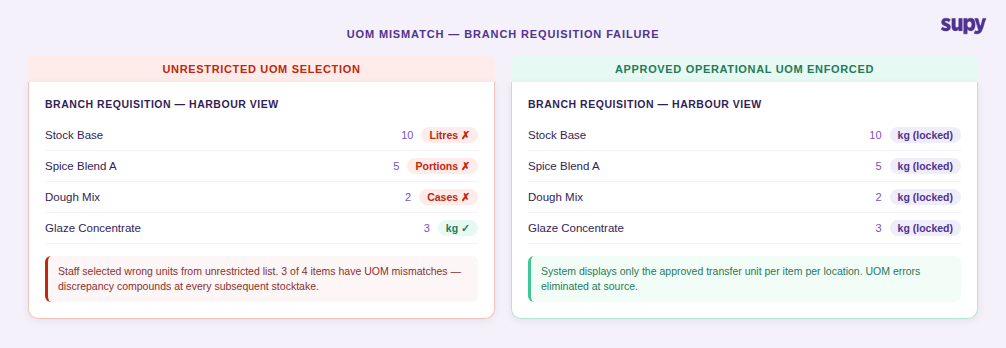
Purpose-built central kitchen management software needs to enforce UOM rules at the point of requisition: each item should display only the approved ordering unit for the requesting location, not the full list of units the system stores. Transfers should generate a timestamp trail with origin location, destination location, item, quantity, unit, and the user who raised, approved, and confirmed the transfer. Without that, reconciliation is manual and always retrospective.
Dispatch accuracy is a related challenge. A 25-location European prospect and a UK dessert chain both raised the same requirement: dispatch staff need to be able to scan barcodes during the picking process to confirm that every item on an outlet order has been picked before the dispatch is sent. A software system that relies on manual tick-off creates a gap between what was supposed to leave the central kitchen and what actually did.
Recipe Confidentiality Between the Central Kitchen and Branches
For many operators, the central kitchen is where the intellectual property lives. Semi-finished products - sauces, dough, spice blends, marinades - are produced to proprietary recipes that the group does not want visible to branch staff or franchise partners. This is especially true in franchise models, where the central kitchen sits inside the franchisor's entity and the branches are operated by third parties.
Multiple groups with central kitchen setups have specifically asked whether branches can be prevented from seeing the semi-finished recipes produced at the CK. Groups in franchise structures have made this a prerequisite: branch staff must not be able to see the semi-finished recipes produced at the central kitchen, and the system must enforce that boundary without requiring manual permission management per user.

What this means in practice: branch-level inventory must be able to receive and count finished or semi-finished items from the central kitchen without those items exposing their sub-recipe components. When a branch counts 40 units of "House Sauce 1kg" against their par level, they should see that item and its cost - not the breakdown of ingredients that constitute it.
This is not just a data-access preference. For franchise operators, recipe confidentiality is often a contractual requirement. Central kitchen management software that cannot enforce this boundary creates a compliance problem, not just an operational one. The software needs to allow item-level visibility controls that separate what the CK can see from what branches can see, without breaking the cost cascade or the inventory accuracy of either layer.
Wastage List Management That Cannot Scale Across Sites
Wastage tracking in a single-site restaurant is manageable manually. In a group with a central kitchen supplying 10, 20, or 50 branches, manual wastage management collapses.
A 20-plus-site UK coffee chain raised this issue during their evaluation of central kitchen and production module functionality. The core concern was that managing wastage lists centrally - defining which wastage categories and items appear at which site - was not possible with manual workarounds. Different teams at each site needed to see different wastage items relevant to their operation. Without centralised control over those lists, the wastage records would not scale at site level.
The practical failure: if wastage categories are managed at site level, you get 20 different lists with inconsistent item names, inconsistent categorisation, and no way to aggregate across the group. Head office cannot identify which sites are generating the most variance in a specific category, because the data is not comparable. Finance cannot produce a group-level wastage report without manually harmonising spreadsheets.
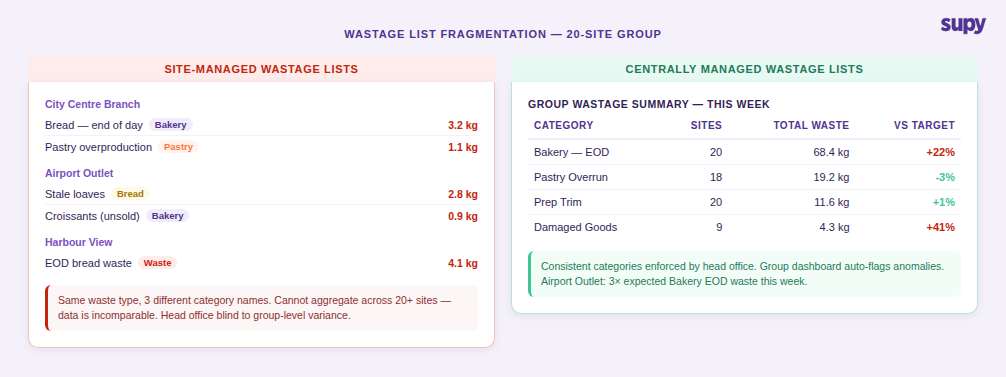
Purpose-built software needs to allow head office to define and maintain the approved wastage item and category list centrally, with role-based controls over which locations see which items. Wastage logged at branch level feeds into a group-level dashboard. Anomalies - a site logging 3x the expected wastage for a specific category in a single week - surface automatically rather than requiring a finance team member to manually review every site's spreadsheet.
Cross-Border B2B Ordering for Franchise Groups
The most complex scenario central kitchen software must handle is the one most vendors ignore: a central kitchen in one country supplying franchise branches registered under a separate legal entity in another country.
A European franchise group asked directly whether branches in one country account could order from a central kitchen in a different country account - a cross-border B2B scenario. This is the operating structure for GCC franchise groups where a UAE-based central kitchen supplies branches in KSA, Bahrain, or Kuwait under separate commercial entities. Each branch entity needs to raise internal purchase orders to the CK entity, receive goods with proper documentation, and have that transaction reflected correctly in both the CK's outgoing inventory and the branch's incoming stock - across different currencies, different VAT regimes, and potentially different supplier catalogues.
No competitor content addresses this scenario. Most central kitchen software is built for single-entity, single-country operators. The assumption is that the CK and branches are all part of the same legal and accounting structure. For GCC franchise groups, that assumption breaks at the point of cross-border expansion.
A system that supports CK B2B ordering allows the central kitchen entity to act as a supplier to branch entities, with full transfer documentation, costing in the correct currency for each entity, and inventory adjustments that reflect reality on both sides. Groups scaling from a single market into a multi-country franchise model need this capability built into the platform from the start - retrofitting it after the fact, across active operations, creates significant risk.
Getting the Central Kitchen to Scale
A central kitchen can only deliver on its operational and commercial promise when it is connected - to procurement, to recipe costing, to branch inventory, and to finance. When any of those connections runs through a spreadsheet or a WhatsApp thread, you lose visibility at exactly the points where cost variance is most likely to occur.
The five failures covered here - production cost visibility, transfer accuracy, recipe confidentiality, wastage list management, and cross-border B2B ordering - are not edge cases. They are the standard operational challenges for any restaurant group running a central kitchen at scale.
Supy is built for multi-location restaurant groups managing central kitchen operations alongside procurement, inventory, and recipe costing. If you are evaluating whether your current system can scale with your kitchen structure, book a demo to see how Supy handles the scenarios your operation actually faces.