.jpg)


Restaurant Franchise Management Software: Choosing a Back-of-House Platform That Standardises Cost Across Every Unit
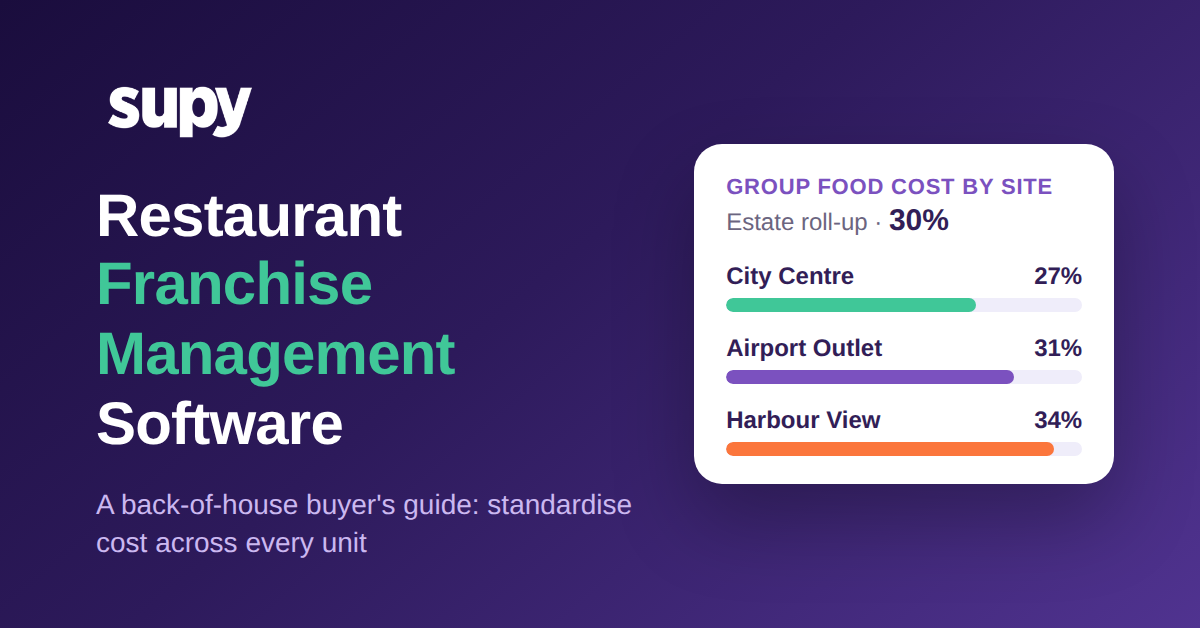
What a Franchise Back-of-House Platform Must Do That a Point-of-Sale Module Cannot
Restaurant franchise management software is usually sold as a front-of-house and administration story: point-of-sale, royalty and fee tracking, lease and franchise-disclosure paperwork, and a portal for onboarding new franchisees. That layer is real work, but it is not where a multi-unit operator's margin is won or lost. Margin is decided in the back of house, in the gap between what a dish should cost to make and what it actually costs once every unit orders, counts and portions its own way. A point-of-sale system records what sold. It does not tell a franchisor whether the same menu item costs the same to produce in unit three as it does in unit fourteen.
So the first evaluation decision is a category decision, not a feature checklist. A back-of-house platform sits alongside the point-of-sale and the accounting system rather than replacing them, then standardises inventory, recipe cost and procurement across the estate and rolls the numbers up for the group. Supy connects to 75+ point-of-sale, accounting, ERP and analytics integrations, so estate data consolidates without anyone switching platforms or re-keying figures between tools. If you are still mapping the wider stack, our guide to multi-unit restaurant management covers how the front-of-house and back-of-house layers fit together.
This matters because the two layers fail in different ways. A point-of-sale problem is loud: an order does not go through, a card is declined, a queue backs up, and someone fixes it that shift. A back-of-house problem is silent. A recipe cost drifts a few cents, a portion creeps up, a delivery gets received short and nobody notices, and the damage only shows up weeks later as a food-cost line that is higher than it should be with no single event to blame. At one or two units an owner can hold that detail in their head. Across a franchise estate, the detail has to live in a system, because no franchisor can personally watch the back of house in every unit at once.
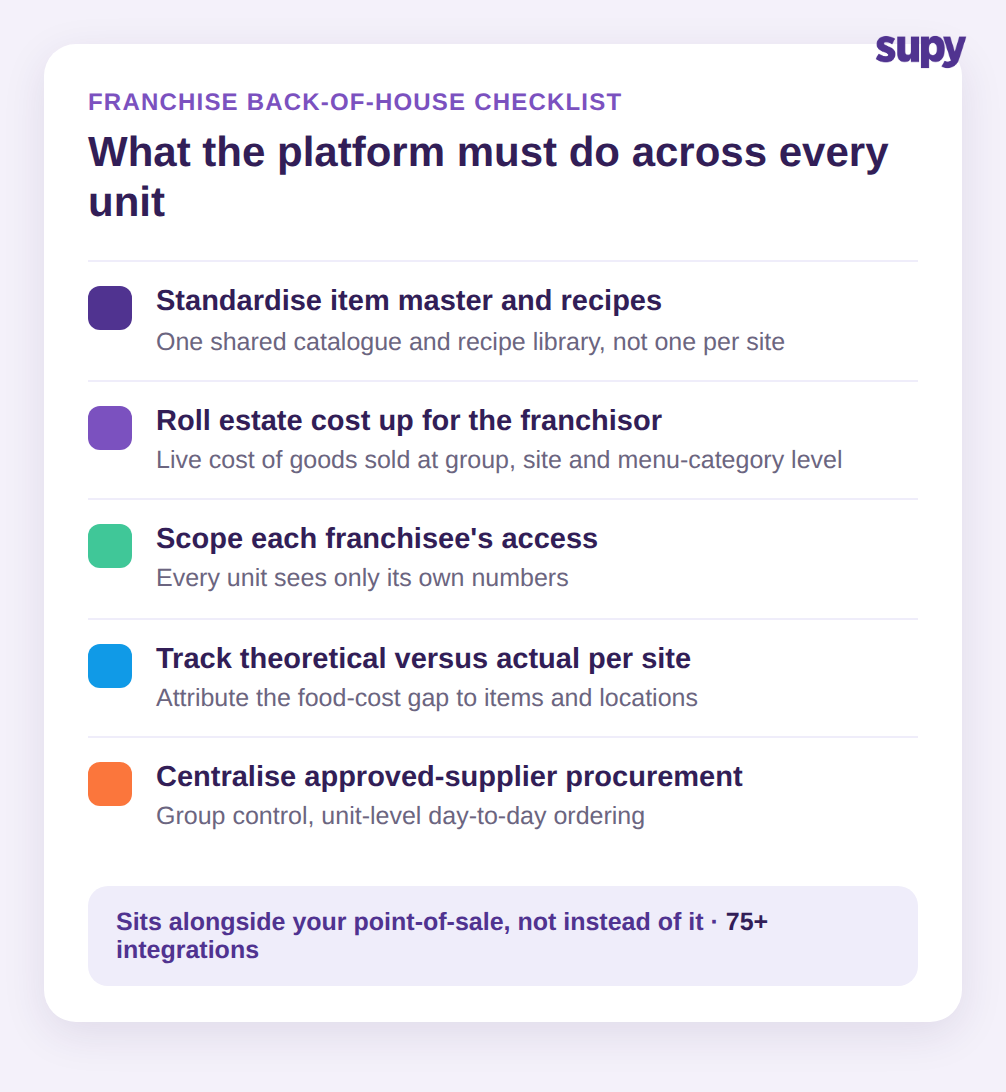
Before you shortlist anything, ask each vendor a single orienting question: does this run the back of house across every unit and report it to the group, or is it a front-of-house tool with an inventory tab bolted on? The rest of this guide is the criteria that answer that question in a demo.
Standardise the Item Master, Recipes and Par Levels Across Every Unit
A multi-location hospitality group's data manager described a problem that quietly corrupts group reporting: the same product is named differently at each site or by each user, so the catalogue fragments and roll-up numbers stop meaning anything. When one unit calls it "olive oil 5L" and another calls it "EVOO catering", the group cannot compare cost per unit, per site, because the platform does not know they are the same thing. Standardisation is not tidiness. It is the precondition for every estate-level number a franchisor wants to trust.
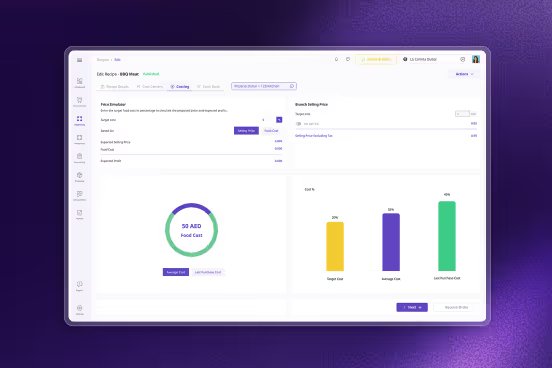
The criterion to test is whether the platform enforces one shared foundation across units rather than letting each site keep its own. Supy uses one base item per ingredient with all supplier packs linked to it, so the group reports on a single catalogue. Recipes link to point-of-sale menu items, including modifiers, so a sale depletes the correct ingredients automatically, and each recipe carries a target cost with over-threshold alerts. Par and minimum thresholds are set per item per site, and reusable stock-count templates in shelf order support parallel counting by several people at once, with a stated time reduction of more than 50% on the count itself.
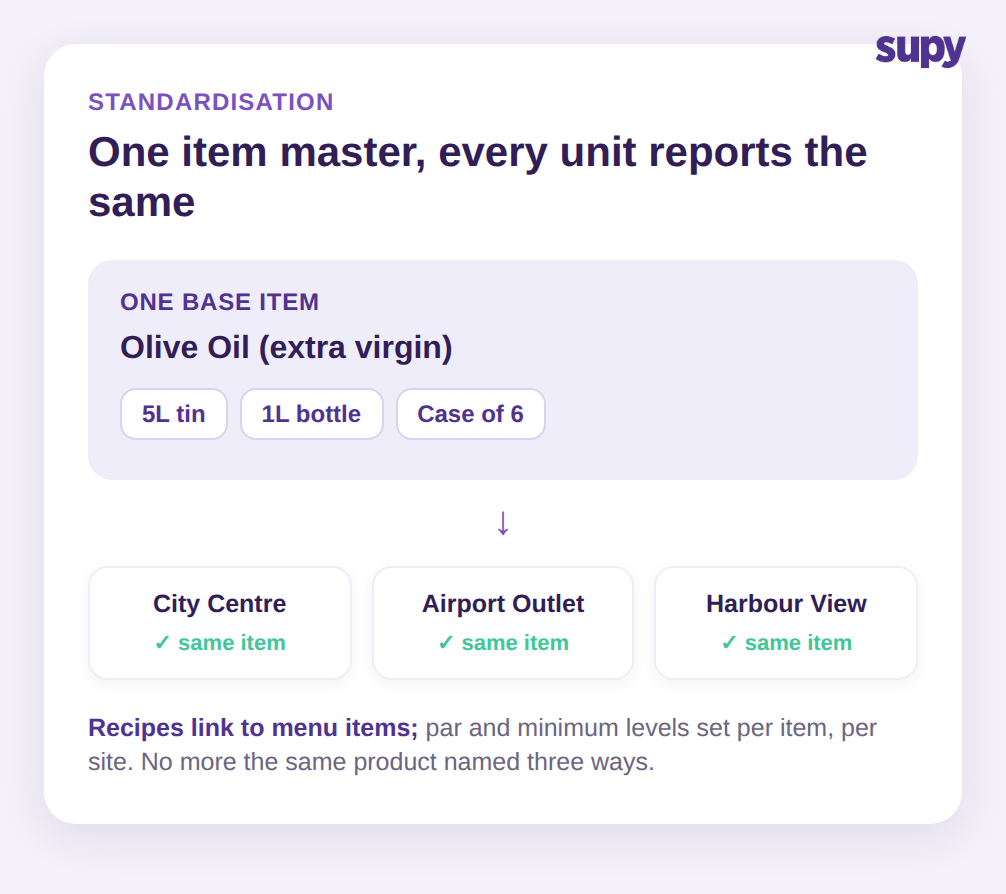
The demo question here is concrete: can the system enforce one item master and one recipe library group-wide, with per-site par levels layered on top, or does standardisation depend on every unit typing the same names the same way? If it is the latter, the reporting will drift no matter how good the dashboards look.
If you'd rather not work par out by hand, the free par level calculator does it for every item on your sheet from your usage, delivery days and supplier lead times.
Give the Franchisor Estate-Wide Visibility Without Exposing Each Franchisee's Numbers
This is the requirement that separates franchise back-of-house software from a generic multi-site tool. A franchise hospitality group's operations lead described needing restricted financial-data visibility per franchisee, custom metrics per franchisee, and a scalable parent-and-child group structure for a multi-brand network. Each franchisee should see only their own numbers, while the franchisor needs a clean group-level roll-up across all of them. A four-location quick-service group's food-and-beverage director put the cost of getting this wrong plainly: multi-unit groups routinely lack centralised inventory visibility, so finance can see food-cost and wastage problems on paper but cannot act on them without real-time cross-site data.
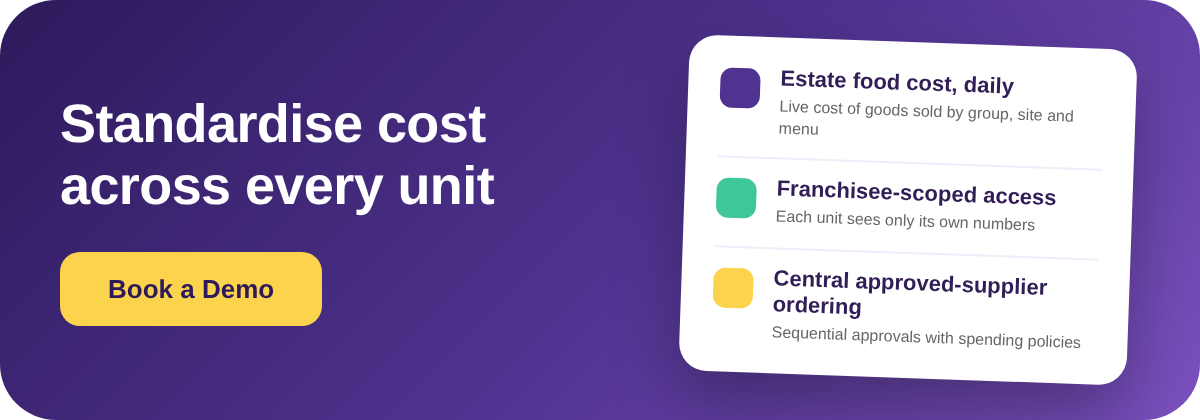
What to look for is two capabilities working together. First, role-based access by entity, so permissions map to the franchisor-franchisee structure; Supy ships 200+ customisable permissions for exactly this scoping. Second, a group roll-up that a franchisor can actually read: live cost of goods sold and food-cost percentage at group, site and menu-category level, with drill-down and export, so the person accountable for the estate sees the whole picture while each operator sees only their unit.
The parent-and-child structure is the part generic tools tend to miss. In a real network, a single franchisee may run several units, a franchisor may run company-owned units alongside franchised ones, and a multi-brand group may sit above all of it. Access has to nest to match, so a regional franchisee sees their cluster, a single operator sees one site, and head office sees everything, all from the same catalogue and the same definitions. When access is flat, franchisors end up either over-sharing sensitive financials or exporting numbers into spreadsheets to slice them by hand, which puts you right back in the fragmented reporting the platform was supposed to remove.
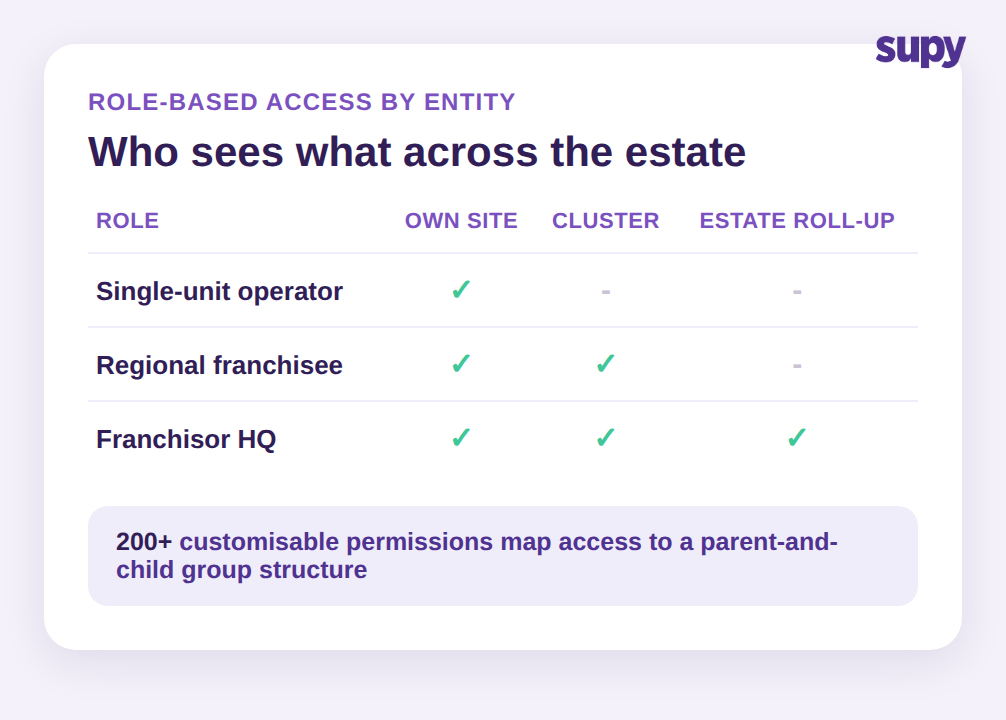
Ask the vendor to show two logins side by side in the demo: a single franchisee who sees only their own site, and a franchisor who sees the estate roll-up. If the tool cannot separate those two views cleanly, it was not built for franchising.
Close the Theoretical-Versus-Actual Food-Cost Gap Per Site
A multi-location fast-casual chain's head of operations reported theoretical gross-profit percentage, the margin the recipes say the business should earn, running 4 to 5 percentage points above the actual figure that landed on the profit-and-loss statement. The causes were the familiar three: recipe costs that had not been updated in months, spoilage that was never recorded, and portion drift from unit to unit. The real problem was not the gap itself but that there was no way to tell which cause dominated in which month or at which site, so nobody could fix it.
The capability that closes this gap is theoretical-versus-actual reporting that works per site, not just for the group. Supy tracks theoretical-versus-actual usage from recipe consumption and receiving, shows instant variance against the system at every stock count with drill-down, and breaks variance and wastage down by type, site and item on live dashboards. That is what turns a "we are running at 33% food cost against a 28% target somewhere" hunch into a named list of items and locations to act on this week.
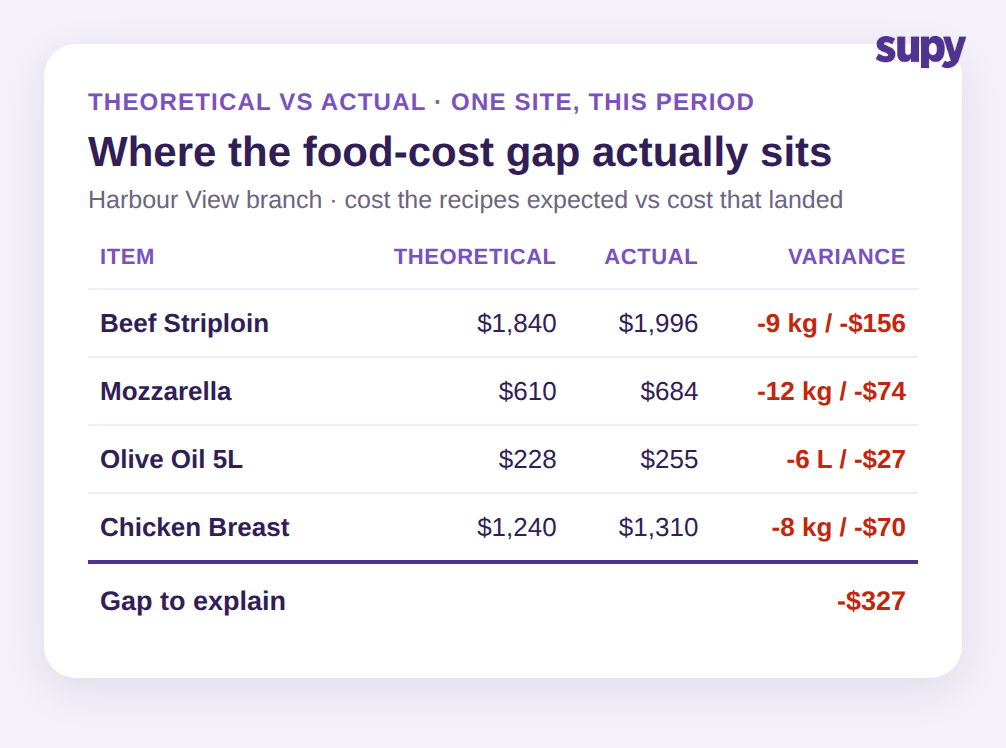
The question to press in a demo: can the platform show theoretical-versus-actual for one specific site and attribute the variance to items, so a manager knows whether to fix a recipe cost, a portioning habit or a wastage leak? A single group-level number is not enough to act on.
Centralise Procurement and Approved-Supplier Control Across Outlets
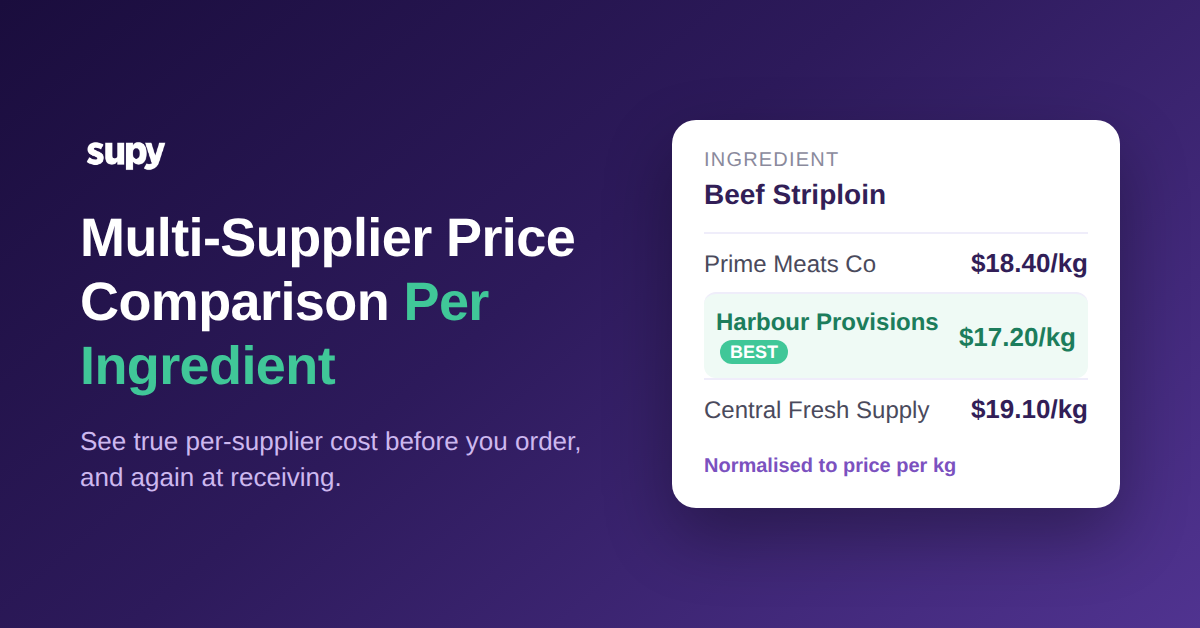
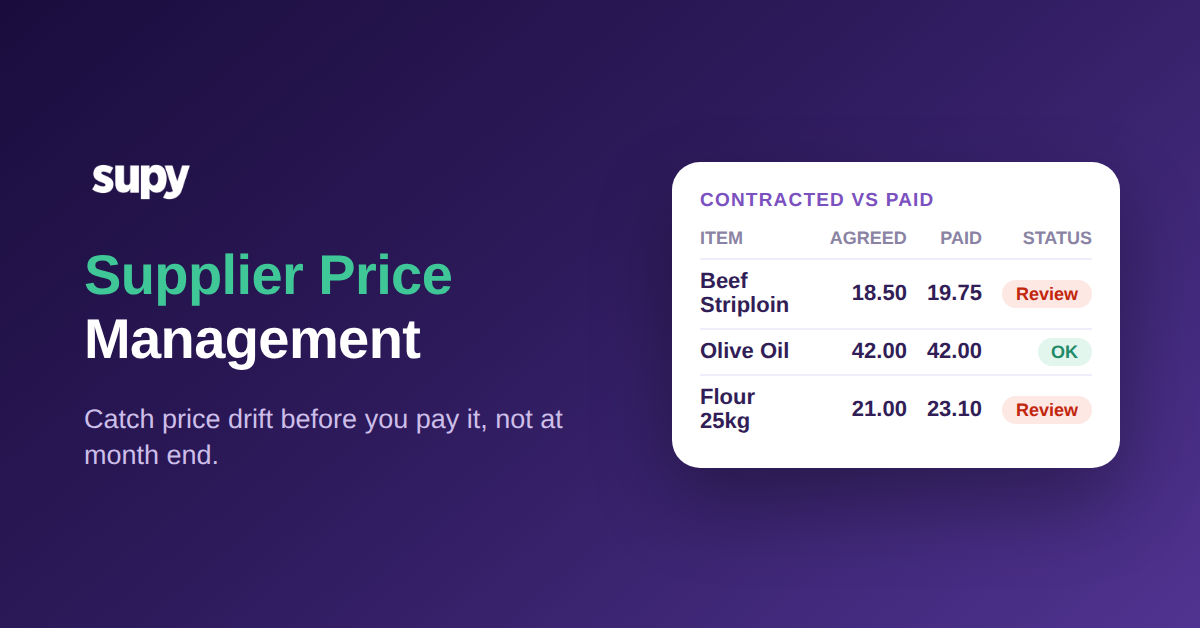
The last criterion is the one operators feel every week: a fragmented stack of point-of-sale plus spreadsheets, with no consolidated, approved-supplier procurement across outlets. When each unit buys from whoever it likes at whatever price it can get, the group loses both its negotiating power and any hope of a clean cost comparison. Centralising procurement is how a franchisor protects brand-consistent cost without taking day-to-day ordering away from the people who run each unit.
Supy handles this as a dedicated layer. A central kitchen receives purchase orders from branches, consolidates cross-branch demand per item, and can order on behalf of any branch, with delivery notes and billing built in. Supplier management holds per-branch delivery schedules, cut-offs and credit terms, and aligns purchase orders to delivery days automatically. Sequential approvals support up to 5 approvers triggered by branch and order value, and spending policies cap purchase-order value by supplier, branch or category, so guardrails are enforced by the system rather than by chasing people. Because the point-of-sale sync runs on each branch's configured opening hours, sales flow into cost reports daily, giving current food-cost figures per site with no manual triggers.
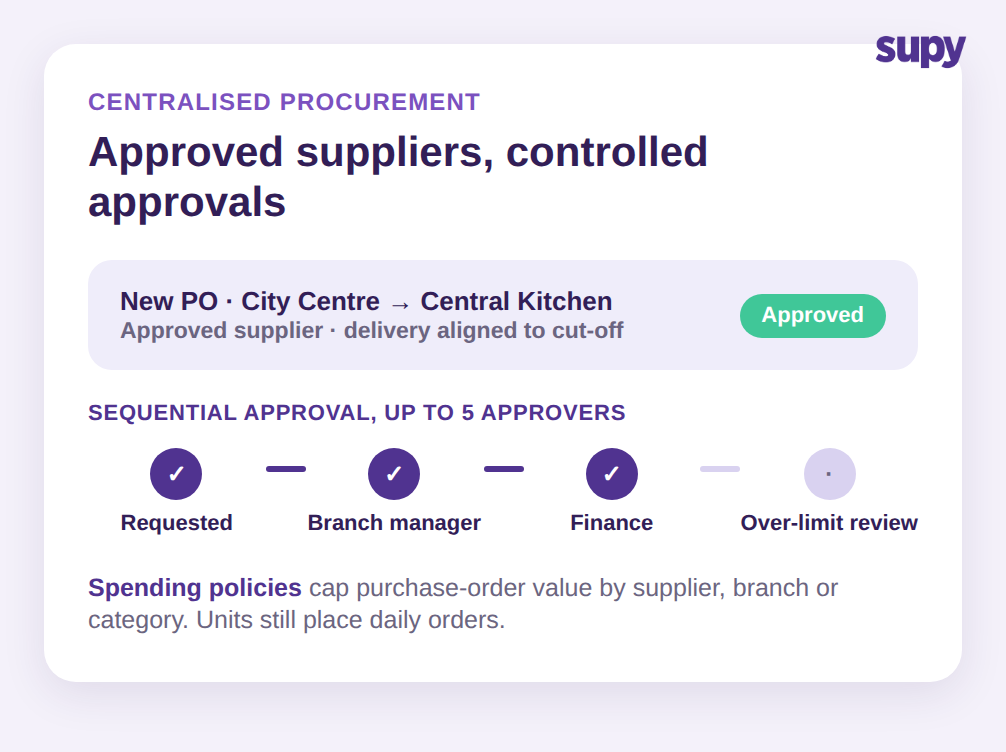
Ask whether the platform can enforce an approved-supplier list and an approval chain across the whole estate while still letting each unit place its own daily orders. Control and autonomy are not opposites here; the right tool gives the franchisor the first without removing the second.
Put together, those five criteria are the shortlist test. When you sit through a demo of any restaurant franchise management software, drive it with four questions and insist on seeing each one work rather than hearing it described:
- Can it hold one master item list, recipe set and par levels centrally and push them to every unit, so no franchisee can quietly redefine a recipe or its cost?
- Can a franchisor see an estate-wide cost roll-up while each franchisee sees only their own site? Ask to see both logins side by side in the demo.
- Can it show theoretical versus actual food cost per site, so you can see which unit is losing margin and why, not just a group average?
- Can it enforce an approved-supplier list and an approval chain across the whole estate while still letting each unit place its own daily orders?
A tool that answers all four is running your back of house across the estate. A tool that answers none of them is a front-of-house system with a reporting tab, and the margin gap between your units will stay exactly where it is. Buy the capability that standardises cost across every unit, not the one that simply files paperwork faster.