.jpg)


Supplier Price Management for Restaurants: Why Prices Drift Up Before Anyone Notices
What Undetected Supplier Price Drift Actually Costs You
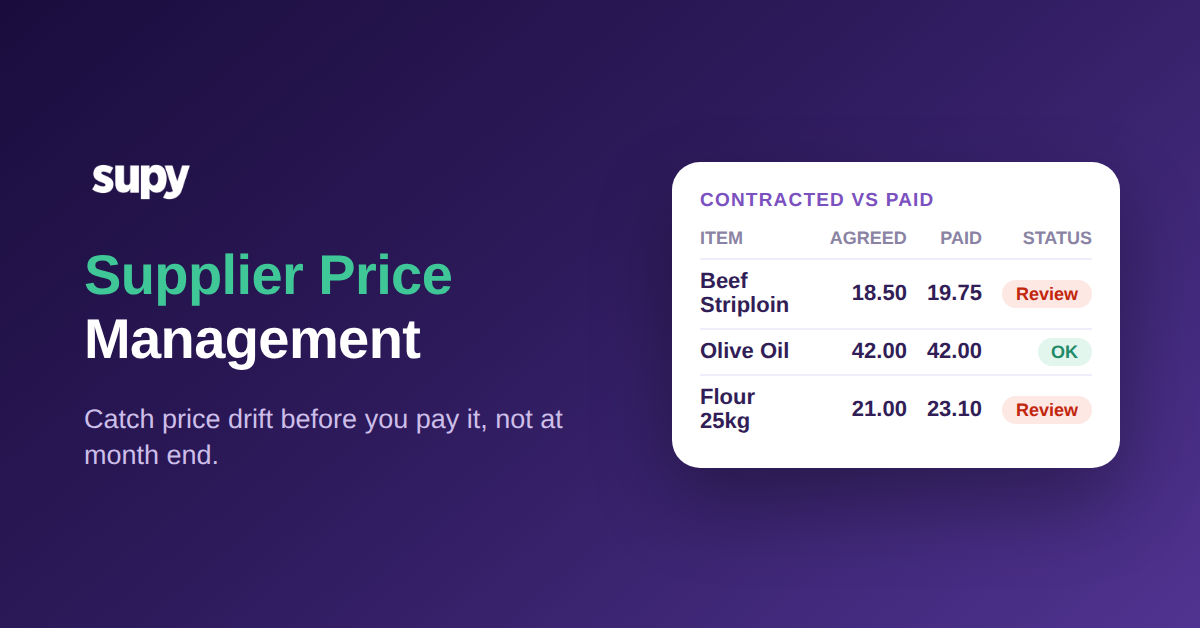
Nobody sends an email announcing that your beef just got more expensive. The price on the invoice creeps up by a few percent, the delivery still arrives, the kitchen still cooks, and the line that used to cost 18.50 a kilo now costs 19.75. Multiply that across a few hundred items and a handful of suppliers, and the money leaves quietly. Most operators only find it at month end, when food cost is a point higher than it should be and no single line looks obviously wrong.
That gap is a supplier price management problem, not a bad-luck problem. When prices are checked by eye, only occasionally, and only when someone happens to remember, drift is invisible until it has already been paid. This guide walks through what that drift costs, why manual checks fall apart as you add locations, the fields a supplier price list actually needs to do its job, and how to turn that list into something that protects margin instead of just recording history.
Price drift is expensive precisely because it is small. A single item moving from 18.50 to 19.75 is a 6.8 percent increase that nobody would sign off on if a supplier asked for it in writing. Spread it across a catalogue and let it happen line by line, and it reads as noise.
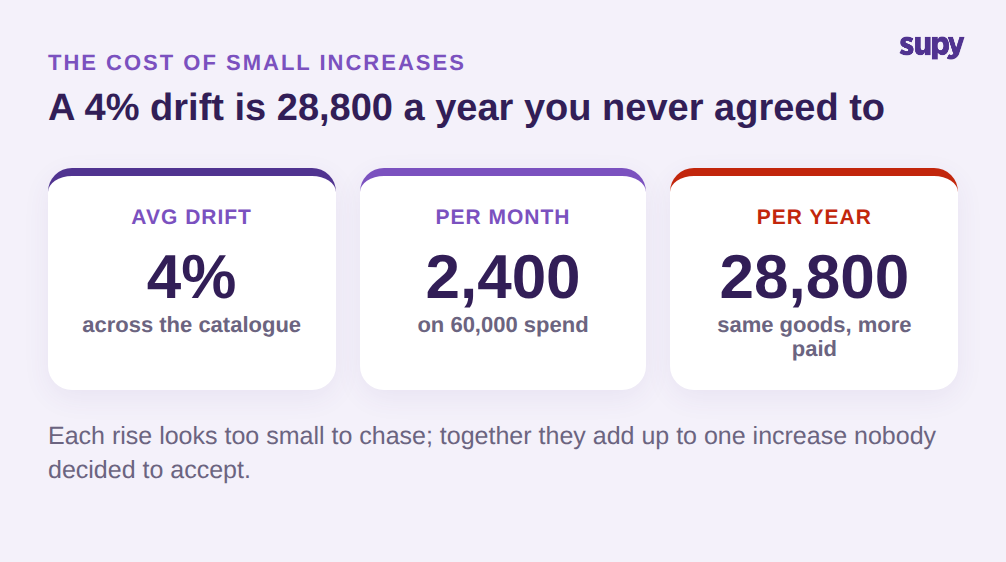
Put a number on it. If your average supplier price drifts up by 4 percent on a monthly food spend of 60,000, that is 2,400 a month leaving the business for exactly the same goods. Across a year it is 28,800. No new covers, no better food, no service improvement bought with it. The money simply moves from your margin to your suppliers' because nobody was watching the prices closely enough to push back.
Each individual rise is also easy to rationalise. A few cents on a case looks like the market moving, not something worth a phone call, so it gets waved through. The problem is that dozens of small, individually reasonable increases add up to one large one that nobody ever decided to accept. The catalogue drifts upward because every single line, on its own, was not worth stopping for.
The reason it survives is that the two moments that should catch it are disconnected. The price you agreed with the supplier lives in one place, often an email or a signed sheet, and the price you actually paid lives on the invoice in another. Unless someone lines them up on purpose, an overcharged line and a correctly billed one look identical on the delivery dock. Operators who treat supplier prices as something to spot-check every couple of months are, in practice, agreeing to pay whatever the invoice says for the weeks in between.
Why Manual Price Checks Break as You Add Locations
A single site with one buyer can just about hold prices in someone's head. The moment you run more than one location, that stops working, and not gradually.
The first problem is volume. Every location generates its own invoices, and the number of lines to check each week grows with each site you open. A finance team that could eyeball prices for one restaurant cannot read hundreds of lines a week across five, so the check quietly becomes a sample, then a formality, then nothing.
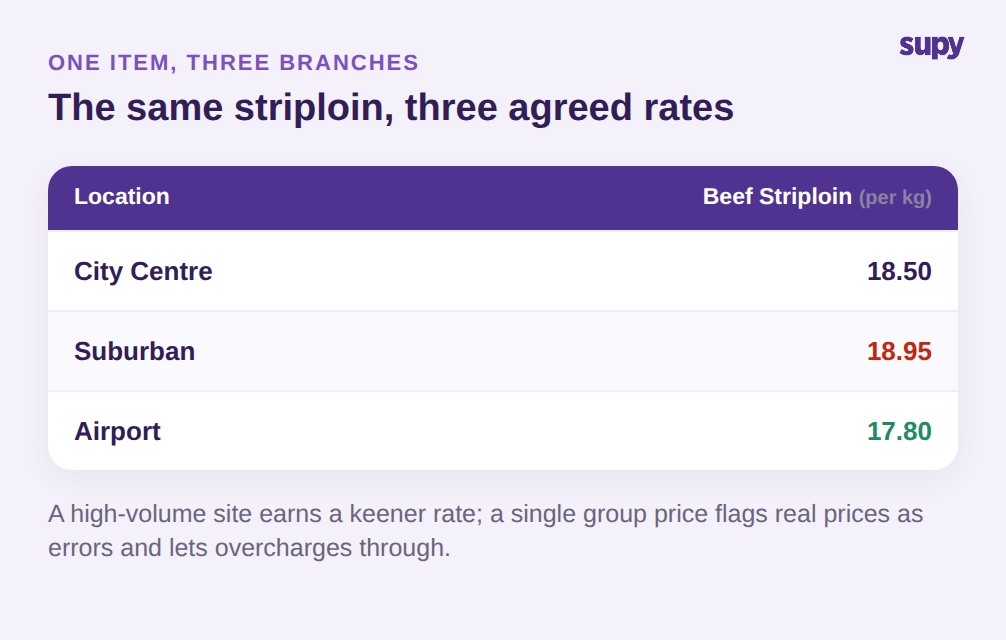
The second problem is that the same item rarely costs the same everywhere. A high-volume city-centre site negotiates a keener rate than a small suburban one; an airport location pays a different rate again because of access and delivery terms. Consider one item across three branches: the same beef striploin might be 18.50 a kilo at the city-centre site, 18.95 in the suburbs, and 17.80 at the airport outlet. A single group-wide "expected price" is wrong for all three, so a spreadsheet built on one number flags real prices as errors and lets genuine overcharges through. Managing supplier prices at scale means holding a correct rate per item per location, which is exactly the kind of detail a shared spreadsheet loses first. If overcharges are already slipping through, our guide to catching supplier overcharging in restaurants covers the reconciliation side in more depth.
The Fields a Working Supplier Price List Needs
A price list earns its place only if every row can answer one question: is this line priced the way we agreed, and if not, by how much. That takes six working fields, not a name and a number.
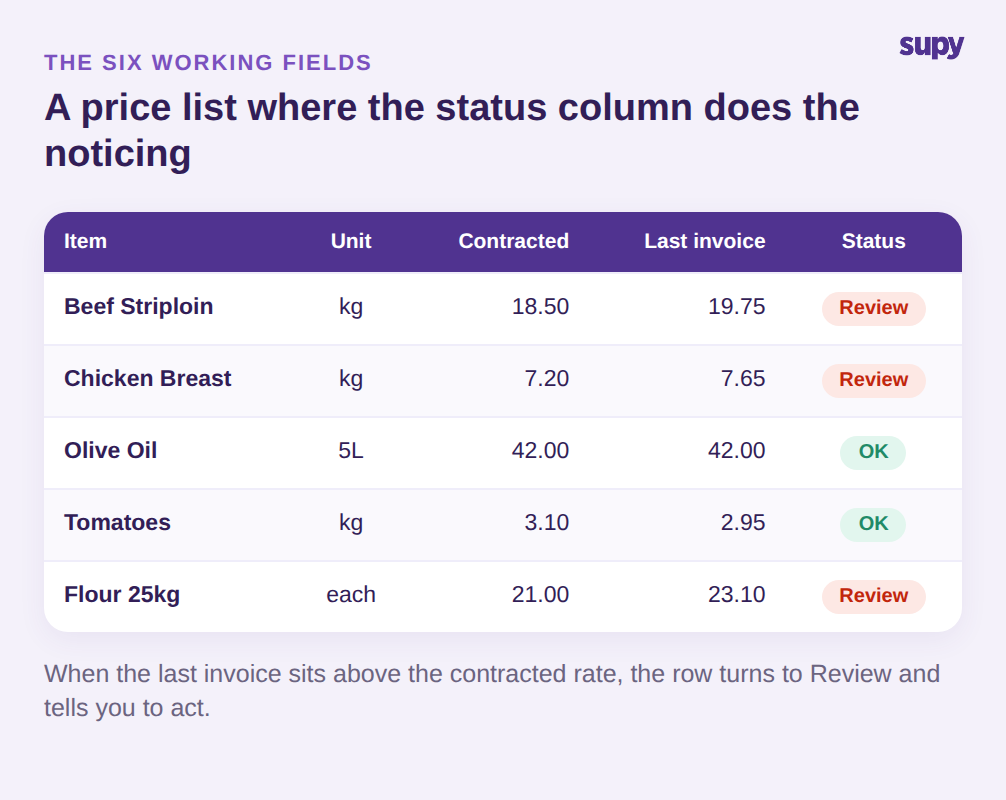
The core fields are the item, the supplier, and the unit of measure, because a price is meaningless without the unit it applies to. To those, add the contracted rate, which is the price you actually agreed, and the last invoice price, which is what you were most recently charged. The sixth field is the one most spreadsheets skip: a status that compares the two, so the row reads as an instruction rather than a record. When the last invoice price sits above the contracted rate, the status turns to Review and the row tells you to act; when it matches, the row stays quiet.
That single comparison is what turns a list into a tool. A row showing flour at a contracted 21.00 and a last invoice of 23.10 is not data to file, it is a 10 percent variance to raise with the supplier this week. Build the list so the status column does the noticing, and you no longer depend on a person remembering to compare two numbers that live in different systems. Keep the same discipline for the rate per location described above, and one list covers every site without pretending they all pay the same.
Two more fields make the list defensible rather than just useful. Record the date each contracted rate took effect, so that when a supplier says a price changed, you can see whether you ever agreed to it and from when. And keep a note of who owns the relationship with each supplier, so a flagged line goes to the person who can actually pick up the phone. A price list that shows what you agreed, what you paid, when it changed, and who to call is one you can act on the same day, not a document that gets rebuilt from scratch every quarter.
From Price List to Protected Margin
A price list that catches drift is the start. The value comes from three moves that follow it, and each one closes a gap where money usually leaks.
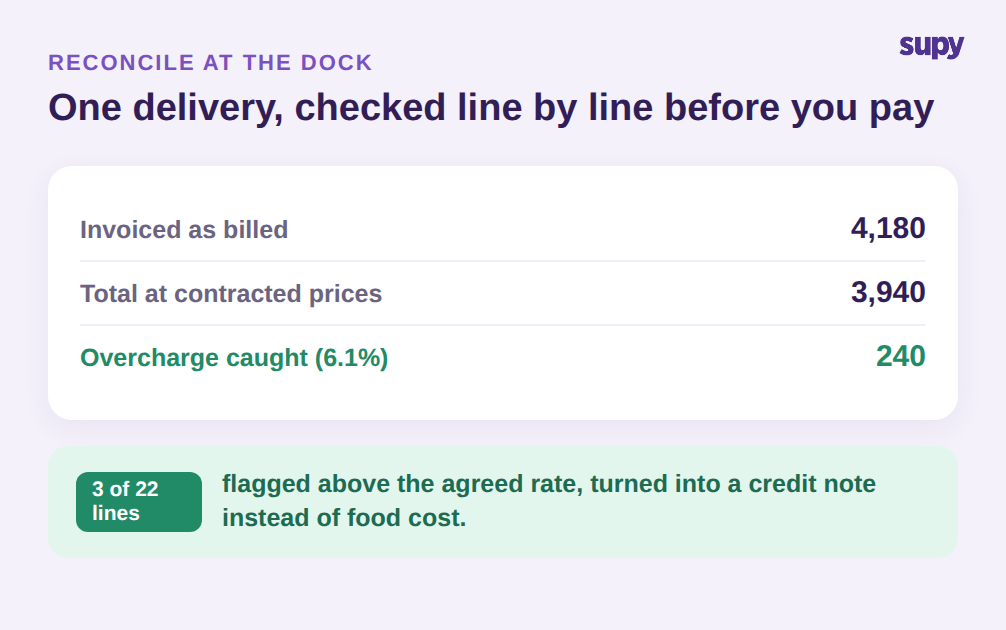
The first move is reconciliation: line up every invoice against the contracted price before you pay it, not at month end. On a single delivery of 22 lines, that check might flag 3 lines and surface an overcharge of 240 against a total that should have been 3,940, a 6.1 percent difference you would otherwise have paid in full. Catch it at the dock and it becomes a credit note; miss it and it becomes food cost.
The second move is cascading the change. When a supplier price genuinely changes and you accept it, that new cost has to flow into your recipe costs and your food cost percentage, or your margins are calculated on numbers that are already stale. A price rise you absorbed last month should already be visible in this month's plate costs. If it is not, you are pricing your menu against a cost you no longer pay. Our explainer on how food cost percentage works shows why a small unnoticed rise on a high-use ingredient moves the whole number.
The third move is using the data as leverage. Once you can see spend by item and by supplier, the picture usually concentrates fast: three suppliers might account for 68 percent of spend, and your single largest supplier might take 210,000 a year. That is a negotiating position, not just a report. A 3 percent reduction on that top supplier is 6,300 a year, and you only ask for it credibly when you can show the spend history that justifies it. Supplier price increases are far easier to resist when you can prove what you buy, how often, and at what rate.
Together, those three moves change the relationship. Instead of discovering price rises after you have paid them, you catch them at the door, keep your costing honest, and walk into supplier conversations with the numbers on your side.
Where to Start This Week
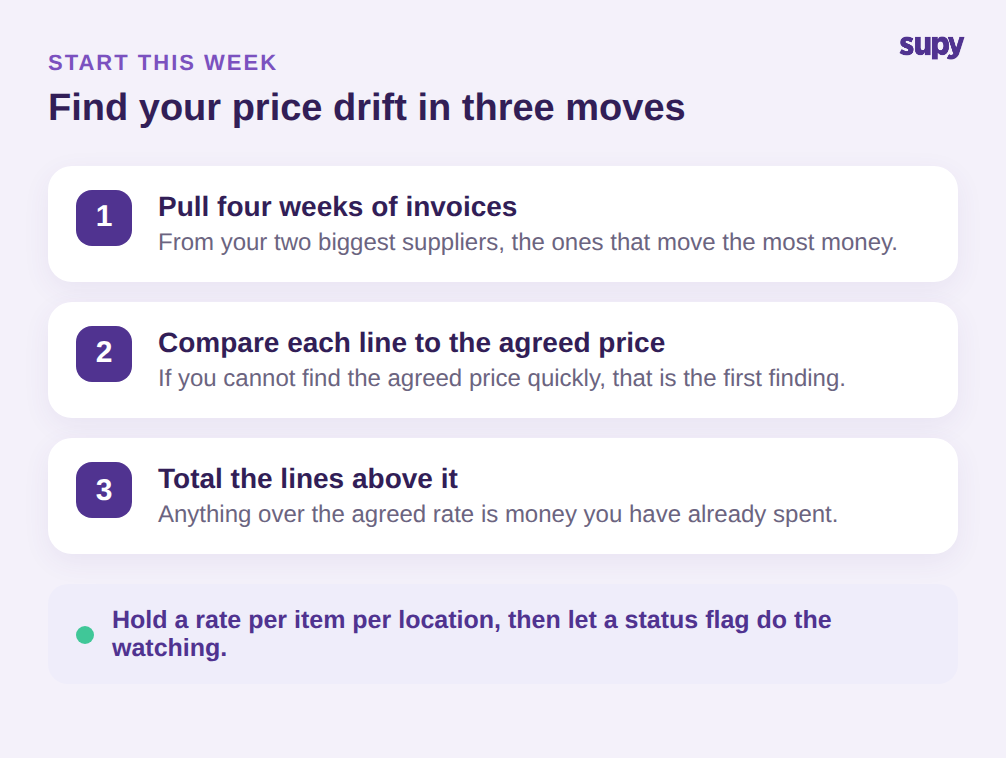
You do not need a project to find out whether price drift is happening to you. Take your last four weeks of invoices from your two biggest suppliers and compare each line against the price you believe you agreed. If you cannot find the agreed price quickly, that is the first finding. If more than a handful of lines are above it, that is the second, and it is money you have already spent.
From there, the fix is a discipline before it is a tool: hold a contracted rate per item per location, compare every invoice against it before paying, and let a status flag do the watching so no one has to remember. A restaurant that manages supplier prices this way stops paying for drift it never agreed to and turns its own purchase history into leverage at the next negotiation.
Supy gives multi-site operators one place to manage supplier prices, reconcile invoices against contracted rates automatically, and cascade any accepted price change straight into recipe costs and food cost reporting across every location, so drift is caught before it is paid rather than after. If manual price checking is quietly costing you margin, that is the gap it closes.