.jpg)


Supplier Returns for Multi-Site Restaurants: How To Recover Every Credit You Are Owed
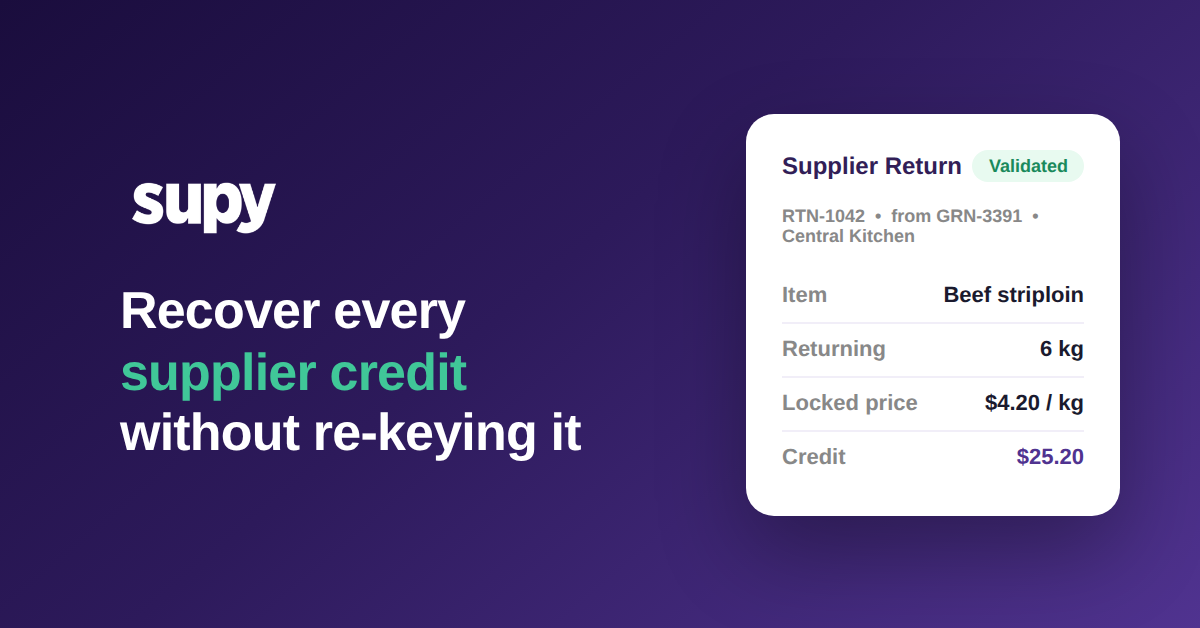
When a delivery arrives short, spoiled, or wrong, the money you are owed only comes back if the return is raised cleanly and the credit note matches what you actually received. The fastest way to get there is to raise the return from the goods received note (GRN) itself, so the items, quantities and prices are already locked to that delivery and the credit claim writes itself. That one change turns returns from a re-typing exercise into a two-minute confirmation, and it is where multi-site groups stop leaking credit they are entitled to.
Raise the Return From the Received GRN, Not a Blank Form
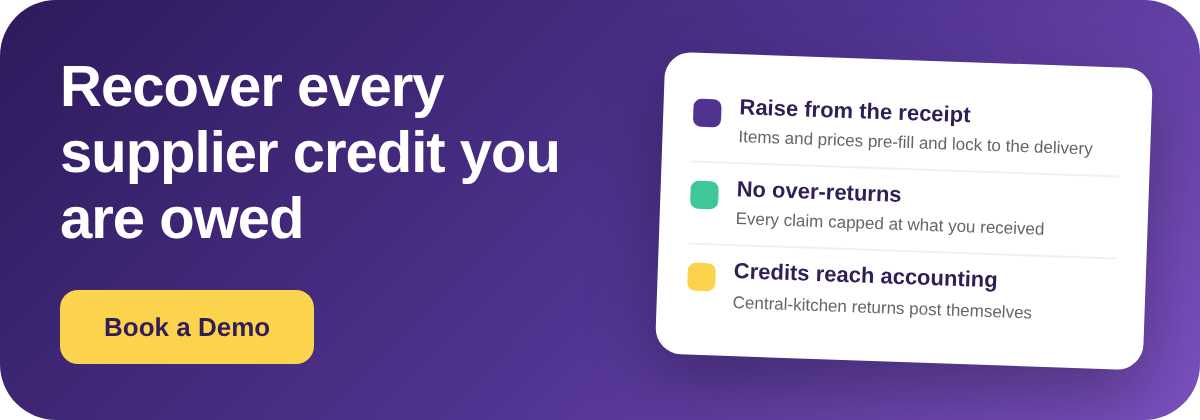
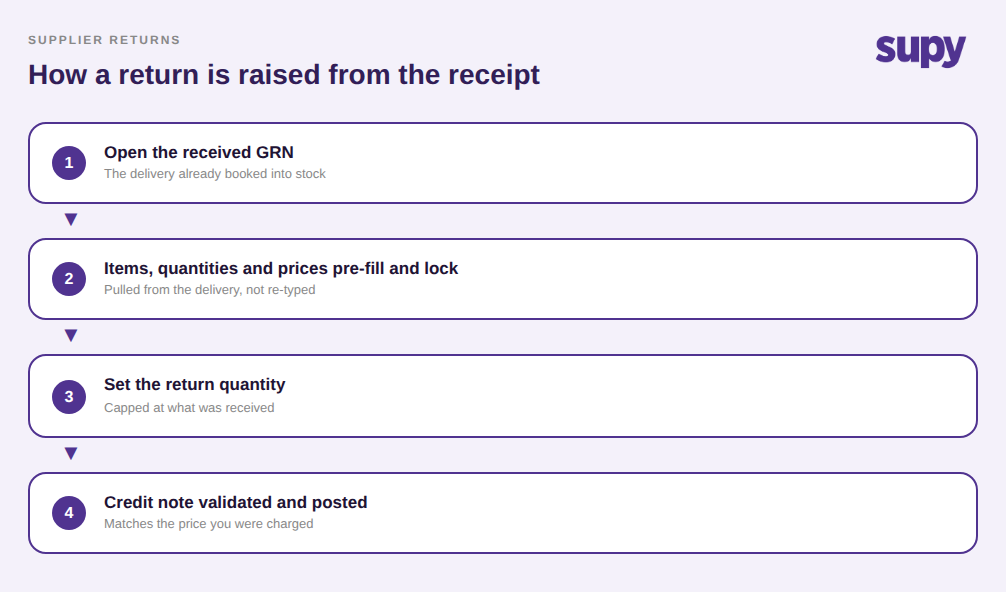
A supplier return is the document you raise to send received stock back to a supplier and claim the credit for it. Raised from the goods received note, it opens pre-filled with the delivery's real items, quantities and locked prices, so the credit note reflects exactly what was booked in - not a figure someone re-keys from memory. You set the return quantity, and the credit calculates against the price you were actually charged.
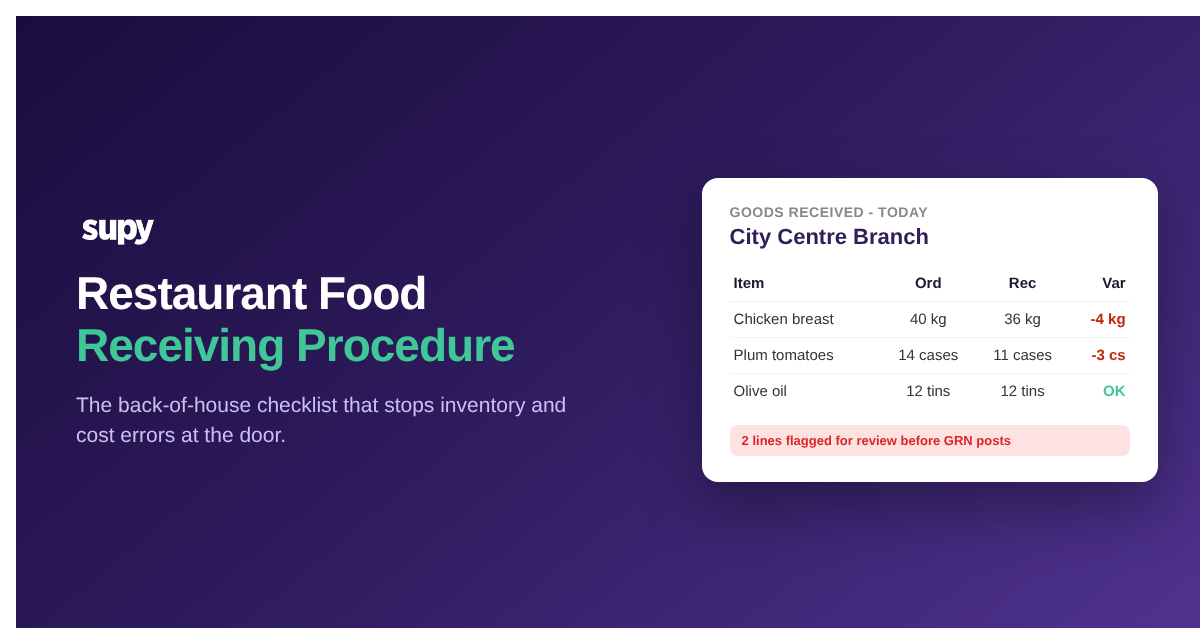
That matters because the alternative is a blank form. When a team member types a return from scratch, they guess the price, round the quantity, and reconcile it later against an invoice that may already be paid. Pulling the return from the GRN removes the guesswork: the beef striploin you booked in at $4.20 per kg comes back as a credit at $4.20 per kg, and a 6 kg return off a 40 kg receipt lands as a $25.20 credit with no arithmetic on anyone's part. Across dozens of deliveries a week and several branches, that is the difference between credits that match and a month-end reconciliation that never quite ties out.
Where Hand-Keyed Returns Leak: Over-Returns and Credit That Never Matches
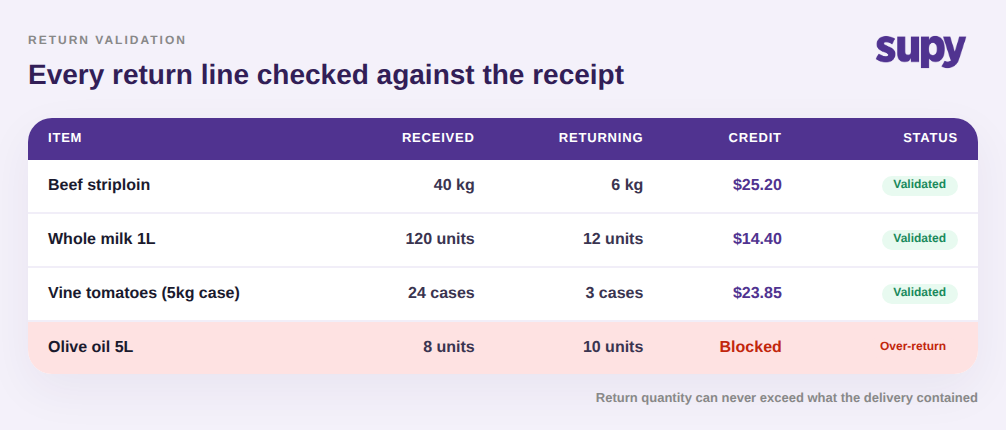
The two failure modes that quietly drain returns are over-returns and mismatched prices, and both come from raising returns detached from the receipt. An over-return is a return for more than you were delivered - a team member claims 10 units back against a receipt of 8, either by mistake or because two people raised the same return. The supplier rejects the excess, the credit note and the claim disagree, and you are now in a discrepancy dispute that costs more staff time than the credit was worth.
Raising from the GRN closes both gaps. The return is capped at the received quantity, so a claim can never exceed what the delivery actually contained, and the credit-note allocation is validated before the return is submitted rather than caught weeks later. The result is that every return line agrees with its receipt on both quantity and price the moment it is created - the validation happens up front, not in a month-end investigation.
Central Kitchen Returns: Closing the Credit-Note Gap Into Accounting
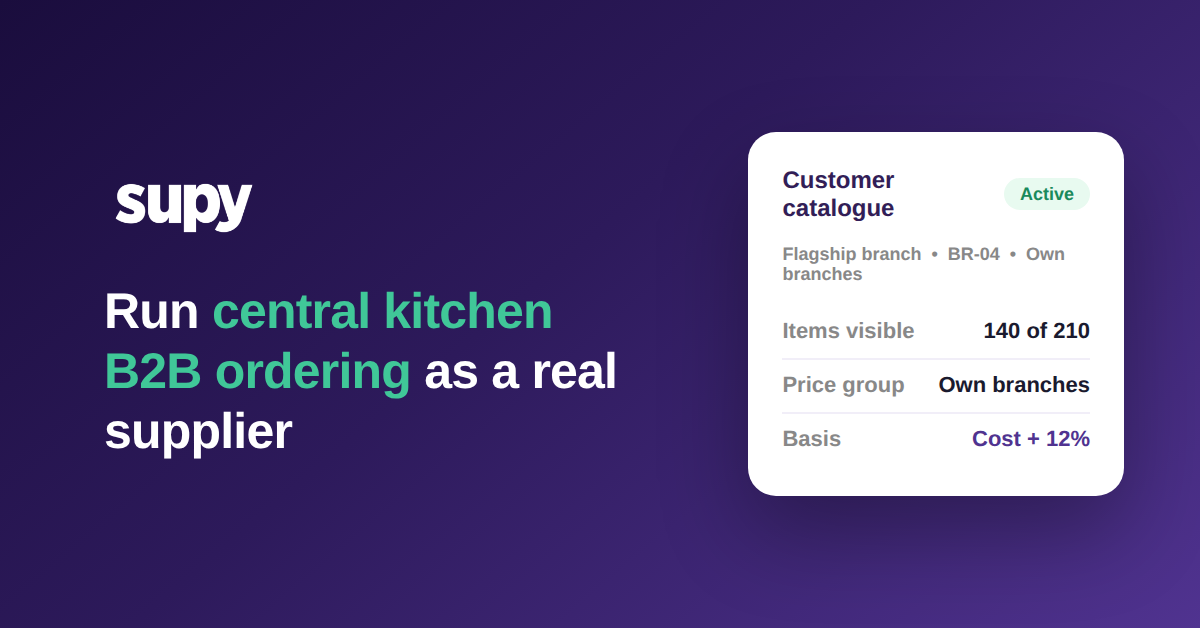
For groups that run a central kitchen supplying their own outlets, returns have historically been where the numbers fall out of the ledger. Operators described the same gap repeatedly: supplier returns raised from the central kitchen did not post to accounting, and there was no clean credit-note flow for returns coming back from the outlets the kitchen serves. Every one of those credits became a manual journal entry, keyed a second time into the accounting system, which is exactly where duplicate-entry errors creep in.
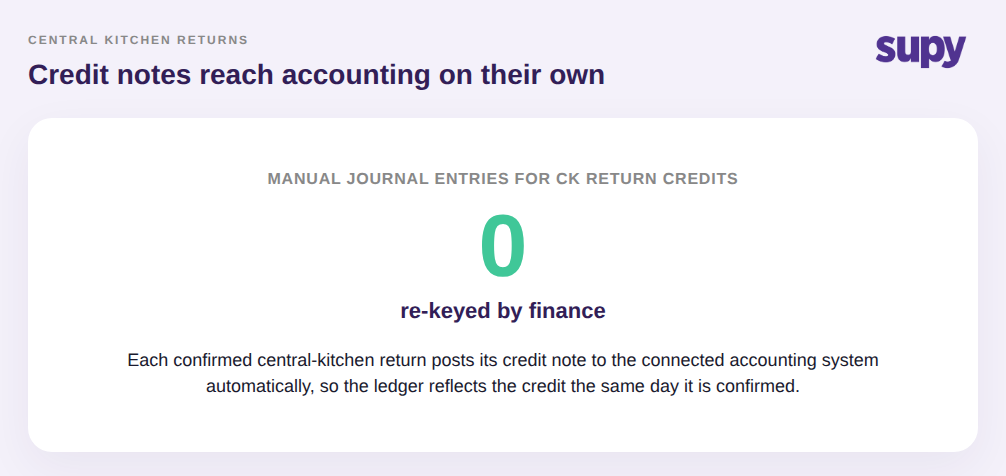
Closing that gap means the credit note posts itself. When a central-kitchen return is confirmed, its credit note is pushed to the connected accounting system automatically - the count of manual journal entries for those credits drops to 0. Finance stops re-keying returns, the ledger reflects the credit the same day it is confirmed, and the two sides of the business stop drifting apart between close cycles.
Decide Which Returns Need Approval and Which Should Just Clear
Not every return should move at the same speed, and treating them the same is its own kind of friction. A return to an outside supplier is a claim against another company's account, so it should carry an approval step before it is confirmed - someone signs off that the goods really are going back and the credit is correct. An internal return from an outlet to your own central kitchen is a movement inside one business, so making a manager chase an approval for it just slows the kitchen down for no control benefit.
The workable rule is to route external supplier returns through approval and let internal central-kitchen returns auto-approve and clear. External claims get the scrutiny they warrant and post to accounting on confirmation; internal returns clear the same day without an approval queue. Because returns can be raised and posted from the mobile app, the person actually holding the stock at the receiving dock can start the return on the spot, and it follows whichever path its type calls for.
| Return type | Approval | Posts to accounting | Clears |
|---|---|---|---|
| External supplier Claim on another company | Approval step | On confirmation | Next day |
| Internal central kitchen Movement inside the business | Auto-approved | Automatically | Same day |
Before your next delivery week, pull one supplier return your team raised by hand last month and check it against its GRN: does the quantity exceed what was received, and does the credit match the price you were charged? If either is off, that is the leak this workflow closes - start by raising your next return straight from the receipt and let the credit note validate itself. If you want to see how returns fit the wider procurement workflow, explore the Supy platform.