





What a Restaurant Manager Checklist Should Prove About Every Shift

What a Good Manager Checklist Proves
A restaurant manager checklist is worth keeping only when it proves checks were done, and done properly, not just ticked. It records who did each check and when, so an operations director can see every site. This article shows what to put on it, and how to prove it.
A tick on a sheet proves nothing. The staff member who ticks it wants to avoid blame from the manager, and the manager wants the same cover from the operations director. So a good checklist carries the evidence.
- A temperature written down with the time
- A photo of the labelled prep
- A sign-off against each closing line
| Shift stage | Check | What good proof looks like |
|---|---|---|
| Opening | Fridge and freezer temperatures | Each reading recorded with the time and the person who took it |
| Opening | Allergen and date labels in place | A photo of the labelled prep attached to the check |
| Mid-shift | Wastage logged as it happens | Each item and reason recorded through the shift, not guessed at close |
| Mid-shift | High-value stock counted | The count submitted, not left in draft |
| Closing | Cleaning and equipment signed off | The manager's sign-off against each line |
| Closing | Cash and handover reconciled | The figures recorded and matched before lock-up |
Supy Ops, Supy's checklist software, lets you build a checklist like this once and run it at every branch, with each step recorded as staff complete it. For a ready-made list to start from, see our restaurant checklist template.
Which Checks Need a Manager, Not a Tick
Most lines on a checklist are routine, but a few need a manager to look and decide. Mark those clearly, because they are where a tick hides a real problem.
- Routine check. A routine check confirms something normal happened, like the lights going on.
- Judgement check. A judgement check asks the manager to read a result and act on it.
These are the lines that usually need a manager:
- A fridge reading over range. Move the stock and record the reading, do not just tick the box.
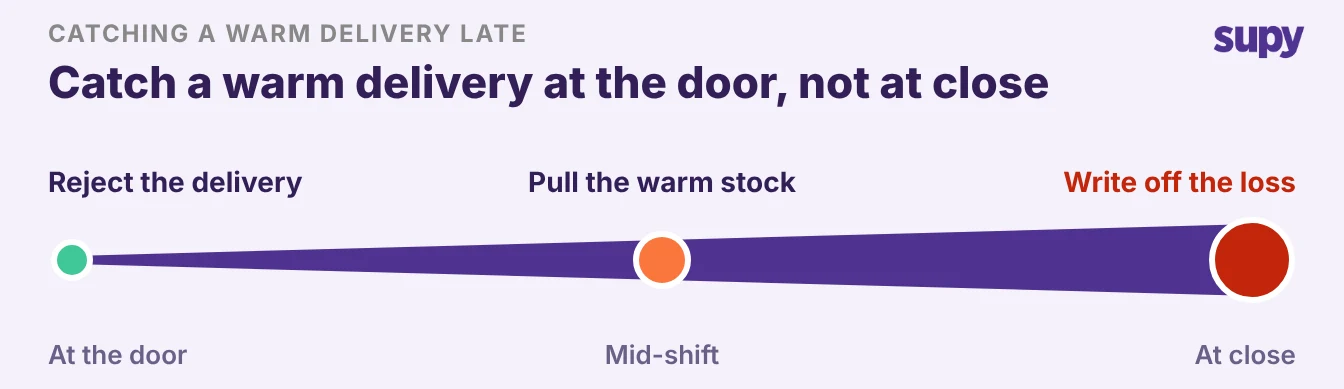
- A delivery that arrived warm or short. Reject or note it at the door, because it is too late at close.
- Fryer oil past its limit. Change it and log it, so the next shift is not cooking in old oil.
Write the action next to the check, so nobody has to remember it. In Supy Ops, a failed step can carry its own corrective action. The manager sees the fix the moment the check fails, not at the end of the shift.
Spotting a Check Done Too Fast or Off-Site
A checklist is only worth keeping if you can trust the checks happened.
- Recorded too fast. Managers sometimes record a ten-step check as done in about two minutes. That is too fast for anyone to have walked the floor.
- Filled from home. Others fill the sheet in before the shift, or from home, so the sheet says one thing and the kitchen says another.
Timestamps are what catch this.
- Run stands out. When each step records the moment it was completed, a run of checks finished in two minutes stands out.
- Before anyone arrived. A check completed before anyone arrived does too.
Ask for the check to be done on the phone, at the site, as the work happens.
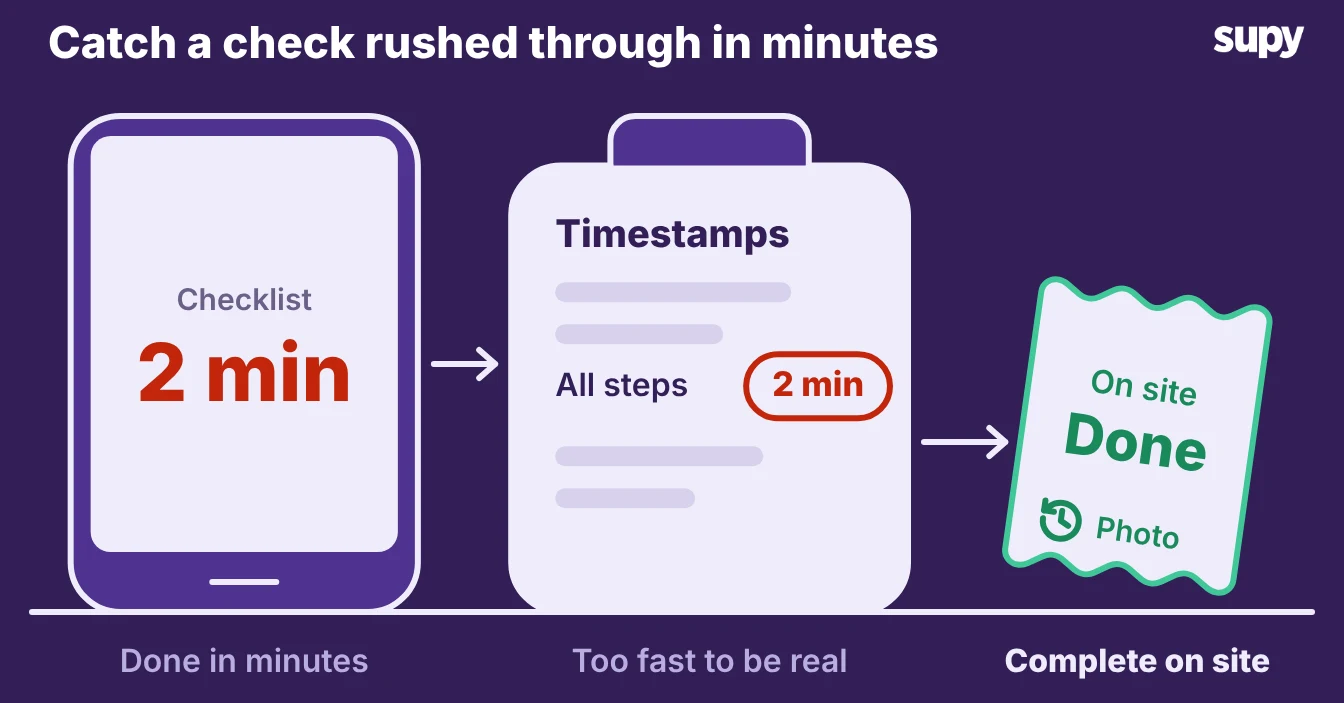
Photo proof raises the bar again. A photo of the labelled fridge or the cleaned line is harder to fake than a tick. Supy Ops records when each step was done and lets staff attach that photo, so a rushed or remote check is visible rather than hidden.
What to Escalate to the Operations Director
Most failed checks the manager fixes on the shift. A few belong with the operations director, and the checklist should move them up without a phone call. A walk-in that fails overnight, a missed delivery, or a safety check that cannot be signed all change what happens tomorrow, not just tonight.
Agree the escalation line in advance. For each judgement check, decide what the manager handles and what goes up. Then nobody has to guess at 11pm, and a panicked message becomes a logged corrective action the director can pick up in the morning.
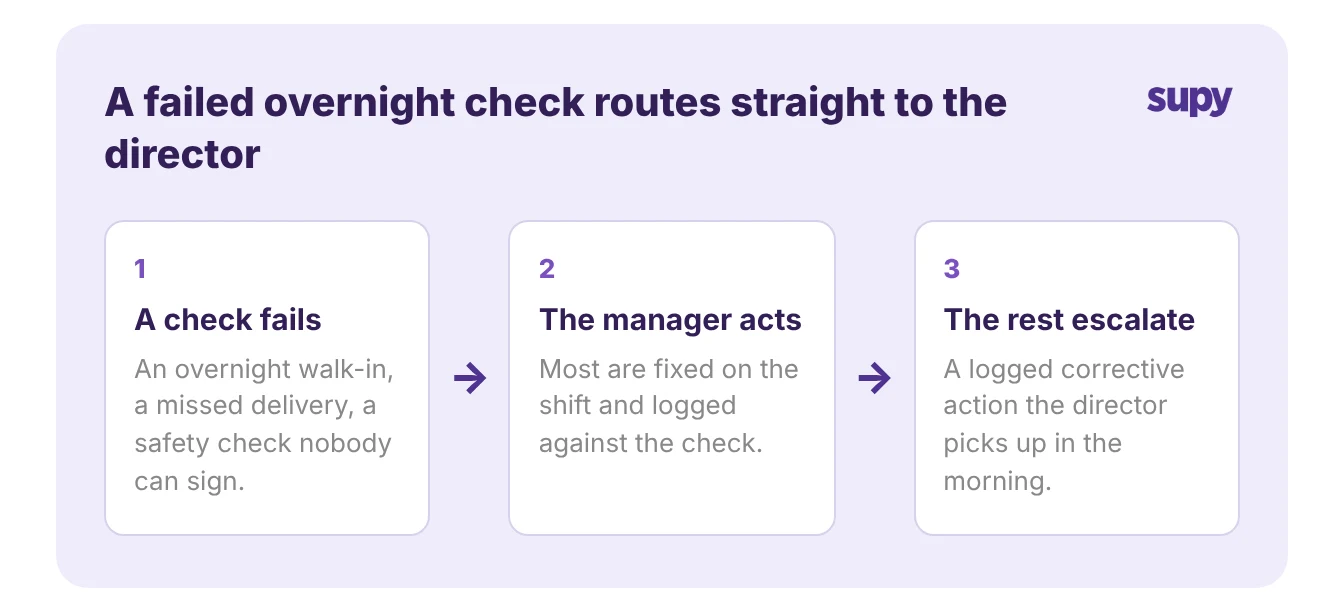
Supy Ops keeps the corrective action and its history. The director sees what failed, who was on, and what was done, without chasing it down. The record is the escalation, and it is already written.
Comparing Completion Across Your Sites
Across a group, the real question is which sites run their checks and which quietly skip them.
- Against group average. One site finishing 98% of its checks and another at 70%, against a group average near 86%, is not something you can see from head office.
- Costs you money. That gap costs you money, because a multi-site group often traces most of its stock variance back to the sites where checks were inconsistent.
A completion view answers it. Supy Ops reports completion across every branch, so the operations director can see who is on top of their checks and who is overdue. Rank the sites, look at the laggards first, and ask what makes the check hard to finish there.
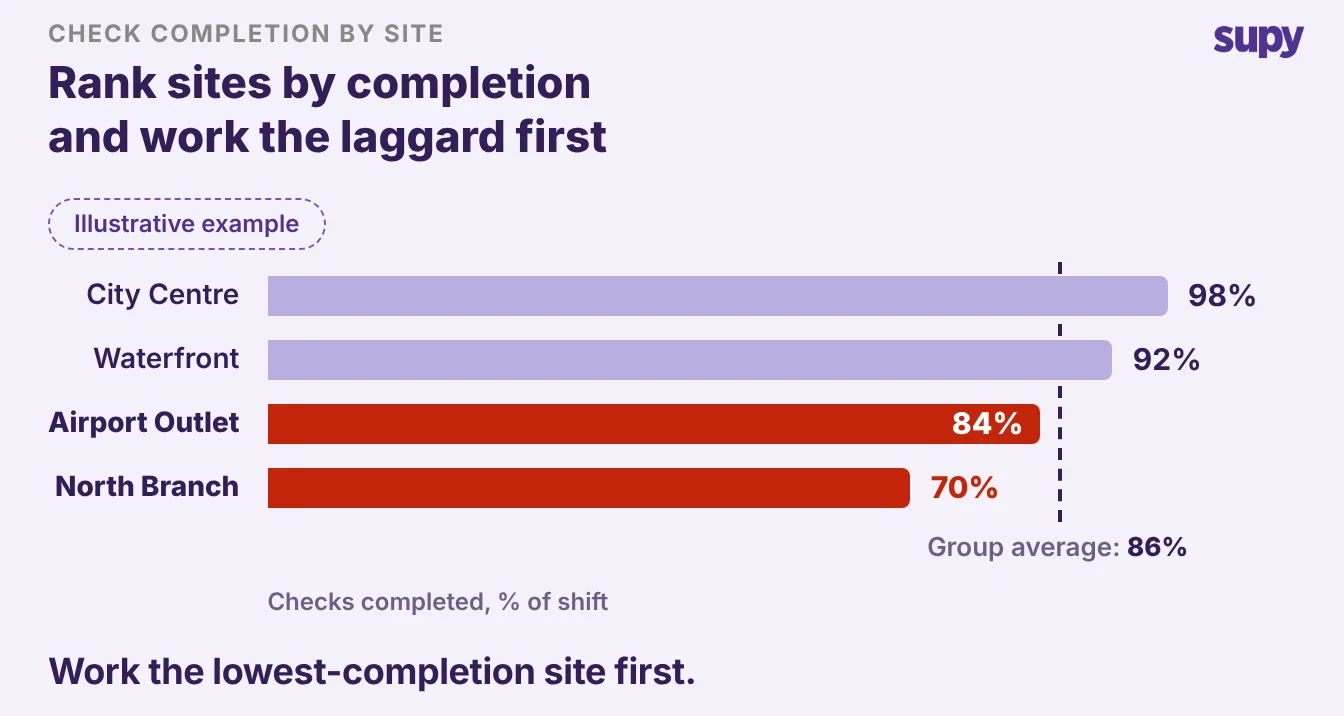
Track that gap as a number you check each week. A site well below the rest usually has a check that is unclear, too long, or owned by nobody. The completion report is what points you at it.
A manager checklist is worth the effort when it proves the shift ran properly, flags the checks that were rushed, and shows the operations director every site at a glance. Build it around the judgement checks, make each one carry its proof, and watch completion the way you watch cost.