





How to Choose a Restaurant Accounting Program for Multiple Sites

What a Restaurant Accounting Program Does, and Where It Stops
A restaurant accounting program records your sales, supplier invoices and payroll and produces your profit and loss statement. It keeps the statutory books, but not the kitchen numbers behind them, so a group can budget food cost at 28% and still read 33% in the books. This article shows what the program does, where it stops, and how to get each site's kitchen numbers into one set of books.
- Does not hold. It does not hold recipes, stock counts or goods received notes, so the cost of goods in it is only as good as the numbers you feed it.
- Separate legal entities. It also rarely fits a group whose central kitchen and venues are separate legal entities. In that group, a stock transfer between them needs an internal recharge invoice. Each side carries a different code: a purchase nominal code for the venue, a sales nominal code for the kitchen.
- Leaves gaps. So a program that looks complete for one site leaves gaps the moment you run several. The books still balance, but the kitchen holds most of the numbers behind the cost of goods, not the accounting program.
Pick the program for what it connects to, not only for what it posts. A restaurant group needs its inventory and recipe costs to reach the books per site.
A restaurant analytics layer between the kitchen and the program matters as much as the program itself. It gives the program the food cost, wastage and supplier numbers each site actually ran.
Why Your Books Show More Food Cost Than the Kitchen Used
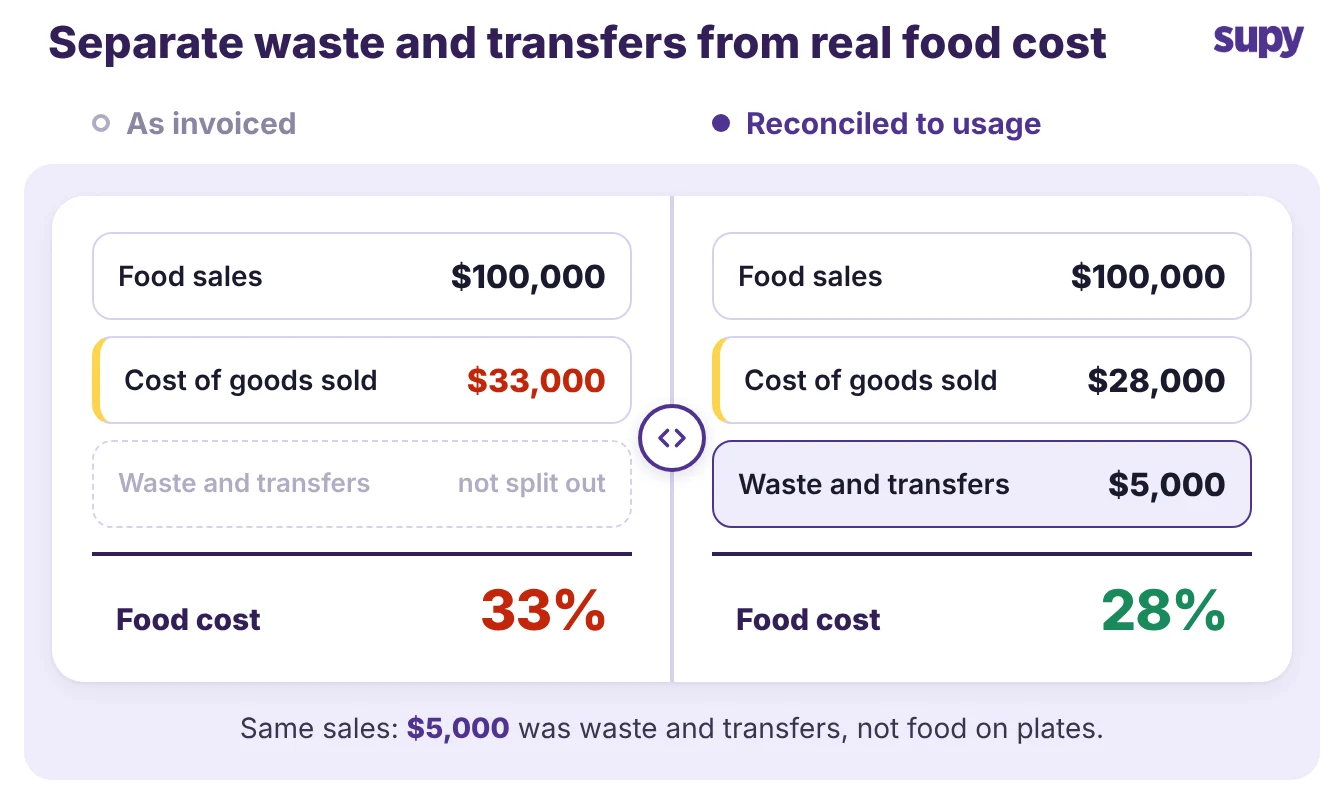
Your books show a higher food cost than the kitchen ran, because the program posts what you were invoiced, not what the kitchen used. Several everyday events move real cost without touching the books until close.
A dish gets costed on last month's prices. An ingredient spoils before service. A transfer between sites arrives but nobody receives it.
- Reports the gap. Say a group budgets food cost at 28% and the books show 33% at month end. The program cannot tell you why. It sees supplier spend and sales, so it reports the gap, not the cause. The cause sits in stock counts, wastage and recipe costs the program never holds.
- Close the variance. You close the variance when you measure cost of goods sold from what the kitchen actually used. Cost each recipe from what the kitchen actually consumed after prep wastage, not the written amount. Then the program's cost of goods matches the kitchen, and the variance stops being a mystery. Our food costing software guide covers how that calculation works.
Getting Inventory and Supplier Invoices Into the Program
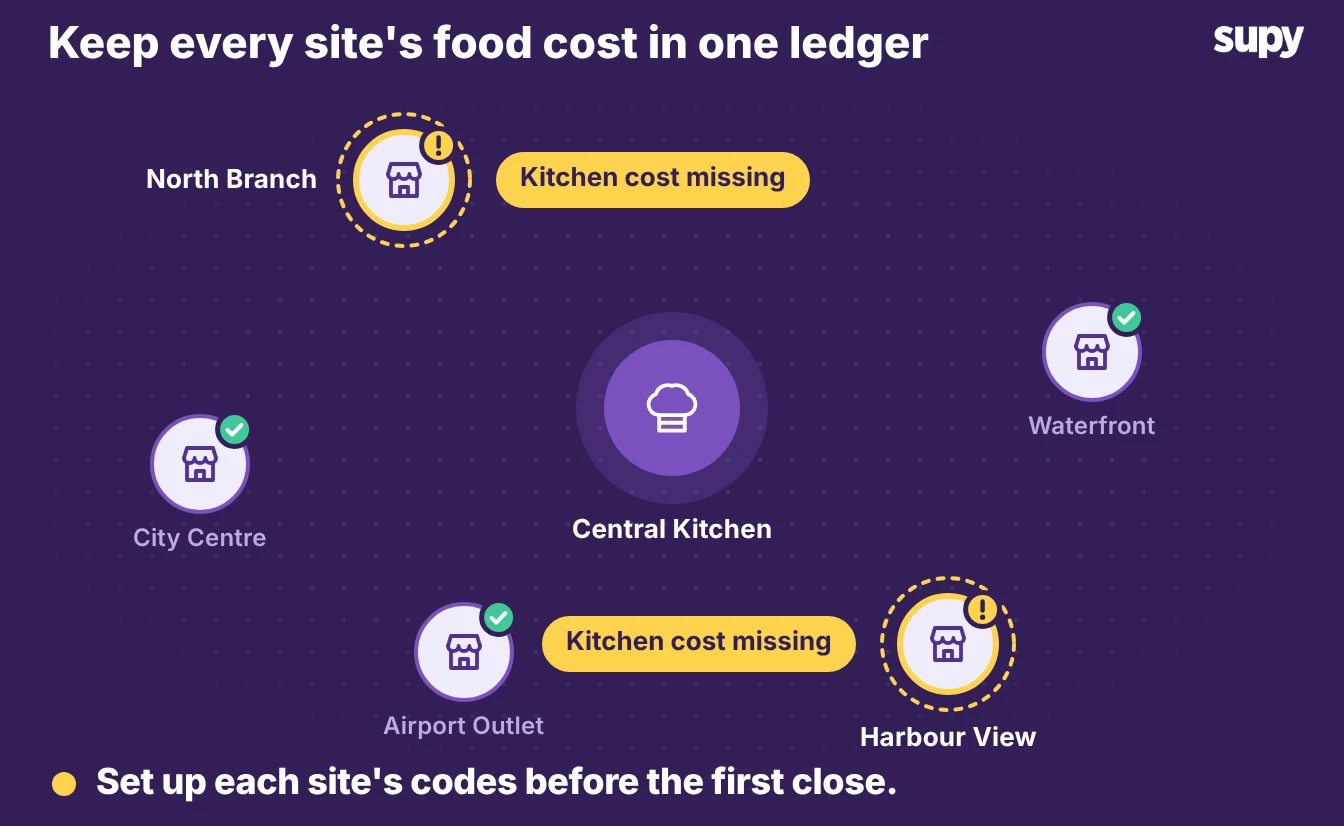
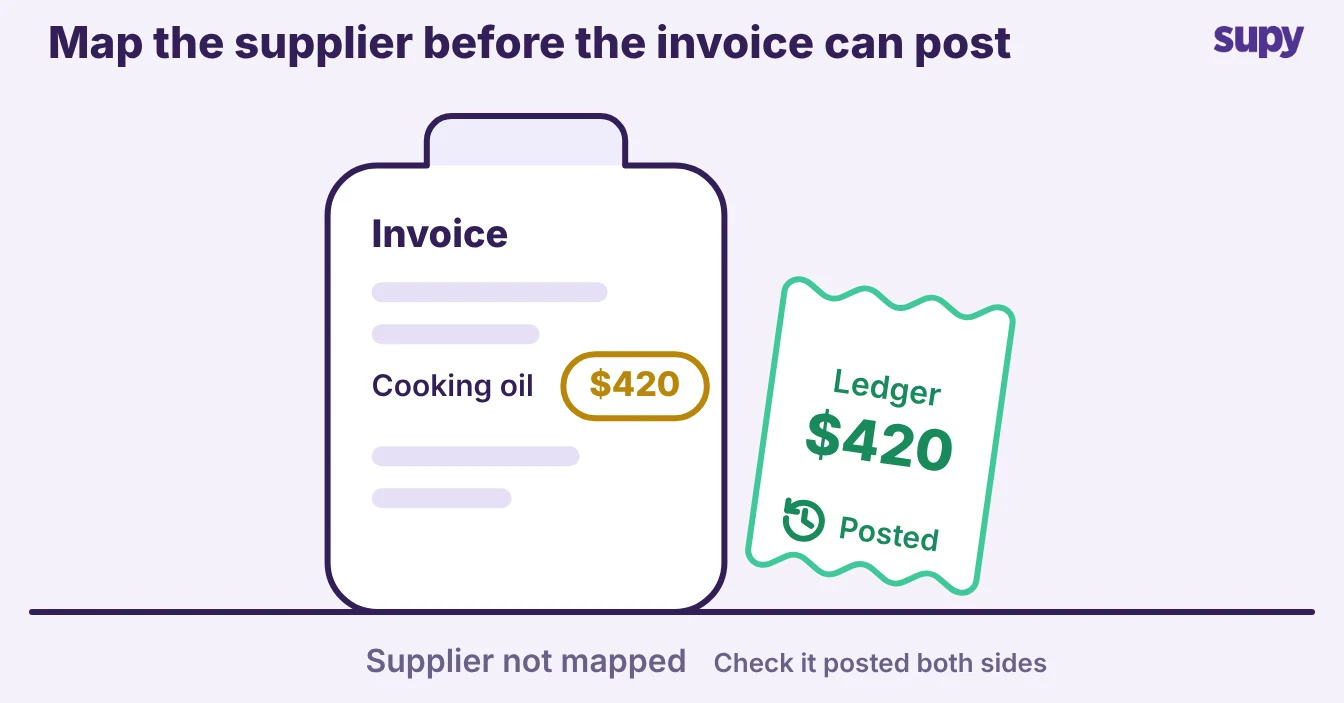
Before anything syncs, you map your branches, suppliers and tax codes to the program's equivalent records. Miss a mapping and the sync stops. An unmapped supplier, an unmapped site or a missing tax code blocks the invoice, and you find out at close rather than at receipt.
- Map per site. Set the mapping up per site before the first period close, not during it. When only one location appears in the program's account mapping list, the other sites' invoices cannot export. The books then look light until someone notices. Verify the general ledger, nominal and tax codes for each category and each venue first, then post.
- Confirm both sides. Confirm each invoice landed on both sides. An invoice can show as posted in the inventory system while the program still lists it as unsent. So a figure you think is in the books is not.
- Re-run the failures. Check both places and re-run the ones that failed. Keep that list of failures, because the same suppliers tend to fail the next close, and you fix the mapping once.
Accounting Across Separate Legal Entities
A group often runs its central kitchen and its restaurants as separate legal entities, each with its own set of books. When the kitchen sends stock to a venue, that transfer is a sale for one entity and a purchase for the other.
So it needs an internal recharge invoice. One side carries a purchase nominal code, the other a sales nominal code.
- Generic item mapping. The same generic item makes this harder. Cleaning chemicals or a food item can carry a different nominal code in each entity, so each entity needs its own mapping.
- Duplicate confuses counts. A program set up for a single company does not expect two codes for one item. The common workaround is to duplicate the item, which confuses stock counts. It also splits the same stock under two names, so a count that looks short is often the duplicate.
| Transaction | Posts in | Code it needs |
|---|---|---|
| Central kitchen buys raw stock | Central kitchen entity | Purchase nominal code |
| Kitchen sends stock to a venue | Both entities | Sales code out, purchase code in |
| Venue sells a dish to a guest | Venue entity | Revenue nominal code |
| Shared supplier invoice split by site | Each entity | Its own purchase code per site |
Ask any program you are weighing how it handles this before you commit. If the answer is a single company file and a manual journal each month, you will carry that work for as long as you run the group.
Choosing a Restaurant Accounting Program for a Group
Judge a restaurant accounting program on how it handles a group, not a single site. Any program handles the statutory posting. The real difference is whether the kitchen's numbers reach the books per site and per entity without a month of manual work.
| Criterion | What to check in a demo |
|---|---|
| Kitchen numbers reach the books | Does cost of goods sold come from real usage, or from invoices alone? |
| Per-site and per-entity mapping | Can every site and legal entity map its own suppliers, tax and nominal codes? |
| Recharge between entities | Does an internal transfer post as a sale and a purchase without a manual journal? |
| Integration, not replacement | Does it connect to the accounting platform you already run, across every site? |
Supy connects to more than 75 systems.
- Accounting platforms. That includes accounting platforms such as QuickBooks, Xero, Zoho Books and Wafeq.
- Feeds the numbers. It feeds them the inventory, recipe cost and supplier numbers each site ran.
- Layer, not replacement. Supy is the layer that gets the kitchen into the books, not a replacement for the program your accountant signs off.
Start with one question in your next demo. Ask to see a stock transfer between two of your entities posting to the right codes on both sides. The answer tells you, in one screen, whether the program was built for a group or for a single restaurant.