.jpg)


Inventory Management Software for Restaurants: What Operators Actually Need
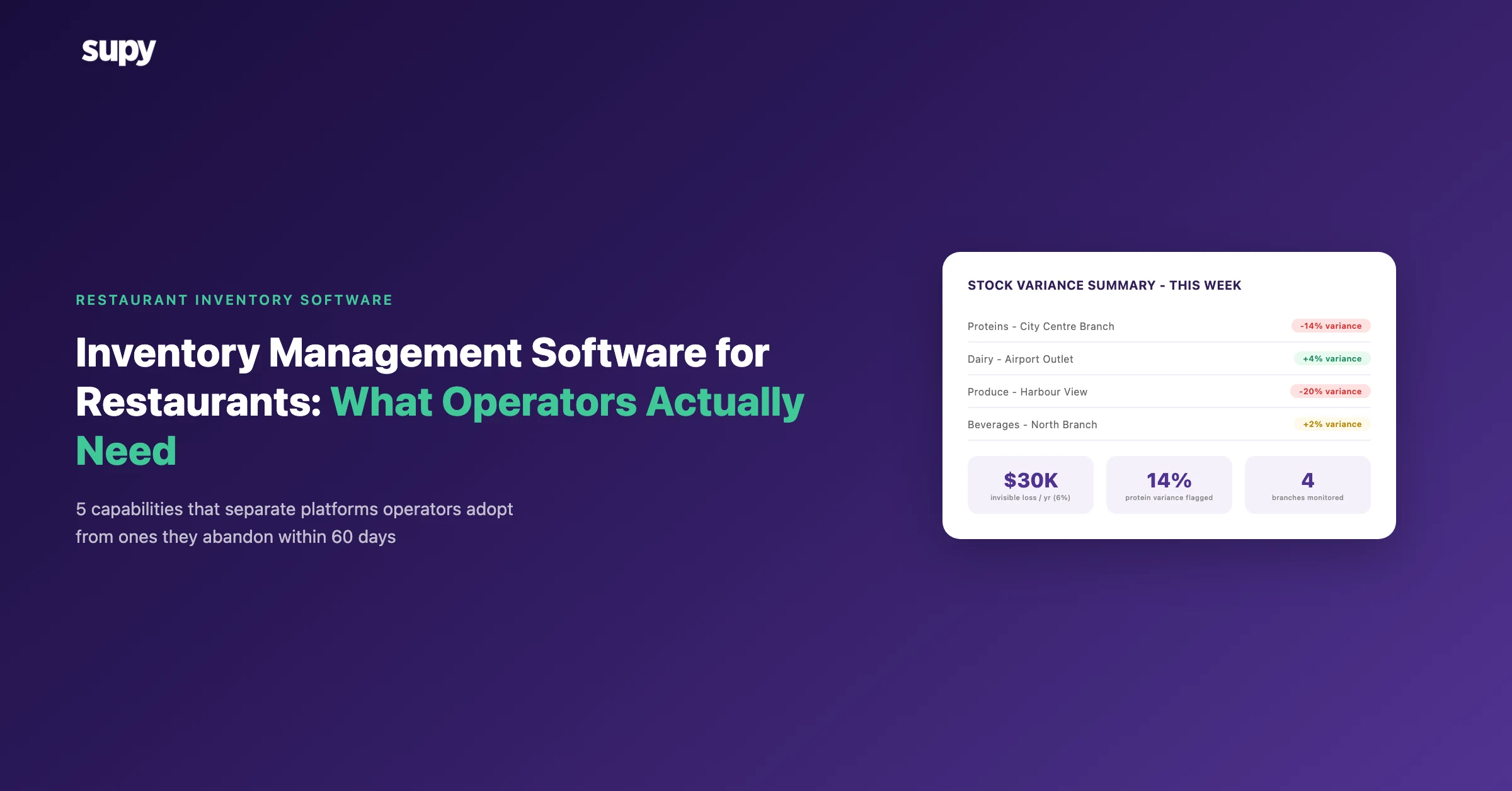
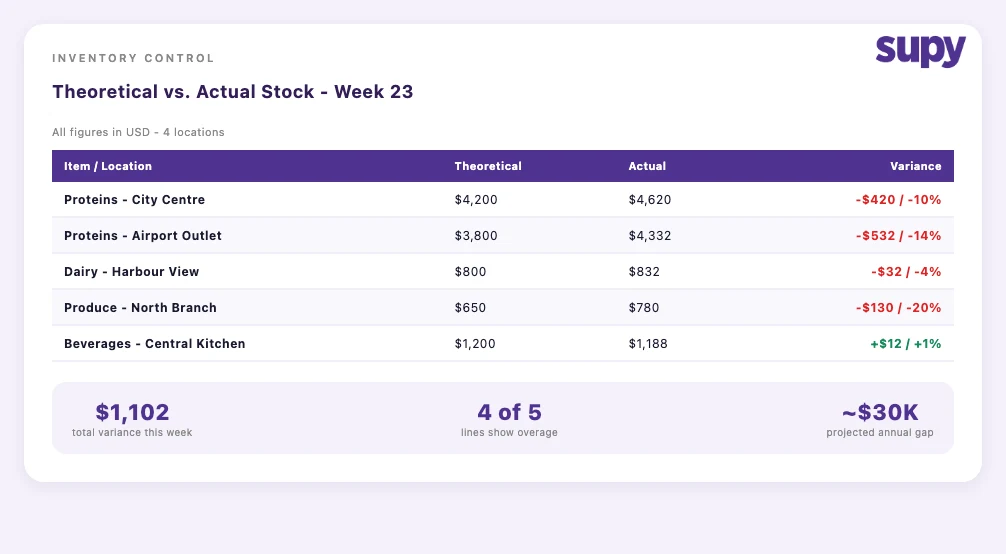
The head of operations at a 12-branch casual dining group in Riyadh ran a physical stock count on a Tuesday. By Wednesday, she had a 14% variance on proteins — $18,000 of ingredient cost she couldn't account for. Her existing system tracked purchases. It tracked recipes. It did not show her where $18,000 had gone. That gap — between what you bought and what you served — is precisely what restaurant inventory management software is supposed to close. Most platforms stop short.
This guide covers what the software must actually do, the five capabilities that separate tools that get adopted from those that get abandoned, and how to evaluate vendors against the operational reality of running multiple F&B locations.
What "Inventory Management" Really Means in a Restaurant Context
Restaurant inventory management software is not a digital stockroom. It is a live financial control system that connects what you purchase, what you prep, what you serve, and what remains on your shelves — and alerts you when those numbers stop reconciling.
The gap between how vendors describe these platforms and what multi-location operators actually need is significant. A system that tracks beginning stock, calculates COGS, and produces an end-of-period report delivers value in a single-site context. In a 10-branch group where one branch transfers stock to another, where a central kitchen dispatches to five outlets, and where a head chef adjusts a recipe mid-quarter — that same system creates manual reconciliation work every time an edge case occurs.
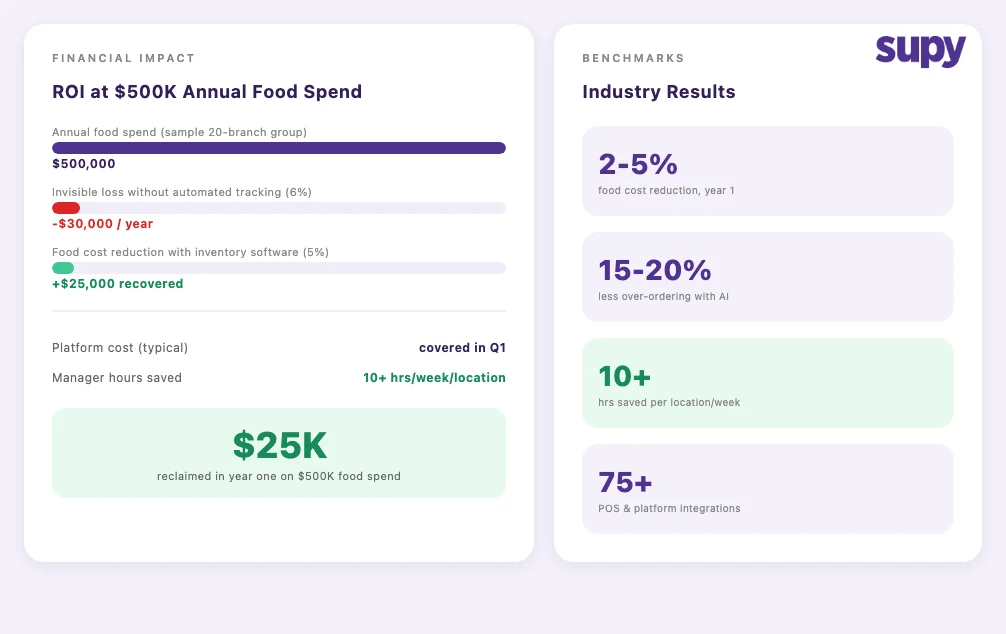
Restaurants typically lose 4–10% of food inventory to waste that is invisible without automated tracking. At $500,000 in annual food costs, a 6% invisible loss is $30,000 per year. Not shrinkage from theft or spoilage — but measurement failure. The software's job is to make that gap visible in real time, not in a monthly report.
What to ask: Can your current system tell you, right now, what your theoretical food cost percentage is versus your actual, and break that variance down by location and ingredient category?
The Five Capabilities That Determine Whether Operators Actually Use the Software
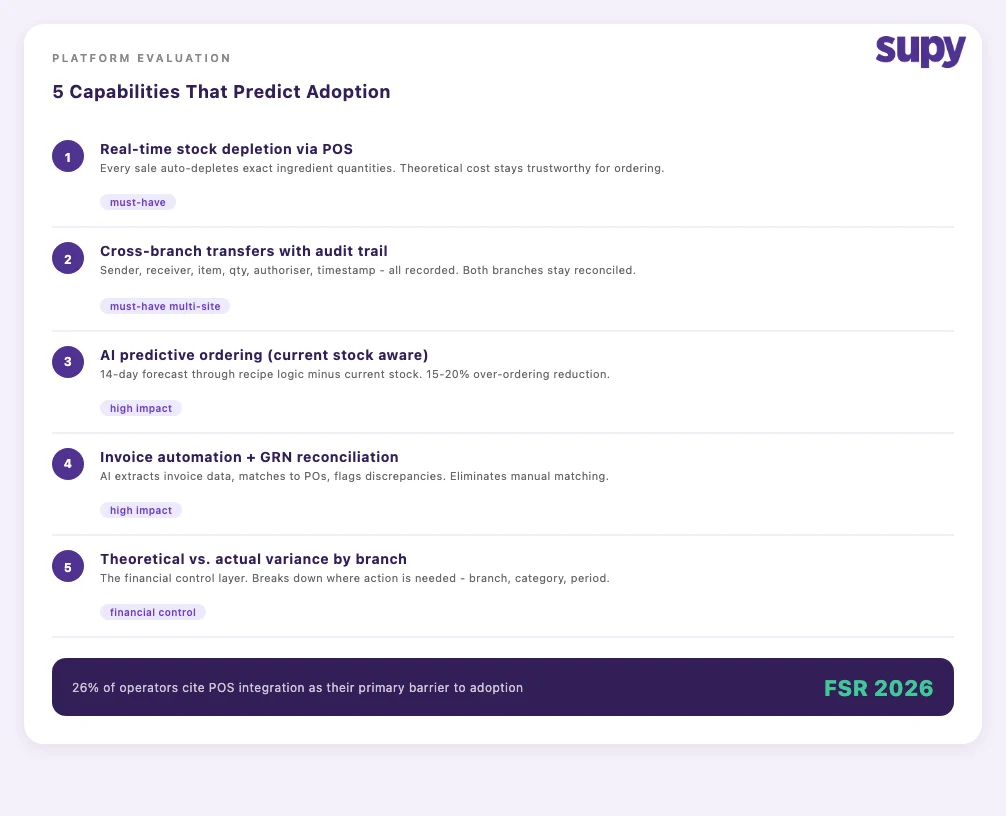
Adoption failure is the industry's dirty secret. According to FSR Magazine's 2026 technology research, 26% of restaurant operators cite POS integration challenges as their primary barrier to adopting inventory software. But even among operators who complete implementation, abandonment within 60 days is common when the system creates more work than it removes. Five capabilities predict whether a platform survives contact with daily operations.
1. Real-time stock depletion through POS integration. Every time a menu item is sold, the system should automatically deplete the exact ingredient quantities from inventory, based on recipe logic. Without this, theoretical food cost is a fiction — managers are manually estimating what the kitchen used rather than knowing it. The POS integration must be bidirectional and reliable enough that the system's theoretical stock figure can be trusted for ordering decisions.
2. Cross-branch stock transfers with audit trail. Multi-location operators consistently identify cross-branch transfers as a non-negotiable requirement. When a branch runs low on a high-velocity ingredient mid-service, the practical platform is a transfer from a neighbouring outlet. If the software cannot record that transfer — including the sending branch, the receiving branch, the item, the quantity, the authorising person, and the timestamp — then the transfer becomes a hole in the financial records. Both branches' stock figures become unreliable.
3. AI-powered predictive ordering that accounts for current stock. Manual ordering is where most operator time is lost and most over-ordering occurs. Platforms with AI-driven ordering build purchase orders from sales forecasts (typically based on 8–14 days of projected demand), run those figures through recipe logic to calculate required ingredients, then subtract current stock levels before generating a draft PO. This process — which previously took a manager 2–3 hours per location per week — runs in minutes. Operators who implement AI ordering consistently report 15–20% reductions in over-ordering.
4. Invoice automation and GRN reconciliation. Invoice management is the most operationally disruptive task in food procurement. A 20-branch group may process 200+ supplier invoices per week across three currencies. When invoice line items must be manually matched to purchase orders and goods received notes, the error rate is high and the time cost is significant. Systems that use AI to auto-extract invoice data, match it to POs, and flag line-item discrepancies — and that give managers a single interface to approve or dispute — eliminate a category of work that scales badly with branch count.
5. Theoretical-versus-actual variance reporting by branch and category. This is the financial control layer that makes everything else worth the investment. Real-time theoretical cost (what the system predicts you should have spent, based on recipes and sales) versus actual cost (what you actually ordered and received) is the number every F&B director needs. When it breaks down by location and ingredient category, the data points directly to where action is needed — whether that's portion control at one branch, a supplier pricing anomaly, or a recipe that has drifted from its costed version.
What to ask: Of these five capabilities, which are native to the platform and which require a third-party integration or manual workaround?
What Multi-Location Operators in GCC and UK Need That Standard Platforms Don't Deliver
Most inventory software was built for the North American market. The operational context in GCC and UK multi-location groups is materially different in ways that affect platform selection.
In GCC, the typical operator group runs across UAE, Saudi Arabia, Qatar, and Bahrain — each with different VAT regimes. The UAE applies 5% VAT on most food items; Saudi Arabia's rate is 15%. Multi-entity groups need invoice formatting and COGS reporting that is FTA-compliant in UAE and ZATCA-compliant in KSA. A platform that cannot handle per-entity VAT rates will create accounting corrections on every cross-border report.
The staffing context is also different. GCC hospitality has chronically high turnover, driven by visa cycles and a competitive talent market. Inventory software needs to be operable by staff who may have been in role for weeks. Complexity tolerance is lower than in a stable, long-tenured team. The counting interface, the waste logging flow, and the receiving screens all need to work in under two minutes per task.
In UK operations, the pressure point is typically supplier negotiation position and food cost variance at scale. Groups operating across London, Manchester, and Edinburgh run into multi-currency supplier invoices (sterling-denominated from local suppliers alongside euro-denominated imports) and need invoice reconciliation that handles both.
Multi-currency support is not a nice-to-have for GCC or UK multi-entity groups — it is a functional requirement for accurate COGS reporting.
What to ask: Which currency and VAT configurations does the platform support natively, and what does the setup process look like for a 15-branch UAE/KSA group?
How to Evaluate Platforms Against Your Operational Reality
Feature lists from vendors describe what the software can do in an ideal implementation. Evaluation should focus on what the software does in the context of your actual operations.
Run a structured pilot on your two most operationally different locations — not your smoothest branch. If cross-branch transfers are a daily occurrence at one site, test that workflow in week one. If your highest-volume branch processes 40 supplier invoices per week, count how long invoice reconciliation takes with the new system before and after implementation. The benchmark that matters is operational time saved, not feature checkbox coverage.
Integration with your POS is the single most important technical dependency. Before signing any contract, get confirmation that the specific POS version you run is in the vendor's integration list, and ask what happens to depletion logic when the POS is offline or when items are comped. The edge cases in POS integration are where most theoretical food cost calculations break.
Ask for customer references from operators with a similar branch count and operational structure to yours — specifically requesting references in your region. A vendor with 500 North American customers and 3 GCC customers is not the same operational risk as a vendor who runs the majority of their accounts in your market.
What to ask: What does your implementation timeline and customer success coverage look like for a 12-branch GCC rollout, and who will be our named account contact after go-live?
What Good Inventory Management Software Delivers at Scale
For a multi-location F&B group, the financial impact of effective inventory management is measurable within a single accounting period. Industry benchmarks consistently show food cost reductions of 2–5% in the first year of implementation, with manager time savings of 10 or more hours per week per location once ordering and receiving workflows are automated. On a $500,000 annual food spend, a 5% improvement means $25,000 reclaimed — typically covering the platform cost in the first quarter.
The less obvious benefit is operational confidence. When the numbers are trustworthy — when the head of operations in Riyadh can see, right now, what her theoretical food cost percentage is, where the variance is, and which supplier line items are in dispute — decisions get faster and accountability gets clearer. The 14% protein variance that cost two days of investigation becomes a real-time alert that resolves in an hour.
What to ask: What ROI benchmarks have your existing customers in our segment achieved, and what did implementation look like in the first 90 days?
Supy: Inventory Management Built for Multi-Location F&B Operations
Supy is a restaurant inventory and procurement platform built specifically for multi-branch F&B groups operating in GCC, UK, and APAC markets.
On the inventory side, Supy provides real-time stock visibility by location, category, and storage unit, with automatic below-par and above-par flagging per item per branch. Stock counting uses reusable templates in shelf order with parallel counting capability (multiple counters, auto-merged). Wastage recording is done by item, quantity, and reason, with cost impact visible by branch and period. Inter-branch transfers include a receiver-must-accept workflow before stock adjustments are applied.
On the procurement side, Supy's AI Predictive Ordering builds ready-to-submit POs from a 14-day AI sales forecast, run through recipe logic against current stock. AI Invoice Receiving uses OCR to auto-extract supplier invoices matched against POs, flagging line-item discrepancies automatically. The platform supports up to 5 sequential approval layers for POs, triggered by branch and order value.
Supy connects to 75+ integrations across POS, accounting, ERP, and delivery platforms, covering the major systems used by GCC and UK restaurant groups.
For F&B groups evaluating inventory management software, book a demo to see how the platform handles your specific operational setup — multi-branch stock counts, cross-branch transfers, and supplier invoice workflows.