.jpg)


How to Order the Right Quantity Every Time: A Guide for Multi-Site Restaurants
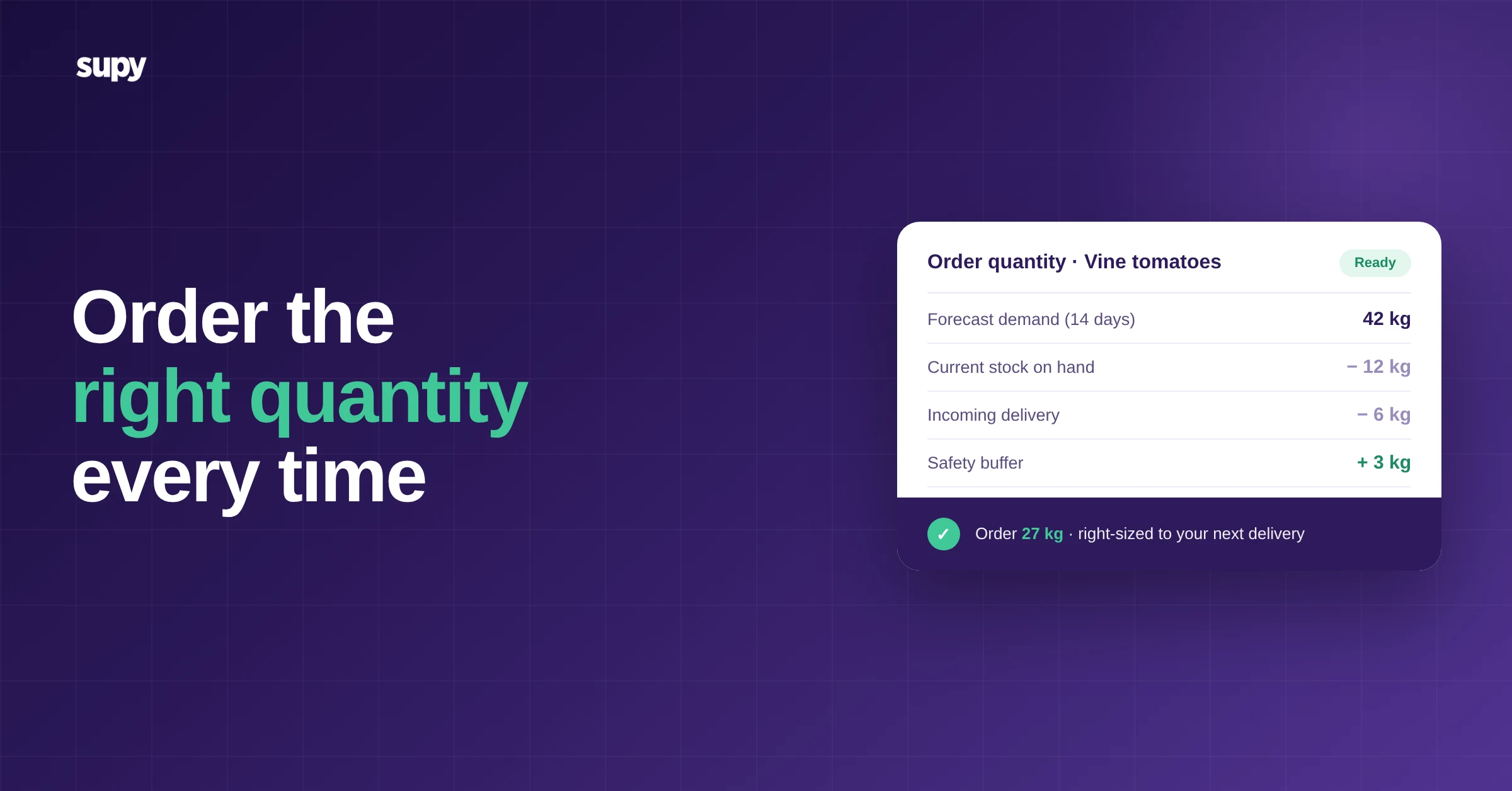
Every order your kitchen places is a bet on the future. Buy too much and the money is gone - tied up in stock that ages, spoils, or quietly becomes waste before anyone sells it. Buy too little and the cost is just as real but harder to see: 86ed dishes, disappointed guests, lost covers, and last-minute top-ups bought at whatever price the supplier feels like charging. Getting the quantity right is not a nice-to-have. For a multi-site group, it is one of the largest controllable drivers of food cost there is.
The trouble is that most teams decide order quantities the same way they did when they ran one site: from memory, from last week's order, or from a fixed par level scribbled in once and rarely revisited. That works until it does not. This guide breaks down why order quantities go wrong, how to calculate the right number properly, the variables most teams miss, and how to move from manual maths to a calculated order you can trust.
If you'd rather not work par out by hand, the free par level calculator does it for every item on your sheet from your usage, delivery days and supplier lead times.
The Real Cost of Ordering the Wrong Quantity
It helps to see both failure modes clearly, because operators tend to fear one and ignore the other.
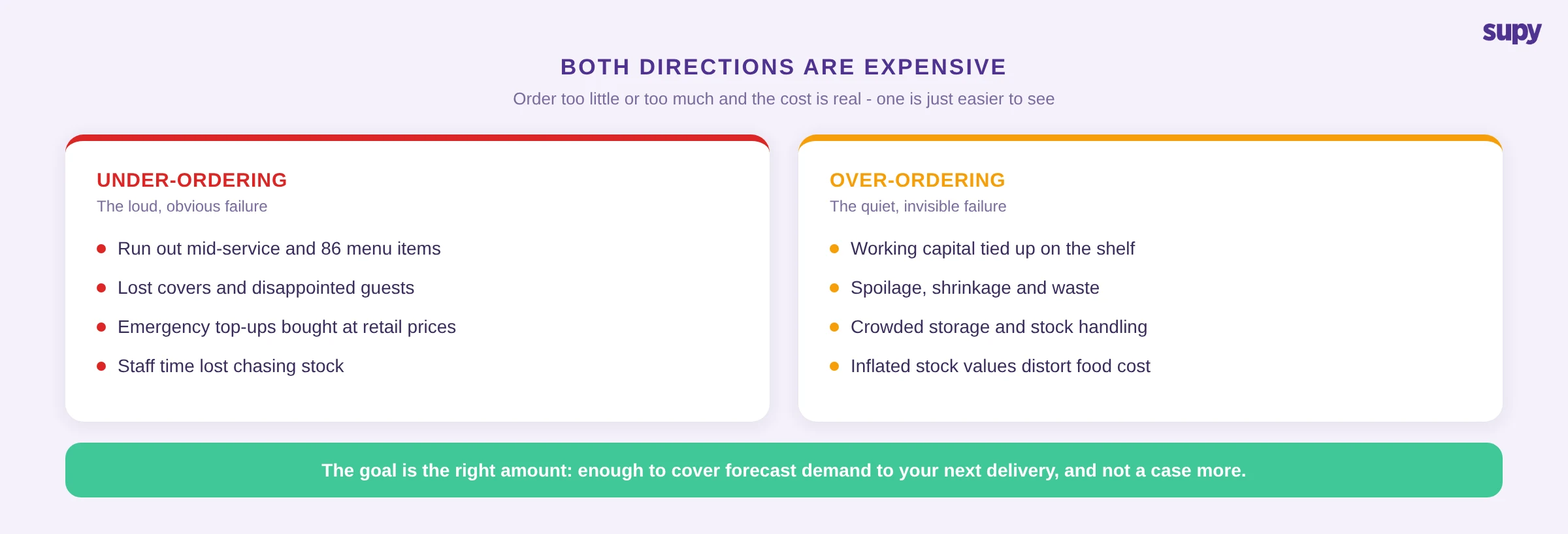
Over-ordering is the quiet one. Excess stock does not trigger an alarm. It sits in the walk-in looking like security. But it ties up working capital, increases the surface area for spoilage and shrinkage, crowds storage, and inflates the stock count values that feed your food cost reporting. Most of the cost is invisible until you measure it - which is exactly why it persists. A kitchen that over-orders by a small margin on every line, every week, across every branch, is carrying a structural cost that never announces itself.
Under-ordering is the loud one. You run out mid-service, pull items from the menu, and either lose the sale or send a runner to a cash-and-carry to buy at retail prices. The financial hit per incident is obvious; the reputational hit - a guest who ordered the dish you no longer have - is not on any report but matters just as much.
The point is that both directions are expensive. The goal is not to "order plenty to be safe" or to "keep it tight to save money". It is to order the right amount: enough to cover forecast demand through to your next delivery, and not a case more.
Why Last Week's Order Is the Wrong Starting Point
The most common ordering method in the industry is also the least reliable: copy the last order and adjust by feel. It is fast, it is familiar, and it bakes in every assumption that next week will resemble last week.
It almost never does. Demand moves with the weather, the calendar, local events, promotions, and menu changes. A copied order absorbs none of that - it simply repeats the past. Worse, errors compound. If last week's order was already 10% too high, this week's copy inherits the 10%, and so does the week after. The baseline never gets corrected because nobody recalculates it from scratch; they just nudge the inherited number.
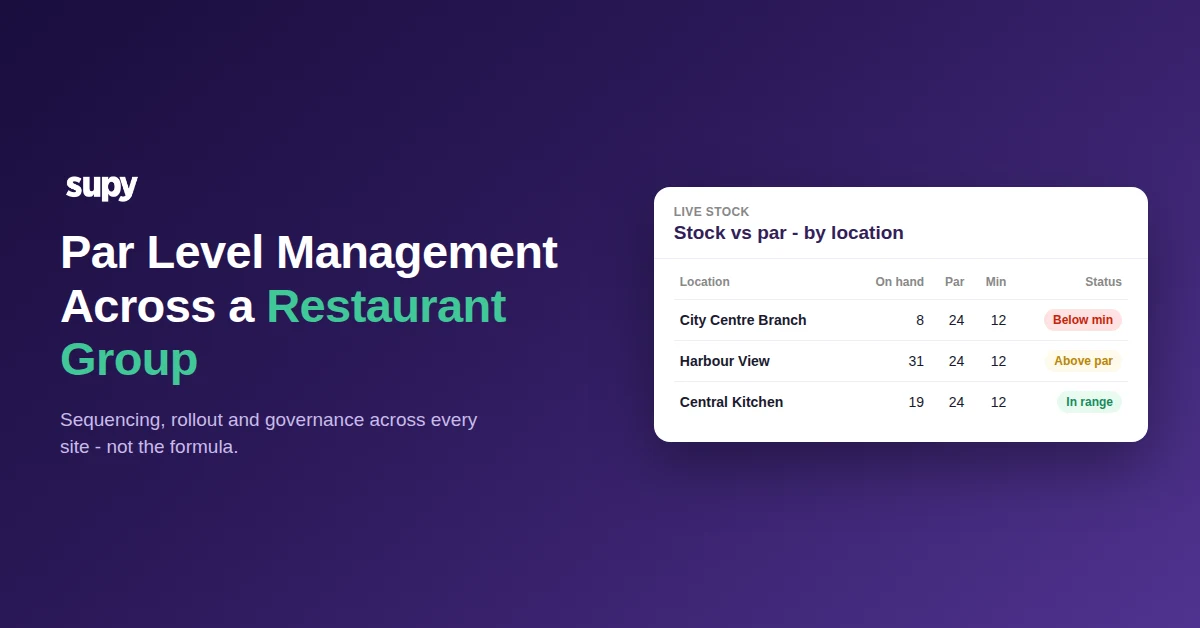
Par levels are a step up because they at least set a target, but they share the same flaw: they are static in a world that is not. A par set in a quiet month is wrong in a busy one, and because pars are usually raised whenever someone runs short and never lowered, they creep upward over time into permanent over-ordering. A good starting point is not last week and not a fixed number. It is a forecast of what you are actually going to sell.
How to Calculate the Right Order Quantity
Done properly, the right order quantity for any ingredient is a straightforward calculation. The discipline is in doing it consistently for every item, every order.
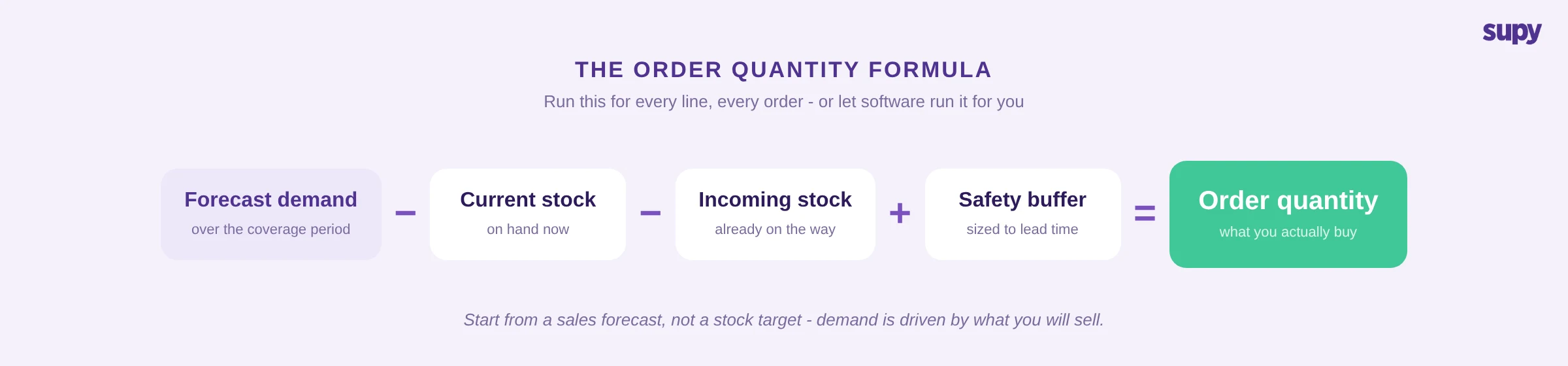
The formula is:
Order quantity = (forecast demand over the coverage period) − (current stock on hand) − (stock already on the way) + (a deliberate safety buffer)
Working through each term:
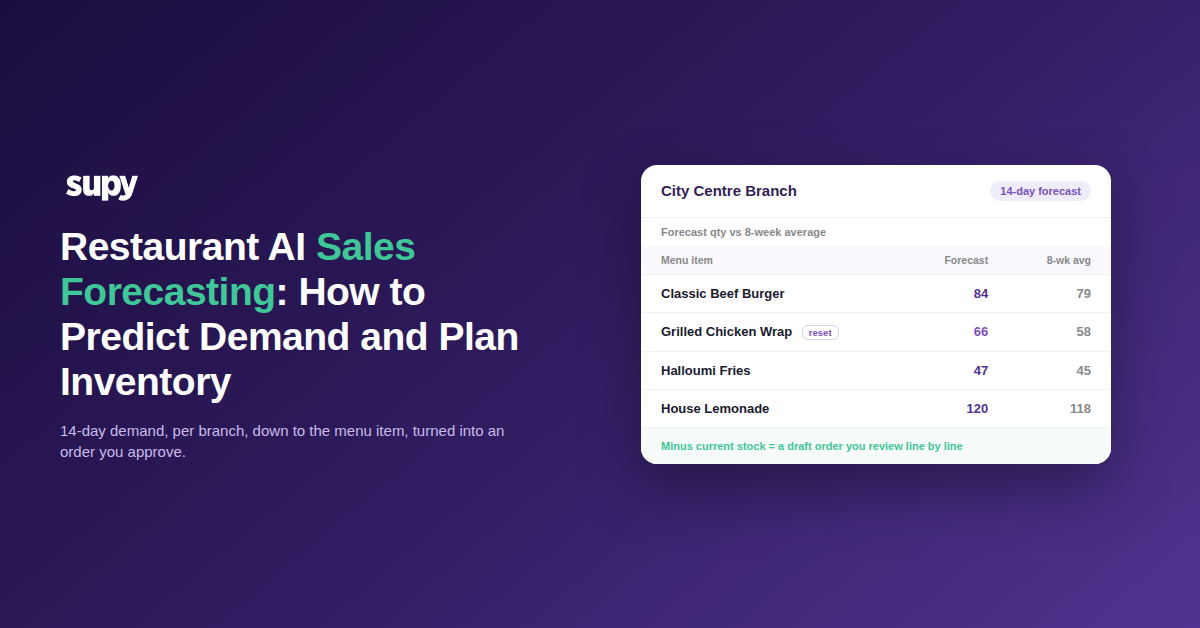
Forecast demand over the coverage period. Start with how much you expect to sell between now and your next delivery, then convert that sales forecast into ingredients through your recipes. If you expect to sell 200 portions of a dish, and each portion uses 150g of an ingredient, that is 30kg of forecast demand for that ingredient. Demand is driven by sales, so the calculation has to start from a sales forecast, not from a stock target.
Current stock on hand. Subtract what you already have. This is where ordering goes wrong most often, because the number is only as good as your last count. If your on-hand figure is stale, every order built on it is wrong.
Stock already on the way. Subtract anything already ordered and due to arrive within the coverage window, so you do not double-order.
A deliberate safety buffer. Add a small, intentional buffer sized to the item's delivery lead time and how critical it is. The buffer should be a decision, not an accident - large enough to absorb normal variation, small enough not to become standing excess.
Run that calculation for every line and you get an order matched to real demand. Run it from memory and you get a guess.
The Variables Most Teams Get Wrong
When order quantities are off despite a team's best efforts, the cause is usually one of four variables.
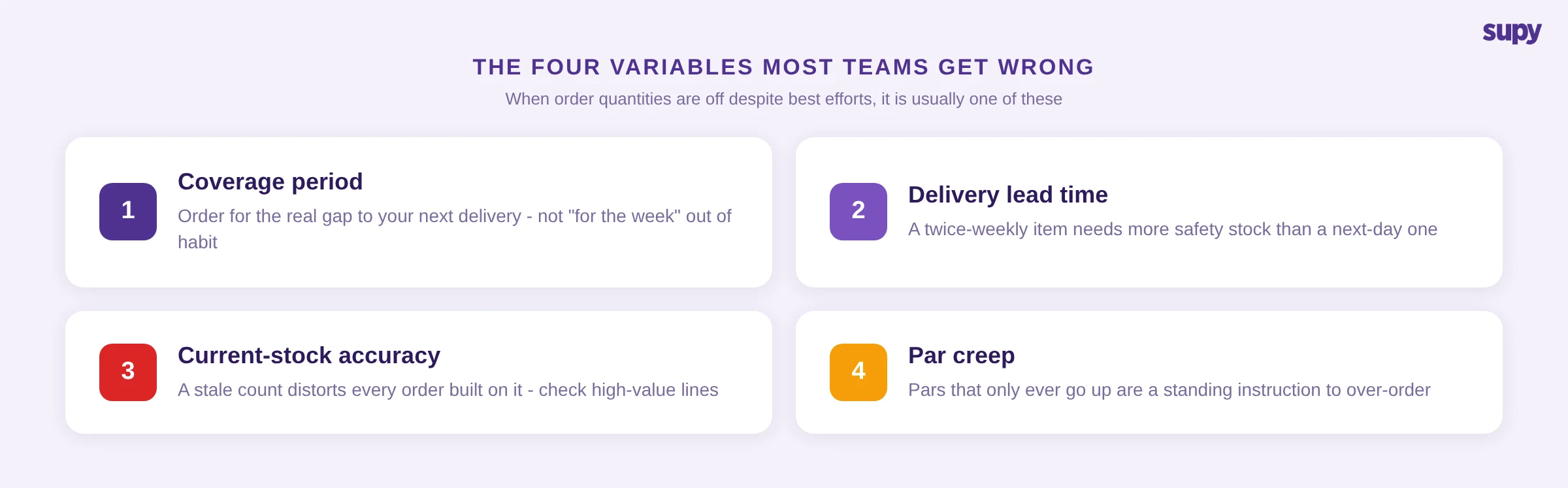
Coverage period. Ordering "for the week" out of habit ignores the actual gap until the next delivery. If you order on Thursday and the next delivery lands Monday, you need to cover exactly those days - over-cover and you carry excess, under-cover and you run short before the truck arrives.
Delivery lead time. The buffer has to reflect how long a supplier actually takes. A next-day item needs far less safety stock than one that arrives twice a week, yet many teams apply the same mental buffer to both.
Current-stock accuracy. This is the big one. The order quantity formula subtracts on-hand stock, so an inaccurate count directly distorts every order. Proteins and premium ingredients are worth a quick physical check before ordering, because a small error on a high-value line is an expensive order. Reliable inventory data is the foundation the whole calculation stands on.
Par creep. If you do work from pars, audit them. Pars that only ever go up are a standing instruction to over-order, and the excess hides inside what looks like a normal process.
Order on a Rhythm, Not in a Panic
Getting the quantity right is partly a maths problem and partly a discipline problem. The groups that order well do it on a fixed rhythm tied to their delivery schedule, not in a last-minute scramble when someone notices the walk-in looks empty. A reactive order is almost always a wrong order: it is placed under time pressure, it leans on memory rather than a count, and it tends to round up "to be safe", which is how over-ordering becomes a habit.
A consistent ordering routine fixes more than it looks like it should. Ordering at the same point in the cycle means the coverage period is always known, so the calculation has a fixed input rather than a guessed one. It also means stock is checked at a predictable moment, which keeps the on-hand figure fresh for the lines that matter. And it makes the order reviewable: when every order is built the same way, an anomaly stands out, because you have a stable baseline to compare it against. Standardising the process across branches is what turns ordering from a personal skill that walks out of the door when a manager leaves into a repeatable system the whole group runs the same way.
The aim is to make the right quantity the default outcome of a routine, rather than something that depends on the most experienced person in the building being on shift that day.
From Manual Maths to AI-Calculated Orders
Everything above is correct - and almost nobody does it by hand for every line, every order, across every branch, because there is not enough time in the day. The calculation is simple; doing it consistently at scale is not. One UK multi-site operator described the manual reality bluntly: rebuilding orders by hand when supplier prices or quantities change takes around three hours, and doing it in bulk is close to impossible. That is the gap automation is built to close.
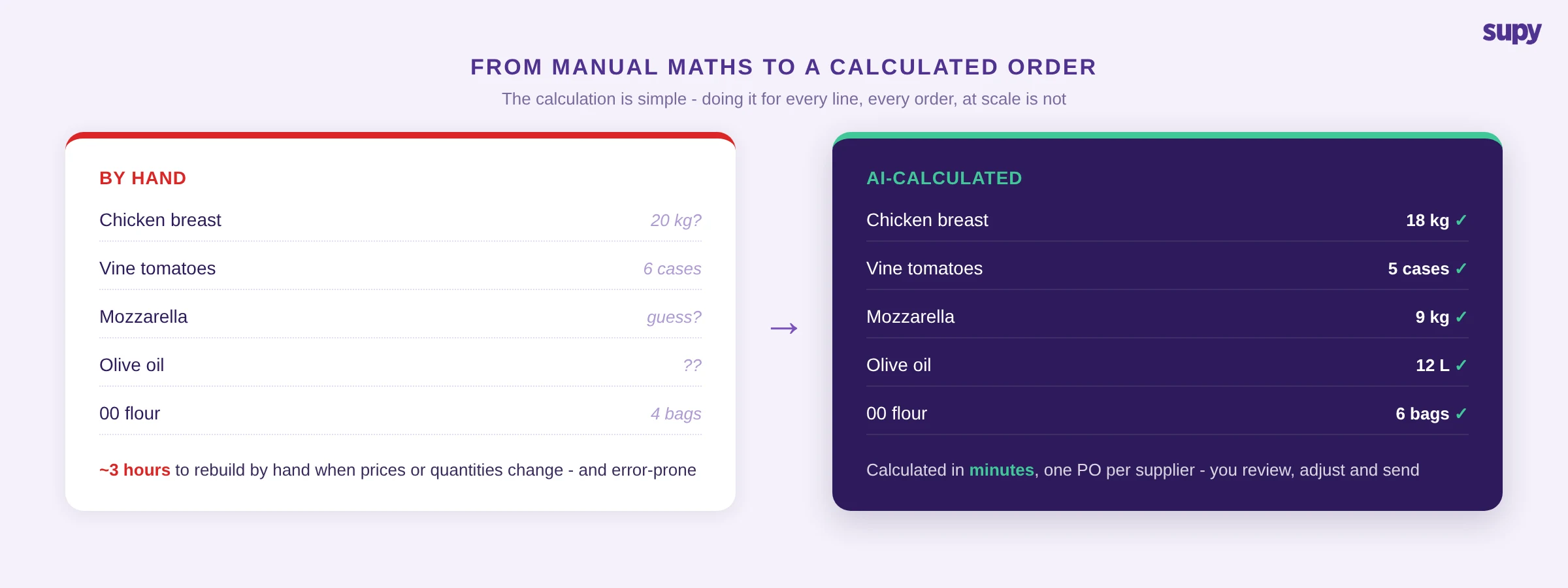
This is what AI predictive ordering does: it runs the exact calculation above, automatically, for every item. Supy forecasts your sales mix for the coverage period by branch and by menu item, converts it to ingredients through your recipes, subtracts current and incoming stock, and builds a suggested order - one per supplier - for the days you choose to cover. You are never handed a black box. The last order quantity and the four-week average are shown next to every suggestion so anomalies are obvious, you can adjust the on-hand figure for any item at the point of ordering, and nothing is sent until you review and submit it. The AI calculates; you decide.
The teams that get ordering right are not the ones with the most experienced chefs or the tightest spreadsheets. They are the ones who stopped guessing and started calculating - and then handed the repetitive part of that calculation to a system that does it the same way, every time, while keeping a person on the send button. Pair an accurate forecast with clean stock data and disciplined coverage periods, and ordering the right quantity stops being a daily gamble and becomes something close to routine.