.jpg)

AI Predictive Ordering for Restaurants: A Complete Guide
Ordering is the one back-of-house decision your team makes every single day, usually under time pressure, and almost always from memory. Order too much and cash sits on the shelf as slow-moving stock, spoilage, and waste. Order too little and you are 86ing menu items by Friday night and paying premium prices for emergency top-ups. For a single site, an experienced chef can hold the numbers in their head. Across ten, twenty, or fifty branches, that instinct does not scale - and the gap between what you should have ordered and what you actually ordered becomes one of the largest uncontrolled costs in the business.
AI predictive ordering closes that gap. Instead of copying last week's order or topping up to a fixed par level, it calculates exactly how much of each ingredient to buy, from each supplier, based on what you are forecast to sell and what you already have in stock. This guide explains what predictive ordering is, how the calculation actually works, where it differs from the tools most operators use today, and how to keep human judgement firmly in the loop.
If you'd rather not work par out by hand, the free par level calculator does it for every item on your sheet from your usage, delivery days and supplier lead times.
What AI Predictive Ordering Actually Is
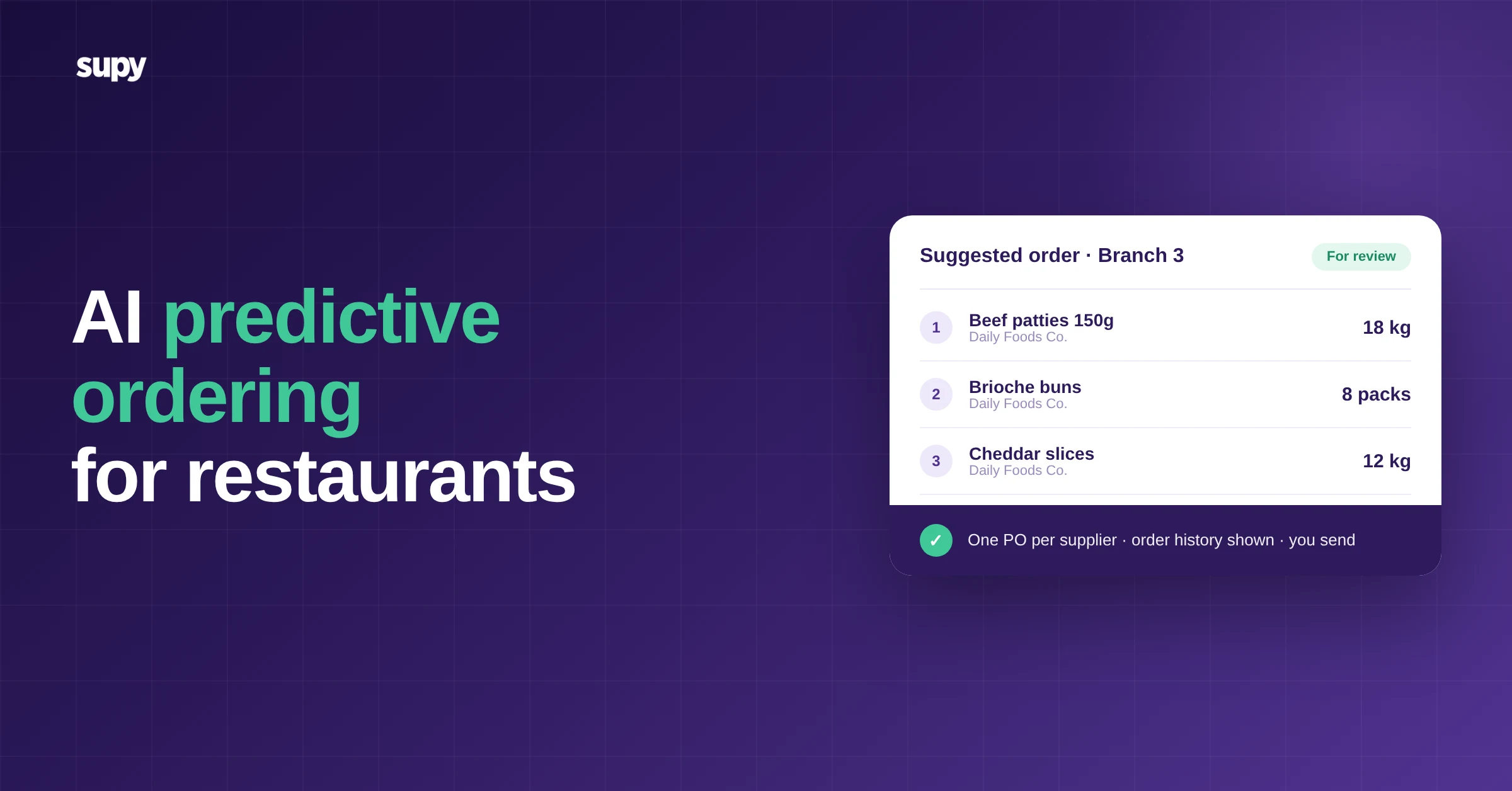
AI predictive ordering is a method of generating purchase orders from a demand forecast rather than from history or habit. The system predicts what each branch will sell, translates that sales mix into the underlying ingredients through your recipes, subtracts the stock you already hold, and produces a suggested order quantity for each item - grouped into one order per supplier.
The important word is predictive. A traditional ordering process looks backwards: it asks "what did we order last week?" or "what is our par level for this item?" A predictive process looks forwards: it asks "what are we going to sell over the coverage period, and what do we therefore need to have on hand?" That shift from backward-looking to forward-looking is the whole point, and it is what makes the order quantity match real demand instead of a static assumption.
It is worth being precise about the "AI" part, because the term is overused. The intelligence sits in the demand forecast. In Supy's case, the forecast predicts your sales mix for the next 14 days, by branch and by menu item, and managers can adjust it for events and promotions before ordering begins. That item-level precision is what allows the system to calculate exactly how much of each ingredient to order. Without an accurate forecast underneath it, "predictive ordering" is just a spreadsheet with extra steps.
Why Last Week's Order and Static Par Levels Quietly Cost You
Most multi-site operators order one of two ways. They copy a previous order and tweak it, or they top up to a par level - a fixed minimum quantity set per item. Both feel safe. Both leak margin.
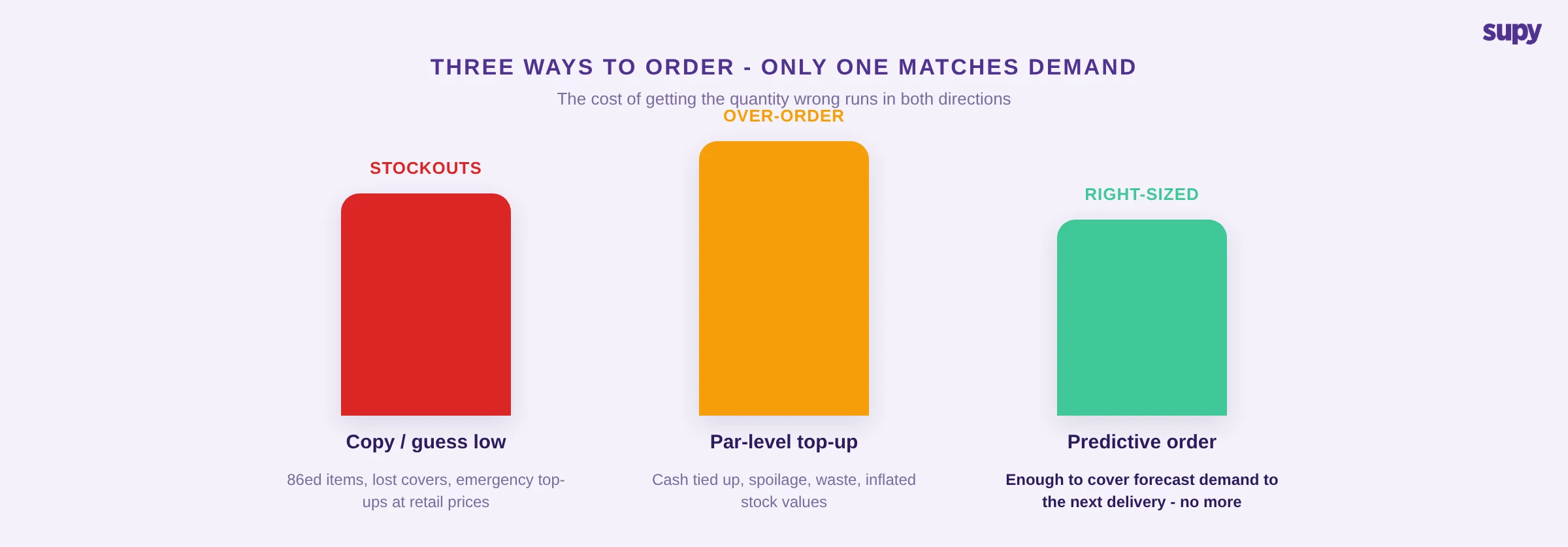
Copying last week assumes next week looks like last week. It rarely does. A bank holiday, a heatwave, a local event, a promotion, or a menu change all move demand, and a copied order absorbs none of it. The order is wrong before it is sent, and the error shows up later as either waste or a stockout.
Static par levels have a subtler problem: they drift. A par set in winter is wrong by summer. A par set for a quiet branch is wrong when that branch gets busy. And because par levels are usually set once and rarely revisited, they tend to creep upwards over time - every time someone runs short, they nudge the par up, and nobody ever nudges it back down. The result is structural over-ordering that nobody notices because it never causes a visible problem. It just sits there as excess stock and quiet cash drag across every location.
Predictive ordering removes both failure modes. There is no last week to copy and no fixed number to drift, because the quantity is recalculated from the forecast every time you order.
How AI Predictive Ordering Works: Forecast to Purchase Order
The calculation runs in four steps, and understanding them is the fastest way to trust the output.
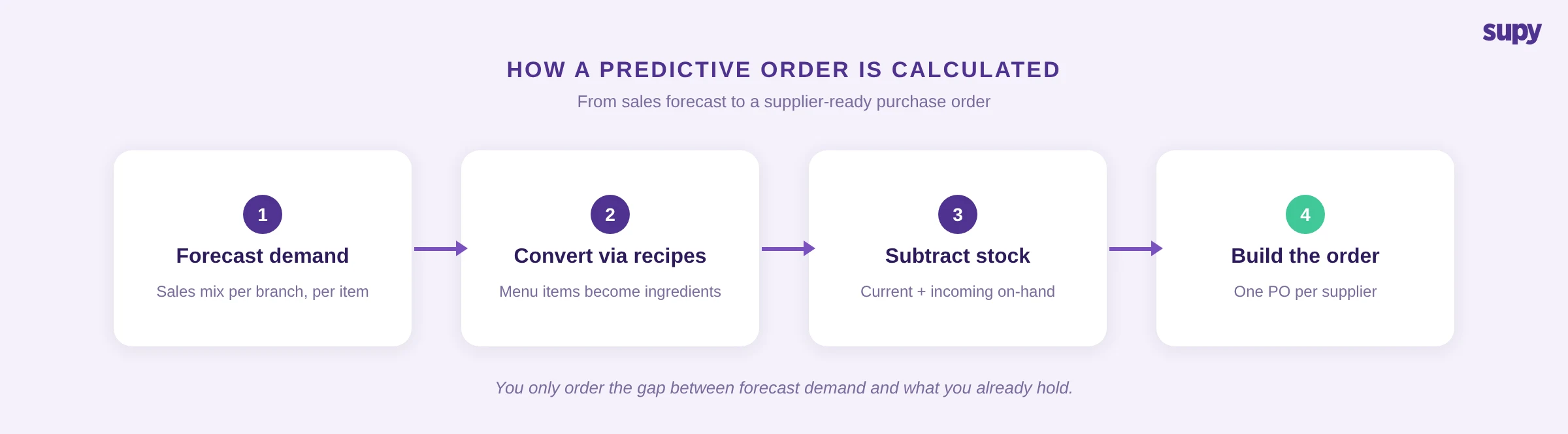
1. Forecast the demand. The system predicts the sales mix for the coverage period you choose - by branch, item by item. This is the foundation everything else rests on.
2. Convert sales into ingredients. Each forecast menu item is run through its recipe to calculate the raw ingredients it consumes. Twelve forecast burgers become a specific quantity of patties, buns, cheese, and sauce. This is where item-level recipe data does the heavy lifting.
3. Subtract what you already hold. The system looks at current stock and projected stock on the delivery date, and nets the forecast requirement against it. You only order the gap, not the gross need - so you never re-buy what is already in the walk-in.
4. Build the order, per supplier. The remaining quantities are grouped into one purchase order per supplier, covering only the items you will actually need during the coverage window. Choose the branch, the supplier, the delivery date, and how many days to cover, and the full order is generated from there.
The output is not a number to act on blindly. It is a starting point that is right far more often than a human guess, presented for review.
The Checks That Keep You in Control
The single biggest objection to automated ordering is loss of control, and it is a fair one. A good predictive ordering system answers it by building the order in front of you, with the context you need to sanity-check every line, and never sending anything automatically.
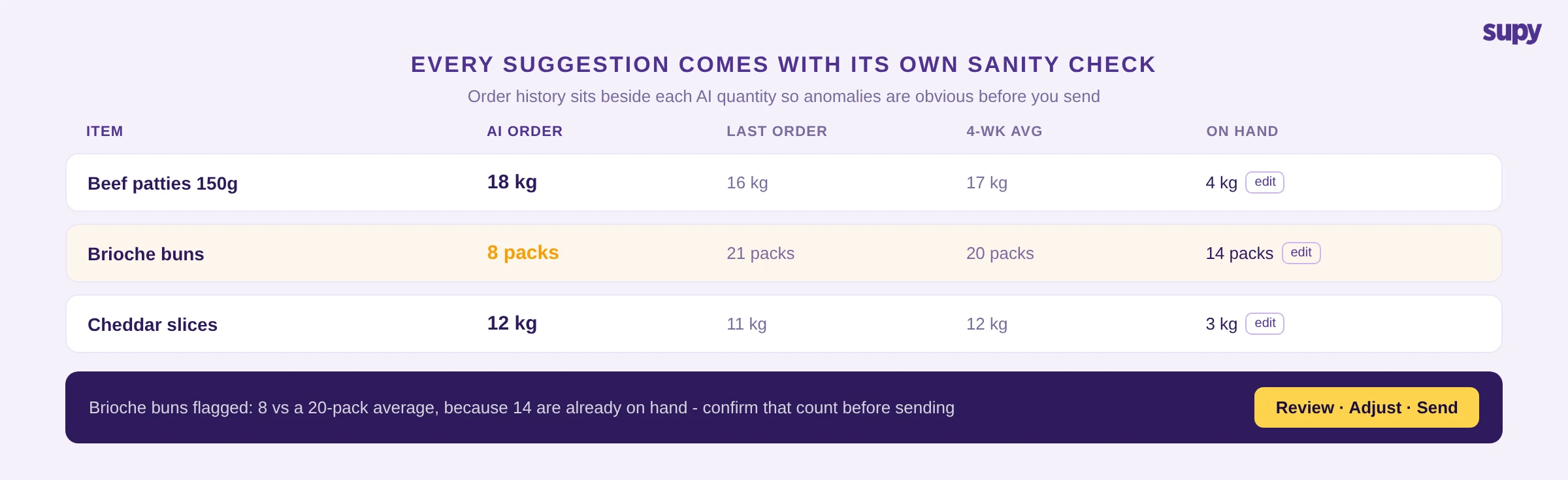
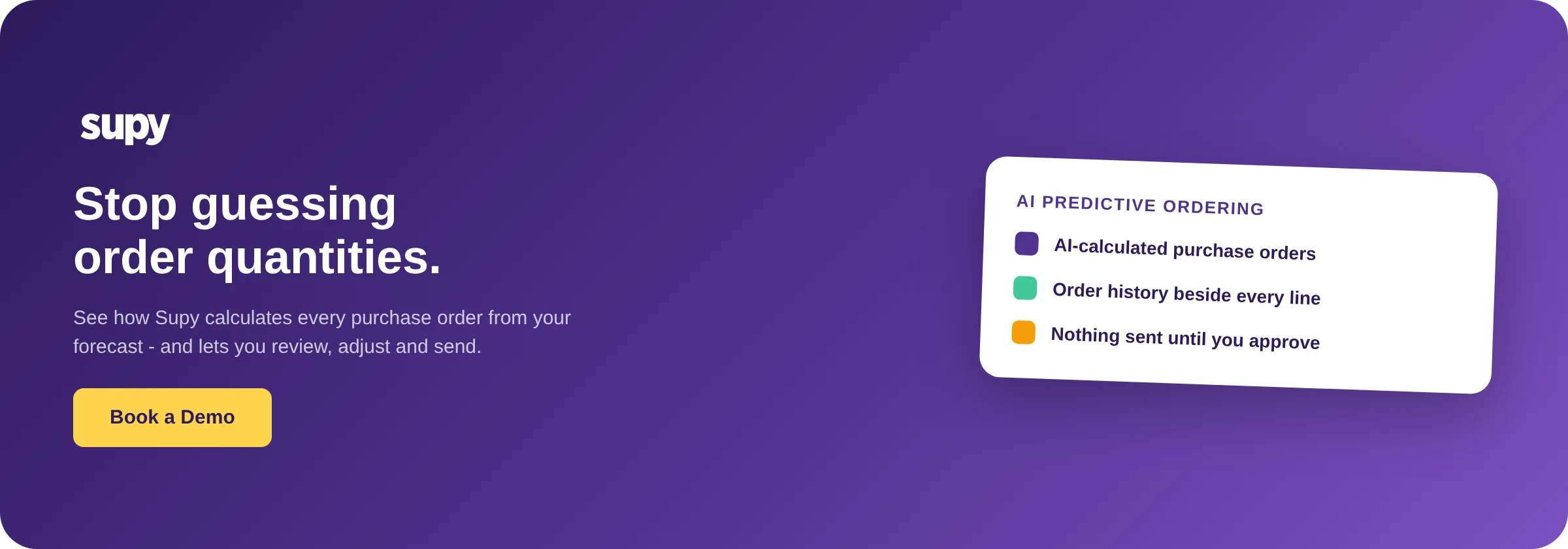
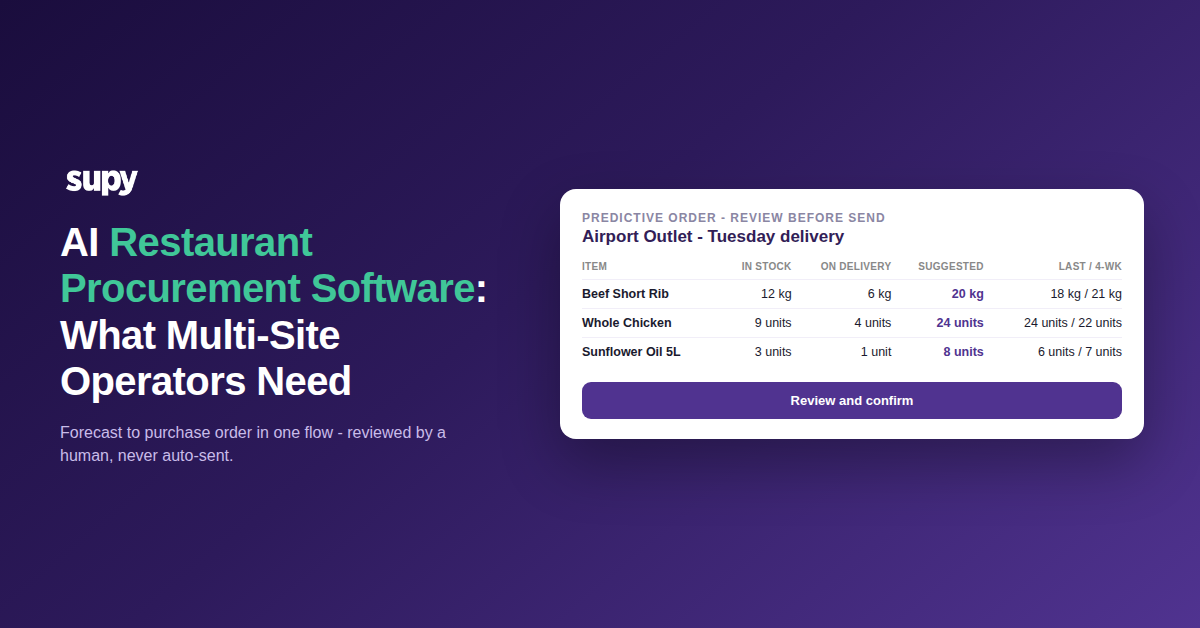
Three controls matter most. First, your order history sits next to every suggestion: the last order quantity and the four-week average order quantity are shown beside each AI-suggested line, so an anomaly jumps out before it leaves the building. If the system suggests four cases of something you normally buy one of, you see it immediately. Second, you can adjust for what is actually in stock at the point of ordering. Stock figures are never perfect between counts, so you can override the on-hand number for any item - most usefully for proteins and premium ingredients where a small error is an expensive order - and the purchase order recalculates. That override affects this order only; your stock records elsewhere stay untouched. It is a ten-second check that can prevent significant over-spend.
Third, and most importantly, nothing is sent automatically. The AI calculates; you decide. Every order is reviewed and submitted by a person, with a full screen showing item name, unit price, and supplier code per line, and you can override any suggested quantity before it goes out. Orders dispatch by email, WhatsApp, or direct supplier integration once you hit send, with a complete audit trail from generation to delivery. Confidence in the system builds naturally as you watch it get the numbers right, week after week.
What Good Predictive Ordering Looks Like at Multi-Site Scale
For a single venue, ordering is a chore. For a group, it is a control problem, and the requirements change.
The unit of calculation has to be the coverage period, not a fixed cycle. Ordering through to Monday should cover exactly those days, no more. Orders have to be grouped per supplier so they mirror the way your buyers already work, rather than forcing a new process on kitchen teams. Visibility has to be filtered by branch, so a location manager sees their own site while group operations sees across all of them. And the whole thing has to be usable by kitchen staff on the floor, not just by a head office analyst - if it needs a laptop and a spreadsheet, it will be bypassed in practice.
The operators who feel this most acutely are the ones running complex purchasing today. A 35-location hospitality group in the Philippines, then running an enterprise procurement suite, told our team the purchasing module was "almost the same as Ariba" and asked to trial it within the same conversation - the appeal was getting enterprise-grade ordering logic without the enterprise-grade overhead. A large UK group went further, asking to bring the automated purchasing workflow in front of its full leadership team after a single demo. The common thread is that ordering is no longer treated as a clerical task but as a lever on margin.
Predictive Ordering vs the Tools You Are Replacing
Most groups arrive at predictive ordering from one of three places, and it helps to be honest about the trade.
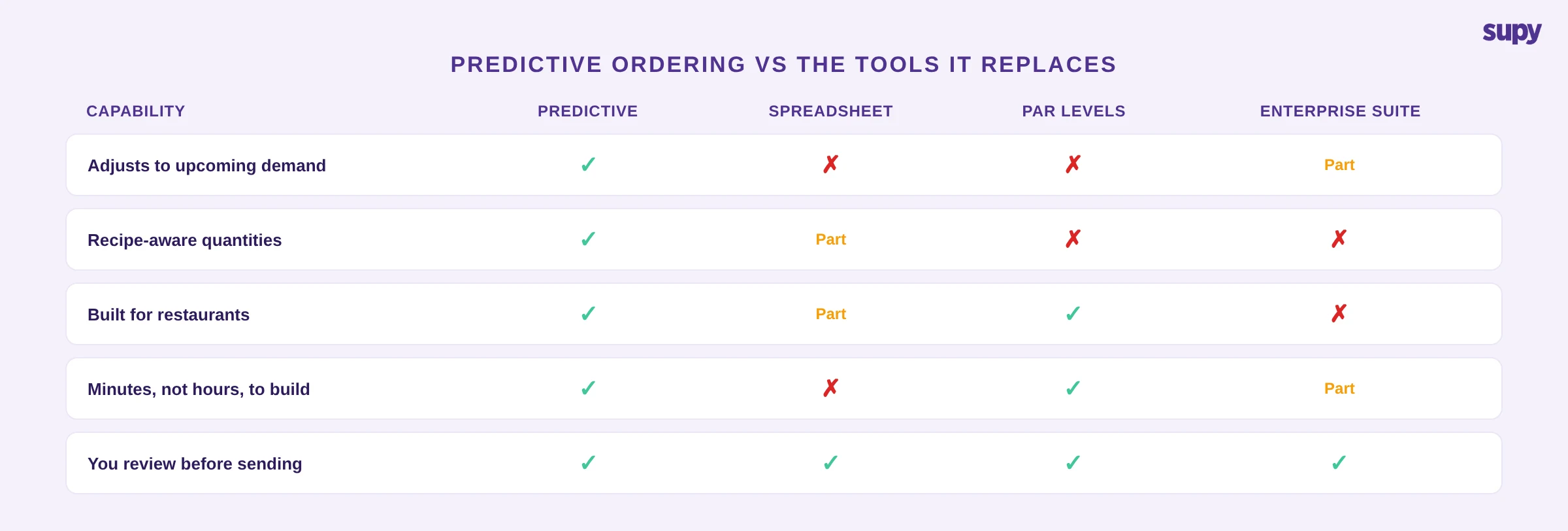
If you are coming from spreadsheets, the gain is time and accuracy. One UK multi-site operator described the manual reality plainly: rebuilding orders by hand when supplier prices change takes around three hours, and doing it in bulk is close to impossible. Predictive ordering removes that work entirely and removes the transcription errors that come with it.
If you are coming from basic purchase order software, you keep the structured PO workflow but add the missing brain: the system now tells you the quantity, not just the form to put it on. The same operators who value being able to set a future delivery date - for a menu change, or to cover someone on leave - get that scheduling plus a calculated quantity rather than a blank field.
If you are coming from an enterprise procurement suite, the gain is fit. General-purpose procurement platforms are built for any industry; predictive ordering built for restaurant procurement understands recipes, coverage periods, and per-branch sales mix natively, which is why it can calculate an order a generic tool cannot.
Predictive ordering is not a bolt-on. It sits on top of an accurate sales forecast and clean inventory data, and it is only as good as those foundations. Get them right, and ordering stops being a daily guess and becomes a reviewed, repeatable decision - one order per supplier, calculated from real demand, with you holding the send button.