.jpg)


Expiry Date and Lot Tracking for Central Kitchen Perishables: Why Weighted-Average Inventory Won't Issue the Oldest Stock First
What Expiry-Date and Lot Tracking Actually Has to Do in a Central Kitchen
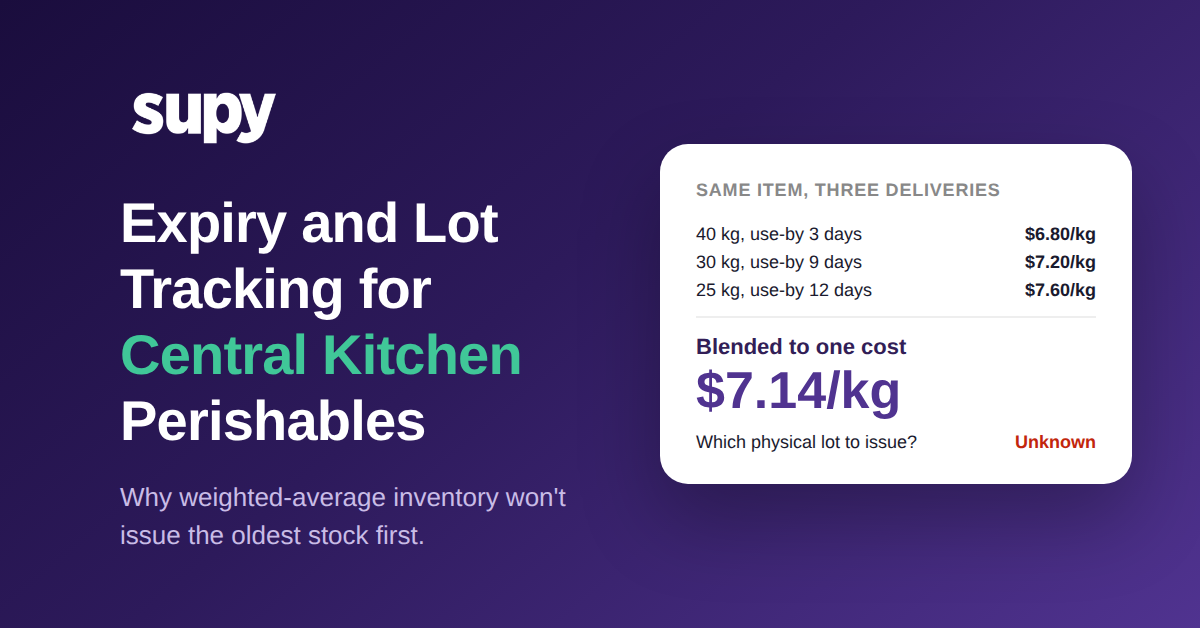
Expiry-date and lot tracking for central kitchen perishables means the system knows which physical delivery of an item is in stock, when each one expires, and forces the oldest-expiring one to be issued into production first. It is the difference between knowing you hold 95 kg of cream and knowing that 40 kg of it expires in three days and must go out today.
A central kitchen makes this harder than a single store. One item arrives in several deliveries at different prices and different use-by dates, gets issued into production runs, and then leaves as finished goods to multiple branches. Three separate jobs sit on top of each other: rotate stock so the shortest-dated batch is used first (first-expired-first-out, often loosely called FIFO), keep each lot identifiable so a quality problem can be traced to the exact delivery it came from, and hold the records a food-safety certification asks for. A perishable that is issued out of date order is waste; a lot you cannot trace is a recall you cannot contain.
Why Weighted-Average Costing Cannot Tell You Which Batch to Issue
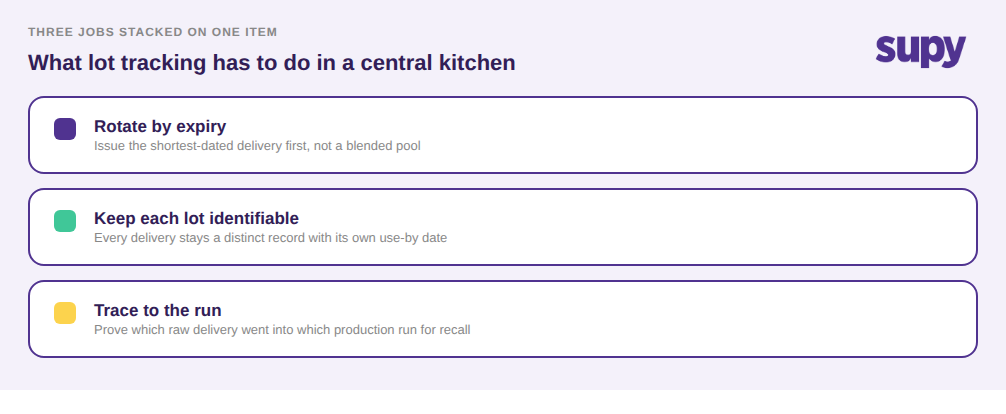
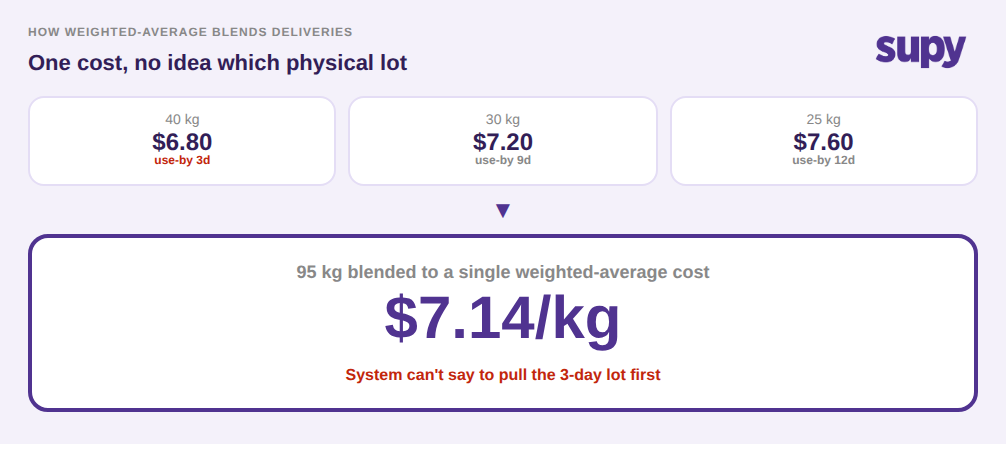
Most multi-site inventory platforms, Supy included, cost every purchase of an item on a weighted average. Buy the same cream three times at $6.80, $7.20 and $7.60 per kg, and the system blends it into one figure of about $7.14 per kg and depletes stock against that single number. This is accurate for costing and clean for reporting, and it is a genuine gap for physical rotation.
A weighted average has no concept of which physical unit you are holding. It cannot tell a counter to pull the delivery that expires in three days before the one that expires in twelve, because in the math there is only one undifferentiated pool of cream at one blended cost. Operators have raised this directly: a procurement team running a central kitchen and warehouse asked whether their platform could tell staff which delivery batch to issue first for expiry management, and were told plainly that weighted-average costing does not track discrete batches or expiry dates. That is the honest state of most inventory tools today, not a Supy-specific shortfall, and it is worth knowing before you assume any one platform closes it.
The Traceability Depth That Keeps a Second System Alive
For groups under a food-safety certification, the requirement goes beyond rotation to per-lot traceability: proving which raw delivery went into which production run, on what date, for allergen control and recall. This is the depth a general inventory platform does not reach, and it is the most common reason a central production unit stays on a dedicated system.
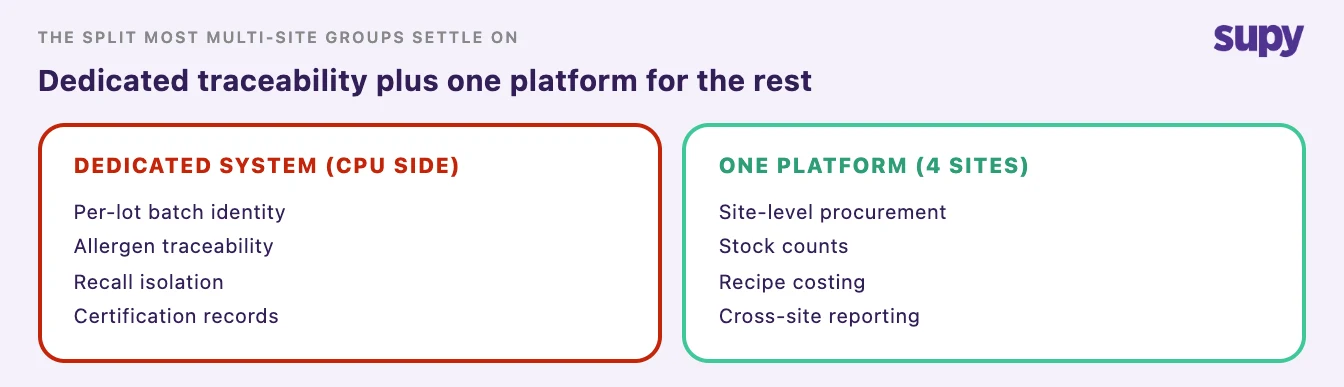
One four-site operator wanted to consolidate everything onto a single platform but kept its production unit on a separate, certification-required traceability system, because the general platform's central kitchen module did not carry the allergen and batch-traceability depth the certification demanded. The vendor acknowledged the gap rather than overstating what the module could do, and recommended a split: keep the dedicated system for production-side batch traceability and compliance, and run store-level procurement, inventory, recipes and reporting on the one platform. That is usually the right call. Forcing certification-grade traceability out of a tool that costs on a weighted average produces neither clean costing nor a defensible audit trail.
QR and Barcode Labelling: What Central Kitchen Teams Actually Ask For
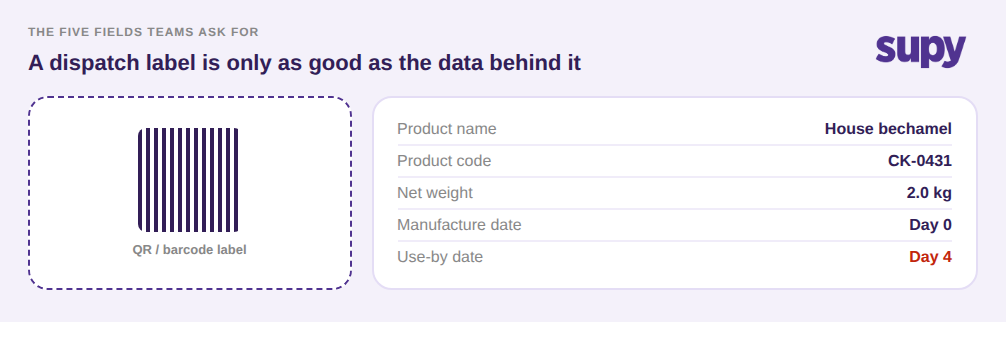
The practical request that comes up again and again is labelling. Teams dispatching finished goods from a central kitchen want a QR or barcode label on every item carrying five things: product name, product code, net weight, manufacture date and use-by date. A logistics manager at a multi-brand group and an independent operator both described the same need, down to the same fields.
A label is only as good as the data behind it. A manufacture date and a use-by date printed on a box are useful at the receiving branch, but they do not create rotation logic back in the kitchen unless the system underneath actually holds each lot as a distinct record. Treat labelling as the visible layer of a traceability system, not a substitute for one. If the platform issuing the label has no per-lot identity, the label documents a batch the software itself cannot tell apart from the next one.
What You Can Control Today: Transfers, Goods Receiving, and Store-Level Stock
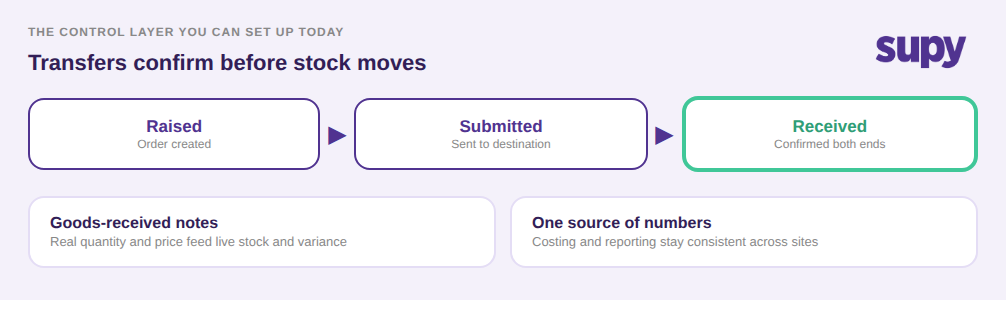
Missing per-lot rotation does not mean flying blind. There is a real layer of central kitchen control a weighted-average inventory platform does give you, and it is worth setting up properly. Inter-location transfers move through a three-stage flow: an order is raised, submitted, and then received, and the destination has to confirm receipt before stock updates at either end. That single rule prevents the phantom adjustments and mystery shrinkage that show up when stock is decremented before anyone confirms it arrived, and it leaves a full audit trail on both sides.
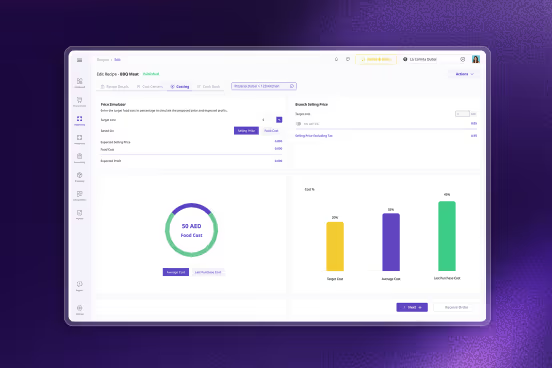
On top of that, goods-received notes capture the real received quantity and price against each order and feed live stock and variance automatically, and recipe costing and cross-site reporting stay consistent because every branch reads from the same data. None of this is lot-level, but all of it is the accurate consolidated base you need before any traceability layer sits on top. Getting transfers, receiving and stocktakes right is what makes the rest of the picture trustworthy, and it is where a single multi-site inventory system earns its place even while lot tracking lives elsewhere.
What to Do About It
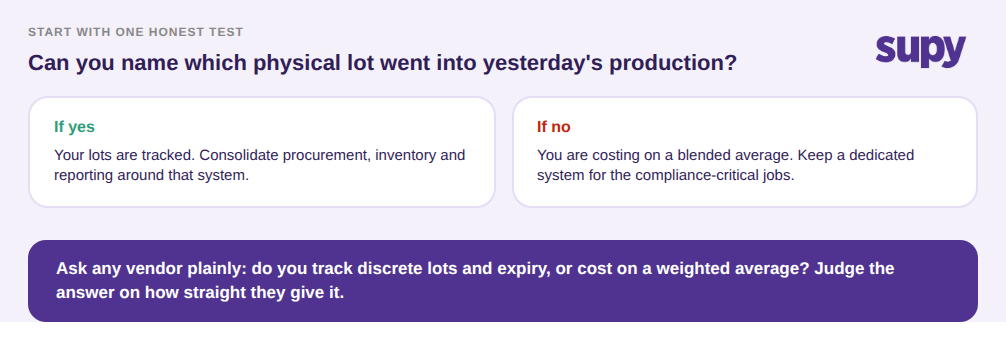
Start with one honest test: can you name, right now, which physical delivery of a perishable your kitchen issued into yesterday's production? If the answer is no, your system is costing on a blended average and is not tracking physical lots, and no amount of care on the counter fully closes that.
From there the decision is a split, not a search for one tool that does everything. Keep a dedicated system for the production-side jobs that need per-lot identity: batch traceability, allergen control, recall isolation and certification records. Consolidate the rest, store-level procurement, inventory counts, recipe costing and cross-site reporting, onto one platform so those numbers stay clean and comparable across sites. Ask any vendor the direct question, whether it tracks discrete batches and expiry dates or costs on a weighted average, and judge the answer on how plainly they give it. A vendor who is straight about the gap is easier to build a compliant operation around than one who blurs it.