.jpg)


Restaurant Supplier Invoices: Auditing Overbilling at Franchise Sites
Start Where the Billing Discrepancy Enters, Not at Month-End
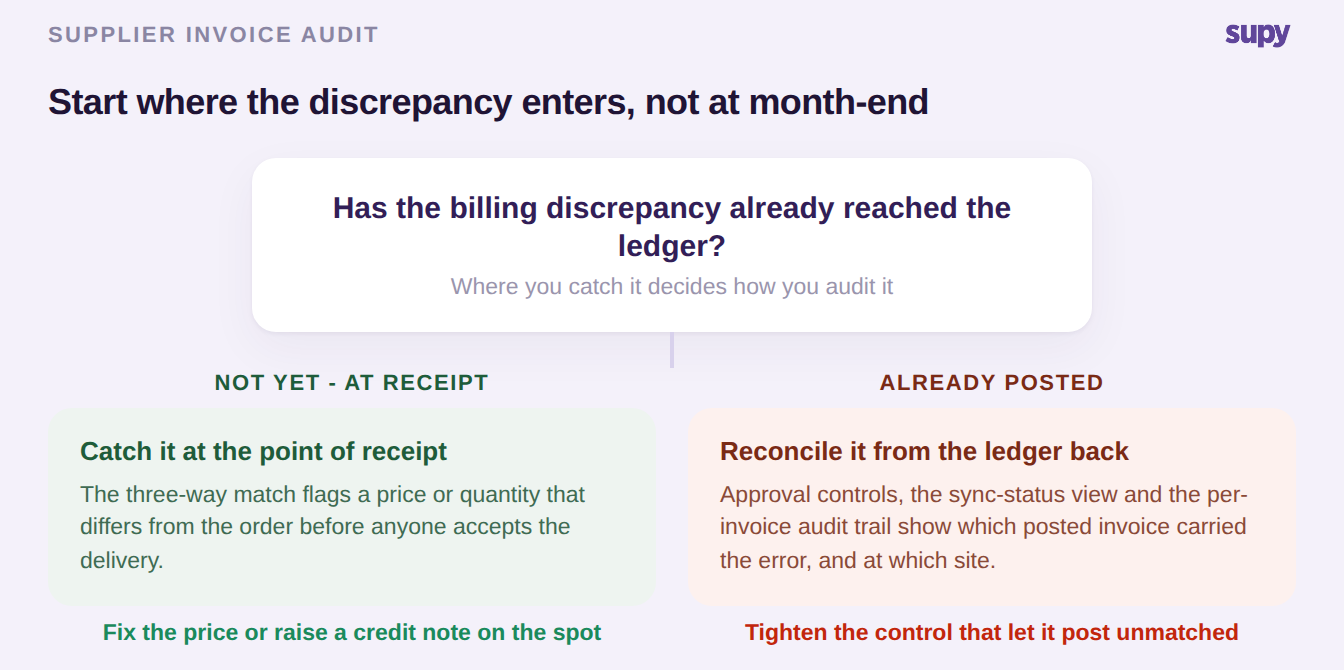
Auditing supplier invoices for billing discrepancies means checking that what a supplier billed matches what you ordered and received, at every location, before the figure reaches your accounts. Across a mixed franchise and corporate estate the audit is really two checks: catch the discrepancy at the point of receipt, or reconcile it back from the ledger once it has already posted.
Overbilling slips through because a franchise and corporate estate does not reconcile the same way twice. Receiving discipline varies store to store, franchisee pricing can differ from the network standard, and franchisees often cannot authorise their own invoices without routing through head office. So a wrong price is either accepted quietly at one site or bottlenecked at the centre. The audit gets simpler the moment you decide, for each discrepancy, where you are going to catch it.
When the Invoice Price Beats the Price You Agreed
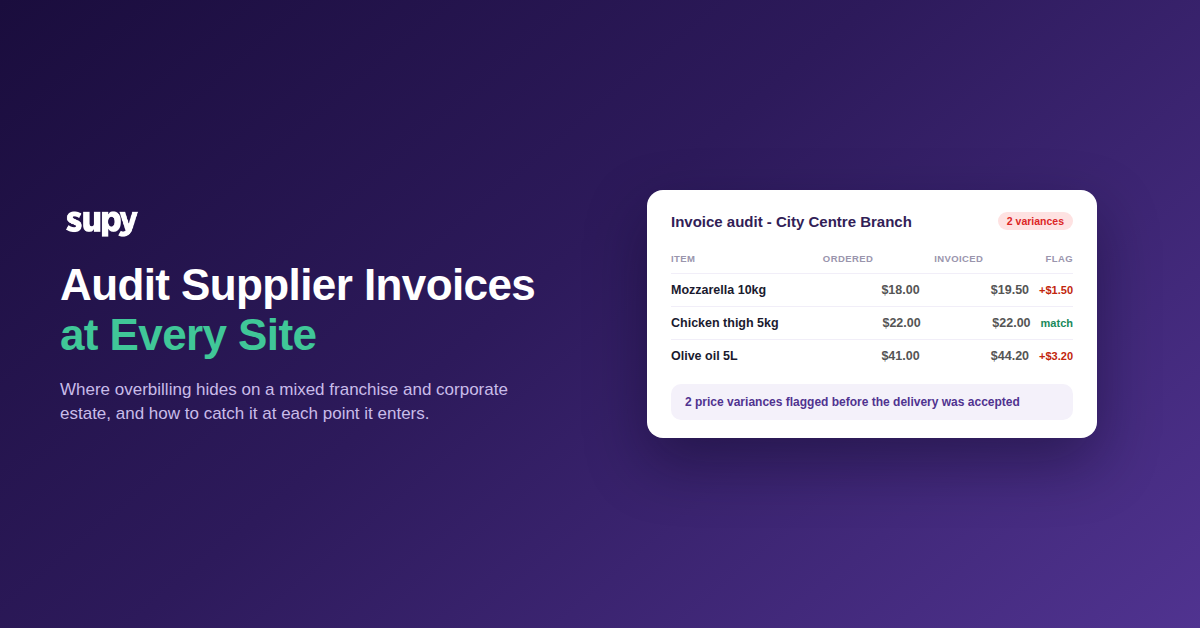
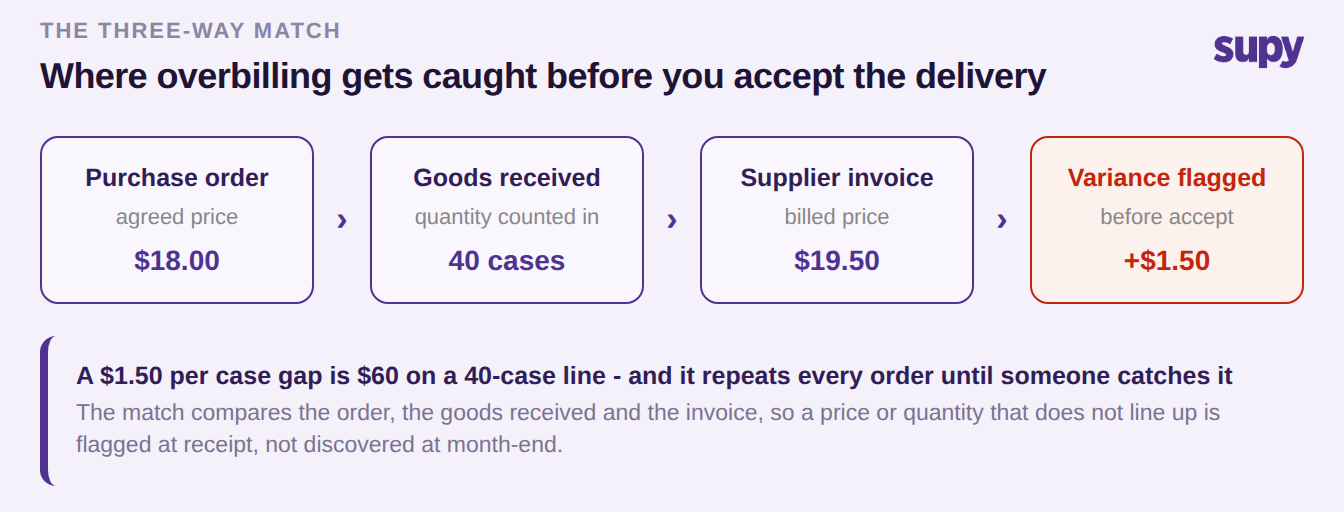
The cheapest discrepancy to fix is the one you never accept. A three-way match compares the purchase order, the goods received and the supplier invoice, and flags any line where the billed price or quantity differs from what was ordered, before the delivery is accepted. That is the single control that stops a price creep at the door rather than in the accounts.
When a received price differs from the expected cost, the person receiving can act on it there and then: update the expected price if the change is real and agreed, or raise a credit note against the supplier if it is not. The change is written to a running price history for that supplier item, so the next order carries the corrected figure and you can see exactly when a price moved and by how much without cross-referencing old invoices. A repeated small overbill stops being a monthly surprise and becomes a flag someone clears in seconds.
When Franchise and Corporate Sites Don't Reconcile the Same Way
A franchise estate carries a structural problem a corporate one does not: a franchisee may need to run its own suppliers and pricing, yet the group still needs a clean, comparable cost picture across every site. Handled badly, franchisee prices that differ from the network standard quietly skew group cost-of-goods figures, and a single missing permission means a franchisee cannot even approve its own invoice. There are two clean ways to set this up, and the right one depends on how much autonomy the franchisee needs.
| Consideration | Franchisee-scoped permissions | Separate franchise account |
|---|---|---|
| Site autonomy | Owns its own items and suppliers for that location | Full control of its own books |
| Group cost visibility | Rolls up into one live group view | Consolidated by report, not live |
| Recipe management | Managed once by the franchisor | Duplicated and maintained in both places |
| Invoice isolation | Each site sees only its own invoices | Fully separate by design |
Either way, each restaurant's invoice inbox is isolated to its own documents, so one site can never see another's supplier invoices, and each entity posts its purchase invoices to its own connected accounting platform. Central kitchen customers can be grouped, so a whole franchise group is one filter rather than a manual list, and group-level procurement sits in its own section with a full audit log, separate from outlet purchasing. The result is an estate you can audit both ways at once: each site on its own books, and the whole group in one view.
When the Discrepancy Only Shows Up in the Ledger
Some discrepancies get past receiving. When they do, they land in the general ledger and inflate cost of sales, and by then the number looks like real cost of goods rather than an error. The controls that matter here sit in the system, not in staff discipline: require approval and invoice-to-receipt matching before an invoice can post, so a conflicting invoice cannot reach the accounts regardless of who is receiving that day.
Once invoices do post, visibility is what keeps the audit honest. A posted invoice shows a sync-status icon confirming it reached the accounting system or surfacing the error if it did not, so nothing sits half-posted. Every invoice carries a full activity trail from email receipt through recognition to goods-receipt creation, and on-demand procurement reports slice invoices, supplier performance and price changes by date range and any combination of sites. That is what lets finance ask "which posted invoice at which site carried this error" and get an answer, instead of re-opening a month.
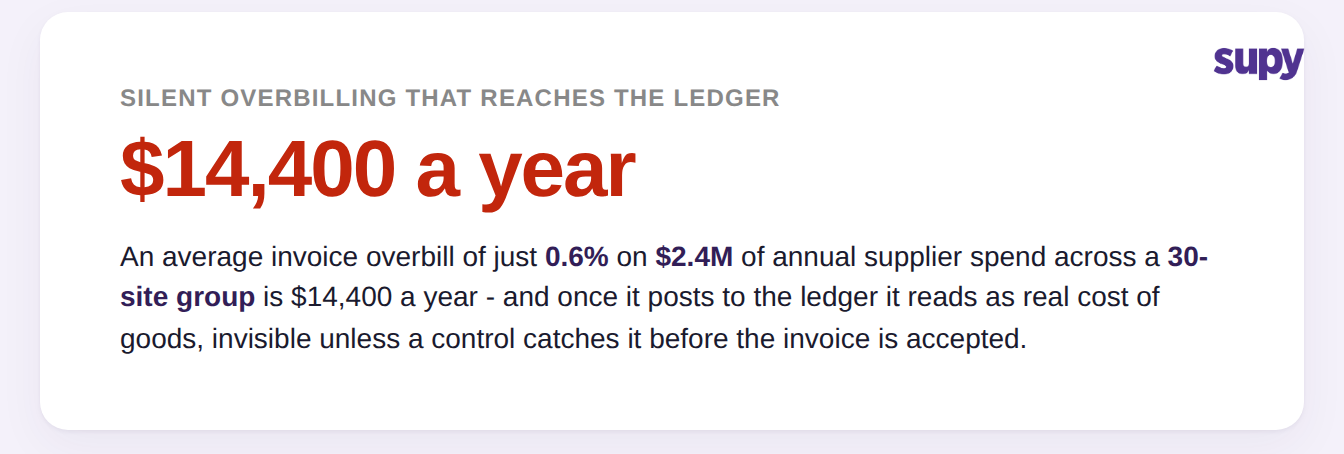
Name the branch you are in. If the discrepancy has not posted yet, your fix is at receipt: turn on price and quantity matching so a variance is flagged before anyone accepts a delivery, and clear each flag on the spot with a corrected price or a credit note. If it has already posted, work backwards from the ledger: use the sync-status view and the per-invoice audit trail to find the invoice and the site, then tighten the approval control that let it through so the same gap does not repeat next month. For a franchise estate, decide the permission model first, because it determines who can catch a discrepancy at each site at all. The single highest-value move for most groups is the receipt-time match, because it is the only one that stops the cost from ever reaching the books. You can see how the tools fit together in Supy's invoices and credit notes feature, compare it with the manual reality in our guides to processing handwritten supplier invoices and managing supplier price changes, and use the food cost calculator to see how much a small overbill moves your food cost percentage.