.jpg)


Yield Costing for Restaurants: Why Static Recipe Costs Overstate Your Margins Until You Account for Yield
What Yield Costing Measures, and Why Spec Yields Overstate Margin
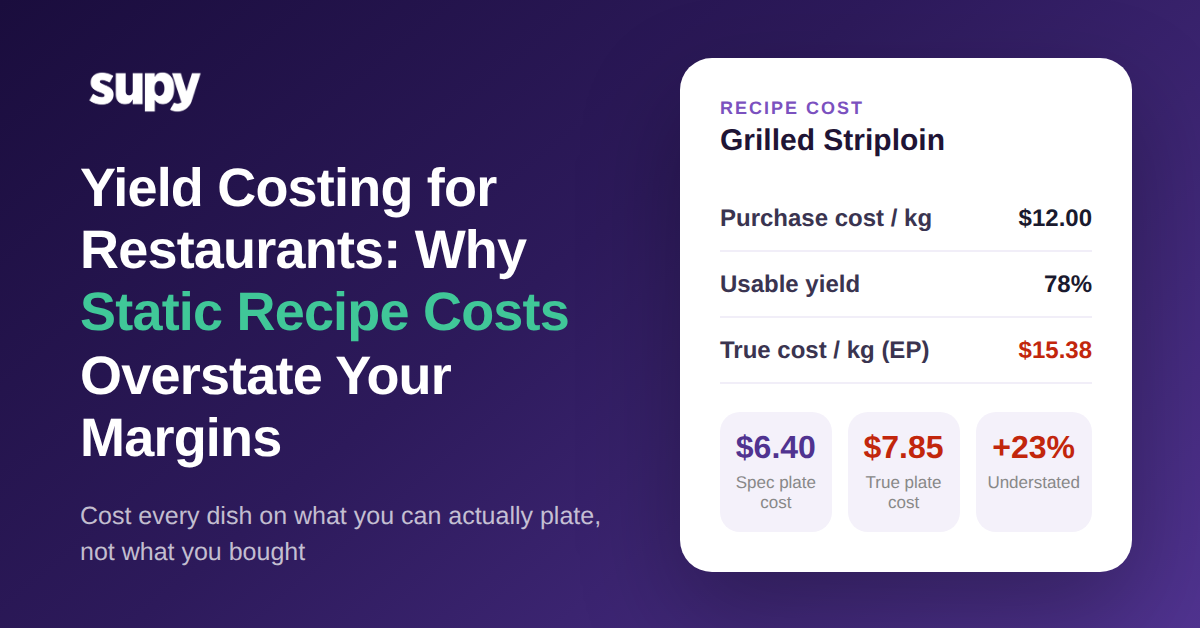
Yield costing is the practice of costing a dish on the quantity of an ingredient you can actually plate, not the quantity you bought. It takes the as-purchased cost, applies the usable yield left after trim, cooking and prep loss, and produces a true edible-portion cost. Skip it, and every recipe card reads a lower cost than the dish truly carries.
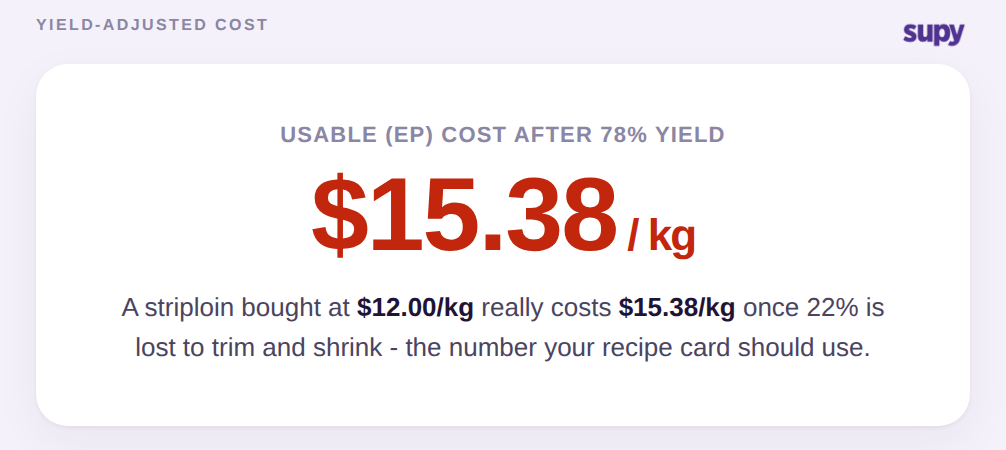
The gap is not small. A beef striploin bought at $12.00/kg is never $12.00/kg on the plate. Once you lose 22% to fat cap, silverskin and cooking shrink, the usable meat costs $15.38/kg. If your recipe card still costs the dish at $12.00/kg, it is quietly overstating the margin on every cover you sell, and it is doing that on your highest-value proteins first, where the yield loss is largest.
This is why a static recipe cost and real profitability drift apart over a service. The card assumes 100% of what you purchase reaches the plate; the kitchen knows it never does. Supy builds usable yield into the recipe cost itself, so the number on the card is the number the dish actually costs.
Where Theoretical and Actual Yield Diverge on the Line
Theoretical usage is what your recipes say you should have consumed for the covers you sold. Actual usage is what left the store. When your recipes are built on spec yields that are more generous than reality, the two never line up, and the difference shows up as ingredients disappearing faster than the recipe explains.
The table below is the pattern most multi-site operators recognise once they measure it: theoretical consumption calculated from the recipe card, actual consumption pulled from stock movement, and a variance that is real money walking out on the highest-value proteins. None of it is theft or miscounting. It is yield the recipe never accounted for.
| Item | Theoretical | Actual | Variance |
|---|---|---|---|
| Beef striploin | 7.5 kg | 9.1 kg | -1.6 kg / -$24.60 |
| Salmon fillet | 6.0 kg | 7.0 kg | -1.0 kg / -$18.00 |
| Lamb shoulder | 5.5 kg | 6.8 kg | -1.3 kg / -$19.50 |
| Roast chicken | 12.0 kg | 13.4 kg | -1.4 kg / -$9.80 |
Costing against actual yield closes this gap at the source. Instead of chasing the variance after the fact in a monthly count, you record the real yield once and every recipe that uses that ingredient inherits the corrected cost. For the full picture of how this variance builds up and how to read it, see our guide to theoretical vs actual food-cost variance.
Why Breakdown Items Have No Real Per-Portion Cost Until You Split by Yield
Some of your most expensive ingredients do not arrive as portions at all. A whole fish, a primal cut or a wheel of cheese is one purchase that becomes several usable items, each with a different value. Until you split that single as-purchased cost across the components by their actual yield, none of them has a per-portion cost you can trust.
Take a whole salmon: 4.0 kg landed at $9.00/kg, so $36.00 in raw cost. The fillet yields 2.3 kg, the remaining 1.7 kg is head, frame and trim. Cost the fillet as if it were still $9.00/kg and you are handing away margin, because the raw cost of the whole fish now sits inside a smaller usable weight. Allocated properly, that fillet carries an effective $15.65/kg, and only then can a dish built on it be costed honestly.
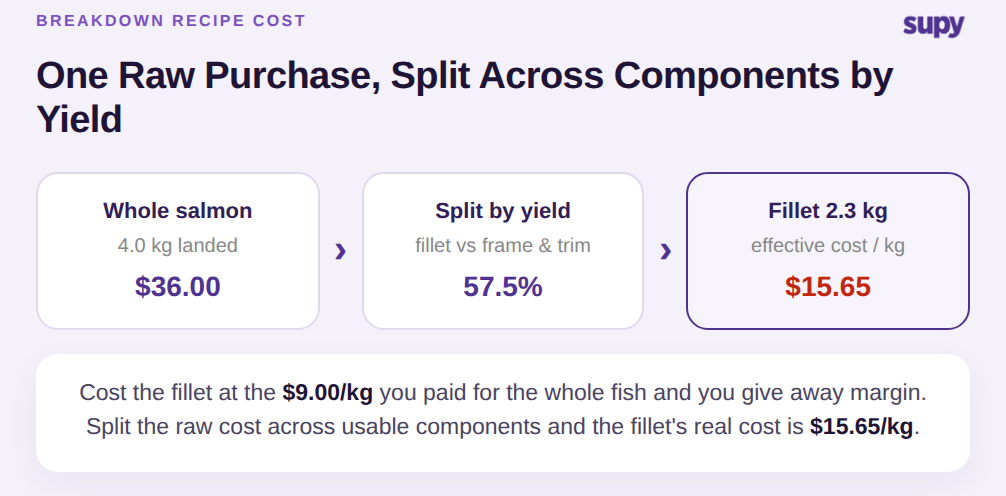
Supy handles this with breakdown recipes: one raw ingredient is broken into multiple component items, and each component carries its share of the raw cost by yield. Butchery, fishmongering and prep sections stop guessing what the primal really costs per usable kilo.
Recording Actual Yield at Production, Not the Recipe's Assumption
The recipe card's yield is a plan. What the section actually gets on a given day, from a given delivery, is the fact you need to cost against. A tougher cut, a less-skilled prep hand or a colder fridge all move the real yield away from the spec, and if you only ever cost against the spec you never see it.
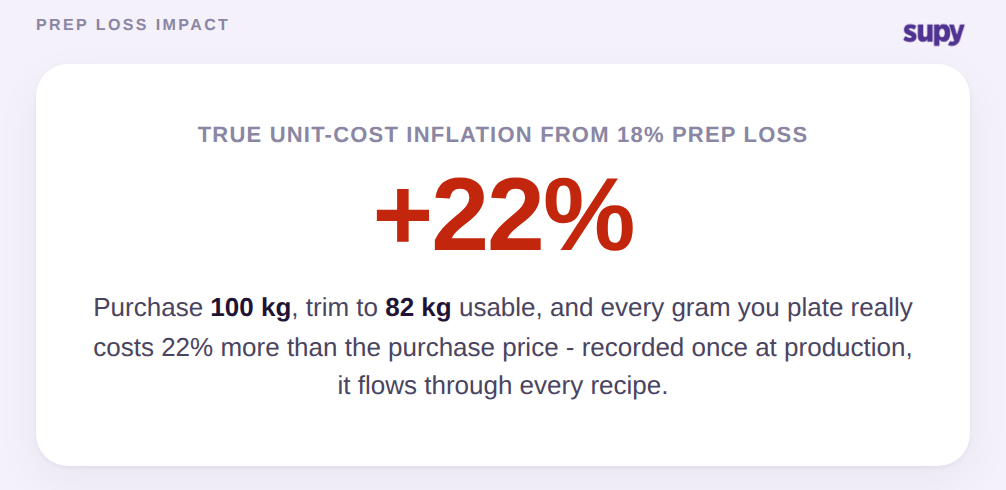
The fix is to capture actual yield at the moment of production. Purchase 100 kg of a raw item, trim it down to 82 kg of usable product, and the true unit cost of that usable product is not the purchase price. An 18% prep loss inflates the real cost of every gram you plate by 22%. Record that once, at the production event, and the cost flows through every downstream recipe automatically.
In Supy, operators override the recipe's expected yield with the actual yield they produced, and prep wastage is accounted for on every ingredient, so an inventory reflects the net usable quantity after trim, not the gross weight purchased. The recipe cost stops being an assumption and starts being a measurement.
Why One Static Yield Misprices the Same Dish Across Your Sites
Even when the recipe is identical, the same dish does not cost the same at every location. Yield moves with the equipment, the prep skill and the delivery each site receives, and ingredient cost moves with what each branch last paid. One static yield and one blended cost applied across the group will misprice the dish everywhere except the one site the average happened to fit.
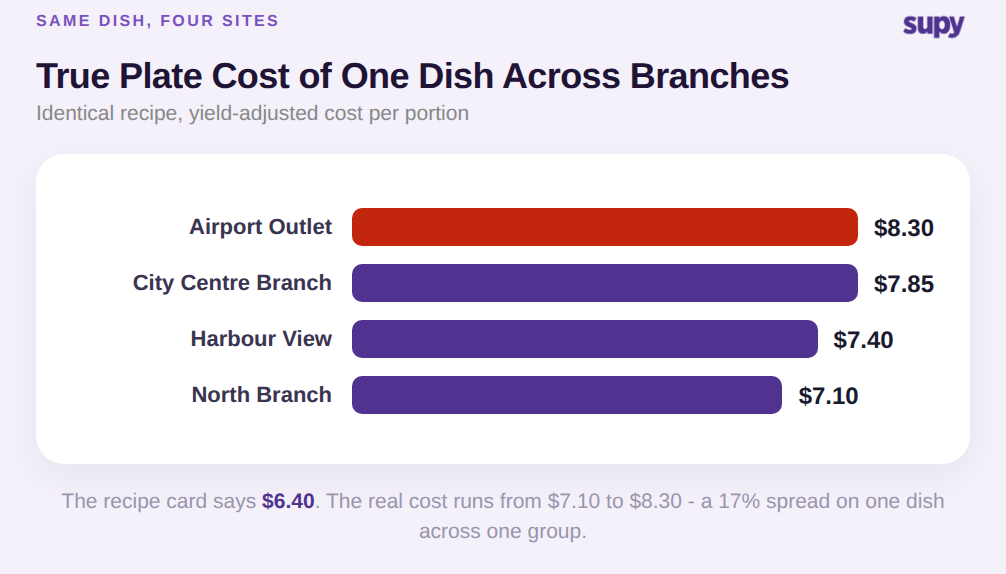
The chart below is the same striploin dish costed at four branches. The recipe says $6.40. The real, yield-adjusted plate cost runs from $7.10 at the tightest site to $8.30 at the loosest, a 17% spread on one dish across one group. Price the menu off the spec cost and the loosest branches are selling at a margin you never agreed to.
Because Supy calculates recipe cost per location and per date, using average or last purchase cost, the same dish can carry its own true cost at each site and over time. That is what makes group-wide menu pricing defensible instead of an average that is wrong nearly everywhere. It is the operational layer under the numbers in our overview of recipe costing software.
How Unrecorded Yield Resurfaces as Variance You Blame on Counting
When yield is never recorded, the cost of it does not vanish. It reappears at month end as a theoretical-vs-actual gap that has to be explained, and the easiest thing to blame is the count. Multi-location groups routinely attribute unexplained food-cost variance to stock-counting error across branches when a large part of it is simply yield the recipes never captured.
Split the drivers of that variance and unrecorded yield loss is usually the biggest single share, ahead of portioning drift, genuine counting error and unlogged waste. Chasing tighter counts while the recipes still run on spec yields fixes the smallest part of the problem and leaves the largest part untouched.
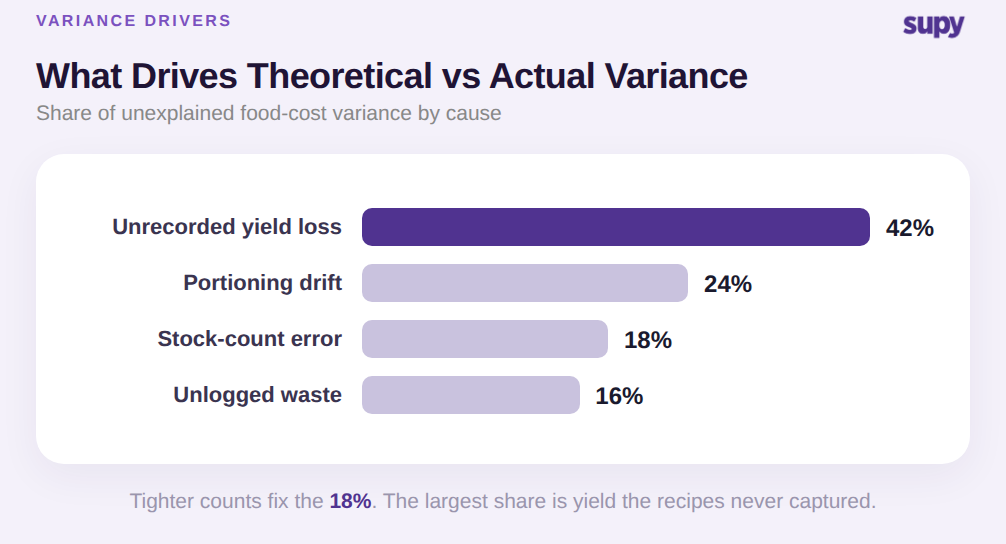
Here is the two-minute check on your own operation: pull the theoretical-vs-actual variance on your five most expensive proteins, then look at whether any recipe using them records an actual yield or a prep-wastage figure. If the variance is material and the yield fields are blank, you are not miscounting; you are costing against a spec yield your kitchen never hits. The first move is to record the real yield on those five ingredients and let the corrected cost flow through, before you touch a single count sheet.
Static recipe costs are comfortable because they are stable. But a cost that never changes is a cost that stopped being true the moment your first delivery trimmed differently than the card assumed. Yield costing is how you make the number on the card match the money in the till, on every dish and at every site.