.jpg)


Recipe Costing Software: Why Static Costs Are Costing You More Than You Think
What Recipe Costing Software Does
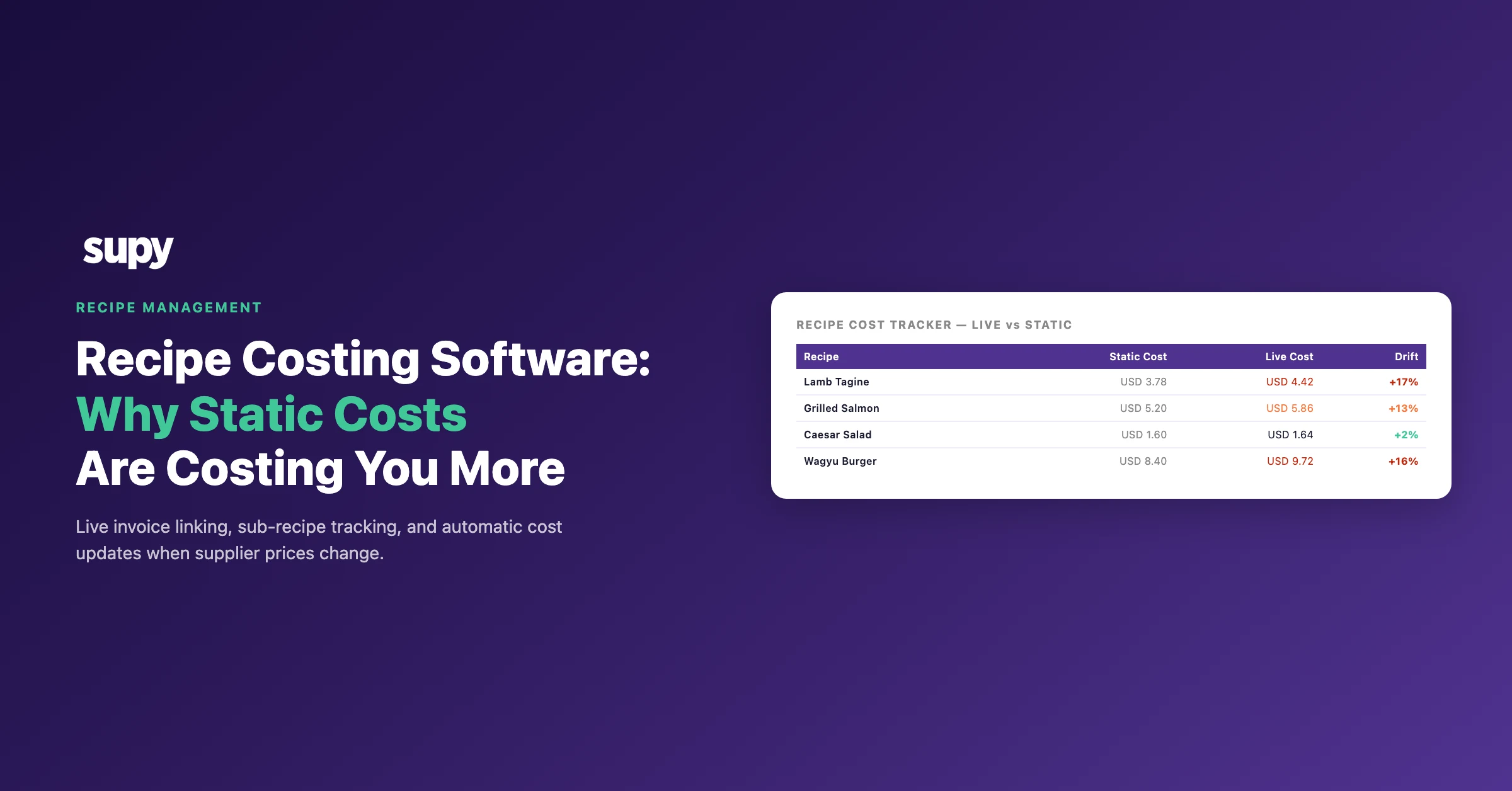
Recipe costing software calculates the cost of each dish by linking the ingredient quantities specified in the recipe to the current purchase price of each ingredient. The result is a live food cost per dish — not the cost at the time the recipe was built, but the cost at the price you paid on the most recent delivery.
The core output is dish-level gross margin: for each menu item, how much of the selling price is ingredient cost, and how much is contribution margin. That number is the foundation for every pricing decision, menu engineering exercise, and food cost investigation.
Beyond individual dish costing, purpose-built software handles sub-recipe costing (stocks, sauces, marinades, and doughs used as components of finished dishes), yield adjustments (accounting for prep waste and trim loss so the cost reflects usable quantity rather than purchased quantity), and automatic price updates when invoices are received and processed.
Where Spreadsheet Recipe Costing Breaks Down
Spreadsheets work at low volume. They break down at scale in three predictable ways.
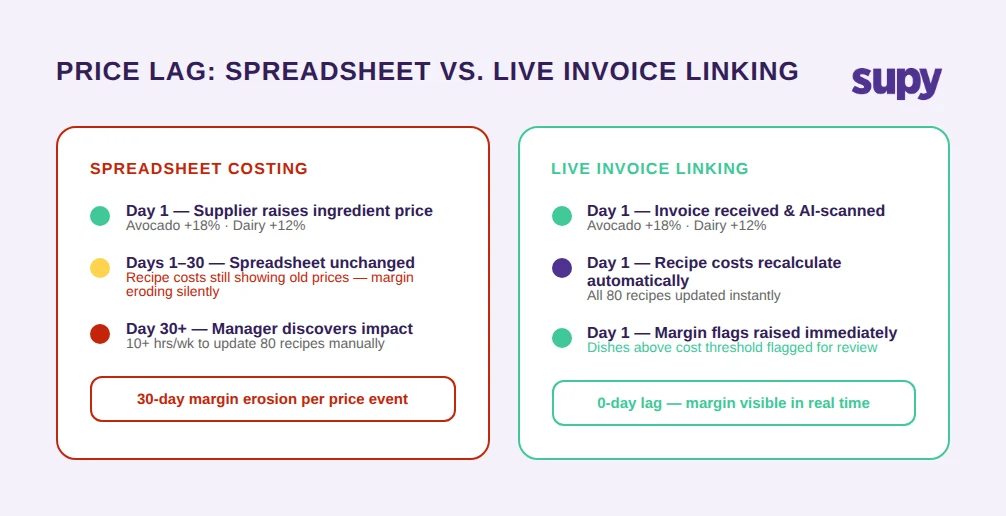
Price lag. A spreadsheet reflects the price entered when the recipe was built. The moment a supplier adjusts a rate, every recipe containing that ingredient is out of date. Research across restaurant operators shows a consistent 30-day lag between when ingredient costs change and when operators discover the impact on dish margins. For operators running 80 recipes with a supplier change affecting 12 ingredients, manually finding and updating each affected recipe takes upwards of 10 hours per week.
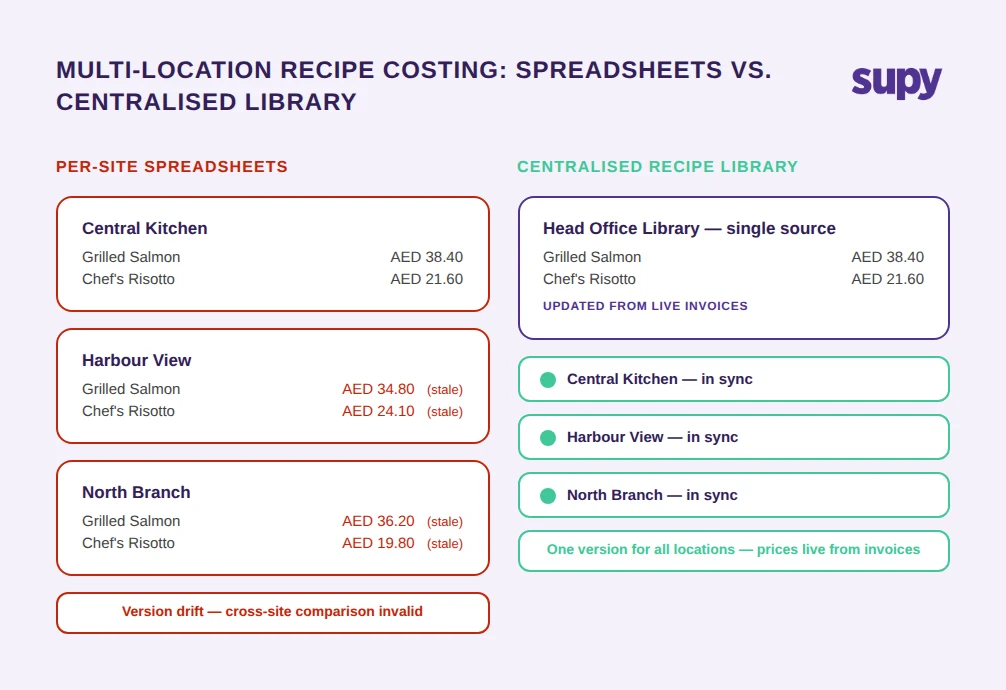
Version inconsistency. Multi-site operators who maintain recipe spreadsheets at the location level end up with each site’s chef managing a separate version. Ingredient quantities drift, yield assumptions diverge, and cross-location food cost percentage comparison becomes meaningless because the underlying data is not consistent.
Missing sub-recipe costs. Spreadsheets that track finished dishes without modelling the prep recipes beneath them understate the cost of any dish using made-in-house components. The labour and ingredient cost of house-made stocks and sauces does not appear in the finished dish cost unless the system explicitly models the relationship.
What to ask before evaluating software: How many of your current recipe costs would change if you updated every ingredient to today’s invoice price? If you cannot answer that within 24 hours, your current system has a lag problem.
How Live Invoice Linking Changes the Cost Picture
The feature that separates purpose-built food cost management software from spreadsheet tools is the live link between supplier invoices and recipe costs.
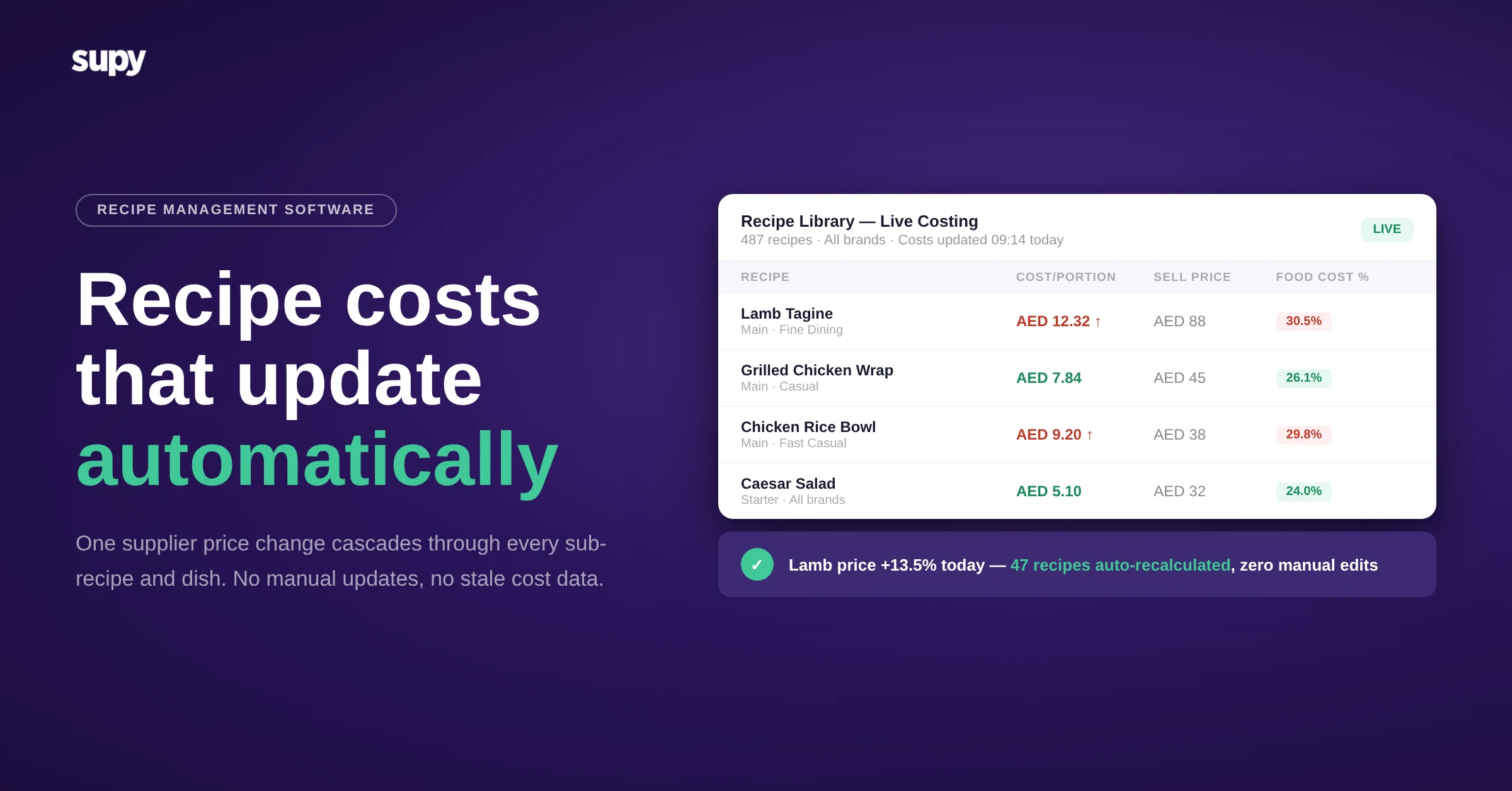
When an invoice is received and processed — automatically, via AI scanning of the delivery document — the ingredient price in the system updates to the invoiced rate. Every recipe containing that ingredient recalculates its cost. Dishes that were profitable at last week’s prices are immediately flagged if the new price pushes the cost above a configurable threshold.
For a kitchen running volatile ingredients — seafood, dairy, avocados — where seasonal price swings of 10–30% are routine, this link is what keeps dish margins visible between quarterly menu reviews. Without it, a mid-season price spike runs silently for weeks before anyone notices the food cost percentage has drifted.
Recipe Costing Across Multiple Locations
For multi-site operators, the challenge is not just keeping costs current — it is keeping them consistent and comparable across a group where each location may have different supplier relationships and local pricing.
A centralised recipe library that every location reads from means a recipe updated at head office applies everywhere simultaneously. When a yield adjustment is made or a prep recipe is revised, all sites reflect the change. There is no version drift, no reconciliation overhead, and no conflicting cost figures when comparing location-level food cost performance.
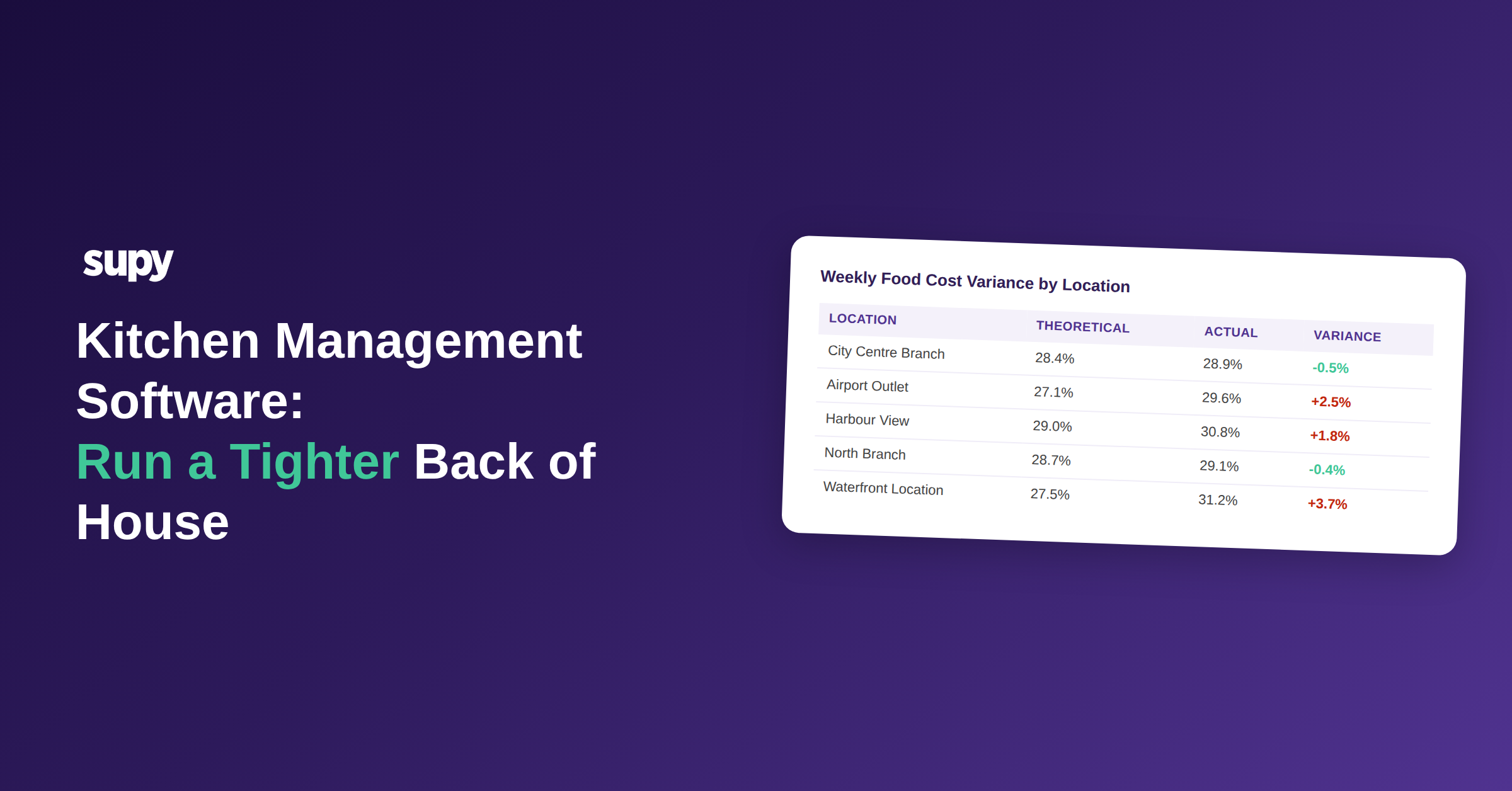
Food and beverage inventory software that connects the recipe library to live stock depletion extends the picture further: not just what each dish should cost, but what the kitchen actually consumed versus what recipes specified, per location, per period.
What to ask when evaluating multi-site platforms: Does a recipe change made at head office apply to all locations automatically, or does each site maintain its own version?
Sub-Recipes, Prep Recipes, and True Dish Cost
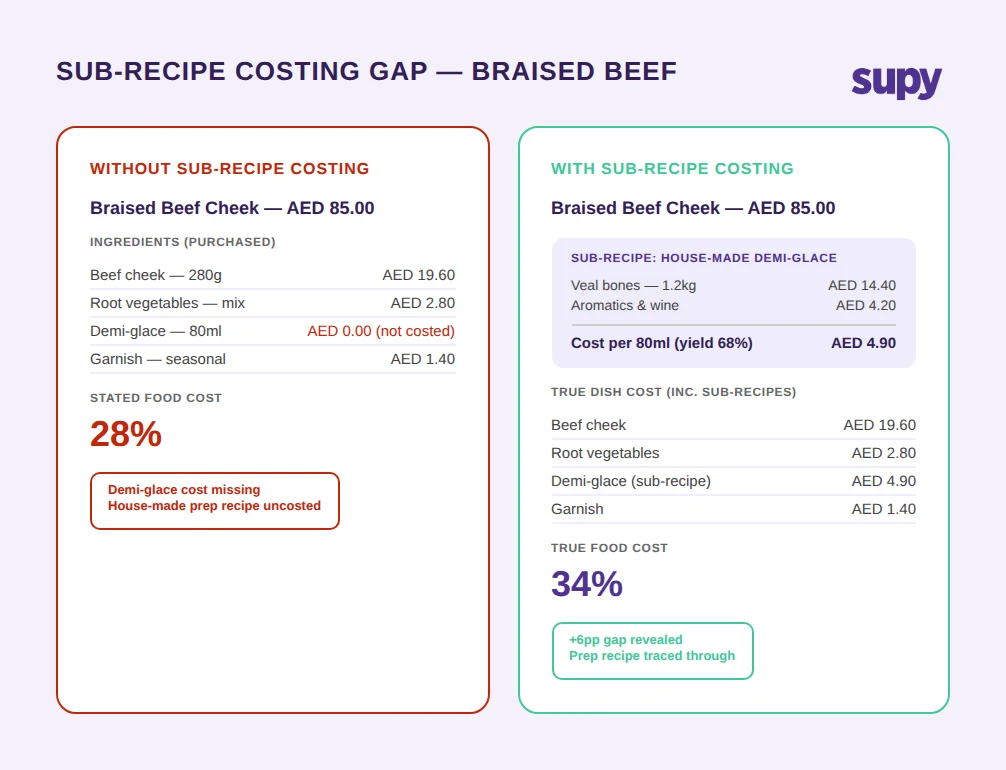
Fine dining, casual dining, and any operation with a scratch kitchen needs recipe costing software that models sub-recipes. A dish that uses house-made stock, house-made pasta, or a house-made sauce has a true cost that includes everything that went into those components.
A system that only costs finished dishes as a list of purchased ingredients will understate the cost of any dish containing a house-made component. This means the highest-complexity dishes — typically the high-margin showpieces of the menu — have the most inaccurate cost data. The gap can be significant: a dish that appears to run at 28% food cost may be running at 34% once sub-recipe costs are correctly modelled.
Proper sub-recipe costing works by modelling each prep recipe as its own cost centre: ingredients in, yield percentage, cost per unit of output. When that prep recipe appears as an ingredient in a finished dish, its cost flows through automatically. A change to a base ingredient propagates up through every sub-recipe and finished dish containing it.
Menu Engineering as the Downstream Output
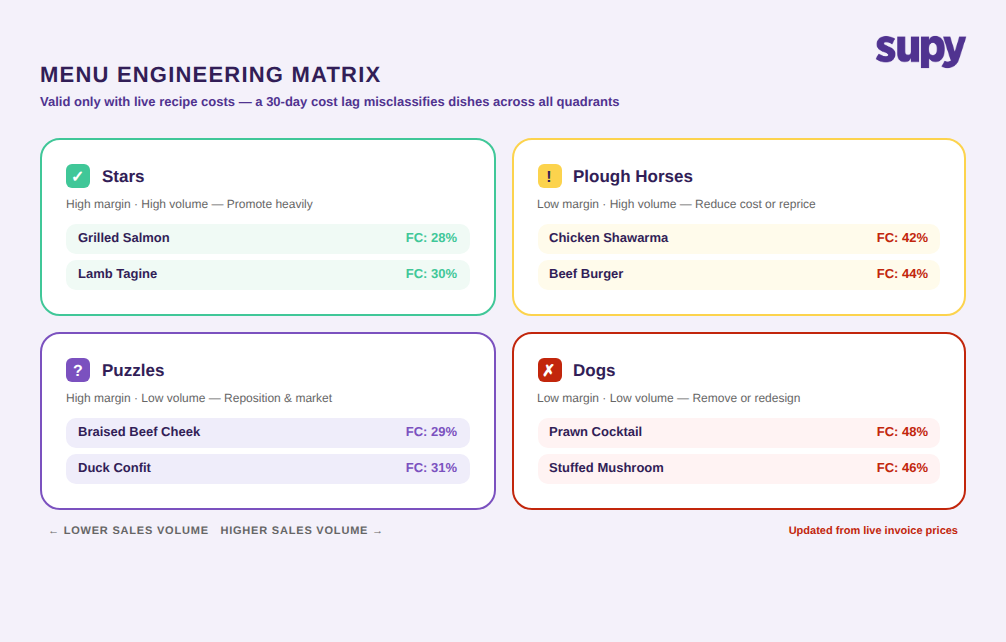
Menu engineering — analysing each dish by food cost percentage and sales volume to decide what to promote, reprice, or remove — requires accurate food cost per dish to be meaningful. A recipe costing tool connected to live invoice prices makes menu engineering a real-time exercise.
The four quadrants of menu engineering (stars, plough horses, puzzles, dogs) are only valid if the cost data underlying the classification is current. A dish that was classified as a high-margin star based on last month’s ingredient prices may have crossed into a low-margin plough horse because of a supplier price increase last week. Without live recipe costing, you are making menu decisions on a map that no longer matches the territory.
Restaurant inventory software that connects recipe costing to POS sales and live stock depletion makes the full picture available: dish cost, actual consumption, and contribution margin updated continuously as service runs.
What to Look For When Evaluating Recipe Costing Software
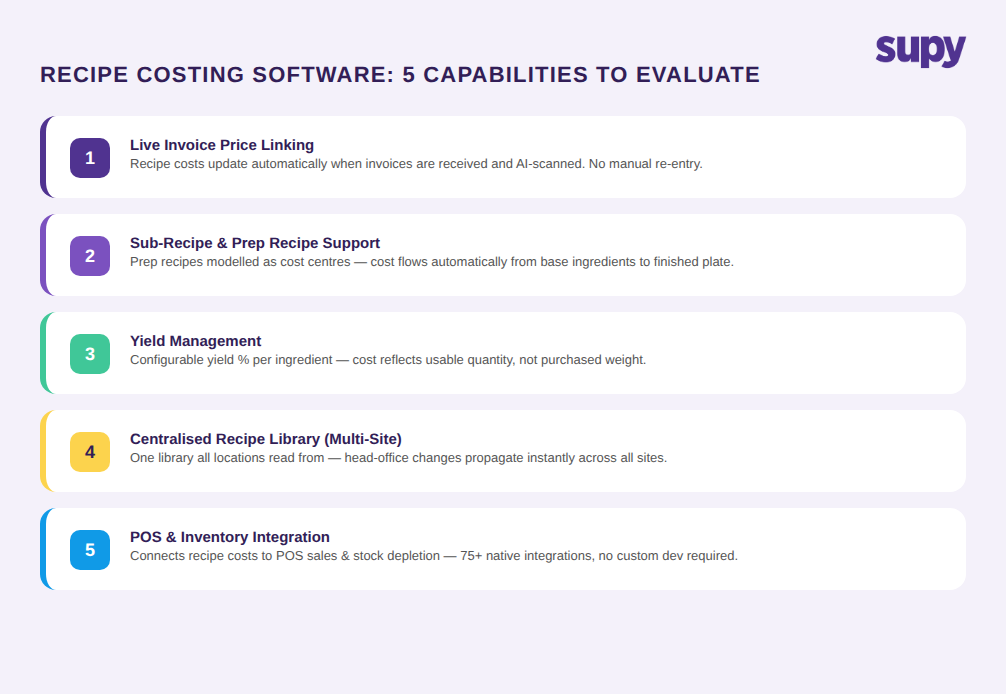
Live invoice price linking: the system should update recipe costs automatically when invoices are received. This is the single most important capability for maintaining accurate costs between menu reviews.
Sub-recipe and prep recipe support: the platform should model prep recipes as components of finished dishes, with cost flowing through automatically from base ingredients to final plate.
Yield management: each ingredient should have a configurable yield percentage so the recipe cost reflects usable quantity, not purchased quantity.
Centralised recipe library for multi-site: one library that all locations read from, with change propagation applying updates everywhere simultaneously.
POS and inventory integration: recipe costs should connect to POS sales data to produce real-time theoretical food cost percentage, and to stock depletion data to surface actual vs theoretical variance. Platforms with 75+ native integrations cover most POS and accounting tools without custom development.