.jpg)


Restaurant Landed Cost: When the Freight Invoice Arrives Late
What Landed Cost Includes, and Where Restaurant Systems Drop It
Landed cost is the full cost of getting an item onto your shelf: the supplier's price plus freight, import duty, customs clearing and handling. For a group buying locally, the supplier price is almost the whole story. For one importing a material share of its goods, those extras are real money, and most inventory systems record only the supplier price.
The gap is structural, not careless. You receive goods against a purchase order at the price on the supplier invoice, because that is the number in front of you. Freight and duty come later, on separate invoices from a forwarder and a clearing agent, and nothing links them back to the items they belong to. So the cost that reaches inventory is the pre-freight price, and it stays that way.
| Cost component | What it covers | Where it usually gets lost |
|---|---|---|
| Supplier price | The agreed price per unit on the purchase order | Captured correctly at receiving |
| Freight | Ocean or air shipping to your door | Billed separately by a forwarder, weeks later |
| Import duty | Customs tariff on the goods | Sits on the clearing agent's invoice, not the supplier's |
| Clearing and handling | Brokerage, port and handling fees | Fragmented across several small invoices |
Depending on how you ship and what duty applies, freight and clearing can be a tenth or more of an imported item's cost. Leave them out and the item is priced wrong from the day it lands.
Why the Freight Invoice Always Arrives After the Food
The timing is the trap. Goods clear customs and arrive; you receive them into stock at the supplier price because that is the only figure you have; the stock is issued, sold and maybe counted. Only then, often weeks later, do the freight and duty invoices land. By that point the pre-freight cost is already baked into issues, recipes, a variance report and, frequently, a closed accounting period.
For an import-heavy group this is not an edge case, it is every shipment. Operators buying directly from overseas suppliers describe cross-border procurement as a standing burden: hundreds of stock items, customs friction, and clearing costs that arrive in pieces long after the delivery. One group with high imported volume received freight invoices so far behind the goods that the stock had already been moved into a new system before the real cost was known.
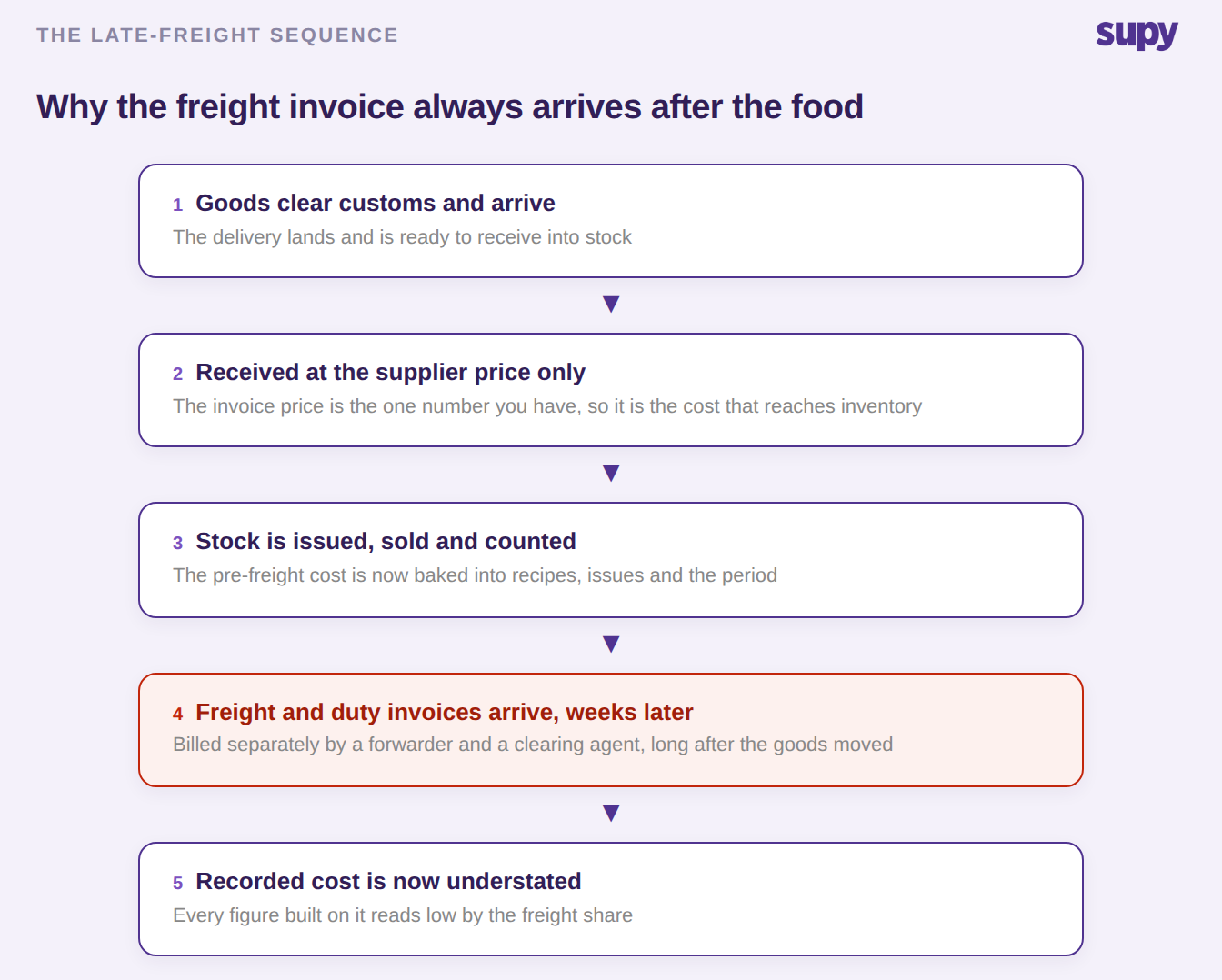
The result is a recorded cost that everyone downstream trusts and that is quietly too low. Getting it right starts at the goods receiving step, where the item cost is first set.
How a Missing Freight Cost Poisons Every Variance Report
When item cost excludes freight, it is not only that one number that is wrong. Every figure derived from it inherits the error: theoretical cost, food-cost percentage, gross margin and the variance report all read low by the freight share, and the shortfall looks like a stock or usage problem it is not.
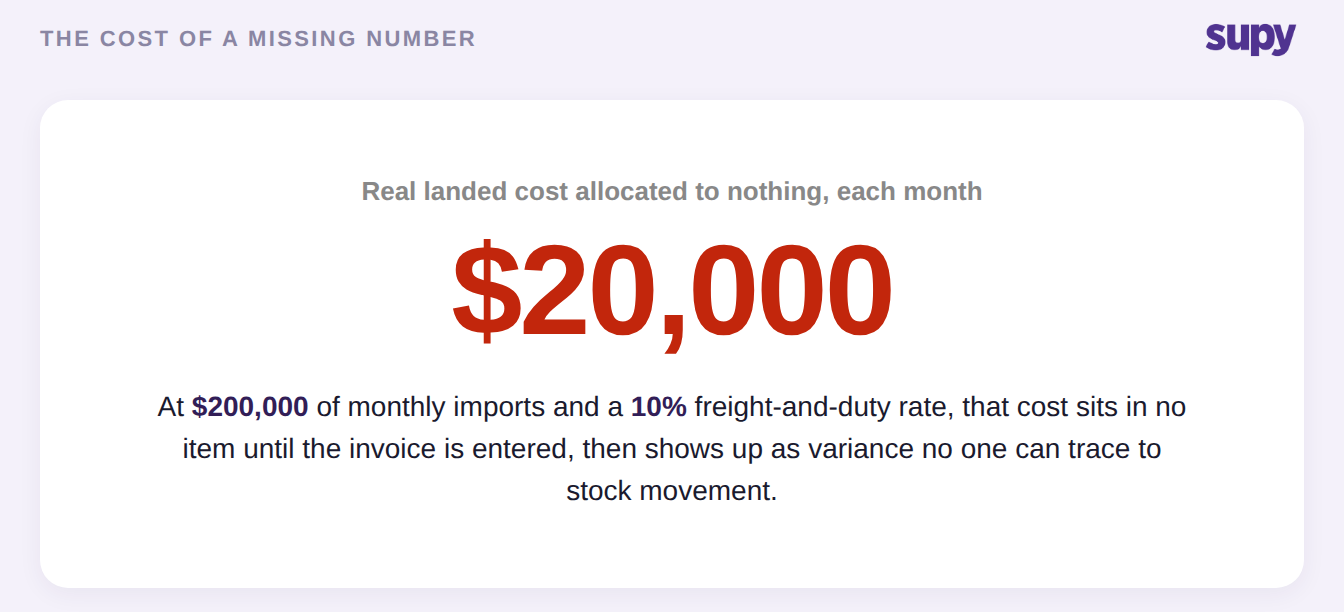
Put numbers on it. Say a group imports $200,000 of goods a month and freight, duty and clearing add 10%. That is $20,000 of real cost each month sitting in no item's cost until the invoices are entered. Finance opens a variance report and sees a swing that has nothing to do with what actually moved through the kitchen.
This is the same failure mode operators hit when an item's cost is set once and never corrected: a single wrong cost per unit has thrown a variance report by a six-figure amount, with no theft, waste or miscount behind it. A late freight invoice is that failure on a schedule. And it puts finance in an impossible spot, because you cannot ask a team to ignore a variance the numbers themselves created. Want to see how the gap moves your food-cost percentage? Our free food cost calculator makes it visible in a minute.
Allocating Landed Cost After the Invoice Finally Lands
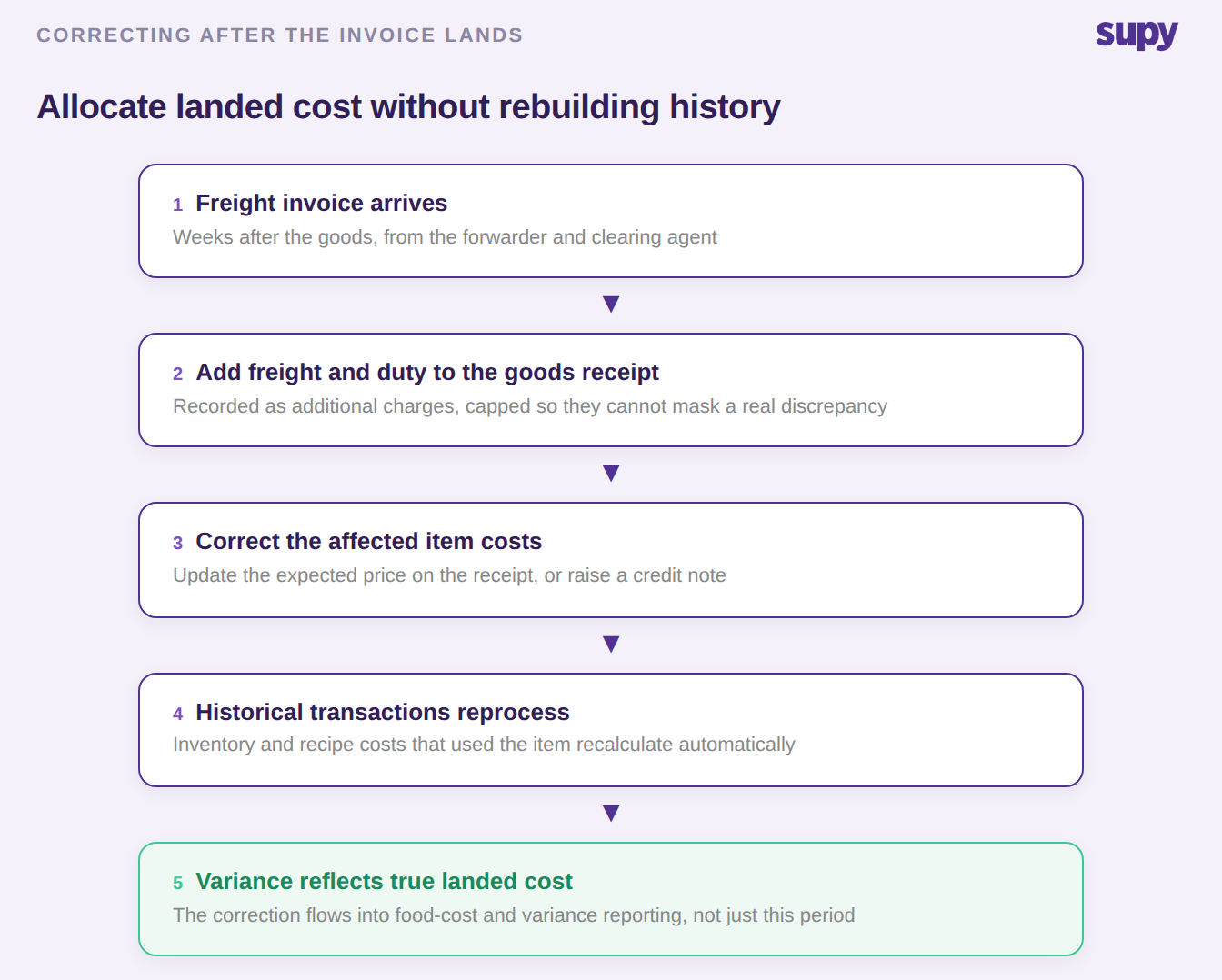
You do not need to rebuild history. When the freight invoice arrives, record it against the goods receipt it belongs to as additional charges, correct the affected item costs, and let the system carry the correction back through the transactions that already used those items.
In Supy that path is deterministic:
- Add freight and duty to the goods receipt as additional charges, with a cap on how large those charges can be so they cannot quietly mask a genuine price discrepancy.
- Correct an item's cost on receipt or from the Received Items page, either by updating the expected price or raising a credit note where the charge was wrong.
- When an item cost changes, Supy automatically reprocesses the historical inventory transactions and recipe costs that used it, so the correction flows into food-cost and variance reporting instead of stranding in the current period.
One thing to be honest about: a system can make a corrected cost stick and cascade, but it will not decide for you how to split a single freight invoice across every item on a shipment. That allocation, by value, by weight or by volume, is a policy you set once and apply each time. The software's job is to make the number correctable and to carry the correction everywhere the old number went, which is exactly the part that manual spreadsheets cannot do. That is the difference between an inventory system that treats cost as correctable and one that freezes it at receipt.
Choosing How Imported Items Carry Their Cost
Correcting after the fact is the recovery move. The durable fix is deciding, per item, how its cost should behave, so the next late invoice has somewhere to land. Supy gives each item one of two costing methods: purchase-order cost, which prices the item from actual purchase orders, and fixed cost, a stable manual cost per unit you set.
| Situation | Costing method | Why |
|---|---|---|
| Freight varies shipment to shipment | Purchase-order cost | Each corrected receipt moves the item cost with the real rate |
| Landed rate is stable and predictable | Fixed cost | Bake the known freight-and-duty rate into a set cost |
| Mostly local, occasional imports | Purchase-order cost | Correct the few imported receipts; local items stay accurate on their own |
Purchase-order cost feeds a 365-day rolling weighted average, so a single high-freight shipment nudges the item cost rather than spiking it. That smoothing is useful, but know the flip side: a large late freight correction spreads gradually rather than landing in one period, so read the trend, not just this week's number.
Is Freight Missing From Your Cost? A Quick Self-Check
You can tell in about ten minutes whether this is happening in your operation. Pull your most import-heavy categories and check three things:
- Does a recently imported item's cost match only the supplier invoice, with no freight or duty added? If yes, freight is missing.
- Do you have freight or clearing invoices from the last quarter that were expensed to overheads instead of allocated to items? Each one is landed cost that never reached inventory.
- Does a variance report show swings on imported items that no one can trace to real stock movement? That is the freight gap surfacing as phantom variance.
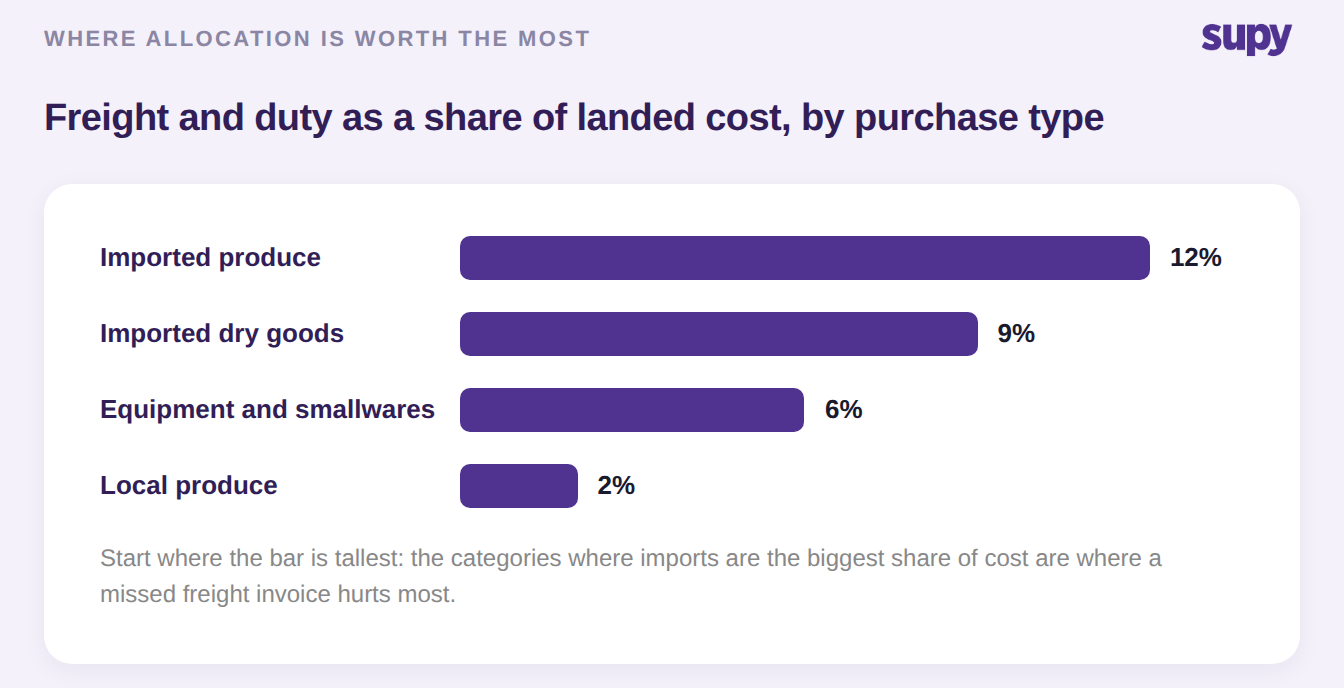
Start where imports are the biggest share of cost, because that is where the correction is worth the most. Fix the costing method for those items first, allocate the freight invoices already sitting in overheads, and the variance report starts telling the truth again.