Inventory

Restaurant Inventory Software Rollout: Pilot to Full Estate
Start With One Site, Not the Whole Estate

A phased inventory rollout means bringing one representative site live first, proving it against fixed success criteria, then expanding site by site rather than switching the whole group at once. For a multi-site restaurant group, the pilot is where you find the data gaps, adoption friction and integration problems cheaply, before they multiply across every outlet.

The instinct on a group deal is to turn everything on at once and be done with it. That is exactly the move that goes wrong. One large multi-country group rolled an inventory module out to every franchisee at the same time, then spent months unwinding the problems it created. A big-bang switch hides which failures are the software, which are the data, and which are the team, because they all arrive together.

Pick a pilot site that looks like the rest of the estate, not the easiest one. A single flagship with a strong manager will pass any test and teach you nothing about the branch that is short-staffed and running on habit. Choose a site with a normal supplier list, a normal menu and a normal team, and agree in advance what the pilot has to prove before anyone signs off on expanding.
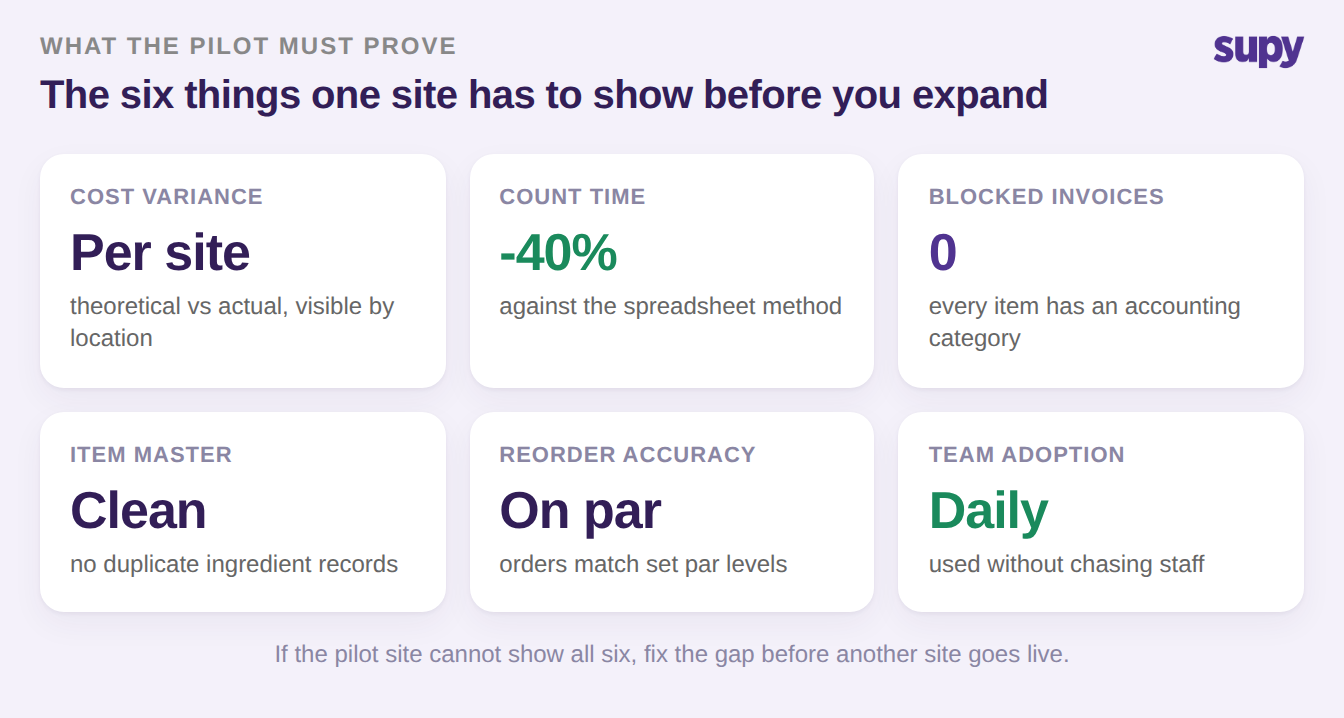
Six pilot success criteria a multi-site restaurant group should prove before expanding an inventory rollout

Get the Data Right Before Any Go-Live

Most rollouts do not stall on the software. They stall on the data that was never cleaned up first. The work that decides whether a go-live is smooth happens in the weeks before it, and almost none of it is visible in a product demo. Standardise item naming across brands and entities, assign an accounting category to every item, and map each point-of-sale item to its recipe, or the first invoice and the first count will expose the gap in front of the whole team.

A single item master is what keeps this manageable at scale: define each ingredient once, with its supplier codes, pack sizes and allergen tags, and let it carry across every outlet rather than being re-keyed site by site. Getting there means resolving duplicate records before go-live, not after, which is its own piece of work worth doing carefully (our guide to item master data hygiene covers the mechanics). It is also the moment to sanity-check recipe costs while the catalog is fresh, which a free food cost calculator makes quick.

Data-prep taskWhat it blocks if skipped
Standardise item names across brandsDuplicate items and reports that will not consolidate across sites
Assign an accounting category to every itemInvoices silently fail to post, and nobody finds out until month-end
Map point-of-sale items to recipesNo theoretical cost and no usable variance reporting
Set par levels per locationReordering stays manual, and the system cannot suggest orders
Decide the group shape (entities, cost centres)Rework later, because the hierarchy is hard to change once live

Owned First, Franchised by Invitation: Sequencing the Estate

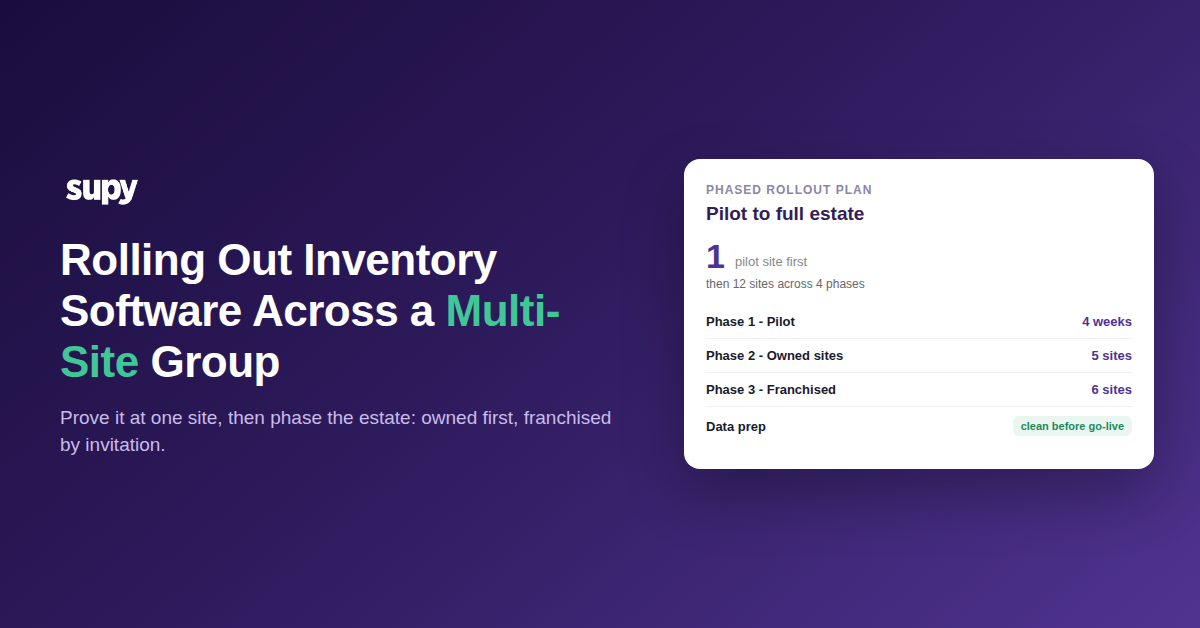
Once the pilot proves out, sequence the rest of the estate rather than opening the doors to everyone. Bring owned sites live first: they carry the learning curve, they absorb the process changes, and you can direct them. By the time you reach franchised sites, the playbook is written and the awkward questions already have answers.

Franchised sites are a different problem, because you often cannot mandate the system. Adoption there has to be earned, not ordered, especially in markets where operators are wary of new back-of-house software. Lead with the incentive an owner actually feels: less time counting, fewer ordering mistakes, a clear picture of where margin leaks. Roll them in waves, so each group of sites has a reference site that already runs on it.

Rollouts that stall usually stall for one of three reasons. The first is single-person dependency: one champion sets everything up and the whole site freezes when they are away. The second is item-master drift, where sites quietly add their own duplicate items and the shared catalog rots. The third is an unfinished chart of accounts, where items without a category block invoice posting long after go-live. Name an owner for each of these before you scale, not after.
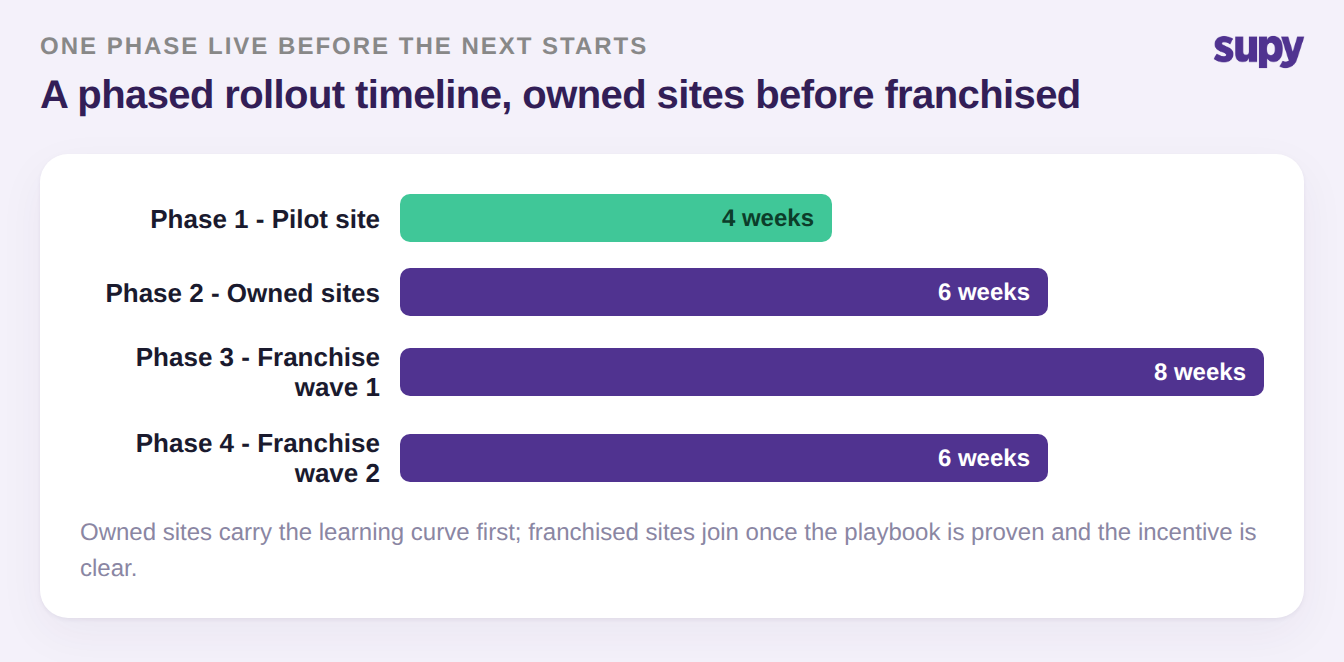
A phased rollout timeline for a multi-site restaurant group, owned sites before franchised, four phases

Your First Move

Before you plan a single go-live date, run one honest check: could you name the pilot site, the exact success criteria, and the person who owns the item master, the accounting categories and adoption at each site? If any of those is still vague, that is the gap to close first. A rollout succeeds because the data was ready and the sequence was deliberate, not because the switch was flipped everywhere at once. Supy gives a group the structure to phase it cleanly: a three-tier group, outlet and location hierarchy, one synced item master, and per-location integration mapping so each outlet comes live on its own schedule with its own inventory management setup intact.
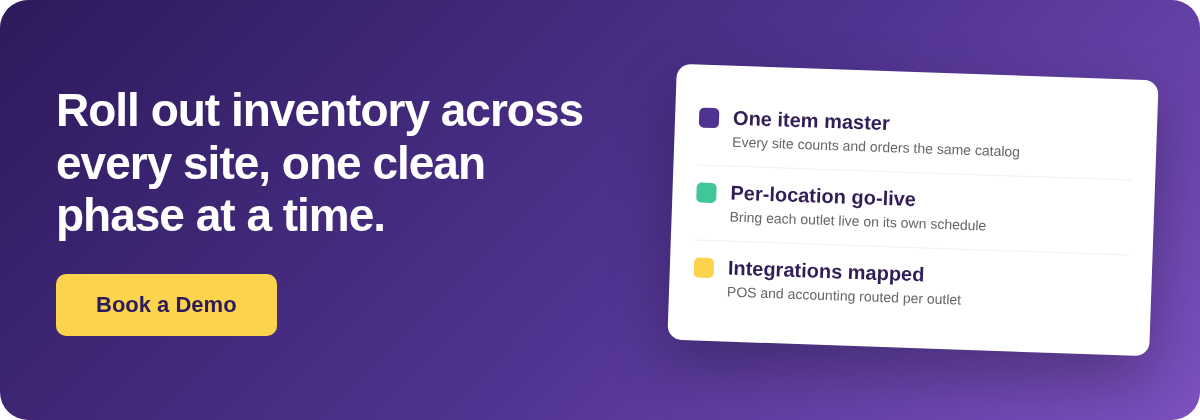
Book a Demo with Supy to roll out inventory across every restaurant site one phase at a time

Ready to optimize your restaurant operations?

Blog

Our operational insights

No items found.

Your questions 
answered

Everything you need to know about Supy — from setup to integrations, pricing, and daily use. If it’s not covered here, just ask.

How long should an inventory rollout take across a multi-site restaurant group?
+

How long a rollout takes depends on estate size and data readiness, not software speed. A sensible shape is a four-week pilot at one site to prove the success criteria, then owned sites in a wave of about six weeks, followed by franchised sites in one or two later waves. The variable that moves the timeline most is data prep: standardised item names, accounting categories on every item, and point-of-sale-to-recipe mapping. Groups that finish that work before each go-live move quickly; groups that discover it at go-live stall. Sequence by readiness, and let each phase go live only once the one before it is stable.

Why start with a pilot site instead of rolling out to every location at once?
+

Starting with one pilot site keeps failures cheap and legible. When you switch a whole group on at once, software issues, data gaps and adoption problems all arrive together, and you cannot tell which is which. A pilot isolates them at a single site you can watch closely and fix fast. Choose a site that looks like the rest of the estate rather than your strongest one, agree in advance what the pilot has to prove, and only expand once it clears every criterion. The pilot is also where your rollout playbook gets written, so later sites inherit answers instead of repeating the same mistakes.

What data needs to be ready before an inventory go-live?
+

Before any go-live, three pieces of data matter most. First, standardise item naming across brands and entities so reports consolidate and duplicates do not multiply. Second, assign an accounting category to every item, because items without one silently block invoice posting and nobody notices until month-end. Third, map each point-of-sale item to its recipe, or you get no theoretical cost and no usable variance reporting. Set par levels per location too, so the system can suggest orders instead of leaving reordering manual. This work is invisible in a demo but decides whether the first invoice and first count go smoothly or expose the gaps in front of the team.

How do you roll out inventory software to franchised sites you cannot mandate?
+

Franchised sites often cannot be ordered onto a system, so adoption has to be earned. Lead with the incentive a franchise owner actually feels: less time spent counting, fewer ordering errors, and a clear view of where margin leaks. Roll franchised sites in waves rather than all at once, and make sure each wave has a nearby reference site already running well, so owners can see it working before they commit. Bring owned sites live first to build that proof and write the playbook. In markets where operators are wary of new back-of-house software, a working neighbour is far more persuasive than a mandate.

What is the most common reason a multi-site inventory rollout stalls?
+

Rollouts usually stall for one of three reasons, and none of them is the software. The first is single-person dependency, where one champion configures everything and the site freezes whenever they are away. The second is item-master drift, where individual sites quietly add their own duplicate items until the shared catalog is unreliable. The third is an unfinished chart of accounts, where items created without an accounting category keep blocking invoice posting long after go-live. The fix is to name an owner for each of these before you scale, not after. Assigning accountability early is what keeps a rollout from unravelling as it expands.

Should owned sites or franchised sites go live first in a rollout?
+

Owned sites should go live first. You can direct them, they absorb the process changes, and they carry the learning curve while the rollout is still finding its rhythm. By the time you reach franchised sites, the playbook is written and the awkward questions already have answers. Owned sites also become the reference points that convince franchise owners the system works, which matters because franchised adoption usually has to be earned rather than mandated. Sequencing owned first, then franchised in waves, means each group of sites joins with a proven process and a working neighbour to copy, instead of improvising alone.

How does a single item master help a phased rollout?
+

A single item master defines each ingredient once, with its supplier codes, pack sizes and allergen tags, and carries it across every outlet instead of being re-keyed site by site. In a phased rollout this is what keeps later sites cheap to bring on: they inherit a clean, shared catalog rather than rebuilding one. It also prevents the item-master drift that stalls rollouts, because sites draw from the same records instead of inventing duplicates. Paired with a group, outlet and location hierarchy and per-location integration mapping, it lets each outlet come live on its own schedule while still reporting into one consistent structure for the whole group.

Ready to transform your operations?

Join 3500+ restaurant operators cutting costs, streamlining operations and making smarter decisions with Supy.