.jpg)


UAE VAT for Restaurant Groups: What E-Invoicing Must Map
Why the Same Supplier Invoice Splits Into Two VAT Buckets
UAE VAT for restaurant accounting is the daily mapping problem of two receipt types living inside one supplier day: formal supplier invoices that carry 5% recoverable input tax, and cash and grocery receipts that carry no valid tax invoice and no input-tax recovery. A restaurant purchase flow has to route each into its correct chart of accounts before the FTA return can be prepared, and the mapping has to hold on every entity in a multi-brand group.
A vegetable order from an authorised supplier arrives with a compliant tax invoice showing the supplier's TRN, the 5% VAT line, and the AED total. The evening top-up from a nearby grocery arrives with a till receipt, no TRN, no VAT line, and the same food items on it. Both purchases feed the same recipe. In the accounts, only one of them is recoverable. Groups that treat these two as a single "food purchases" line lose input-tax recovery on the first and misstate cost of goods sold on the second, and the error compounds every month until the tax rate flag is set at the receipt level, not the return level.
The receipt-level split that must reach the ledger:
| Receipt type | Input VAT position | Chart of accounts treatment |
|---|---|---|
| Formal supplier tax invoice (TRN present, valid line-level VAT) | 5% recoverable, claimable on the FTA return in the same tax period as the invoice date | Post net cost to the food expense line; post the VAT to the recoverable input-tax control account |
| Cash and carry, grocery, market receipt (no valid tax invoice) | 0% recoverable, no input-tax claim regardless of the amount | Post gross value to the food expense line; no entry to the input-tax control account |
| Non-food expense on a tax invoice (utilities, packaging, cleaning) | 5% recoverable if the supplier is TRN-registered and the item is not blocked | Post net cost to the correct non-food expense line; VAT to the same input-tax control account |
| Zero-rated or exempt supply (specific medical, exports, some transport) | Zero-rated is recoverable at 0%; exempt items break the input-tax claim on related inputs | Track separately in the ledger so the FTA return categorises correctly |
The last two rows matter for the same reason the first two do: a group whose accounting stack cannot see the receipt type does not report VAT correctly, and no line-level mapping means the finance lead reconstructs the split by hand every month.
Where a Two Hour Invoice Reconciliation Comes From
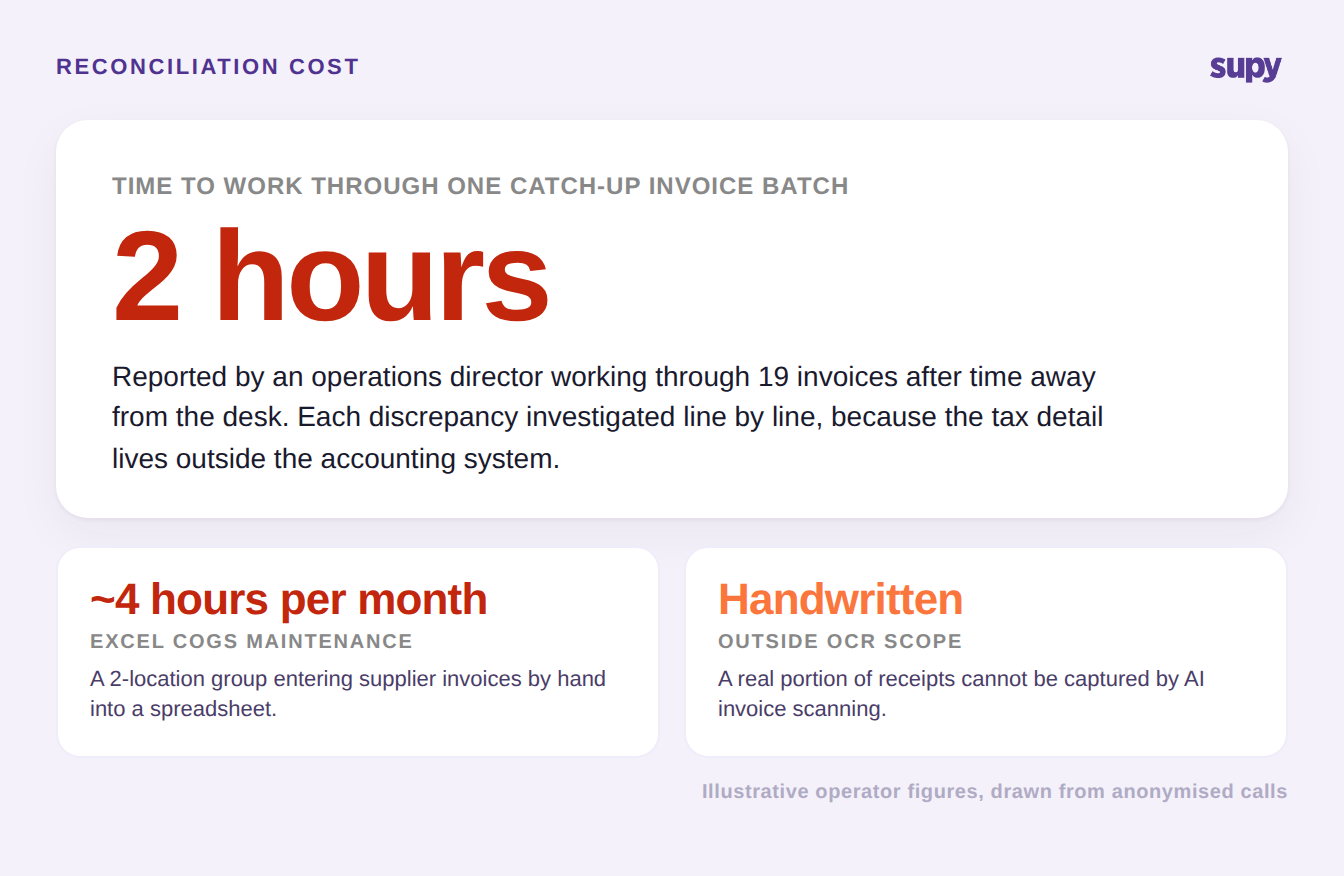
Two hours to reconcile 19 invoices is what an operations director in a fine dining restaurant reported after a period away from the desk, with each discrepancy investigated line by line. Half a day per month is what a 2-location group's owner spends entering supplier invoices into an Excel cost of goods sold sheet, with missed VAT amounts and entirely missed invoices surfacing at month-end. Both numbers describe the same failure mode: the accounting system sees a total, and the tax detail lives somewhere else.
Manual data entry into a spreadsheet has no line-level tax flag, so a VAT-eligible invoice and a cash receipt become the same row of numbers. AI invoice scanning solves part of it and cannot solve the rest: handwritten supplier invoices, which sit in a real portion of a UAE operator's receipt pile, fall outside optical character recognition and remain fully manual regardless of the tool. Even a modern OCR pipeline still needs a human to verify every delivery receipt against the invoice, because the receipt is what determines whether the VAT position is real.
The reconciliation time is a symptom of the mapping gap, not of the reconciliation activity itself. Fix the mapping at the receipt entry point and the two hours collapse to a review pass on the exceptions; leave the mapping to month-end and every catch-up cycle repeats it.
Configuring Per-Entity Tax Rates in the Accounting Stack So the Split Runs Itself
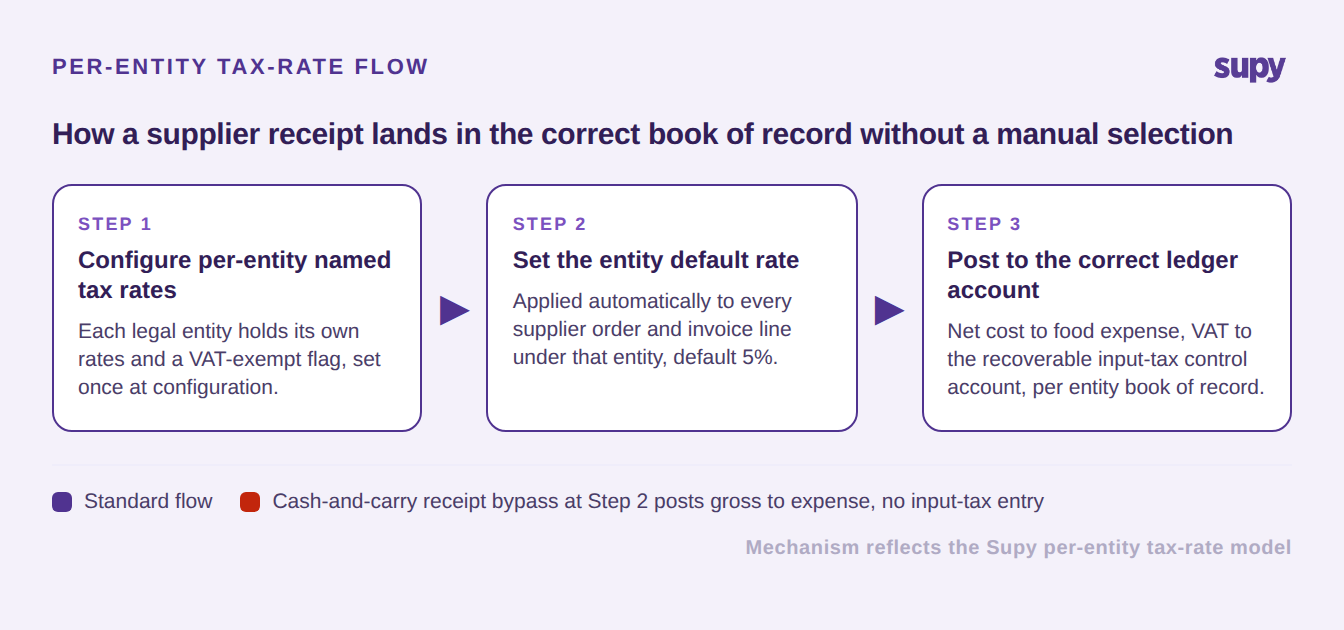
A group finance lead does the split once, at configuration time, per legal entity. Each entity in a multi-brand restaurant group holds its own named tax rates, including a VAT-exempt flag for qualifying items, and the platform applies the correct rate automatically at the point of receiving. The receipt no longer needs a human judgement at reconciliation time because the tax treatment was already decided when the supplier and item were set up.
The mechanism that closes the missed-VAT failure mode is a per-entity default tax rate on supplier invoice cost. When a supplier order or invoice arrives against an entity, Supy applies that entity's configured default tax rate at the line level, so food cost figures and the general ledger entry reflect the correct VAT treatment without a manual rate selection on each row. A restaurant group with three brands sharing a Central Kitchen configures three sets of named rates, and each brand's food expense line lands in its own book of record with the tax split already resolved. For the underlying platform primitives that carry this configuration into the broader procurement stack, our restaurant procurement software documents the supplier, receiving, and invoice-approval mechanics that read the rates.
The tax-rate structure is only half the resolution. A restaurant chart of accounts built for a multi-entity group has to hold a separate recoverable-VAT control account, non-recoverable input handling for the cash line, and per-entity food expense codes that map cleanly into the group consolidation. Without that structure in the accounting system, a correct tax rate on the platform side has nowhere clean to post to, and the receipt-level split turns back into a manual reconciliation at month-end.
What the E-Invoicing Mandate Actually Asks of a Restaurant Purchase Flow
The UAE Ministry of Finance has published a phased rollout of a mandatory e-invoicing regime under an Accredited Service Provider framework. The consultation and taxpayer-category schedules have moved, so a restaurant operator should never plan against a specific rumoured go-live date without checking the current FTA position. What is stable in the design is the operator side of the flow: which receipts route through an accredited channel, which do not, and where the archival duty sits when both types exist in the same accounts payable inbox.
The operator translation is the part missing from most restaurant accounting content. A formal supplier tax invoice from a TRN-registered supplier is what the ASP framework is designed to carry; a cash and carry receipt from an unregistered vendor is not, and remains captured through the normal receipt-attach workflow. A restaurant that receives both types on the same day needs its purchase flow to hold the two in the same accounts payable view without collapsing them into a single "supplier invoice" bucket. That is the mapping the platform side has to hand the accounting system.
How a UAE restaurant purchase flow routes each receipt type when e-invoicing is live:
| Receipt event | Route via ASP | Captured outside ASP | Archival owner |
|---|---|---|---|
| Formal supplier tax invoice, TRN-registered supplier | Yes, through the supplier's or buyer's accredited channel | No | ASP retains for the FTA-mandated period; the accounting system holds the local copy |
| Cash and carry receipt, no TRN on receipt | No | Yes, captured as a photo or scan attached to a receiving event | The restaurant's own document store; keep the paper receipt per FTA record-keeping rules |
| Supplier credit note, TRN-registered supplier | Yes, routed the same way as the original invoice | No | Same as the invoice; the credit note must match the original for input-tax adjustment |
| Petty-cash grocery top-up | No | Yes, attached to the petty-cash entry | The restaurant's own document store, with the petty-cash reconciliation record |
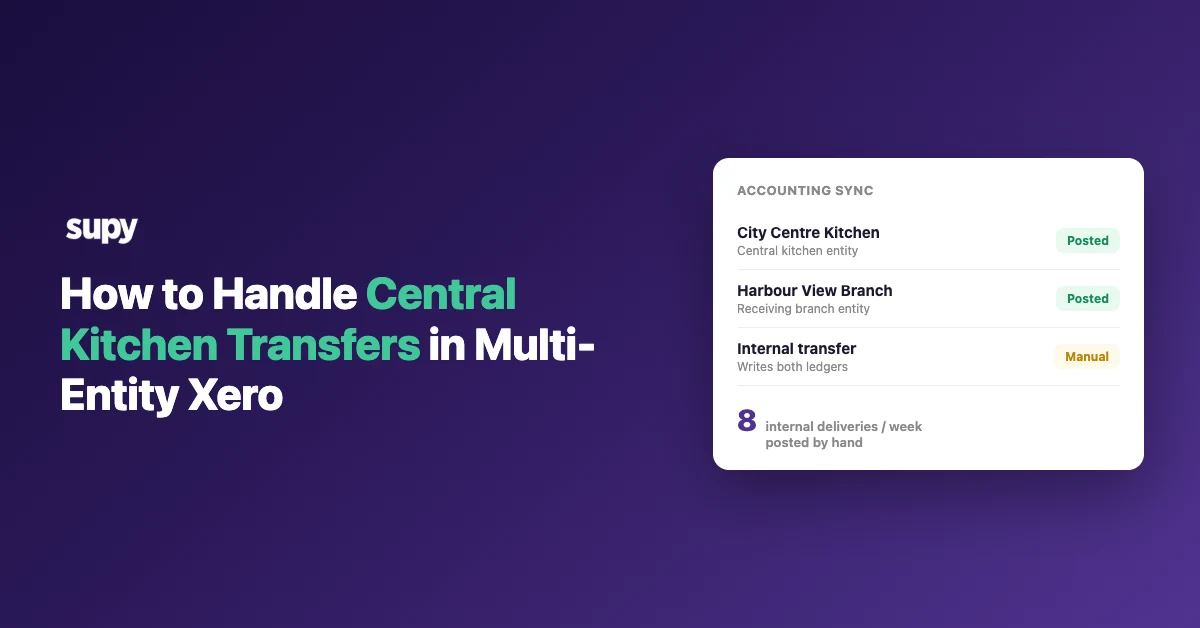
| Central Kitchen invoice to a brand entity in the same group | Depends on whether the CK entity is TRN-registered and issues a tax invoice; a group that has structured internal transfers as taxable supplies routes them the same as an external supplier invoice | No, if a tax invoice is issued between the entities | Both entities archive; the transfer-pricing file needs the same record |
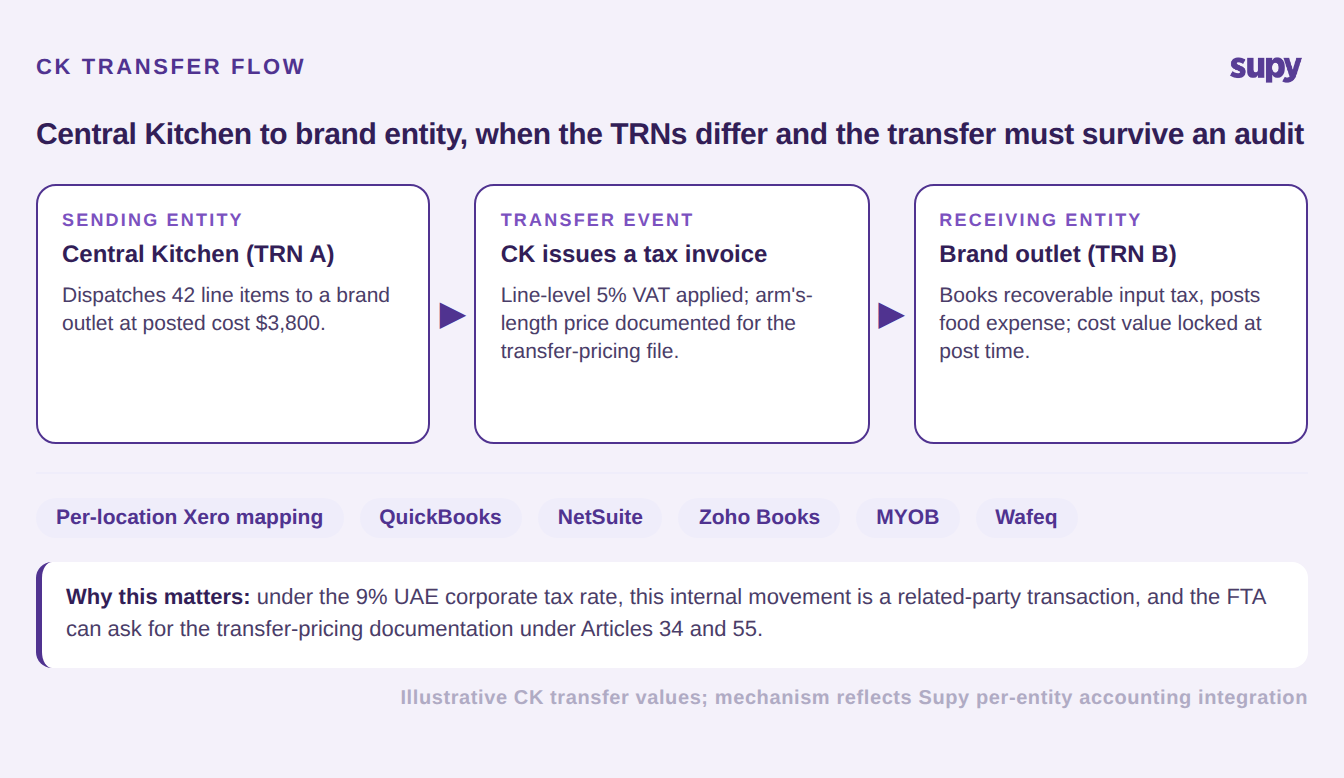
The last row is the one that trips groups running a Central Kitchen: the internal transfer between the CK and a brand is a taxable supply if the entities are separately TRN-registered, and it carries the same recoverable input on the receiving side as any external supplier invoice would. The e-invoicing mandate reads that transfer the same way, and the platform side has to be able to issue it.
Central Kitchen Transfers and the Setup Order Before Month-End
Inter-entity transfer accounting is the third UAE regulatory hook, and it sits at the intersection of VAT recoverability, e-invoicing routing, and 9% corporate tax transfer-pricing documentation. A 4-location group with one Central Kitchen and three brand outlets makes several dozen internal movements a week; every one of them is a taxable supply if the entities are on separate TRNs, and every one of them is a comparable-uncontrolled-price benchmark the FTA can ask to see under Articles 34 and 55 of the Corporate Tax Law.
The mechanism that keeps these movements clean is per-location and per-entity accounting mapping. Supy connects to Xero, QuickBooks, NetSuite, MYOB, Zoho, and Wafeq at the entity level, so each outlet in a multi-brand group can route its purchasing and its Central Kitchen receipts into its own book of record. Xero specifically supports per-location mapping, and Wafeq is the UAE-native accounting integration on the list. When a Central Kitchen order is posted to the accounting system, its cost is locked at the time of posting and does not recalculate later, and the sync status is visible on the order itself, so a failed post is a fixable exception rather than a silent miss.
A four step setup order for the month leading into the next return:
- Set the named tax rates per entity, not once for the group. Give each legal entity its own standard 5%, zero-rated and exempt rates, then set the per-entity default tax rate on supplier invoice cost so a formal tax invoice picks up the recoverable rate the moment it arrives.
- Split the chart of accounts so recoverable VAT has its own control account. The food purchases line takes net cost on a tax invoice and gross value on a cash-and-carry receipt, and the input-tax control account only ever receives the recoverable portion.
- Decide how the Central Kitchen bills each brand before the first transfer of the month. Where the entities sit on separate TRNs, set the Central Kitchen up as an internal supplier issuing a tax invoice, so the movement carries its own VAT treatment and leaves its own transfer-pricing record.
- Map every outlet to its own book of record, then watch the sync status. Point each entity's purchasing and Central Kitchen receipts at the accounting system that entity reports from, and check the sync status on the orders themselves so a failed post is fixed inside the week rather than found at month-end.
Run through this list once per entity before the next month-end and the FTA return preparation moves from a two-hour catch-up into a review pass. Skip any of the four, and the missed line becomes the reconciliation that grows every month.
Where to start, and how to tell if it is worth doing. Take one entity in the group and check three things this week: are your named tax rates set per entity or shared, are your cash-and-carry receipts landing in the same food-purchases line as your tax-invoiced ones, and does your Central Kitchen bill the receiving brand as an internal supplier when the TRNs differ. If two of the three answers are wrong for the entity you checked, the reconciliation cost you are absorbing every month is the setup cost you have not yet spent, and an ROI estimate on the tooling change is likely to justify the setup week. The regulatory hooks are not going away, and each one gets more expensive the longer it lives in the reconciliation instead of in the configuration.
Book a demo when the check surfaces the mapping gap, so a UAE-VAT-aware setup runs against a real day of your receipts rather than a theoretical one.