.jpg)


Restaurant Supplier Scorecards: How To Track Supplier Performance
Why scoring suppliers on price alone costs you
A supplier performance scorecard is a short, repeatable rating of each supplier on the things that actually move your food cost: price accuracy, delivery reliability, and how often something has to be claimed back. For a multi-site group it turns a pile of receiving records into a ranked view of which suppliers to keep, push, or replace.
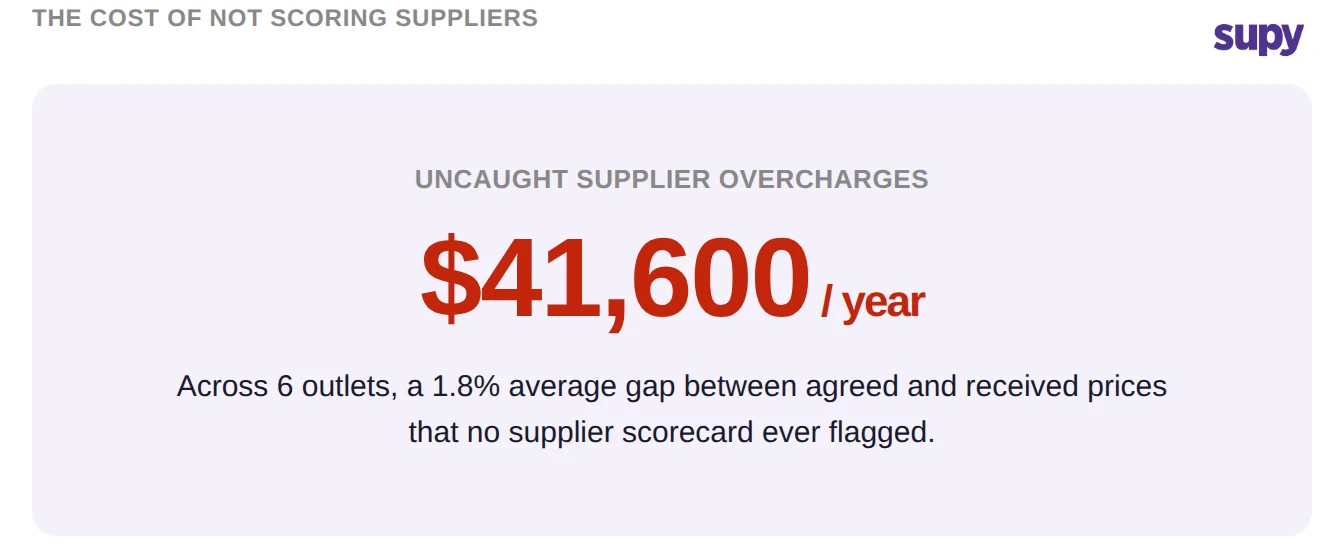
Most groups still choose and keep suppliers on the quoted price and a rough sense of who is reliable. That misses where the money leaks. One two-site restaurant and event venue group's operations manager described suppliers quietly overcharging, with no reconciliation step catching it. The quoted price was fine; the received price was not.
The question is not which supplier is cheapest on paper. It is which one delivers what you ordered, at the price you agreed, without a monthly round of corrections. This is also different from vetting a brand new supplier: for choosing one in the first place, see our supplier evaluation framework. This guide is about scoring the suppliers you already buy from.
The five metrics a restaurant supplier scorecard needs
Keep the scorecard to metrics you can pull from data your team already records at receiving. Five cover almost every decision a procurement lead makes, and each one maps to a number you can defend in a supplier review.
| Metric | What it measures | Where the data comes from |
|---|---|---|
| Price accuracy | Share of received lines charged at the agreed price | Purchase order vs goods received note vs invoice price |
| Delivery accuracy | Orders delivered complete and on time | Received quantities against what was ordered |
| Credit and returns rate | How often you have to claim money back | Credit notes and supplier returns raised |
| Price competitiveness | How a supplier's prices compare per ingredient | Prices across suppliers linked to the same item |
| Responsiveness | How quickly issues and short deliveries get resolved | Time from a raised issue to a credit or fix |
You do not need all five on day one. Start with the two that carry the most money for your group, then add the rest once the review habit sticks.
Price accuracy: the metric most groups never measure
Price accuracy answers one question: were you charged the price you agreed? It is the metric that catches the quiet increases, because a supplier rarely announces a rise. The price simply arrives a little higher on the next delivery, and across dozens of lines and several outlets nobody notices until the food cost report drifts.
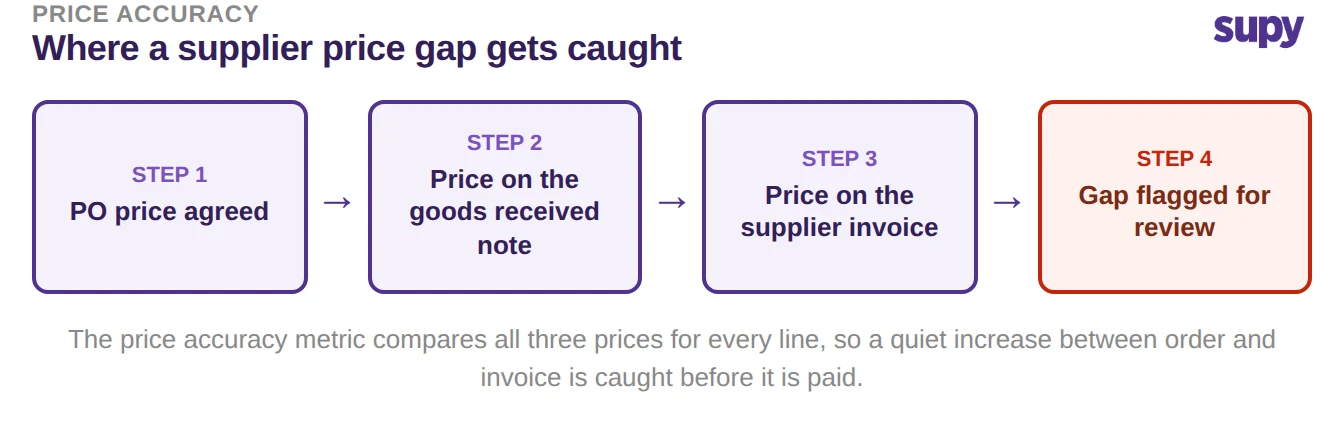
To score it, compare three prices for every received line: the price on the purchase order, the price on the goods received note, and the price on the supplier invoice. The share of lines where all three agree is the supplier's price accuracy. A small average gap looks harmless per line, but a 1.8 percent drift across six outlets is real money over a year. Because price accuracy protects your food cost directly, it is worth pairing this metric with a food cost calculator so you can see the margin effect of each price gap.
Delivery and receiving accuracy: what short deliveries hide
Delivery accuracy is the share of orders that arrive complete and on time. It is easy to feel and hard to prove, which is why it rarely makes it onto a formal review. A short delivery does not just cost the missing stock. It triggers an emergency top-up order at a worse price, a par level breach, and a kitchen improvising around a missing ingredient.
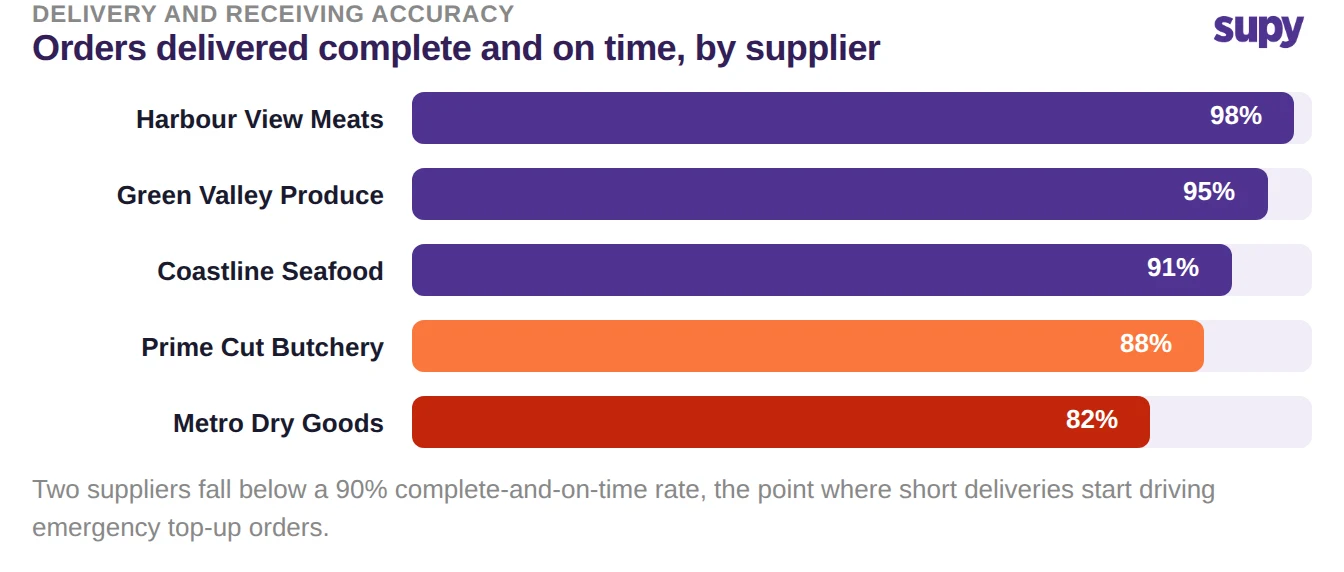
Score it from the received quantities your team already enters against what was ordered. A useful line to hold is 90 percent complete and on time; below that, short deliveries start driving the emergency orders that quietly raise your cost. When an order is closed without a goods received note ever being created, that supplier's delivery record is invisible, so the receiving step is where this metric is won or lost.
Turning the metrics into a scorecard you actually use
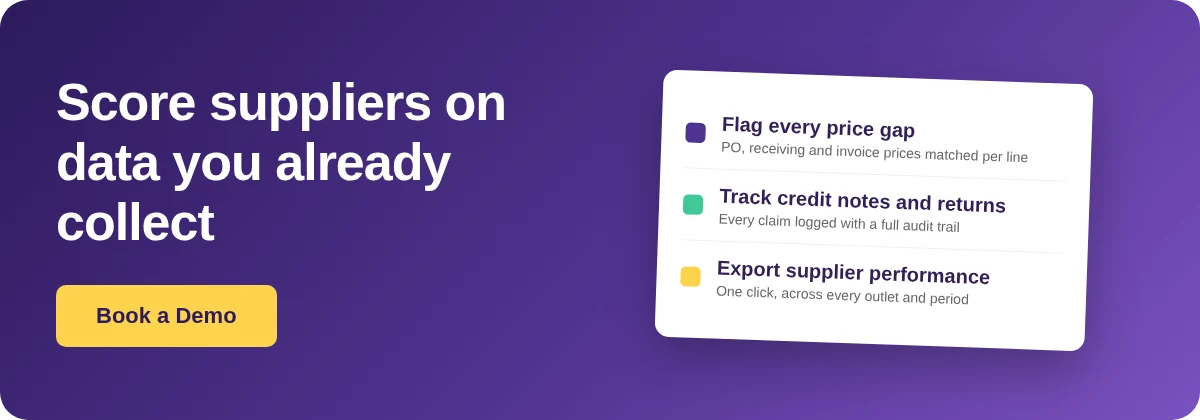
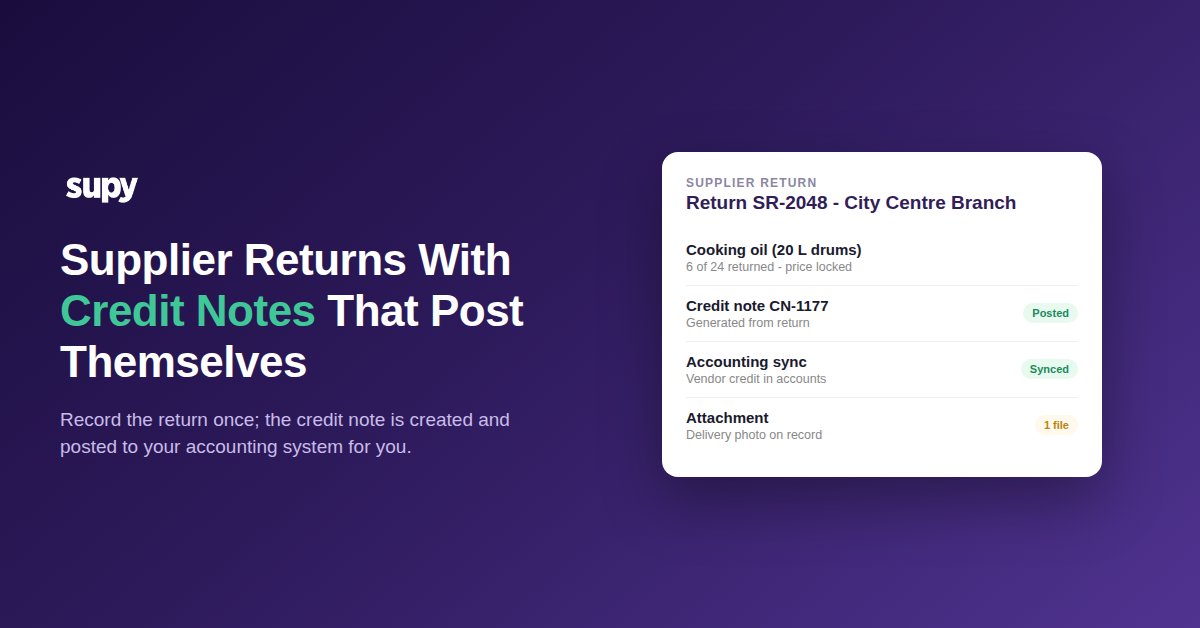
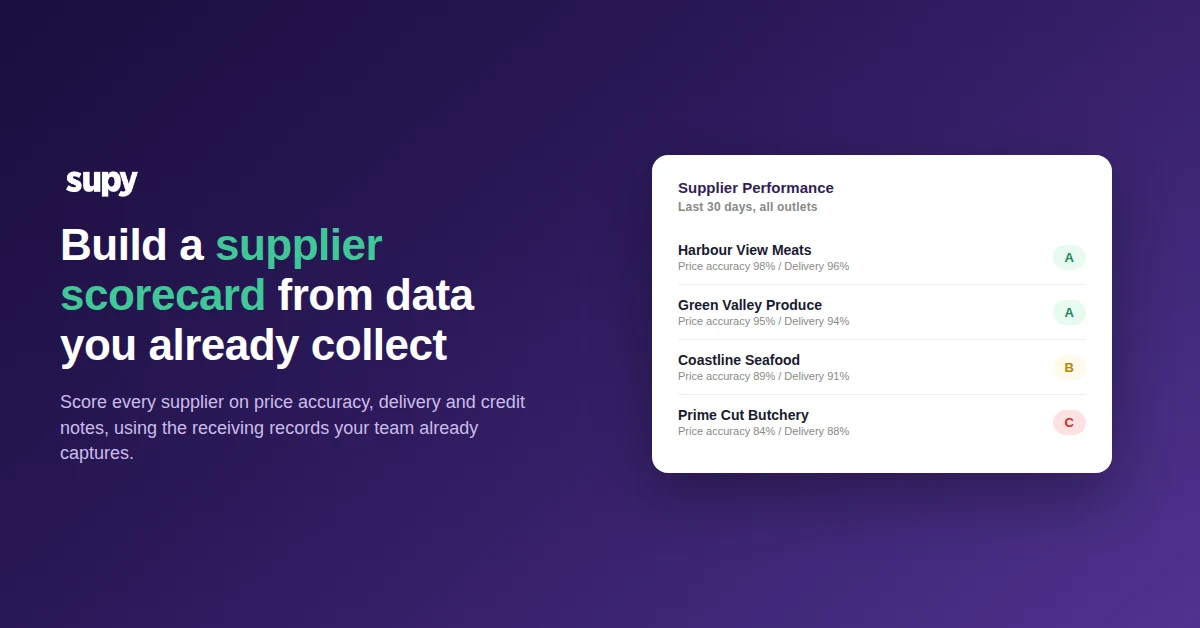
The reason most scorecards live in a spreadsheet nobody updates is that the data sits in a different place from the score. If your supplier management and receiving run in one system, the scorecard is a read of data you already capture rather than a monthly data-entry chore. In Supy, the Received Items page lists every received line and defaults to a price-discrepancy filter, so price accuracy is a view, not a hunt. Credit notes and supplier returns are logged against the supplier with a full audit trail, which gives you the credit and returns rate. Supplier performance then exports in one click across every outlet and period, so the scorecard refreshes itself.
| Supplier | Price accuracy | Delivery accuracy | Overall |
|---|---|---|---|
| Harbour View Meats | 98% | 96% | A |
| Green Valley Produce | 95% | 94% | A |
| Coastline Seafood | 89% | 91% | B |
| Prime Cut Butchery | 84% | 88% | C |
Start narrow and make it a habit. Pick price accuracy and delivery accuracy, pull the supplier performance export on a 30-day cycle, and review credit notes over a rolling 90 days. Act on anything below 90 percent: take the numbers to the supplier, ask for a corrected price list or a service commitment, and score again next cycle. A supplier stuck at a C after two reviews is telling you where to move volume. That is the whole point of a scorecard: not a report you admire, but a short list of the calls to make this month.