Procurement

Posting Restaurant Orders to Accounting You Can Trust: Approval Control, Confirmed Sync Status, and Clean Failure Recovery
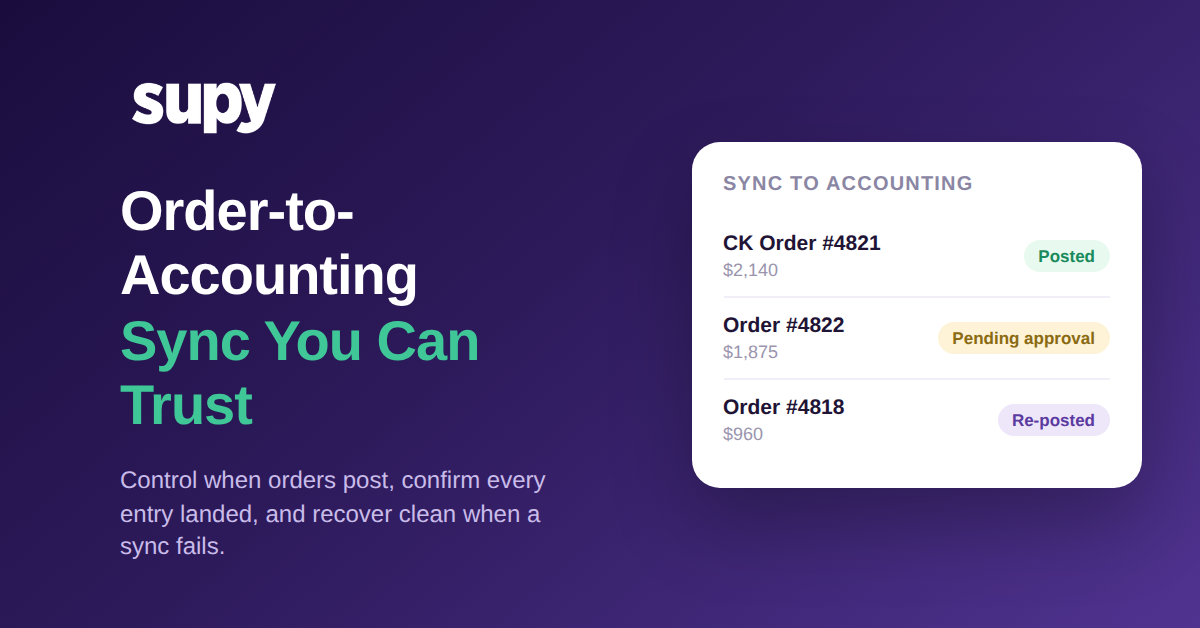
Order-to-accounting sync dashboard showing orders Posted, Pending approval and Re-posted

Posting to Accounting Should Be a Decision, Not an Automatic Side Effect

Posting an order to accounting is the moment a working document becomes a financial record, so a finance team should decide when it happens, not discover it after the fact. With Supy, an order or invoice waits for exception approval before it updates your accounts, which means the person accountable for the ledger controls the timing of every entry that lands in it.

Finance leaders at multi-site groups keep asking for the same thing: a checkpoint before store orders finalise to the accounting system, so nothing publishes unreviewed or ahead of schedule. Unattended posting removes that checkpoint entirely. Orders flow to the ledger the instant they are raised, and the first time finance sees them is when they are already booked, sometimes in the wrong period or against the wrong supplier record.

An approval gate closes that gap without slowing the kitchen down. Branch teams keep ordering as they always have, while the accounting side gets a single, controlled point where entries are reviewed and released. The order does not become a journal entry until someone with authority says it should. The question worth settling for your own operation: who holds that approval, and at what point should an order stop being an editable working document and become a booked entry?
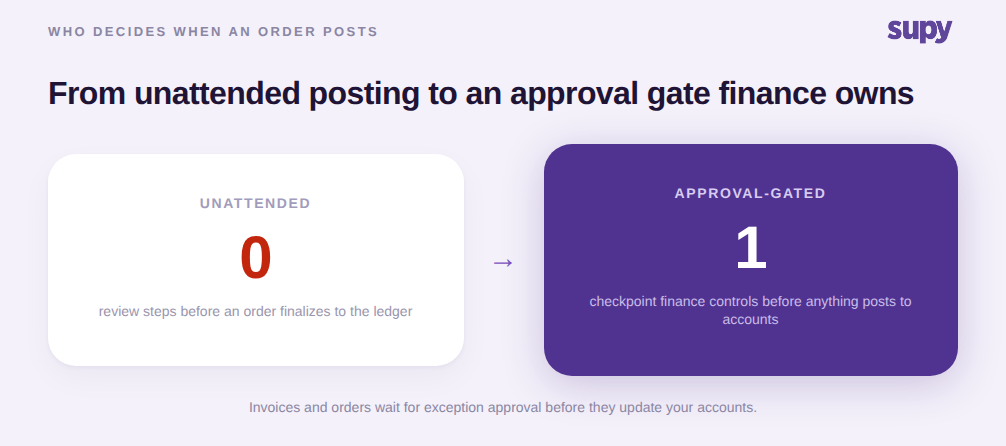
Comparison of unattended posting with zero review steps versus one approval checkpoint finance controls before anything posts to accounts


When a Sync Fails, What Happens Next Decides Whether You Trust the Setup

A sync will fail sometimes, and what the system does in that moment matters more than the fact that it failed. In Supy, a failed sync reverts the order to unposted automatically, shows the exact error reason on the order itself, and puts the Post to accounting action back within reach, so the fix is one clear step rather than a manual reversal.

Compare that with the usual experience. A posting quietly fails, the order sits in a half-booked state, and nobody notices until month-end reconciliation does not tie out. Then someone spends an afternoon working out which entry never made it across and reversing it by hand in the accounting tool. The failure was small; the clean-up was not.

Because the error reason is written on the order, the cause is usually obvious: a supplier or tax code that was never mapped, for example. Fix the mapping, press post again, and the retry succeeds. Retrying before the root cause is fixed simply will not go through, which stops the loop of pressing the same button and hoping. This is the reliability layer that generic accounting connectors rarely describe, and it sits on top of the one-time GL and tax-code mapping that codes every document correctly in the first place. When you weigh any connector, ask what it does the moment a sync fails, not only how it behaves when everything goes right.
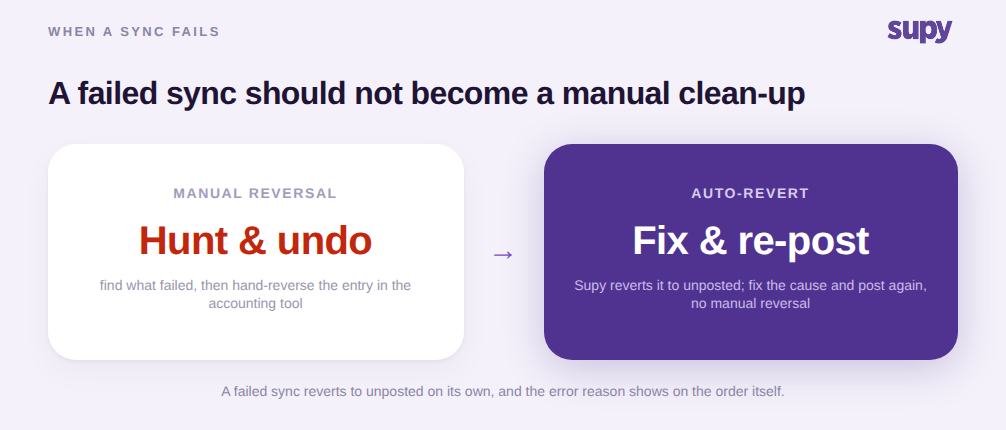
A failed sync reverts to unposted automatically so the operator fixes the cause and re-posts, instead of hunting for the failure and hand-reversing it


Posted Has to Mean the Entry Exists, Not That You Pressed Send

A status is only useful if you can act on it without checking. In Supy, an order shows Posted only after the accounting system confirms it received the record, so Posted is proof the entry exists rather than a note that a request was sent. That distinction is what lets finance reconcile from the order list instead of opening the accounting tool to verify each one.

Plenty of integrations mark a document as synced the moment they hand it off, with no acknowledgement that anything landed on the other side. That gives you a status you cannot trust, which is worse than no status at all, because it invites you to close the books on records that may not be there. When Posted waits for confirmation, a clean order list at period-end genuinely means the ledger is complete. So before you trust a synced label, check whether it waits for the accounting system to confirm receipt, or simply reports that a request went out.
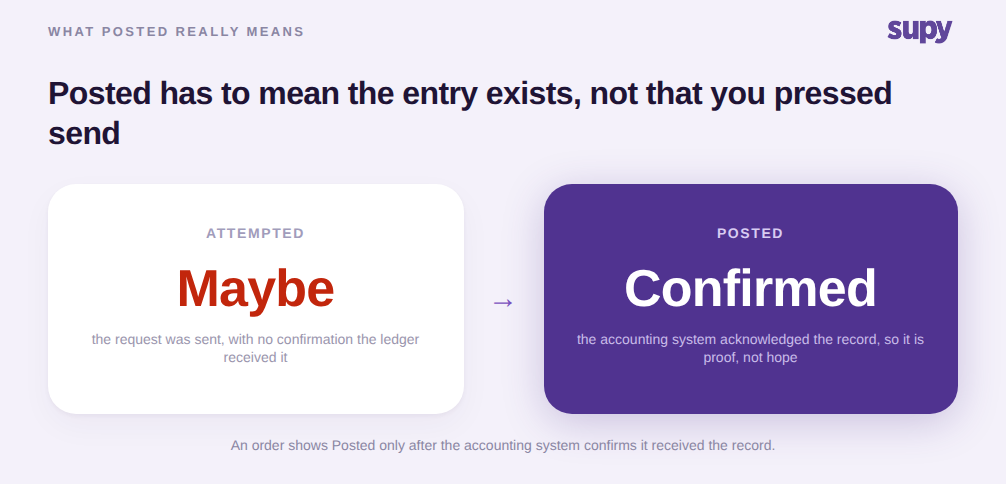
An attempted sync gives no confirmation the ledger received it, while a Posted status means the accounting system acknowledged the record


The Cost You Posted Should Stay the Cost of Record

When a central kitchen order posts to accounting, Supy locks its costs at that point and never recalculates them, and unposting the order later does not change them either. The number that hit the ledger stays the number of record, which is exactly what finance needs for reconciliation and margin reporting to stay stable over time.

Costs that keep recalculating after posting are a quiet source of period-end pain. A price correction or a recipe change updates a figure that was already booked, and now the ledger and your operational reports disagree about the same order. Locking the posted cost breaks that drift. Paired with a tamper-proof audit trail that records who did what and when, every posted order carries one defensible cost that an auditor or a franchise partner can rely on.

This is the same discipline that makes Supy's connections to 75+ accounting, POS and ERP systems worth trusting: the data that crosses over is deliberate, confirmed, and fixed once it lands. The decision to make here is explicit: ask whether a posted cost can change after the fact, and if it can, how you will stop the ledger and your operational reports from drifting apart.
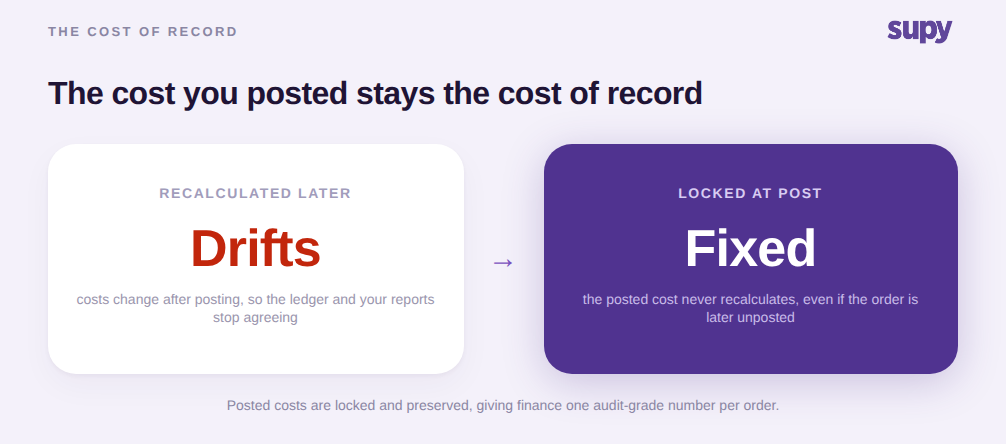
Costs that recalculate after posting cause the ledger and reports to drift, while costs locked at post stay fixed even if the order is later unposted


Your first move: watch one posting run end to end in a demo, and ask to see three things. Where the approval checkpoint sits before an order finalises to the ledger. What the screen shows when a sync fails, and how the re-post works. And whether the Posted status waits for the accounting system to confirm receipt. If all three hold up, your finance team gets control over timing, a clean recovery path, and a status it can reconcile against. That is the difference between an integration that moves data and one your books can depend on.

Book a Demo with Supy for order-to-accounting posting control, confirmed sync status and clean failure recovery

Ready to optimize your restaurant operations?

Blog

Our operational insights

No items found.

Your questions 
answered

Everything you need to know about Supy — from setup to integrations, pricing, and daily use. If it’s not covered here, just ask.

What does it mean to control when an order posts to accounting?
+

Controlling when an order posts means a finance team decides the moment a working order or invoice becomes a booked financial record, rather than having it publish automatically. In Supy, an order waits for exception approval before it updates your accounts, so the person accountable for the ledger releases each entry. That control matters most for multi-site groups, where orders are raised across many branches but the books are owned centrally. The kitchen keeps ordering as usual, while finance gets one reviewed, deliberate point where entries are released to the accounting system.

How does Supy handle an order that fails to sync to the accounting system?
+

When a sync fails, Supy automatically reverts the order to unposted, shows the specific error reason on the order itself, and makes the Post to accounting action available again. There is no half-booked limbo and no manual reversal in the accounting tool. Because the error is written on the order, the cause is usually clear, such as a supplier or tax code that was never mapped. You fix the cause, post again, and the retry succeeds. Retrying before the root cause is fixed will not go through, so no attempts are wasted.

What is the difference between an order that was attempted and one that is Posted?
+

An attempted sync means the request was sent, with no confirmation that the accounting system received the record. A Posted status in Supy means the opposite: the accounting system has acknowledged the entry, so Posted is proof the record exists rather than a note that a button was pressed. That distinction lets a finance team reconcile from the order list instead of opening the accounting tool to verify each one. A clean order list at period-end then genuinely means the ledger is complete, which is the whole point of a status you can trust.

Why do posted order costs stay locked instead of recalculating?
+

When a central kitchen order posts to accounting, Supy locks its costs at that point and never recalculates them, and unposting the order later does not change them either. The reason is reconciliation: the number that hit the ledger has to stay the number of record, or the ledger and your operational reports drift apart every time a price or recipe changes. Locking the posted cost keeps them aligned. Combined with a tamper-proof audit trail of who did what and when, each posted order carries one defensible cost figure an auditor or franchise partner can rely on.

Which accounting systems can restaurant orders post to?
+

Supy connects to 75+ integrations, including accounting platforms such as QuickBooks, Xero, Zoho Books and Wafeq, alongside POS and ERP systems. Orders, goods-received notes, invoices and credit notes can post to the connected accounting system with the right general ledger account and tax code applied. The mechanism is the same regardless of platform: entries are mapped once, released under your approval, confirmed on receipt, and locked at their posted cost. That means a multi-site group can standardise how every branch feeds the books, even when different regions run different accounting tools.

Can finance approve orders before they reach the accounting ledger?
+

Yes. Supy supports exception approval before an order or invoice updates your accounts, so finance can review and release entries rather than having them post unattended. This answers a common request from multi-site finance teams who want visibility and control over when store orders finalise, to prevent premature or unauthorised posting. The approval gate does not slow branch ordering; teams raise orders as usual, and the accounting side gets a single controlled point where entries are released. The order only becomes a journal entry when someone with authority approves it.

How does approval-gated posting help a multi-site restaurant group?
+

For a multi-site group, orders are raised across many branches but the books are owned centrally, so unattended posting scatters unreviewed entries into the ledger from every location at once. Approval-gated posting gives head-office finance one place to review and release those entries, on their own schedule and in the right period. Paired with confirmed Posted statuses and costs that lock at posting, it means reconciliation works from a single trustworthy order list rather than a manual audit across locations. The larger the group, the more that central control is worth.

Ready to transform your operations?

Join 3500+ restaurant operators cutting costs, streamlining operations and making smarter decisions with Supy.