Inventory

Cycle Counting vs Full Stocktakes: How Multi-Site Restaurants Keep Inventory Accurate Without Closing the Kitchen

Cycle counting vs full stocktakes for multi-site restaurant inventory

What Cycle Counting and Full Stocktakes Each Tell You

A full stocktake counts every item on site in one sitting to set a complete, point-in-time valuation. A cycle count checks a small, rotating slice of stock, usually your highest-value or fastest-moving sections, on a frequent schedule. One gives you a whole-site baseline a few times a period; the other keeps that baseline honest in between, without stopping service.

The two are often set up as rivals, but they answer different questions. A full stocktake tells you what the whole operation is worth right now. A rolling cycle count tells you whether the sections most likely to drift, proteins, spirits, high-theft or high-spoilage items, still match the system today. Multi-site groups that treat them as one layered system, rather than picking a side, get an accurate valuation and an early-warning signal at the same time. The comparison below lines up where each method earns its place.
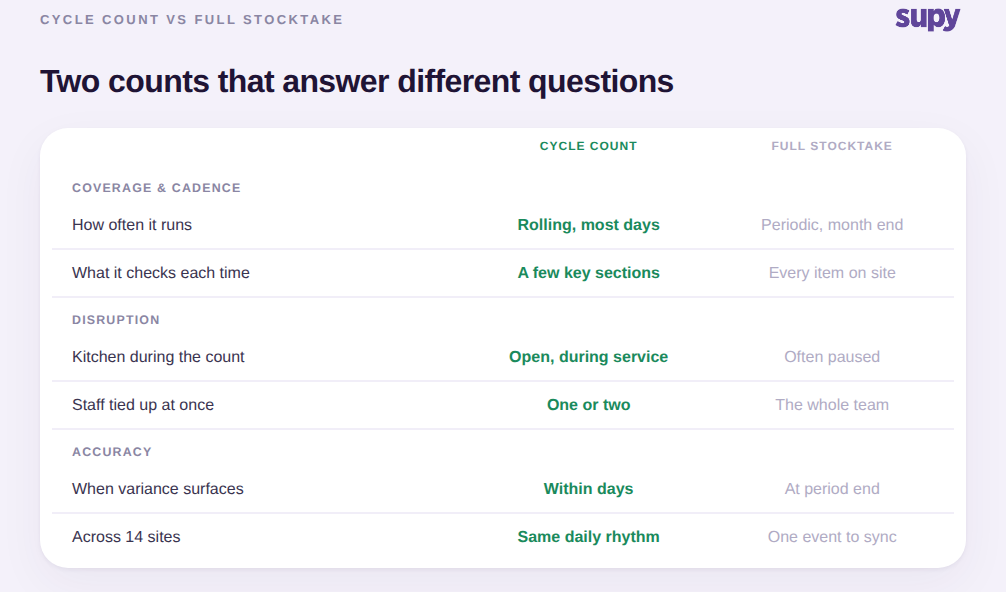
Head-to-head comparison of cycle counting and full stocktakes across coverage, disruption and accuracy


Why Variance Hides Between Full Stocktakes

The weakness of relying on the full stocktake alone is timing. Between counts, stock keeps moving, deliveries, prep, waste, the occasional miscount, and none of it shows up against the system until the next whole-site count. By then a small daily discrepancy has compounded into a number nobody can explain. In one multi-branch group's inventory review, the gap reached roughly 54,000 units net once the positives and negatives were tallied, drift that had built quietly between infrequent counts.

The cost of that lag is not abstract. A discrepancy that surfaces only at a quarterly stocktake has had a full quarter to grow, so you end up reconciling history instead of catching a live problem. Cycle counting closes the gap by checking the riskiest sections often enough that variance shows up while you can still act on it. For a fuller treatment of tracing where a gap actually comes from, see our guide to restaurant inventory variance analysis.

Stat callout showing the cost of stock variance found only at a quarterly stocktake


Running a Rolling Count Without Closing the Kitchen

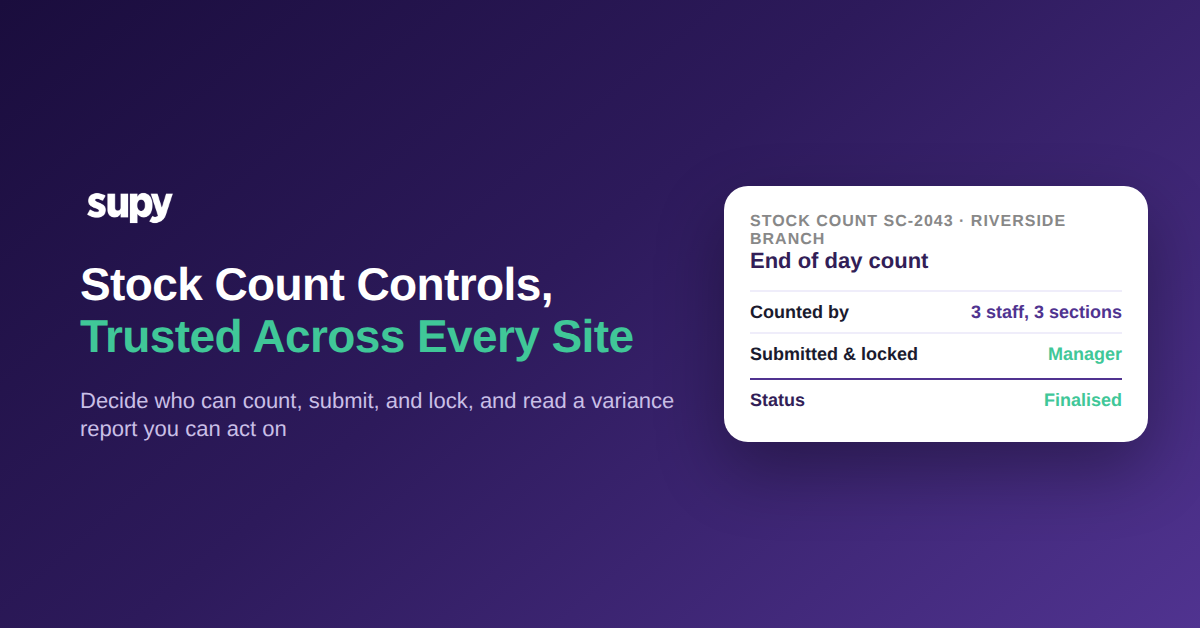
The objection most operators raise is practical: who has time to count during service? The answer is that a cycle count is not a shrunk-down stocktake, it is a different workflow. In Supy, a single stock count can be split into sub-counts so several people count different sections at the same time, each locking their section when it is done so nobody overwrites it. One person counts the walk-in at pre-open while another checks the bar after close, and the counts merge automatically with full attribution of who counted what.

Because every count is checked against theoretical stock the moment it is submitted, the system prices each discrepancy and posts it to the inventory ledger straight away. You are not waiting on a spreadsheet reconciliation; you see what the count found versus what the system expected, with the cost of each gap, before the next shift starts. Deciding how often each section needs a count is its own question, and we cover the cadence in our stock-count frequency benchmarks. The practical trick is a schedule that rotates high-value, fast-moving stock into the count most often and slow, low-value stock least often.
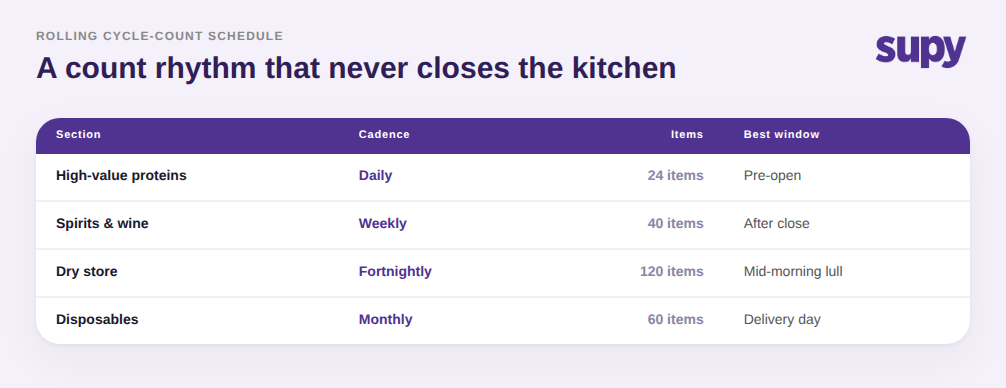
A rolling cycle-count schedule showing sections, cadence, item counts and the best window to count each


Choosing Your Count Rhythm - and What It Saves

None of this means the full stocktake goes away. It stays the periodic baseline that resets the whole valuation and catches anything the rotation missed. The point is to stop leaning on it as your only source of truth. Layering a rolling cycle count on top also changes the economics of counting: reaching the same whole-site coverage through short, parallel section counts takes far less dedicated labour than shutting down for one long count, cutting counting time by over 50% while keeping the kitchen open.
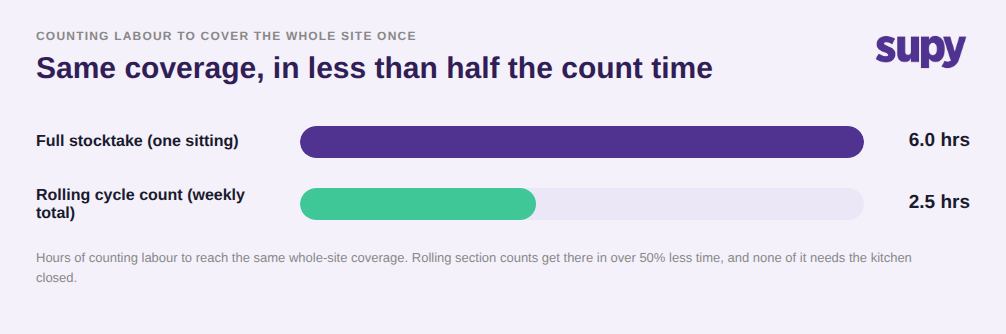
Bar chart comparing counting labour for a full stocktake versus a rolling cycle count


So the rule is simple. Run a rolling cycle count when you need to keep high-value or high-movement stock honest day to day, catch variance while it is still small, and avoid closing the kitchen to do it. Lean on the full stocktake when you need a complete, audited valuation for the period, for month-end accounts, or as the opening baseline for a new site. If you only run full counts today, start by putting your three highest-value sections on a weekly rotation and watch how quickly the first discrepancies surface. That is usually all it takes to see why the two methods belong together rather than in competition.

Book a Demo with Supy - cycle counting vs full stocktakes

Ready to optimize your restaurant operations?

Blog

Our operational insights

No items found.

Your questions 
answered

Everything you need to know about Supy — from setup to integrations, pricing, and daily use. If it’s not covered here, just ask.

What is cycle counting in a restaurant?
+

Cycle counting is a stock-taking method where you count a small, rotating slice of your inventory on a frequent schedule rather than counting everything at once. Instead of closing to count the whole site, a restaurant counts its highest-value or fastest-moving sections, proteins, spirits, or high-spoilage items, on a set rotation. Each count is checked against the system's expected stock, so discrepancies surface within days instead of at month-end. The goal is not a full valuation every time, but a steady stream of early warnings that keeps inventory accurate between full stocktakes.

How is cycle counting different from a full stocktake?
+

A full stocktake counts every item on site in one sitting to produce a complete, point-in-time valuation, usually monthly or quarterly. Cycle counting checks only a rotating subset of stock, but does so far more often. The full stocktake answers what the whole operation is worth right now; the cycle count answers whether the sections most likely to drift still match the system today. They are not competitors: most multi-site groups run both, using the stocktake as a periodic baseline and cycle counts to keep that baseline accurate in between without pausing service.

Can you cycle count without closing the kitchen?
+

Yes, and that is one of its main advantages. Because a cycle count covers only a section or two at a time, it fits into the natural quiet points of a shift, a walk-in counted at pre-open, the bar counted after close. Software that supports parallel sub-counts lets several staff count different sections at once and locks each section as it is finished, so the counts merge without anyone overwriting another. The kitchen keeps running throughout. Reaching full-site coverage this way takes less dedicated labour than shutting down for a single long count.

How often should each section be cycle counted?
+

How often depends on value and movement, not a single fixed rule. High-value, fast-moving stock such as proteins and spirits usually warrants a daily or weekly count, because that is where variance and cost build fastest. Dry goods and low-value items can be counted fortnightly or monthly. A common approach is an ABC-style rotation: your most critical sections come up most often, everything else less frequently, so coverage is complete over a period without counting everything every day. Reviewing your variance history shows which sections drift most and deserve a tighter cadence.

Does cycle counting replace the full stocktake?
+

No. Cycle counting is a complement to the full stocktake, not a replacement. The periodic full count still plays a role the rotation cannot: it resets the entire valuation, catches anything the schedule missed, and provides the audited, point-in-time figure that month-end accounts and new-site openings need. What cycle counting changes is how much you rely on that single event. With frequent section counts catching drift early, the full stocktake stops being your only source of truth and becomes a confirmation step rather than the moment you first discover a problem.

Which stock should you cycle count most often?
+

Prioritise the stock where errors cost the most and move the fastest. In most restaurants that means proteins, seafood, spirits, wine, and any high-theft or high-spoilage items. These categories tie up the most money and drift the quickest through prep, portioning, waste, and pouring, so counting them daily or weekly catches problems while they are still small. Lower-value, slow-moving items such as dry store and disposables can sit on a fortnightly or monthly cadence. The aim is to spend your counting effort where a small percentage variance turns into a large monetary one.

How do you keep a rolling count accurate across multiple sites?
+

Consistency and attribution are what hold a rolling count together across sites. Every location should work from the same section templates in shelf order, so counts are comparable and nothing is skipped. Each count should be checked against the system's theoretical stock the moment it is submitted, so variance and its cost are visible immediately rather than at period-end. Just as important is a clear record of who counted what and when: per-section locking and an audit log mean a count done by shift staff is still trustworthy, and a manager can see exactly where a discrepancy originated.

Ready to transform your operations?

Join 3500+ restaurant operators cutting costs, streamlining operations and making smarter decisions with Supy.