.jpg)

Food and Beverage Procurement Solutions: What Multi-Outlet Groups Need Beyond the Purchase Order
What F&B Procurement Solutions Need to Cover for Multi-Outlet Operators
The minimum scope of a food and beverage procurement solution is a digital purchase order - something better than email or a paper requisition book. But for a hospitality group with 3 or more outlets, the procurement cycle extends far beyond the PO itself.
A complete procurement cycle starts before the purchase order. It begins with a demand signal - a requisition from a branch team - that captures what is needed, in what quantity, from which supplier, and at which site. That demand signal should travel through a review step before becoming a committed purchase order. The review might be simple (manager approval above a threshold) or complex (category-specific approvers, separate rules for different outlet types). Without this step, the purchase order stage is where all discipline is applied, which is too late.
The purchase order stage links to contracted supplier prices and delivery schedules. A PO generated at the wrong price is not just an accounting error - it is a signal that the system is not enforcing the commercial terms the group has negotiated. The PO stage should apply the correct price per outlet automatically, not require the person placing the order to remember which price applies to their site.
The delivery stage closes the loop. Goods are received against the original PO. If the quantity delivered is short, the shortfall is recorded. If the invoice price differs from the PO, the discrepancy is flagged. The cost posts only when the reconciliation is complete. For multi-outlet groups where deliveries arrive at different sites on different schedules, this close-loop process needs to work consistently across all locations without requiring a central team to manually verify each delivery.
Food and beverage procurement solutions that handle only the PO stage leave the requisition, approval, and delivery reconciliation stages unaddressed. Those gaps are where cost leakage accumulates.

Aggregated Demand: Where Multi-Outlet Procurement Becomes Efficient
For a single-outlet operator, aggregated demand visibility is not a relevant requirement. For a hospitality group with 5 or more outlets ordering from overlapping supplier lists, it is the feature that most directly determines whether the procurement solution saves or costs management time.
When each outlet submits orders independently - even through a digital platform - a central procurement manager sees multiple separate order requests that must be reviewed, approved, and transmitted individually. This is an improvement over paper, but it does not address the underlying coordination problem: the manager has no single view of total demand per supplier before orders are sent.
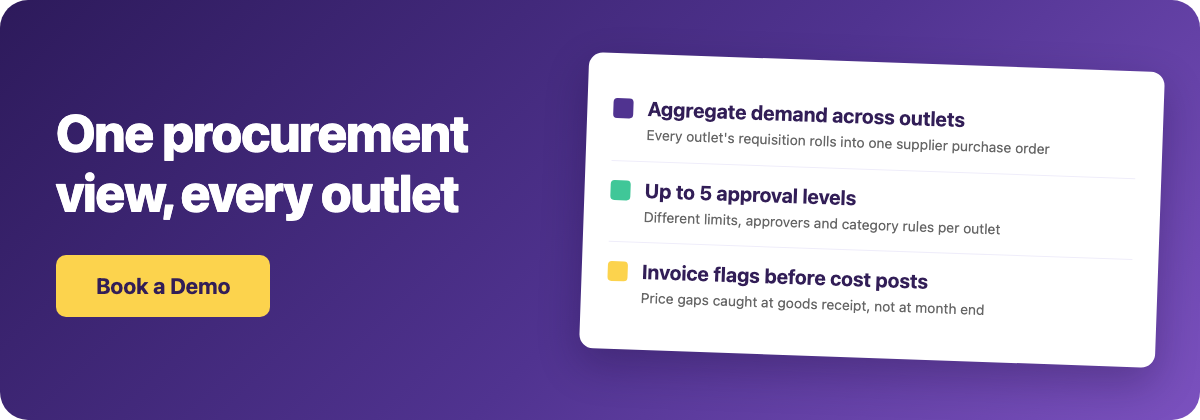
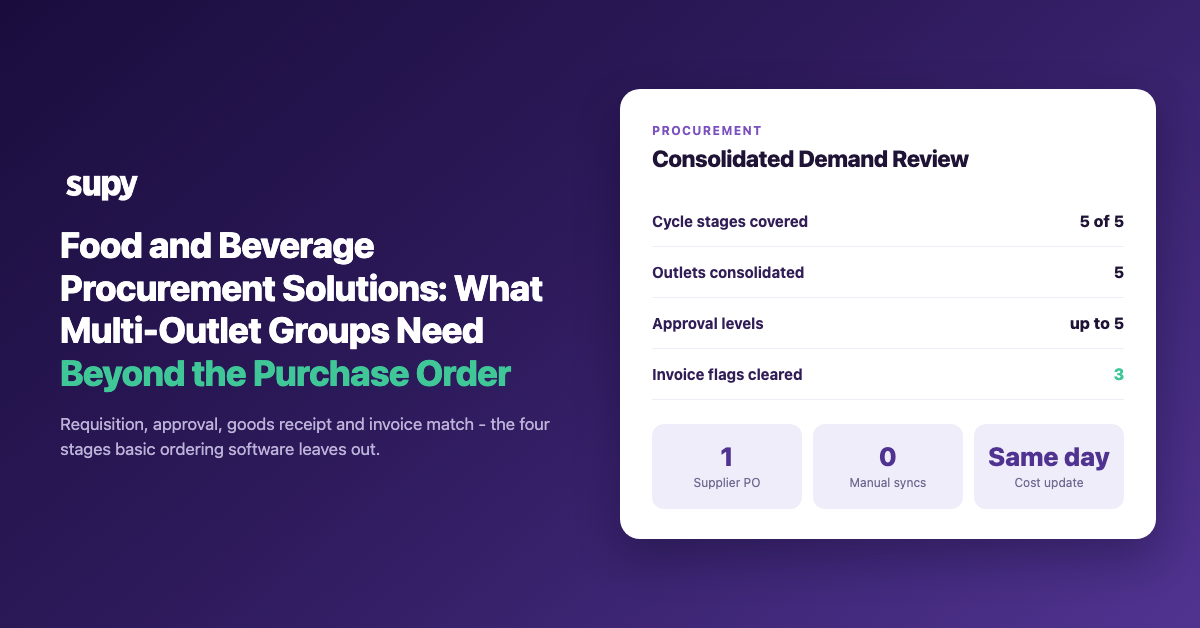
In a food and beverage procurement solution built for multi-outlet operators, demand from all outlets aggregates automatically. The procurement manager sees a consolidated view: how much of each item has been requested across all sites, from which supplier, for which delivery date. From that view, demand can be reviewed as a group, adjusted, and converted to supplier purchase orders in a single operation - without logging into each outlet's account separately.
PAR-level integration strengthens this further. When the solution displays each item's current stock position alongside the PAR level configured for that outlet, the system can calculate the shortfall automatically. The ordering team sees a pre-populated order based on current stock, adjusts for known demand changes, and submits. Routine weekly replenishment across 5 outlets - which previously required a manager to compile requests from each site - becomes a review and confirm operation rather than a calculation exercise.

Approval Workflows and Budget Controls in F&B Procurement
One of the most common causes of food cost overruns in hospitality groups is uncontrolled ordering at the outlet level. A manager who has always been responsible for their own ordering does not naturally apply a budget constraint. The result is over-purchasing, orders placed outside contracted supplier arrangements, and spend that only surfaces in the food cost report at month-end.
Spending policies define the rules that apply before an order is transmitted. A policy might cap total order value per outlet per period, restrict a category to approved suppliers only, or require a second sign-off for any order above a defined value threshold. The policy runs automatically - the branch manager submitting the order does not need to know the rules; the system applies them and routes the order appropriately.
Approval workflows determine who reviews an order that has triggered a policy. Up to 5 sequential approvers can be configured per order type, with different rules per location, category, or order value. An order for fresh produce at one outlet might require only branch manager approval; a large equipment supply order might require finance director sign-off. The approval trail is timestamped and attributed to the named approver, creating a reviewable record that answers the question of who authorised a given purchase and when.
For hospitality groups operating across different outlet types - hotel F&B, standalone restaurants, catering operations - the ability to configure separate approval rules per outlet type or category is material. A blanket approval structure that treats all outlet types the same does not reflect how procurement risk actually varies across the estate.
Which orders stop for review, and who signs them off
| Order Type | Policy Trigger | Approval Required | Routing |
|---|---|---|---|
| Standard weekly replenishment | Within outlet spend limit | Auto-approved | Order sent straight to supplier |
| High-value produce order | Exceeds outlet threshold | Level 1 review | Outlet manager sign-off |
| Non-approved supplier selected | Supplier restriction policy | Compliance review | Procurement team escalation |
| Cross-outlet high-value order | Period budget cap exceeded | Level 2 review | Finance director sign-off |
| Alcohol and beverage category | Category-specific restriction | Category review | Food and beverage manager |
How Procurement Data Should Connect to Inventory and Food Cost
The commercial case for a connected procurement platform is strongest when the procurement data does not sit in a separate system from inventory and food cost reporting.
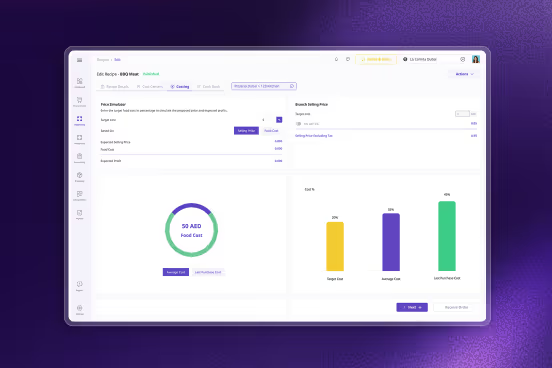
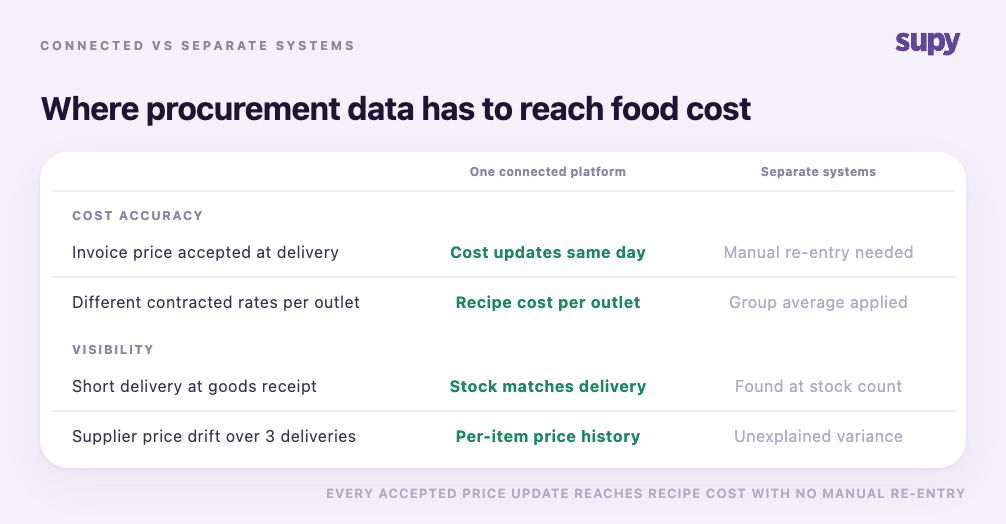
When purchase orders, goods receipts, and accepted price updates feed directly into the same platform that calculates recipe costs and food cost percentages, the food cost report reflects what was actually paid rather than what was planned. An invoice discrepancy accepted at delivery - a price increase acknowledged and recorded - updates the ingredient's cost at that outlet immediately. The next recipe cost calculation at that site uses the updated price. A group with 5 outlets purchasing the same ingredient at different contracted rates will see different recipe costs per site. That is the accurate picture and the basis for a meaningful supplier conversation.
For hospitality operators managing multiple outlet types, this cost connection operates at the outlet level. A hotel's restaurant, bar, and kitchen supply different menus at different cost structures. Procurement data aggregated at the estate level with no outlet-level breakdown cannot support outlet-level food cost management. A solution that maintains outlet-level procurement records while providing group-level aggregation covers both requirements.
Spreadsheet reports that export purchase value by supplier, price movement by ingredient, order frequency by outlet, and invoice exception rates by site give a procurement or finance team the data to act on patterns - not just to review history. For groups managing large supplier relationships, those reports are the operational output that justifies the investment in a structured procurement platform over the tools groups typically use before they adopt one.
What to Ask When Evaluating Food and Beverage Procurement Solutions
The standard demo for a food and beverage procurement solution covers placing an order and viewing a purchase history. For multi-outlet hospitality operators, the evaluation needs to go beyond that baseline.
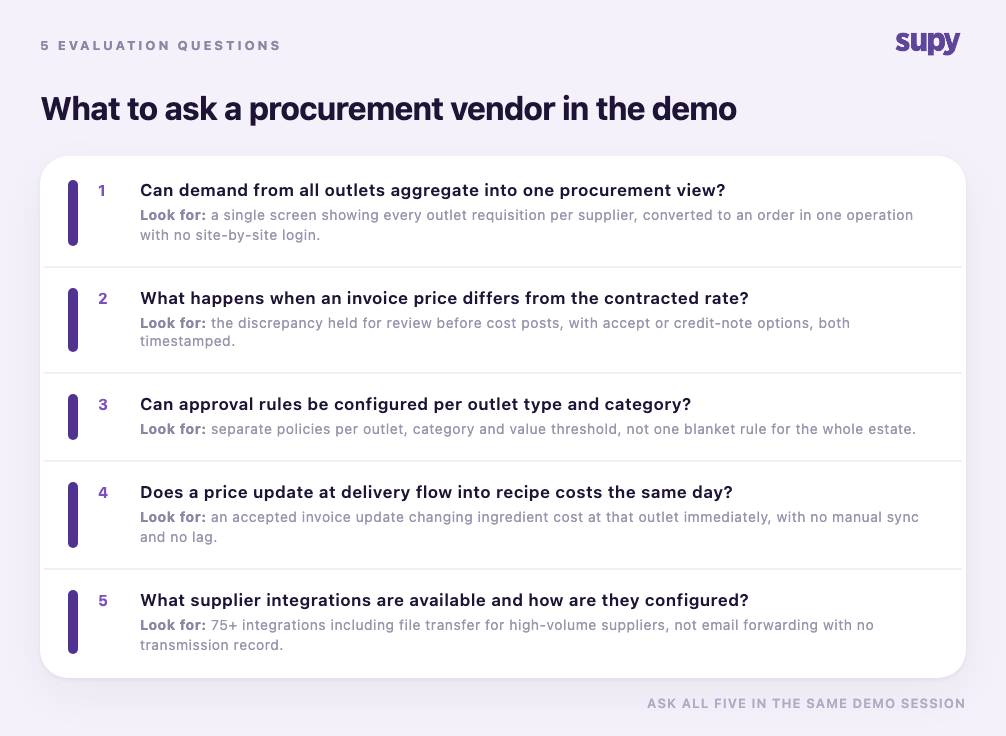
Ask the vendor to demonstrate: how demand from all outlets aggregates into a single procurement view and how the purchasing manager converts that consolidated demand to supplier POs without logging into each outlet separately. This reveals whether the platform is genuinely built for multi-outlet operations or whether multi-outlet is an add-on to a single-site product.
Ask what happens when an invoice arrives at a price above the contracted rate - who sees it, where, and what actions are available. A platform that flags the discrepancy before cost posts and provides a clear accept-or-reject workflow with a documented record is materially different from one that allows the cost to post and records the variance in a separate report.
Ask how approval rules are configured: can different outlets have different spending limits, different approver chains, and different category-level restrictions? The answer reveals whether the platform's approval model is flexible enough for a hospitality estate with different outlet types and different risk profiles per outlet.
Ask specifically about the connection between procurement and food cost: does an accepted price update at delivery flow into the recipe cost calculation for that outlet on the same day? If the answer requires a manual sync or an export-import step, the food cost visibility is lagged and the connection between procurement decisions and cost outcomes is broken.
Supy's food and beverage procurement platform covers the full cycle - requisitions, multi-level approvals, consolidated multi-outlet demand, supplier PO generation, goods receipt, and invoice matching - within the same system that tracks inventory and calculates food cost in real time across every outlet. To see how it maps to your group's procurement structure, book a demo at supy.io/book-a-demo.