Inventory

Finished vs Semi-Finished Recipes in a Central Kitchen: How to Classify Component Recipes So Cost and Stock Depletion Stay Accurate
Finished vs semi-finished recipes in a central kitchen

Start Here: Do You Make This Component to Store It, or to Serve It?

The fastest way to classify a central kitchen recipe is one question: do you produce it in batches to hold and issue later, or do you assemble it to order and serve straight away? A component you make ahead and store - a sauce, a stock, a dough, a par-cooked protein - is a semi-finished recipe, and it should be tracked as stock. A dish that is plated and served on the spot is a finished recipe, and it depletes its ingredients at the point of sale instead.

That single distinction is where most central kitchen onboarding goes wrong. Operators see a long list of prep items and reach for "finished" because the batch is, in a plain-English sense, finished cooking. But in inventory terms "finished" means the opposite of what a stored component needs. Answer the store-or-serve question first, and the rest of the setup follows from it.
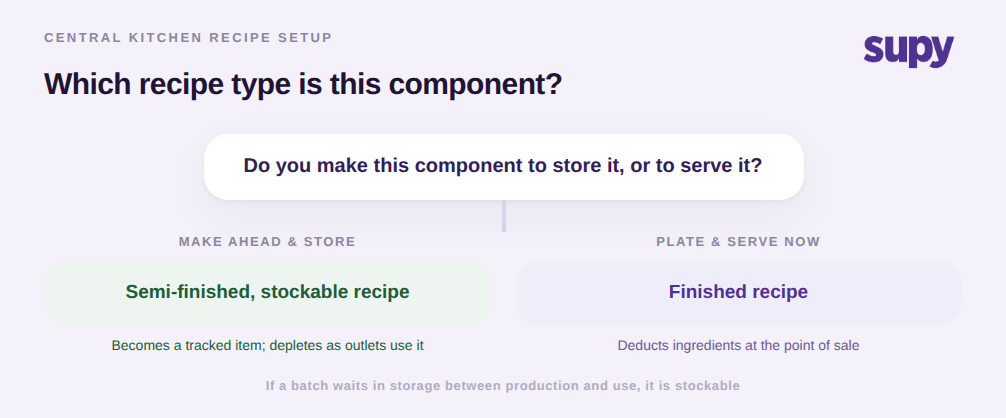
Decision tree for classifying a central kitchen component recipe as semi-finished or finished


Why a Miscategorised Prep Recipe Stops Depleting Component Stock

Here is the mechanism that breaks. When you mark a semi-finished component as stockable, the system creates a tracked inventory item for it, restricts its production to the locations you have enabled, and updates every parent recipe that uses it. Logging a production batch then deducts the raw ingredients from live stock and adds the finished component to stock at the central kitchen. As outlets consume it, the component depletes.

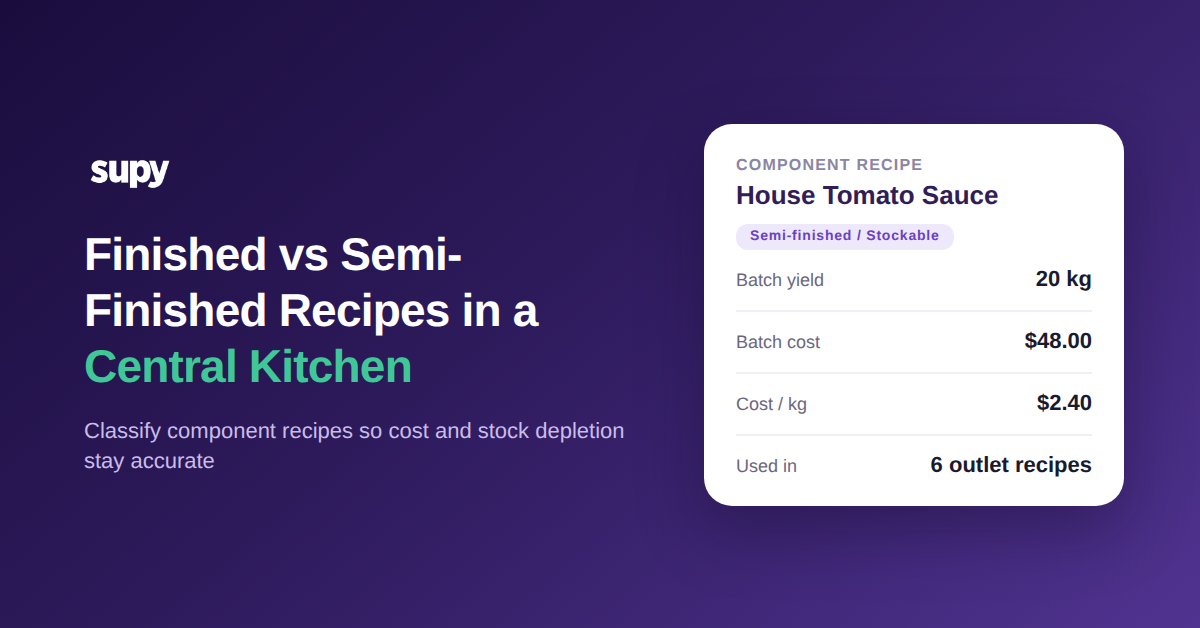
Mark that same component as a finished, non-stockable recipe and none of that happens. No tracked item is created, so producing it never adds component stock, and outlets drawing on it never deplete anything. Take a house sauce batched at 20 kg for a batch cost of 48.00. If six outlets pull 120 g per dish across 240 covers a day, that is 28.8 kg leaving the central kitchen daily that the system never records as gone. Over a month it is roughly 864 kg of phantom component that shows as still on hand when the shelf is empty.
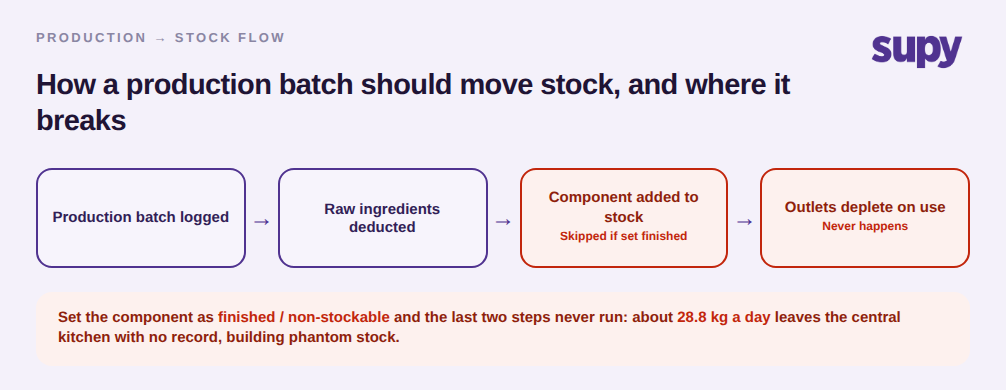
How a production batch moves stock and where a finished setting breaks depletion


How One Wrong Setting Skews Cost in Every Recipe Above It

The cost damage is quieter but larger. A correctly set semi-finished recipe carries its real production cost - the batch cost spread across the actual yield, grossed up for prep wastage - into every outlet recipe that uses it. At 2.40 per kg, a dish using 120 g of the component carries 0.29 of component cost, and that number reflects what the kitchen actually consumed.

When the component is non-stockable, its cost is applied by recipe rate rather than tracked as a real stock movement, so production variance on that batch is never captured and the parent recipe's food cost drifts away from what the outlet actually spent. One mis-set component quietly carries about 2,074 a month of phantom stock value on the books, and because it feeds several plated dishes, the error repeats in every recipe above it. This is a direct contributor to the gap between theoretical and actual food cost that variance reviews spend hours chasing.
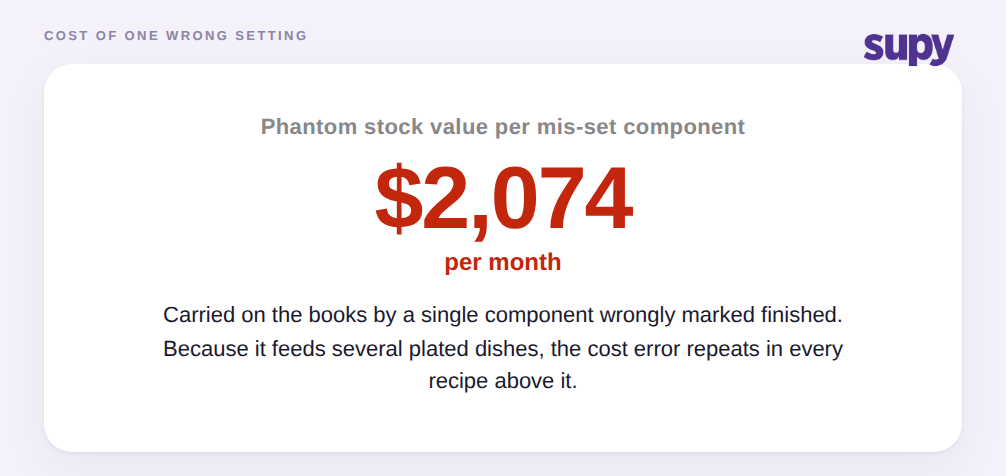
Phantom stock value of 2074 dollars per month from one mis-set component recipe


Matching the Recipe Type to the Job: Stockable, Non-Stockable, and Plated

There are three recipe types and each one is correct for a specific job. A semi-finished, stockable recipe is for anything you produce ahead and hold: sauces, stocks, doughs, marinades, par-cooked bases, and the components a central kitchen ships to outlets. It becomes a tracked item, it is produced only at production-enabled locations, and it depletes as it is used.

A non-stockable recipe is for a build you cost but do not hold as inventory - a component assembled on demand where there is no batch sitting on a shelf to count. A plated dish is a finished menu item: it links to its point-of-sale item so a sale deducts the correct ingredients, including modifiers. The test is always the same store-or-serve question. If a batch physically waits in a fridge or on a rack between production and use, it is semi-finished and stockable, full stop. For the underlying setup of yields, prep wastage, and batch production, this all runs on Supy's recipe and inventory platform.
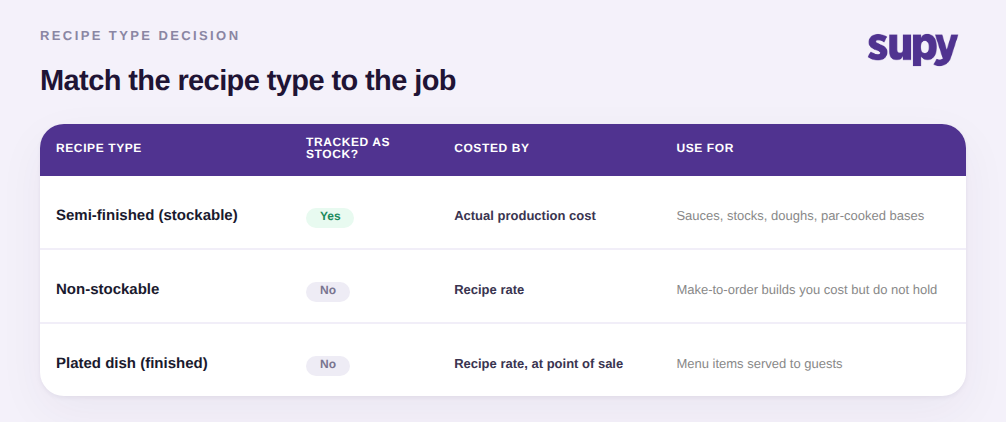
Table matching recipe type to stockable, non-stockable, or plated dish


Which Branch Are You In? The One Setup Move for Each Case

Name your branch and make the one move it needs. If you make the component ahead and store it, set it as a semi-finished, stockable recipe and enable production at your central kitchen location - then run one test production batch and confirm the component appears as a tracked item whose stock rises on production and falls as outlets consume it. If the item is plated and served immediately, keep it a finished dish linked to its point-of-sale item so sales deplete its ingredients directly.
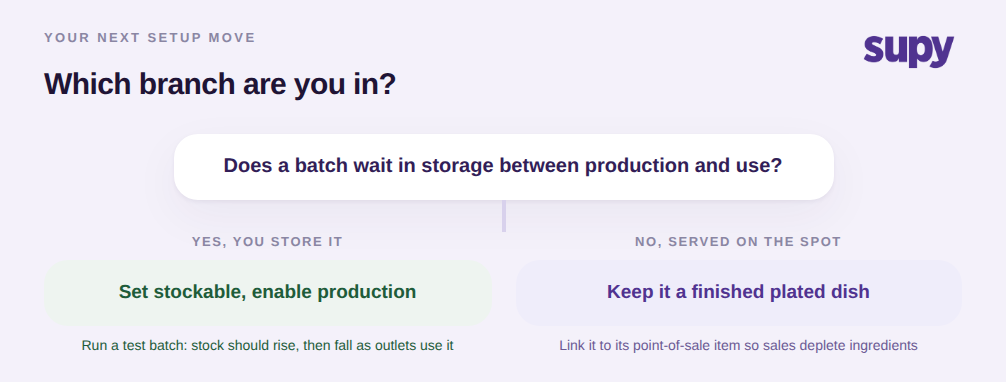
Decision tree for the correct setup move by operator situation


If you are not sure a component is set correctly right now, the fastest audit is that same test batch: produce a known quantity, then check whether the component's on-hand stock moved. If it did not move, it is mis-classified as finished, and every outlet recipe that uses it is carrying a cost and stock error today. Fixing the type is a one-time setup change that stops the drift at its source, before it reaches your central kitchen operations reporting.

Book a Demo with Supy - central kitchen recipe setup

Ready to optimize your restaurant operations?

Blog

Our operational insights

No items found.

Your questions 
answered

Everything you need to know about Supy — from setup to integrations, pricing, and daily use. If it’s not covered here, just ask.

What is the difference between a finished and a semi-finished recipe in a central kitchen?
+

A semi-finished recipe is a component you produce in batches and store before it is used - a sauce, stock, dough, or par-cooked base. It should be tracked as stock so it depletes as outlets consume it. A finished recipe is a dish that is plated and served on the spot, and it deducts its ingredients at the point of sale rather than sitting in inventory. The quickest test is whether a batch physically waits between production and use. If it does, it is semi-finished and stockable; if it is served immediately, it is finished.

Why does marking a prep recipe as finished stop it depleting stock?
+

When a component is set as a stockable semi-finished recipe, producing a batch creates a tracked inventory item, deducts the raw ingredients from live stock, and lets the component deplete as outlets use it. Marking that same component as a finished, non-stockable recipe skips all of that: no tracked item is created, so production never adds component stock and consumption never removes any. The result is phantom stock that shows as on hand when the shelf is empty. A house sauce pulled at 28.8 kg a day can leave roughly 864 kg unaccounted for over a month.

How does the wrong recipe type affect food cost accuracy?
+

A correctly classified semi-finished recipe carries its real production cost - the batch cost spread across the actual yield and grossed up for prep wastage - into every outlet recipe that uses it. When the component is left non-stockable, its cost is applied by recipe rate instead of tracked as a real stock movement, so production variance is never captured and the parent recipe's food cost drifts from what the outlet actually spent. Because one component usually feeds several plated dishes, that error repeats in every recipe above it and widens the gap between theoretical and actual food cost.

When should a central kitchen component be stockable?
+

Any component you produce ahead and hold should be stockable: sauces, stocks, doughs, marinades, par-cooked proteins, and the prepared items a central kitchen ships to outlets. Making it stockable creates a tracked inventory item, restricts its production to the locations you enable, and updates every parent recipe that uses it. The rule is simple: if a batch waits in a fridge, freezer, or on a rack between production and use, it is stockable. Only builds that are assembled on demand, with no batch sitting in storage to count, should stay non-stockable.

What is a non-stockable recipe used for?
+

A non-stockable recipe is for a build you want to cost but do not hold as inventory - typically a component assembled on demand where there is no batch waiting on a shelf to count. It is costed by recipe rate rather than tracked as a stock movement. The risk is using it for something you actually store, such as a batched sauce, because then the component never depletes and its cost never reconciles against real production. Reserve non-stockable for genuine make-to-order builds, and make anything you batch and hold a stockable semi-finished recipe instead.

How can I tell if a component recipe is set up correctly?
+

Run one test production batch. Produce a known quantity of the component, then check whether its on-hand stock actually moved. If the stock rose on production and then falls as outlets consume it, the recipe is correctly set as stockable. If nothing moved, it is mis-classified as finished, and every outlet recipe that uses it is carrying a cost and stock error right now. This test takes minutes and is the fastest audit for a central kitchen that suspects its component recipes were set up wrong during onboarding. Fixing the type is a one-time change that stops the drift at its source.

Does a plated dish need to be stockable?
+

No. A plated dish is a finished menu item and should not be stockable. It links to its point-of-sale item so that a sale deducts the correct ingredients directly, including modifiers, without holding the finished plate in inventory. Making a plated dish stockable would create a tracked item nobody counts and add noise to your stock figures. Keep stockable status for the components you batch and store upstream - the sauces, bases, and prepped items produced in the central kitchen - and let the plated dishes that use them deplete their ingredients at the point of sale.

Ready to transform your operations?

Join 3500+ restaurant operators cutting costs, streamlining operations and making smarter decisions with Supy.