.jpg)


Blanket Purchase Orders for Restaurants: When to Commit Volume
What a Blanket Purchase Order Actually Commits You To
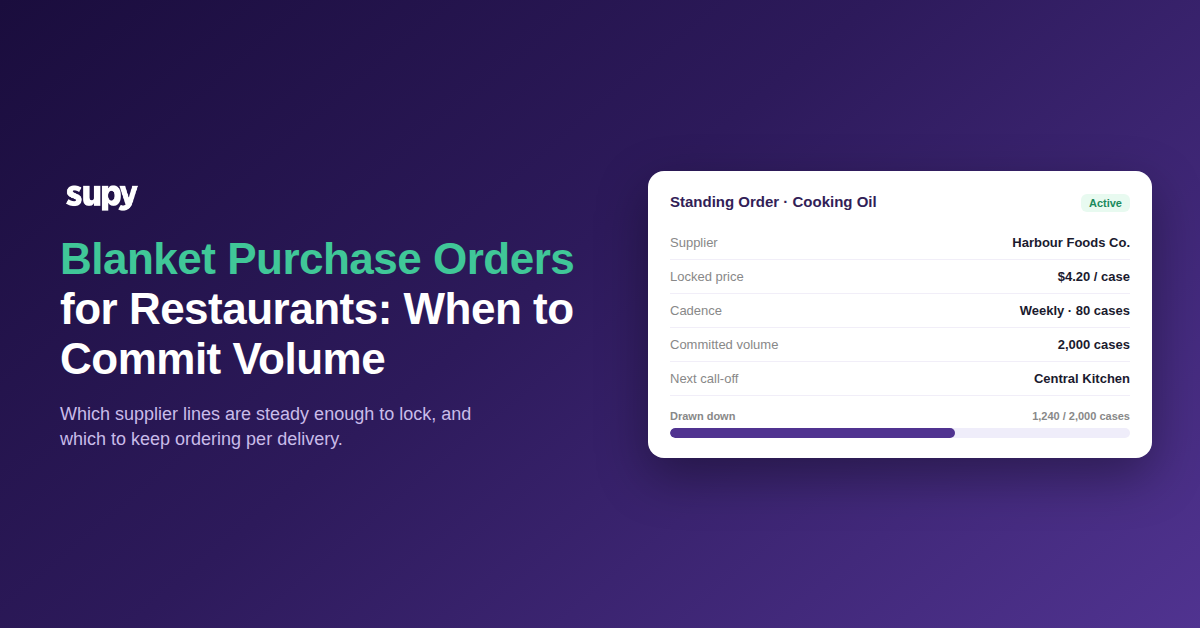
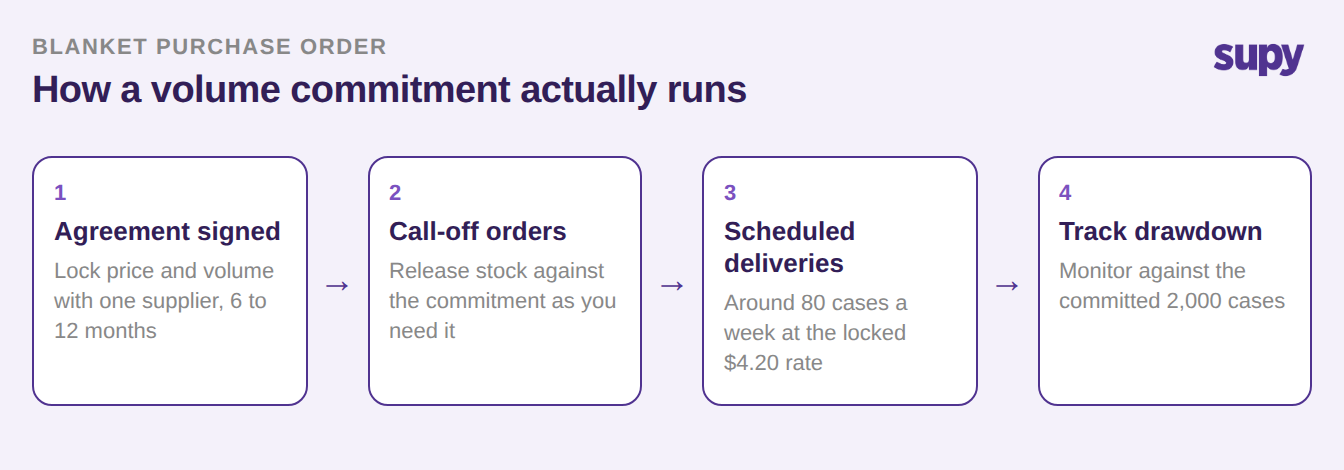
A blanket purchase order is a single agreement to buy an agreed volume of an item from one supplier over a set period, usually 6 to 12 months, at a price fixed in advance. Instead of raising a new order every time, you release smaller call-off orders against the commitment as you need stock. It trades flexibility for a locked price and less admin.
That trade is the whole decision. When you sign a blanket order for, say, 2,000 cases of cooking oil at $4.20 a case over six months, you are betting that the certainty is worth more than the option to shop around. If the spot price drifts between $3.90 and $5.10 across the period, the lock protects you on the way up and costs you on the way down. You have also committed to move roughly 80 cases a week; if a menu change cuts that item, you still owe the volume.
For a restaurant group, three details matter more than they do in general procurement. The item has to have predictable demand, because a commitment you cannot draw down becomes dead stock or a penalty. The supplier has to be one you already trust on quality and delivery, because you are locking yourself to them. And the price has to be volatile enough that locking it is worth losing the option to buy cheaper elsewhere.
Blanket Order vs Ordering Per Delivery: The Trade-Offs
Ordering per delivery keeps every option open: you pay the current price, you can switch supplier at any time, and you never carry a commitment you cannot use. The cost is administrative load and exposure to price rises. A blanket order inverts both. The right choice is item by item, not a single policy for the whole catalogue.
| Factor | Blanket order | Order per delivery |
|---|---|---|
| Price | Locked for the term | Current market rate |
| Flexibility | Tied to the volume and supplier | Switch or skip anytime |
| Admin load | One agreement, then call-offs | A new order every time |
| Best for | High-volume, stable, storable | Fresh, seasonal, low-volume |
| Main risk | Paying for volume you do not use | Price rises and time cost |
The pattern is clear. A blanket order earns its place on high-volume, stable, storable lines where price moves and the supplier is proven. Everything fresh, seasonal, or low-volume is better ordered per delivery, where flexibility is worth more than the price lock.
Which Items Deserve a Volume Commitment, and Which Don't
The cleanest way to sort your catalogue is on two axes: how predictable the demand is, and how much the price moves. Commit only where both point the same way.
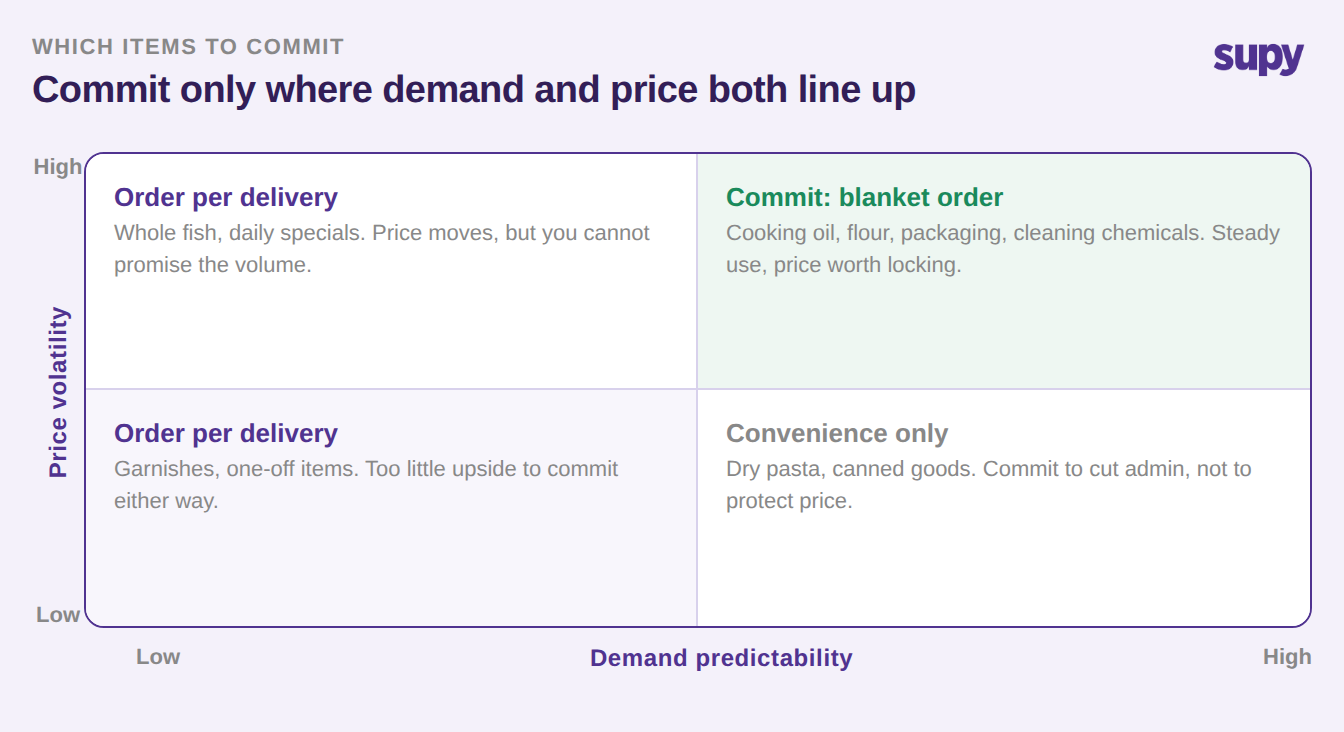
High predictability and high price volatility is the sweet spot for a blanket order: cooking oil, flour, standard packaging, cleaning chemicals. You will use the volume, and locking the price removes a real cost risk. High predictability but stable price means a blanket order buys you convenience but little financial protection, so use it only to cut admin on your highest-frequency lines. Anything with unpredictable demand belongs on per-delivery ordering regardless of price, because the commitment risk outweighs any saving. Fresh produce, whole fish, and daily specials sit here: you cannot promise the volume, so do not commit to it.
Run this sort once a quarter against your own purchase data, and put a rough saving on each candidate with a restaurant ROI calculator before you commit. An item that was steady last season can turn seasonal, and a supplier price that was volatile can settle. The list of what deserves a commitment is not fixed.
Running a Volume Commitment Without a Blanket-PO Field
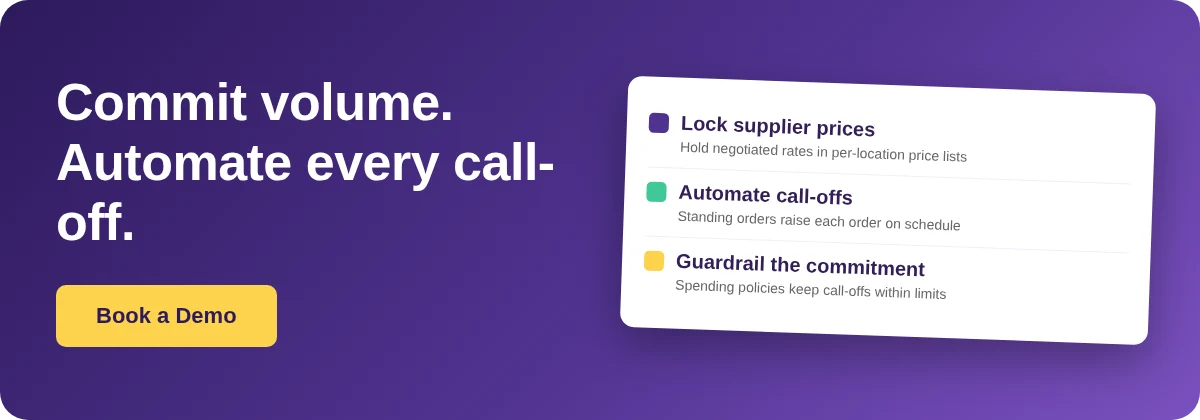
Most restaurant systems, Supy included, do not have a formal blanket purchase order object with a contractual drawdown counter. That does not stop you running the commitment cleanly; it means you assemble it from the ordering tools a restaurant procurement platform already provides rather than one dedicated field. Each part of a blanket order maps onto a tool the platform already gives you.
| Part of a blanket order | Tool that runs it | What it does |
|---|---|---|
| Locked price | Supplier price list | Carries the negotiated rate onto every order |
| Committed item list | Order template | Prefills each call-off, no rebuild |
| Scheduled drawdown | Standing order | Raises each call-off order automatically |
| Volume guardrails | Spending policies | Keeps call-offs within agreed limits |
| Group-level volume | Consolidated ordering | Aggregates demand across every outlet |
The mechanism most worth setting up is the standing order: configure the supplier, location, and items once with a weekly or monthly cadence, and each call-off purchase order is raised automatically on the scheduled date. The one thing to track outside the system is the running total against your committed volume, because there is no drawdown counter doing it for you. A supplier purchase-value report, pulled monthly, tells you whether you are on pace to meet the commitment or heading for a shortfall you will have to explain to the supplier at renewal. Set a calendar reminder for that check rather than trusting yourself to remember it.
Choose a blanket purchase order when an item has steady, predictable demand, a price that genuinely moves, and a supplier you already trust: you lock the rate, cut the ordering admin, and protect the margin on a line you know you will use. Choose per-delivery ordering when demand is uncertain, the item is perishable, or the volume is too low to matter: the flexibility is worth more than the lock, and a commitment you cannot draw down is a liability, not a saving. Sort your catalogue on demand predictability and price volatility, commit only where both line up, and re-run the sort each quarter as your menu and your suppliers change.