Clean Restaurant Data with Supy: Ensuring Accuracy Across Multiple Branches

In the messy, fast-paced world of multi-location restaurant management, one must always have a solid system in place for storing and maintaining restaurant data. The process of “data cleansing” refers to the process of fixing or removing incorrect, duplicate, incomplete, or corrupted raw data. Thus, clean data is a set of data that is free of errors, consistent, and accurate, and must be the bedrock of all your restaurant operations.
- The Importance of Clean Restaurant Data
- Challenges in Multi-Location Data Management
- How Supy is Designed to Help
- Recipe Management and Consistency With Supy
- Maintaining Inventory Accuracy With Supy
- User Permissions and Data Integrity
- Making Data-Driven Decisions with Supy
- Conclusion
- About Supy
From standardizing recipes to managing inventory, ensuring the consistency o data across branches is vital. Yet, achieving this can prove to be a tricky process. Many restaurants face significant challenges when it comes to maintaining data accuracy:
- Recipe inconsistencies between branches can lead to variations in dish quality, damaging the brand’s reputation.
- Mismatches in inventory often result in over-ordering or under-stocking, escalating your costs and waste.
- Improper user permissions can allow unauthorized staff to make changes to critical data, creating a cascade of operational disruptions.
These issues not only affect day-to-day efficiency but also hinder data-driven decision-making, leading to missed opportunities for growth.
Enter Supy, the ultimate platform for clean restaurant data management. With its robust features designed specifically for multi-location master data management, Supy empowers restaurant owners to take control of their data and transform it into actionable insights.
Read on to learn how Supy can best serve you and all your data cleansing needs!
1. The Importance of Clean Restaurant Data
Gathering and maintaining clean data is the backbone of any efficient and profitable restaurant operation. In this context, we can use the term to refer to data that is accurate, up-to-date, and error-free. Such information often underpins critical processes such as inventory management, recipe standardization, and operational consistency. In multi-location restaurant chains, maintaining data integrity is vital to ensuring a seamless means of communication and coordination across multiple branches. This helps make sure everything is easily traceable and transparent.
When recipes and inventory data are inconsistent or outdated, the consequences for large-scale restaurant chains can be disastrous. For instance, errors in ingredient quantities can lead to over- or under-preparation, resulting in food wastage and revenue loss. According to the ReFED Insights Engine, in the United States alone, it is estimated that up to 40% of the food supply is wasted, costing approximately $218 billion annually! Nothing could emphasize the critical role of data accuracy more. Furthermore, inaccurate tracking of cooking yields can distort profit margins and complicate forecasting, leading to loss after loss if not rectified quickly!
Clean data also impacts customer satisfaction. Imagine a scenario where discrepancies across precise location data lead to variations in dish quality—this inconsistency erodes customer trust in the brand. With precise data, restaurant chains can maintain uniformity in taste, portion size, and cost, ensuring a consistent customer experience.
It’s clear that for large restaurant operations, investing in clean business data is no longer optional. Fragmented or erroneous data across branches can create bottlenecks, disrupt supply chains, and inflate costs. Maintaining a clean system of data also sets the foundation for your future, since advanced technologies like predictive analytics and automated inventory management, all depend on a reliable source of data,
2. Challenges in Multi-Location Data Management

Despite the importance of maintaining a clean system of data storage and access, many restaurant chains struggle to enact such reform across multiple locations. Without a robust system in place, however, many restaurants have to deal with:
- Inconsistent Recipe Updates
A restaurant’s recipes are the backbone of its operations. Yet when recipe updates fail to synchronize across your restaurant chain, it can lead to variations in taste, portion sizes, and even incorrect inventory depletion.
- Errors in Inventory Tracking
A manual inventory tracking process will more often than not lead to discrepancies in data, leading to emergencies like running out of critical ingredients. This not only impacts customer satisfaction but can increase your operational costs.
- Unauthorized Data Modifications
When staff members have broad access to your inventory and recipe management systems, there is a high chance that unauthorized changes to the system may occur. The consequences of a single unintended modification can be high, cascading into much larger issues that could easily have been avoided.
The Shortcomings of Manual Data Keeping
Although manual data management systems might work out just fine for small standalone restaurants, they are far from an ideal solution for large multi-location chains. Prone to human error and inefficiency, keeping data manually synchronized and accurate across multiple locations is a monumental task, often leading to fragmented systems and miscommunication.
Such challenges highlight the critical need for centralized solutions like Supy.
3. How Supy is Designed to Help

Maintaining a clean and accurate system of data storage across multiple locations is critical to the operational success of any large restaurant chain. By providing a centralized platform for data storage, Supy allows each of your locations to back its data up to the cloud. This allows local restaurant managers to make informed, data-driven decisions pertaining to things like branch waste management and operational efficiency.
Another standout feature is Supy’s automated inventory updates. These have been designed to reduce your restaurant’s rate of manual errors and provide a clear picture of your total available stock at any given time. By integrating inventory data with sales and usage reports, Supy helps you keep your ingredient quantities accurate and thus helps minimize waste. With Supy’s inventory tracking feature, you can easily transfer goods between inventories online and assign a unique storage location to every item you create.
Finally, to safeguard data integrity, Supy allows restaurant owners and managers to employ controlled user permissions. This feature ensures that only authorized personnel can edit critical information: such as recipes, inventory levels, or supplier details. Staff roles and access levels can be customized to minimize the risk of errors or unauthorized changes.
Behind its intuitive user interface, the Supy app is powered by a robust backend system that guarantees speed, scalability, and reliability. Our platform is designed to prioritize ease of use, enabling teams to quickly access and manage data without extensive training.
4. Recipe Management and Consistency With Supy
One of the most critical aspects of running a multi-location restaurant chain is producing a consistent product from the same recipe, over and over again. Yet, challenges like inaccurate yields, untracked prep wastage, and deviations in preparation instructions can decrease the efficiency of the entire process, leading to higher costs and disgruntled customers. Without a streamlined approach to recipe management, these issues can cause serious issues with inventory and revenue.
One way Supy addresses these challenges is with robust recipe management tools designed to keep your output consistent across all your branches. With the advanced recipe builder, for instance, Supy allows restaurants to make recipes that are precise, profitable, and easy to replicate! All you have to do is specify what ingredients you have on hand and in what quantities you need them. This ensures that every ingredient is used efficiently, minimizing waste while maintaining consistent quality.
Additionally, Supy tracks prep wastage in real time, by allowing you to log wastage events directly into the app. These insights help kitchens keep their inventory accurate at all times and quickly adjust their processes in real time. Supy’s platform also standardizes recipes by integrating clear, centralized instructions for every menu item. Whether it’s precise ingredient measurements, step-by-step cooking methods, or portioning guidelines, staff across all locations can access up-to-date recipe information from a single source of truth.
By combining these features, Supy can help you keep your recipe deviations to a minimum, control sources of wastage, and keep your standards uniform throughout your chain.
5. Maintaining Inventory Accuracy With Supy
Another major step in the way of gathering clean restaurant data is poor inventory management. Discrepancies in inventory data—whether due to manual errors or inconsistent updates—can disrupt workflows and lead to significant financial losses.
Supy’s advanced inventory tracking system revolutionizes how restaurant chains manage their inventory. With the “find & fix discrepancies” feature, you can monitor inventory levels at a glance, ensuring stock levels never go higher or lower than they should. By providing real-time updates, the platform ensures that inventory data is always current, reflecting actual stock levels across all branches. This not only improves visibility but also allows for a dynamic connection between what’s happening at the front and back of the house.
By keeping all your inventories in one place, you can also effortlessly manage your kitchen and bar operations by keeping a close eye on your prized ingredients. One standout feature of Supy’s platform is its automated discrepancy alerts. These alerts flag mismatches between recorded and actual inventory levels, empowering managers to address issues immediately. Additionally, Supy’s data-driven forecasting tools can help you plan your operations better and order ingredients more accurately. By analyzing past sales and consumption patterns, these tools can estimate how much of each ingredient will be required for a given period. This foresight allows you to adjust orders pre-emptively, reducing the likelihood of surplus stock that could become waste.
6. User Permissions and Data Integrity
In multi-location restaurant chains, another obstacle in the path towards clean data collection is unauthorized or accidental data modification. Whether it's an inventory discrepancy, a miscalculation in recipe yields, or an incorrect update in a menu item, such errors can disrupt operations across all locations.
Supy’s platform addresses this challenge by implementing a robust user permissions system designed to safeguard data integrity. Through role-based access controls, Supy ensures that only authorized personnel can modify critical information, such as inventory counts, recipe details, and pricing data. This minimizes the risk of human error and intentional manipulation, which can lead to inconsistent data across locations.
Supy allows restaurants to define specific roles for staff and assign access levels based on responsibilities. For example, a cook may only have permission to view recipes and cooking instructions, while a branch manager can update inventory and adjust stock levels. This granular control not only ensures the security of sensitive data but also enables staff to access only the information necessary for their tasks.
7. Making Data-Driven Decisions with Supyants

In the end, the process of cleaning and collecting all of this data serves one ultimate purpose: the power to make smart and informed decisions.
Supy’s advanced reporting and analytics tools are designed to provide real-time insights into the various aspects of your restaurant operations. By analyzing trends and tracking performance metrics such as sales, inventory turnover, and wastage, Supy enables restaurant owners to identify opportunities for improvement.
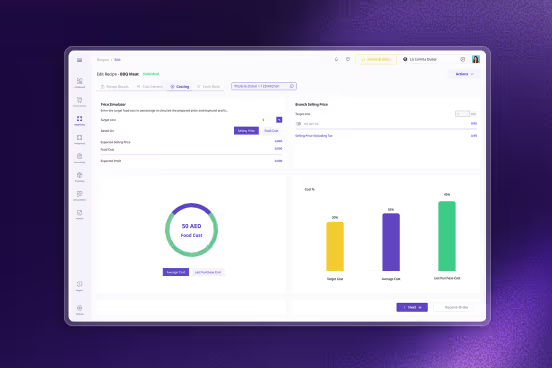
One of the standout features of Supy’s platform is its ability to track recipe profitability in real time. By linking and regularly updating all ingredient costs to your recipes, Supy instantly sends restaurant managers alerts if ingredient prices increase and affect your recipe’s profitability. This enables timely decisions, like adjusting the menu to eliminate underperforming dishes or renegotiating supplier contracts based on accurate, up-to-date data. With Supy’s clean, actionable data at their fingertips, restaurant owners can feel empowered to make intelligent decisions that keep their operations running smoothly and their customers coming back for more!
8. Conclusion
In the end, managing clean and accurate data across multiple restaurant locations can present a series of significant challenges. Without a unified system, your business is vulnerable to inconsistent inventory management, prep wastage, and poor decision-making. What’s worse, mistakes in large restaurant chains are likely to multiply across each new location!
Have no fear, Supy’s data warehouse was designed to tackle each of these challenges head-on. By providing a centralized data management system, Supy ensures that accurate location data allows each branch to operate with the most up-to-date information, from inventory tracking to recipe management. The platform’s unique features, such as real-time syncing of data across locations and customizable user permissions, minimize the chances of data inaccuracies and empower managers to make informed decisions.
Ready to see how Supy can transform your restaurant operations management? Book a free demo today or subscribe to our newsletter to learn more!
9. About Supy
Supy is the best restaurant inventory management software platform tailored for multi-branch restaurants and franchises. With features like real-time inventory tracking, smart procurement systems, and advanced analytics, Supy helps restaurants manage their various demands effectively and provides the tools restaurants need to thrive in a dynamic industry.
For the latest expert insights, download Supy’s ebook: The Ultimate Guide to Reducing Food Costs in Multi-Branch & Enterprise Restaurants.
Ready to find out more? Schedule a demo with Supy today and take the first step towards a streamlined, profitable future.