.jpg)


What Does All Day Mean in a Kitchen? The BOH Term Explained
What “All Day” Means in a Kitchen
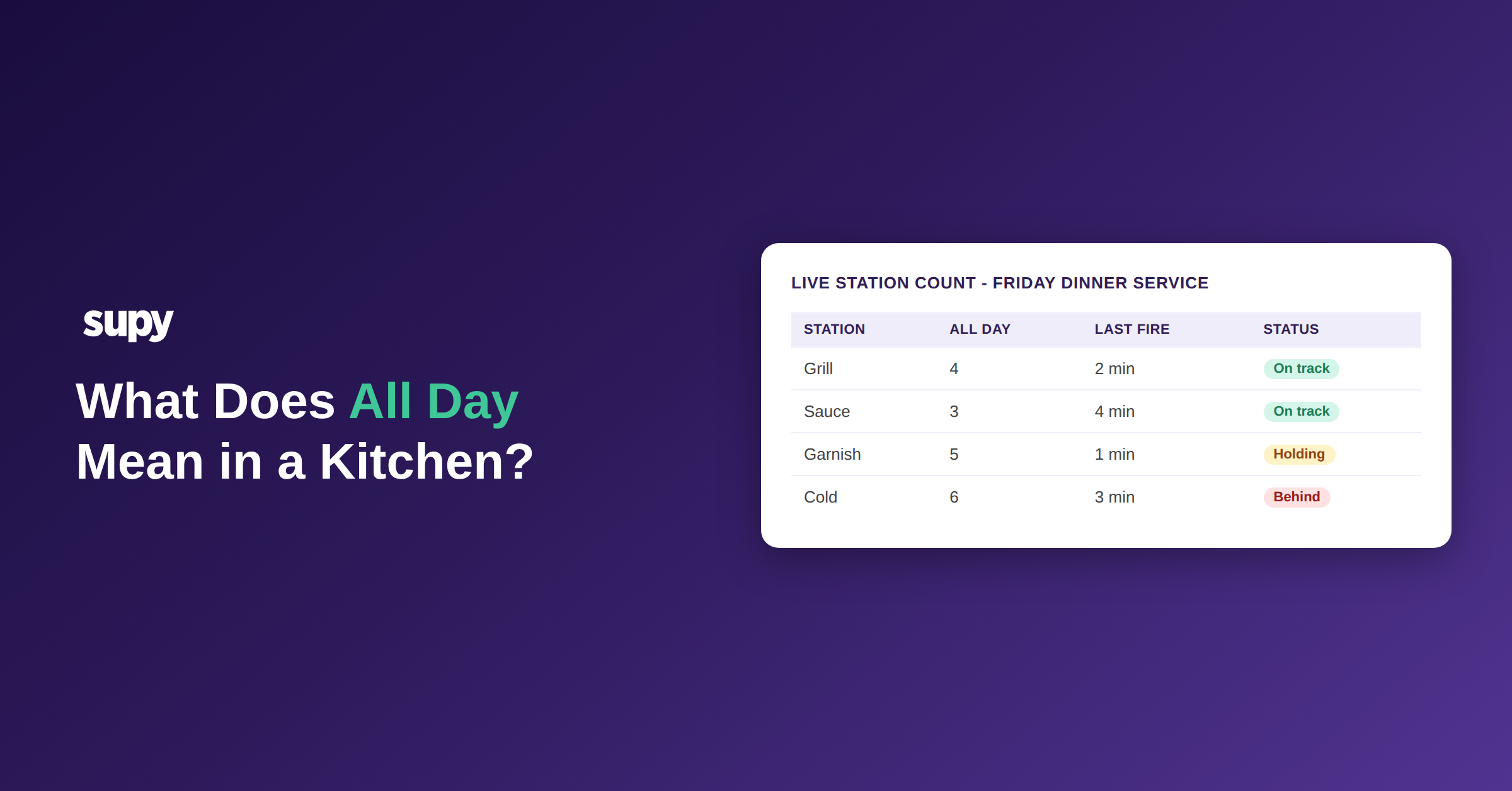
“All day” is the running total count of a dish still outstanding across all active tickets at any given moment during service. It is not a reference to the time of day or the length of service. It means: right now, across every open ticket on the pass, this is how many of that dish we still need to cook and plate.
When a head chef or expediter calls out “four steaks all day,” the grill cook hears that there are four steaks outstanding across all active orders - not necessarily four on a single ticket. The number is cumulative. As tickets are completed and new ones come in, the all-day count changes continuously.
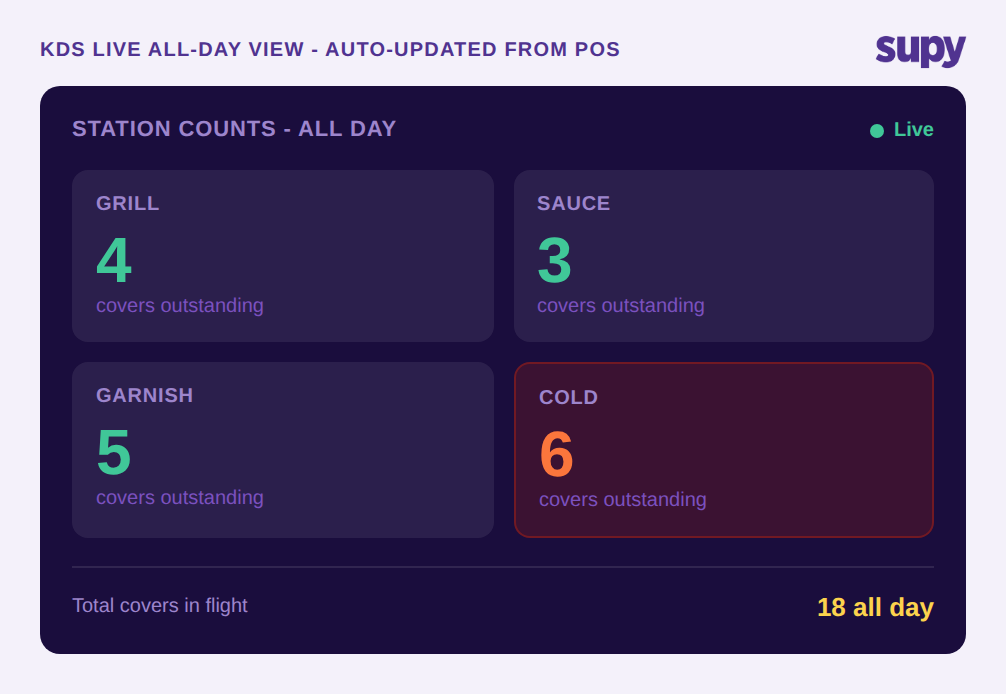
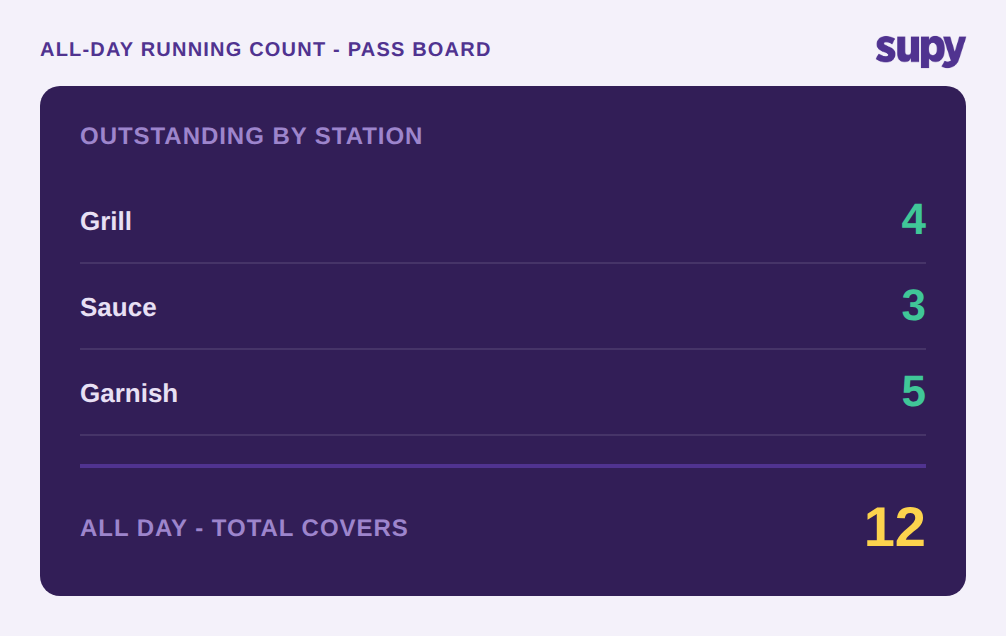
In practice, an expediter might call it like this: “Grill: four steaks all day. Sauce: three mains all day. Garnish: five plates all day.” That means 12 covers are in flight for the current service cycle across those three stations, and each station knows its share of the current load.
The term comes from professional kitchen communication systems designed to keep the pass moving without stopping for ticket-by-ticket recaps. It gives every station a single number to work to rather than forcing them to mentally aggregate individual tickets.
What to ask before service: How will each station track the all-day count once service gets busy - verbally only, on a board, or through a display?
Where “All Day” Fits in the BOH Communication System
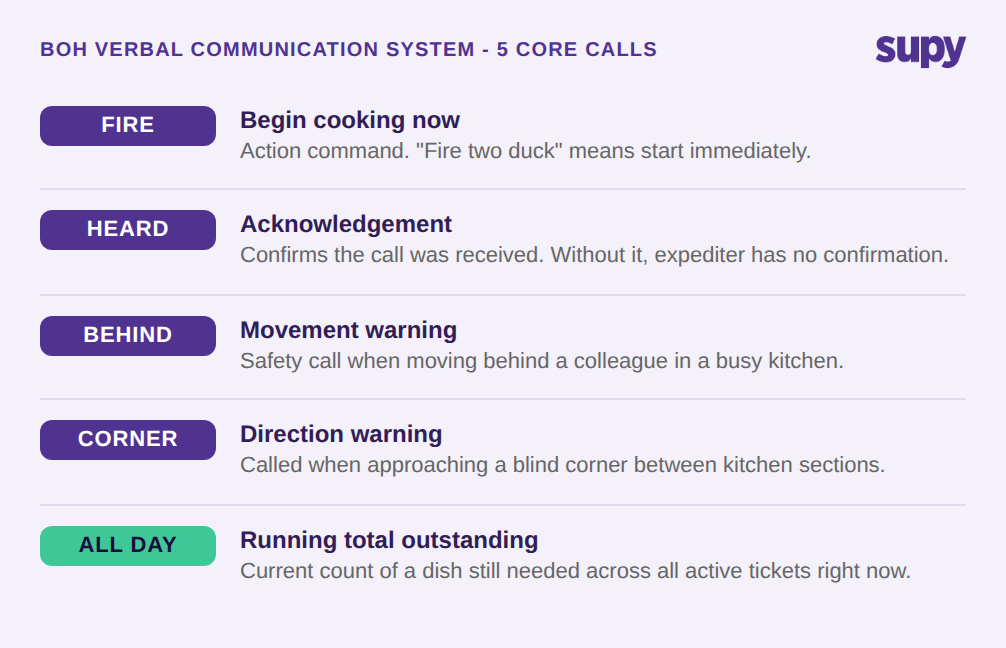
Professional kitchens run on five core verbal calls. Each one carries a specific meaning, and using them correctly is the difference between a clean service and a chaotic one.
Fire: Begin cooking this dish now. A call of “fire two duck” means start two duck dishes immediately. This is an action command.
Heard: Acknowledgement that the call was received. Cooks respond “heard” to confirm they caught the instruction. Without heard, the expediter does not know the message landed.
Behind: A movement warning. Anyone moving behind a colleague in a busy kitchen calls “behind” to prevent collisions. It is a safety call.
Corner: A direction warning when approaching a blind corner, typically in the path between hot and cold sections or between the kitchen and pass. “Corner” prevents collisions around unsighted turns.
All Day: The current running total of a dish or station’s workload, as described above.
These five calls work together as a closed communication loop. Fire sets the action. Heard confirms receipt. Behind and Corner protect movement. All Day gives each station its total outstanding obligation.
The system only works when everyone uses the same calls in the same way. In a team of 12 to 20 people across multiple stations, a single cook using “all day” to mean “so far tonight” rather than “outstanding right now” creates a mismatch that cascades through every order that follows.
What to ask when training new staff: Can each new hire explain the difference between “fire two duck” and “two duck all day” before they work an unsupervised service?
What Happens When the All-Day Count Gets Misread
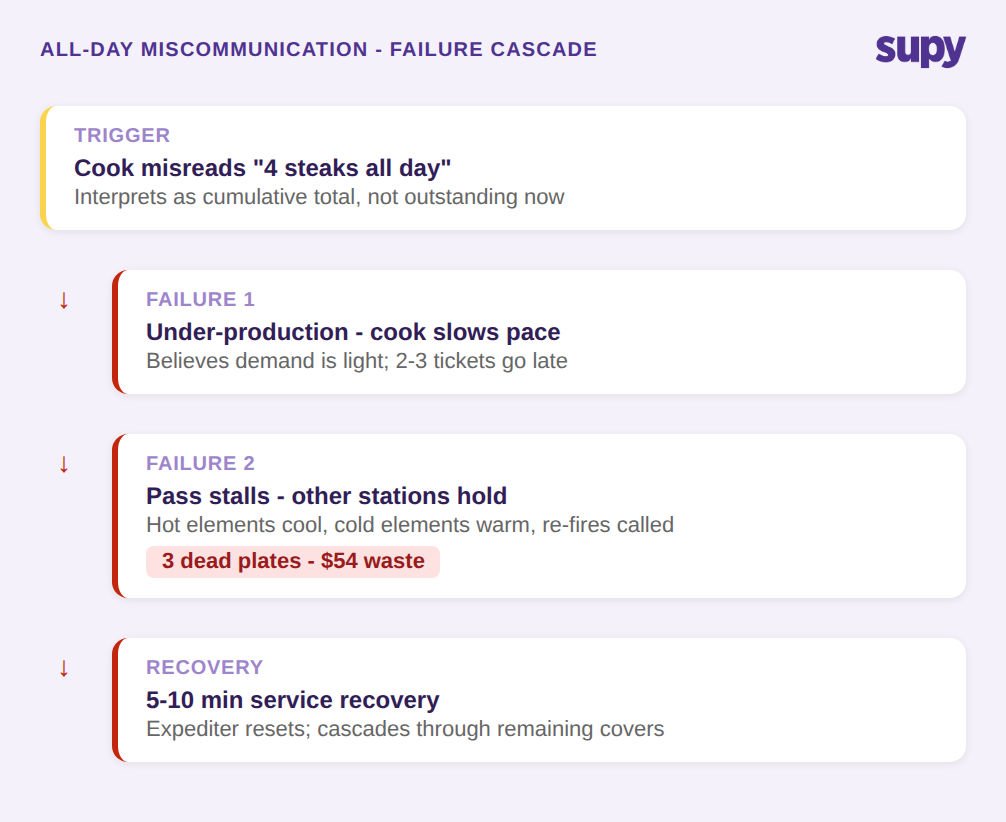
The failure mode is specific and expensive. A cook hears “four steaks all day” and interprets it as confirmation that only four steaks total have been ordered so far in the service, when in fact four steaks are outstanding right now across open tickets. They slow their pace because they think they are ahead of demand. By the time the error surfaces, two or three tickets are late, the pass is stalled, and covers have waited.
In a mid-range restaurant, a dead plate - food cooked but returned or wasted because the timing has collapsed - costs approximately $18 in food and labour. A single all-day miscommunication that produces three dead plates costs the kitchen $54 and takes five to ten minutes to recover.
The compounding effect is what makes this matter. An all-day error during a busy Friday service does not just affect one station. If the grill is behind because the cook underestimated the outstanding count, every other station timed to that dish has to hold. Cold elements get warm. Hot elements cool down. The expediter has to call re-fires. One misread number produces a chain of wasted prep.
The pattern is most common in a kitchen’s first 90 days with a new hire. New cooks have the knowledge of what “all day” means from training, but under the noise and pressure of a live service, they default to the most intuitive interpretation: all day equals all night equals everything so far. The professional meaning - outstanding right now - requires repetition before it becomes instinct.
What to ask after a service: Where did the all-day count get lost, and was it a communication gap or a process gap?
Why Verbal Calls Break Down in High-Volume Kitchens
At peak service, a commercial kitchen operates at noise levels around 85 dB - comparable to standing next to a running lawnmower. At that volume, a verbal call that is not immediately confirmed and repeated can disappear entirely. Heard is not just politeness; it is the error-catching mechanism in a system with no written record.
The problem scales with team size and station distance. In a single-site kitchen with six people, an expediter can make eye contact with every station and read confirmation from body language. In a kitchen with 15 to 20 people across a long pass, or across a back-of-house operation feeding multiple satellite locations, verbal confirmation is unreliable as the sole tracking method.
Multi-site operations add another layer. If a central kitchen is producing for four or five outlets and coordinating through an expediter calling all-day counts for each location’s ticket board, the verbal system is managing several independent running totals simultaneously. A single missed call or misheard number affects a different location’s service.
Staff turnover amplifies the risk. Restaurant kitchens run at high staff churn, and in many markets, a percentage of the kitchen team at any given time will be in their first 90 days. The verbal system depends on shared understanding that takes weeks to build. New starters bring the problem back to the baseline.
What to ask when designing a kitchen system: At what point does the team size or location count make verbal-only all-day tracking an unacceptable risk?
How Kitchen Display Systems Automate the Running Count
A kitchen display system (KDS) solves the all-day problem by making the running count visible and automatic. Orders feed from the POS directly to a screen at each station. The KDS aggregates open tickets and shows each station exactly what is outstanding, updated in real time as tickets are bumped.
The cook at the grill does not need to hear “four steaks all day” from the expediter and confirm receipt before knowing their current load. The screen shows it. When a table’s order is completed and bumped, the count decreases. When a new order comes in, it increases. The number is always current, it does not need to travel through a noisy room, and there is no ambiguity about what “all day” means when it is displayed as a live count rather than spoken.
For multi-site and central kitchen operations, live visibility tools that track prep production and stock movement across locations provide the operational equivalent of an all-day count at the group level: what is outstanding, what is available, and where the gap is. Explore how kitchen management software brings this visibility together.