.jpg)

Restaurant Procurement: How Multi-Site Groups Lose Control Before Month-End
Why Email Ordering Destroys Audit Trails in Multi-Site Operations
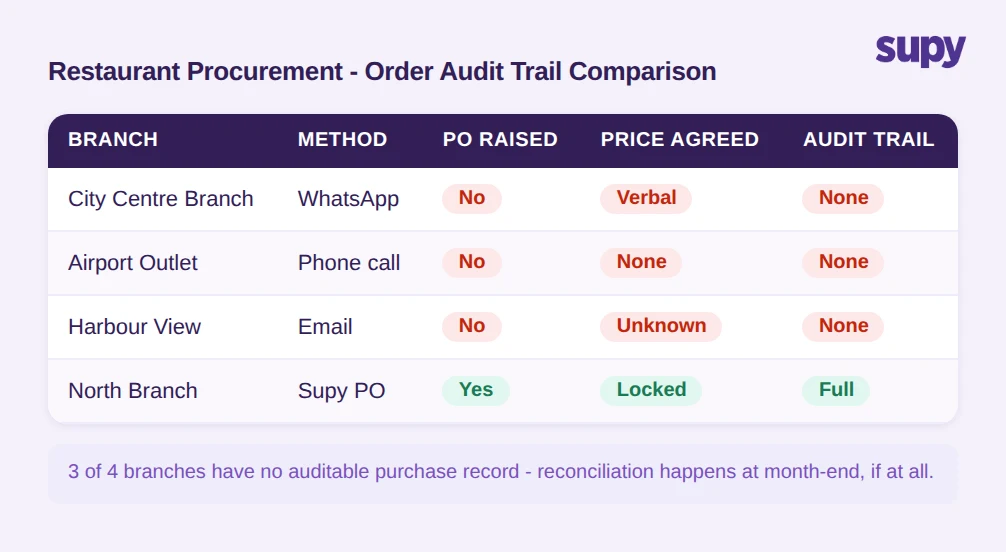
A manager at the City Centre branch needs protein for the weekend. She sends a WhatsApp to the supplier contact she has saved on her phone. The Airport Outlet manager orders the same SKU from the same supplier the following day but gets a different price because his contact is a different rep. Neither order is visible to the operations director until it shows up on a supplier statement.
This is the baseline state for restaurant procurement at groups that have grown without putting purchasing infrastructure in place. Every branch operates as an independent buyer. There is no consolidated view of what has been ordered, no consistent pricing across outlets, and no record that could be audited if a query arose.
The mechanics of the problem: orders go out by email, WhatsApp, or phone with no reference number. Suppliers confirm back to the individual manager, not to a central system. There is no PO against which the delivery can be checked. Price changes are accepted at the point of delivery or not noticed at all. Month-end requires someone to manually reconcile supplier statements against bank payments.
At a 12-location group operating across 8 suppliers, this compounds into hundreds of untracked transactions per week. One operator described the process as "ordering blind and reconciling late" - by the time food cost data reaches the operations team, the window to act on it has already closed.
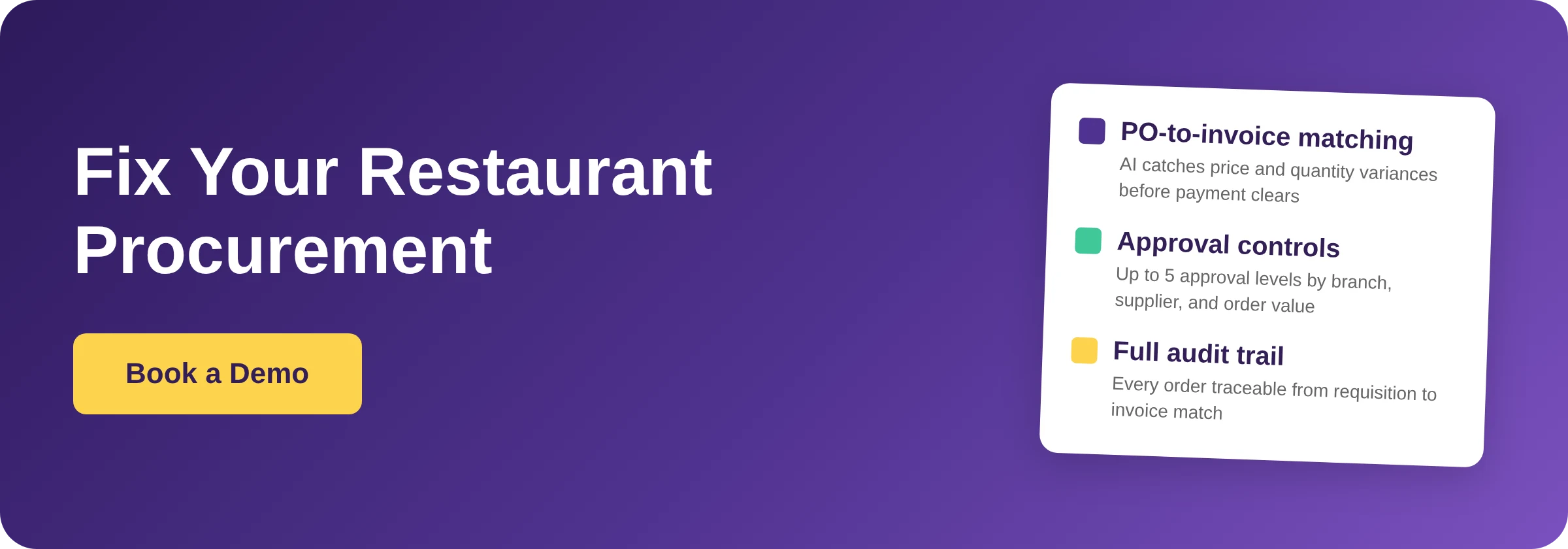
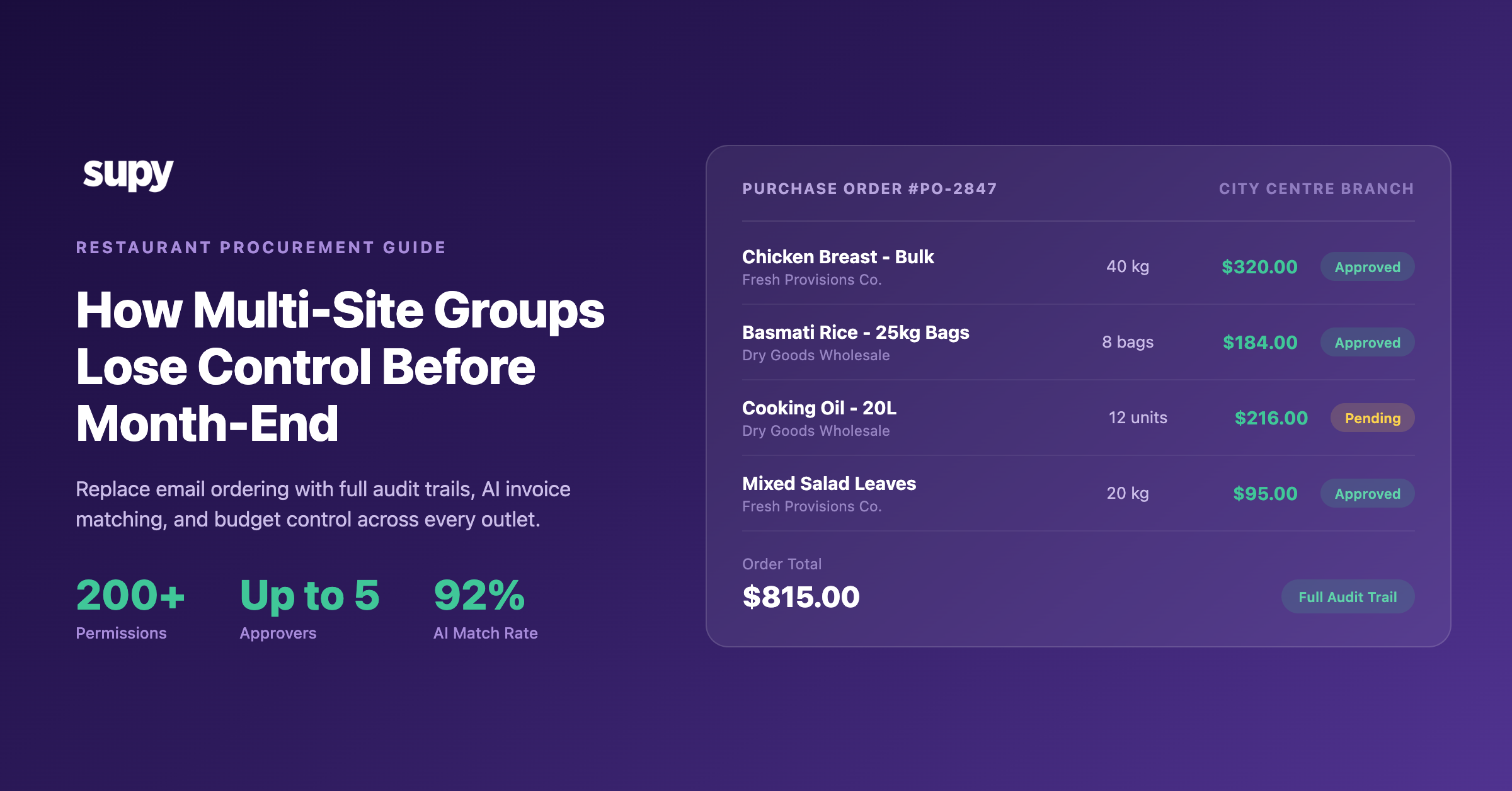
Structured restaurant procurement starts by moving every order onto a platform where requisitions are raised on web or mobile, reviewed and approved before a PO is generated, and sent to suppliers via email, WhatsApp, or direct integration - all with a full audit trail from requisition through to delivery.
How Price Drift Goes Undetected for Weeks Without Invoice Matching
Supplier invoices are the most under-scrutinized document in most restaurant operations. An invoice arrives, it matches the delivery - or appears to - and it gets processed for payment. The possibility that the price on the invoice differs from the price on the original PO is rarely checked systematically.
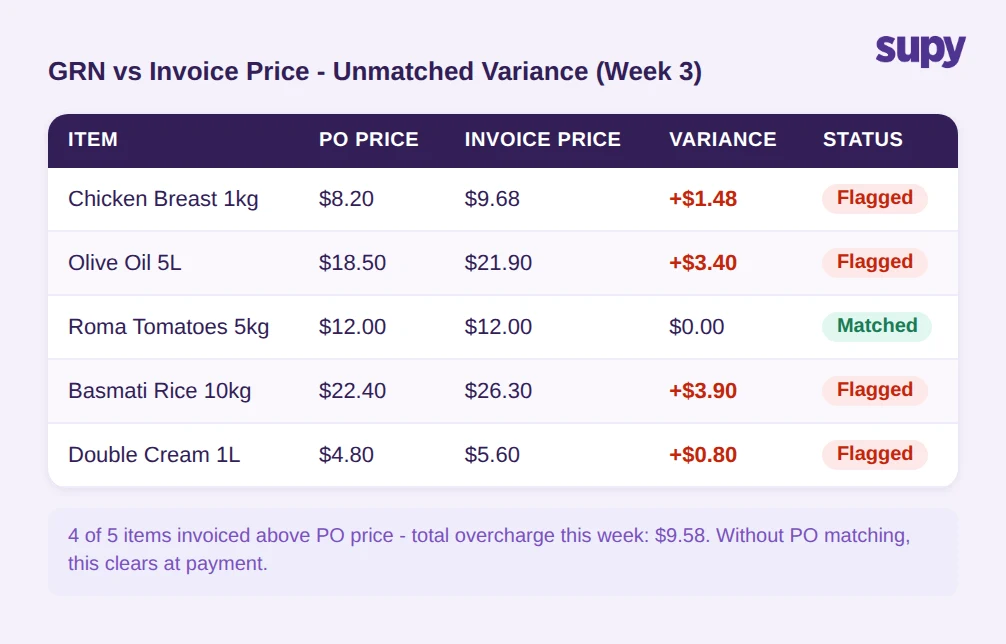
In practice, price drift accumulates over 3 weeks or longer before anyone catches it. A supplier updates their price list. The change flows through to invoices immediately. But if there is no PO-to-invoice matching in place, the higher price is accepted and paid without flag.
At scale, the math adds up quickly. An 18% cost overrun across a category does not announce itself. It arrives as a slow drift in food cost percentage that gets attributed to waste, portioning, or theft before someone traces it back to an uninvoiced price increase.
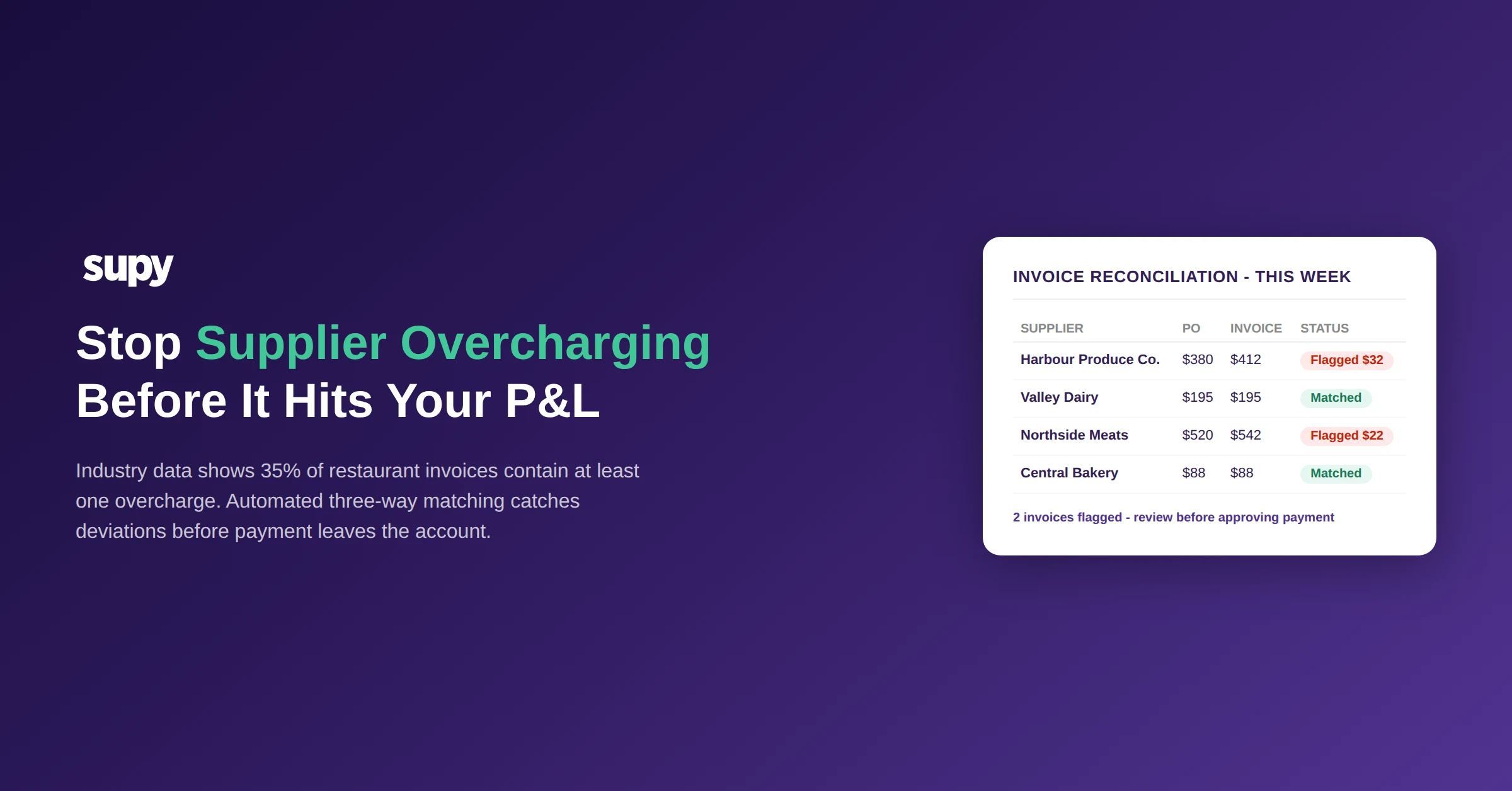
Two controls close this gap in structured restaurant procurement. PO-to-GRN matching means that when stock is received, the team confirms quantities and prices against the original purchase order. Variances - whether in quantity or price - are flagged before the GRN is finalized. The system supports multiple GRNs per PO for split deliveries, and allows credit notes to be raised immediately for over-charges or incorrect items, with a full audit trail.
AI invoice scanning works alongside this. Suppliers email invoices to a dedicated per-restaurant inbox. AI extracts supplier details, invoice numbers, dates, line items, prices, taxes, and totals - regardless of invoice format. The system auto-matches each invoice against the corresponding PO. Price and quantity conflicts are flagged for review before anything updates stock or accounts. A 92% auto-match rate means the operations team reviews exceptions, not every invoice.
If your group does not have consistent par level management in place, that establishes the baseline that makes ordering quantities defensible against supplier invoice claims.
Budget Visibility and Approval Gaps That Show Up at Month-End
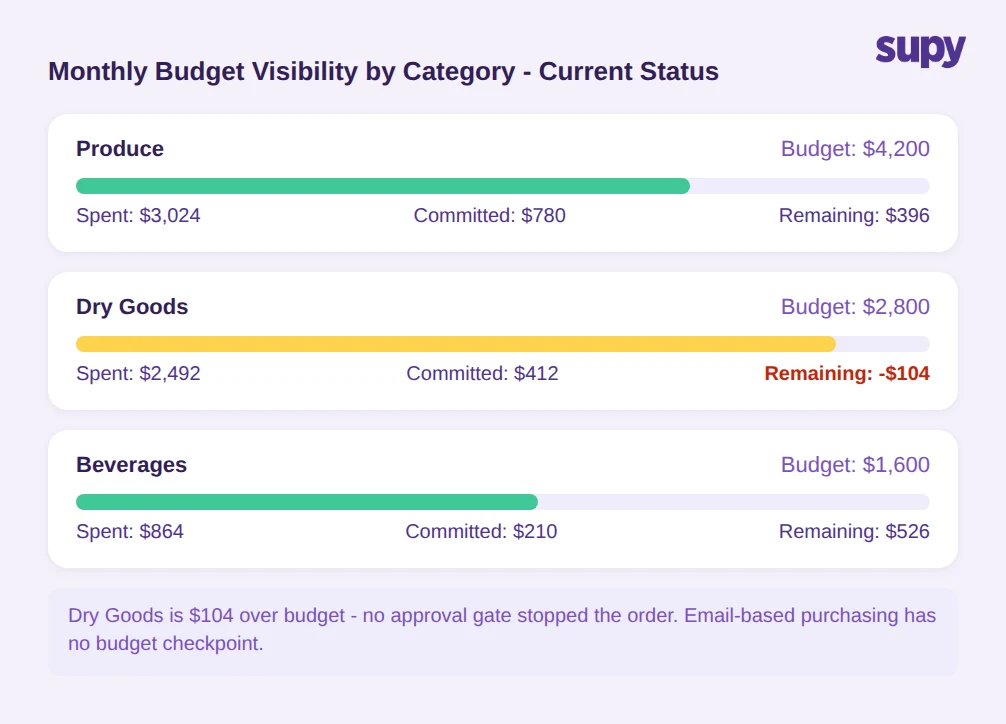
The 18% overspend discovery at month-end is almost always preceded by a simpler failure: managers with ordering authority had no visibility into budget remaining at the time they placed orders.
In email-based restaurant procurement, there is no mechanism to enforce budget limits at the point of ordering. A manager who has authority to order from a supplier will order. They are not operating with a live view of how much budget remains in that category for the month, how much has already been committed in outstanding POs, or whether the group's purchasing rules require sign-off above a certain value.
Structured restaurant procurement addresses this through a combination of approval workflows and configurable spending controls. The approval layer supports sequential sign-off with up to 5 approvers, triggered by a combination of branch, supplier, and order value. A $500 produce order from a branch manager might auto-approve; a $3,000 order from the same manager might route to the operations director before a PO is generated.
Spending rules can be set by supplier, branch, category, user, or par - and applied across different time windows: daily, weekly, monthly, or quarterly. This means the system can enforce a monthly category budget without requiring manual oversight of every transaction. Over 200 configurable permissions give the operations team control over who can raise requisitions, who can approve POs, who can receive stock against a GRN, and who can authorize credit notes.
The separation of requisition and PO flows matters here. A manager raises a requisition - it is a request to purchase, not an order. The approval workflow acts on the requisition before a PO is generated. This creates the budget checkpoint that email ordering cannot provide.
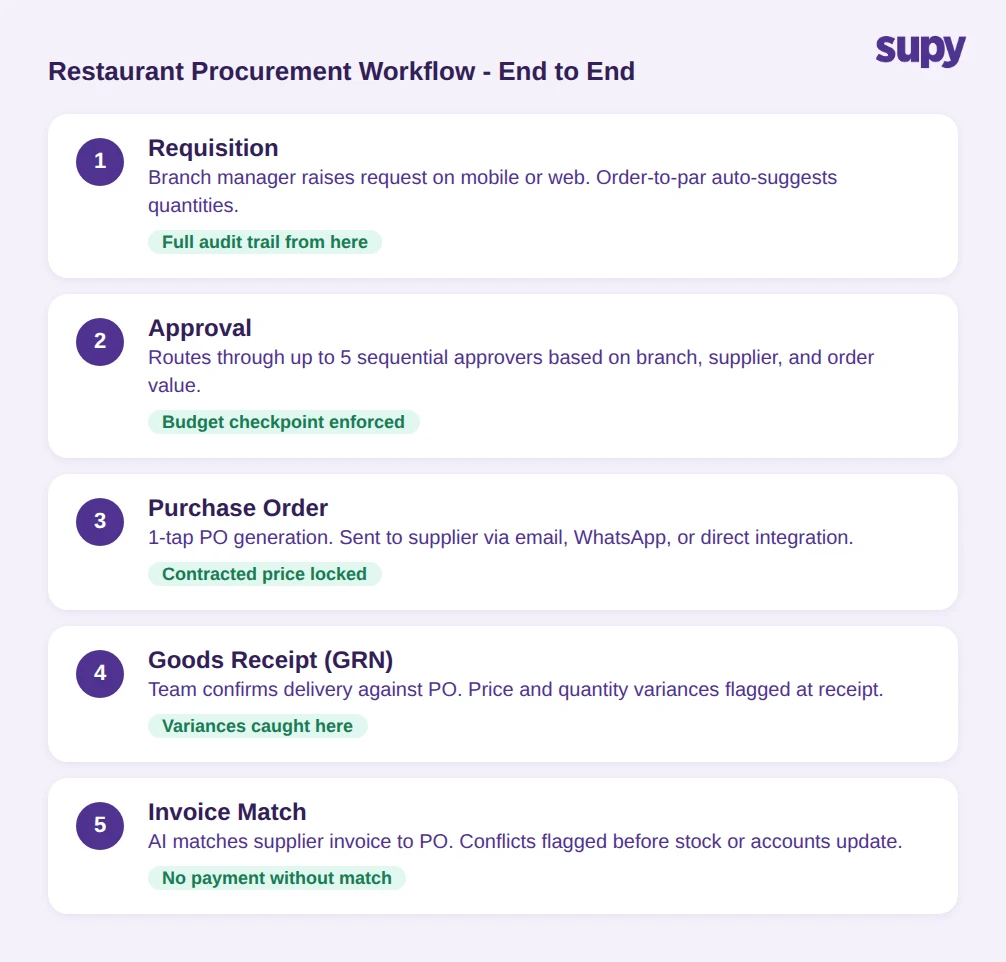
The Full Restaurant Procurement Workflow: Requisition to Delivery
Replacing email ordering is not just about software. It requires a workflow that covers every stage from the moment a need is identified through to the point at which stock is confirmed received and the invoice is matched.
A structured restaurant procurement workflow runs as follows. At the requisition stage, a branch manager identifies a need and raises a requisition on web or mobile. They specify item, quantity, preferred supplier, and any notes or images. The system supports order-to-par logic - meaning the requisition can be generated automatically based on current stock levels relative to par.
At the review and approval stage, the requisition routes through the configured approval chain. Approvers can review, edit, or reject before a PO is issued. No order leaves the business without passing through this stage.
For PO generation, approved requisitions are converted to purchase orders in one tap. POs go to suppliers via email, WhatsApp, or direct integration. The system auto-aligns POs to each supplier's delivery schedule and cut-off times, eliminating the manual coordination that breaks during busy periods. Understanding how a purchase order management system works in practice is useful context at this stage.
When stock arrives, the team confirms delivery against the PO. Quantity and price variances are flagged at point of receipt. For multi-outlet groups operating a central kitchen, the CK can receive orders from branches, consolidate cross-branch demand per SKU, and generate its own supplier POs - with billing, delivery notes, and statements of account to branches.
At invoice matching, supplier invoices arrive and are matched to POs automatically. The 4-hour ordering window before a supplier's cut-off is managed by the system rather than by memory. This end-to-end flow creates the audit trail that email ordering cannot: every order traceable from requisition through to GRN, invoice, and payment.
Ordering Compliance and AI Predictive Ordering
The last category of procurement failure at multi-site groups is subtler than the others: orders that should have been placed are placed late, placed incorrectly, or not placed at all - and no one flags the compliance failure until it shows up as a stock-out or an emergency purchase at a higher spot price.
In a manual system, ordering compliance is entirely dependent on individual managers following procedures they may not fully understand. There is no mechanism to check whether a manager ordered within the correct window, whether the quantities make sense relative to forecasted sales, or whether the order went to the approved supplier for that item.
Structured restaurant procurement adds compliance visibility at the operational level. The system supports preferred-supplier-per-item settings, so orders default to the approved supplier. Spending controls and approval rules catch out-of-bounds orders before they are placed. The audit trail makes it possible to identify which orders were placed late, which bypassed approval, and which went to unauthorized suppliers.
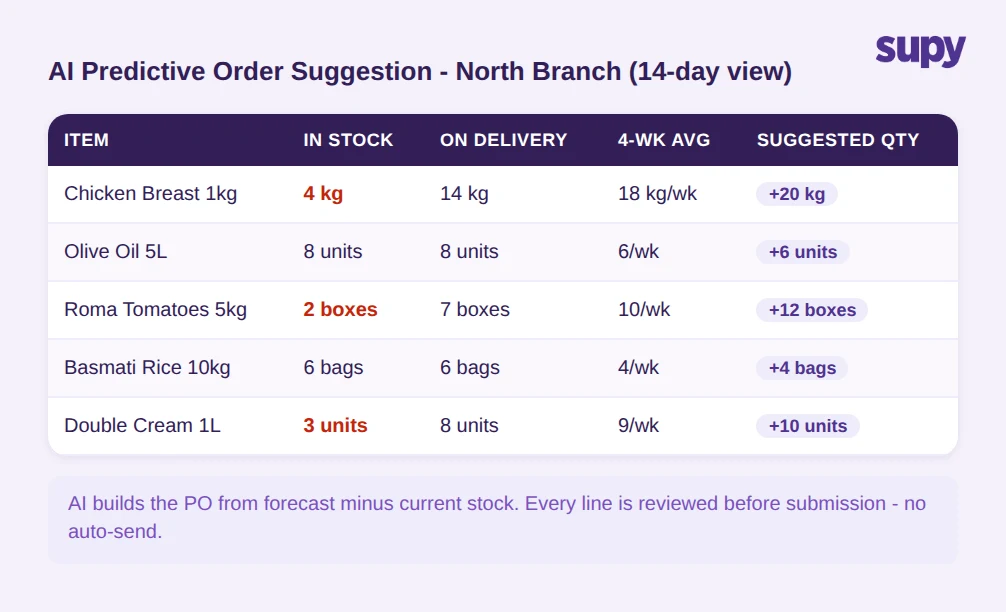
AI predictive ordering closes the gap between ordering and demand. The system builds ready-to-submit POs by running an AI sales forecast through the group's recipes and subtracting current stock. Each suggested order line shows current stock, projected stock on delivery date, last order quantity, and 4-week average usage. The AI never auto-submits - every line is reviewed before the PO is generated. This requires the AI Sales Forecasting module and produces a 14-day forward demand view.
For groups running 12 locations with different menus, seasonality, and supplier relationships, predictive ordering is the difference between reactive purchasing and a managed procurement cycle.
Restaurant procurement at scale is not an ordering problem - it is a visibility and control problem. Email and WhatsApp ordering work at a single site because the manager carries context in their head. At 5, 10, or 20 locations, that context becomes fragmented, inconsistent, and impossible to audit.
The operational cost of fragmented procurement shows up as price drift that goes undetected, budget overruns discovered too late to act on, and audit trails that cannot be reconstructed. Structured digital procurement replaces each of these failure modes with a traceable, controlled workflow from requisition to payment.
The groups that move earliest to structured procurement tend to do so after a specific event: a month-end that cannot be explained, a supplier overcharge that took 3 weeks to identify, or an invoice dispute with no documentation to support the claim. The better trigger is before any of those.