Integration
Restaurant operations

Multi-Entity Accounting for Restaurant Groups: Clean Books Per Site
Why a Restaurant Group's Books Split by Legal Entity

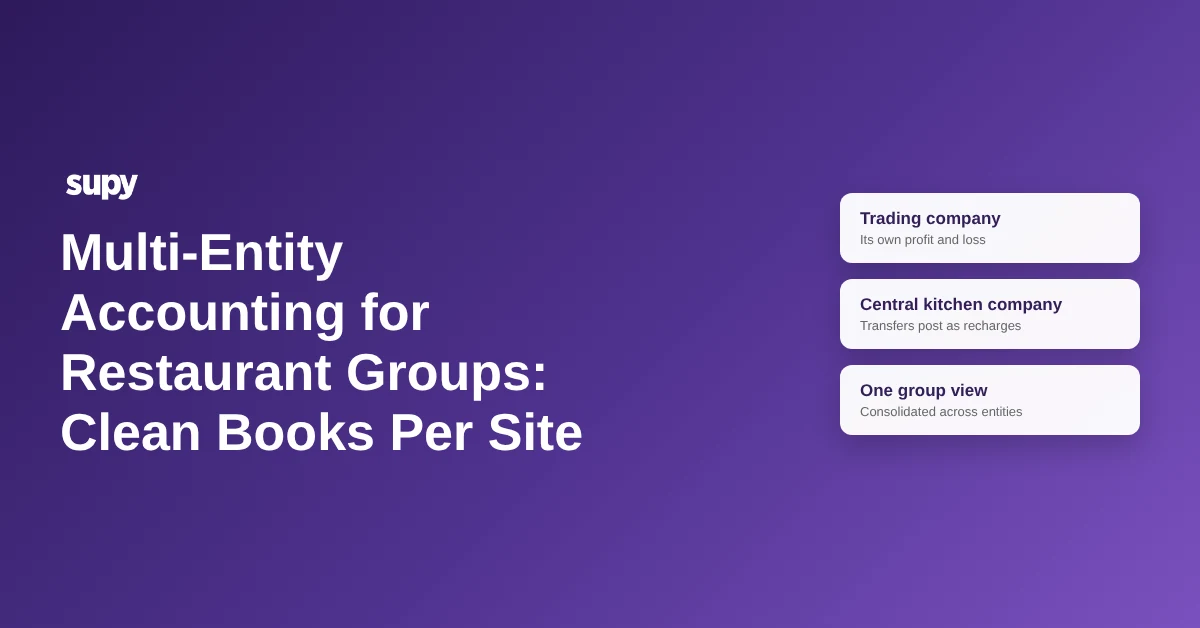
Multi-entity accounting is how a restaurant group keeps separate legal entities on one reporting structure while each entity still files its own books. Each trading company has its own profit and loss and balance sheet. Stock, invoices and sales have to land in the right one. When they do not, group reporting stops reconciling.

A group of three entities and 12 outlets shows the shape of the problem. Two trading companies hold the restaurants. A third company owns the central kitchen. The food an outlet sells started as a purchase in the central kitchen's books, moved across a legal boundary, and has to show up as a cost in the outlet's books and a sale in the kitchen's. Nothing about that is automatic once the entities are separate.

Supy maps each location to its matching entity in the connected accounting system, so a document knows which books it belongs to before anyone touches it. The group still sees one consolidated view across all three.
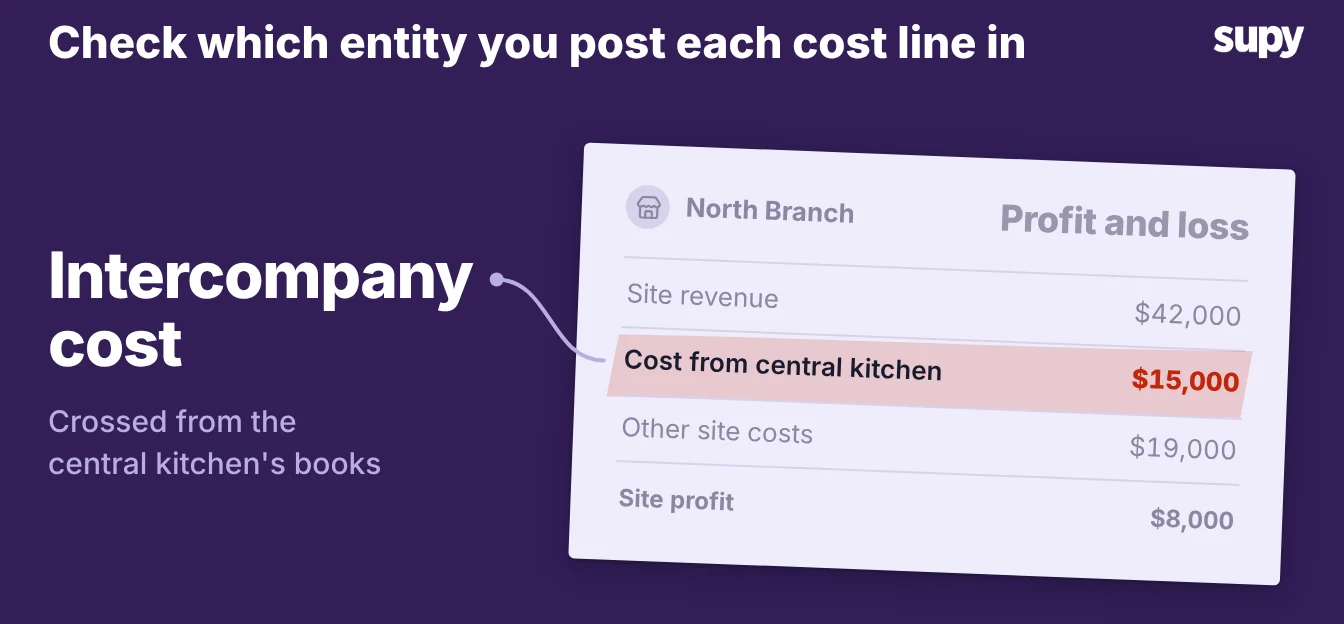
Outlet profit and loss with the intercompany cost line from the central kitchen flagged

How Two Entities Code the Same Cost Differently

The chart of accounts is the first thing to break. As a group adds branches and entities, the same cost category stops carrying the same code everywhere. One entity books packaging to one account, another books it somewhere else, and a consolidated profit and loss can no longer trust its own subtotals.

The drift is quiet. It does not throw an error. It shows up at month-end when two sites that run the same menu report different cost structures, and finance cannot tell whether that is real or a mapping mistake. A partner who onboards multi-branch groups named this as the scalability wall operators hit on standard accounting platforms.

A shared mapping fixes it at the source. Supy posts each entity's invoices and costs against one consistent account structure, so "food cost" means the same thing in every entity's ledger. The group reports on like-for-like categories instead of reconciling three different charts into one.
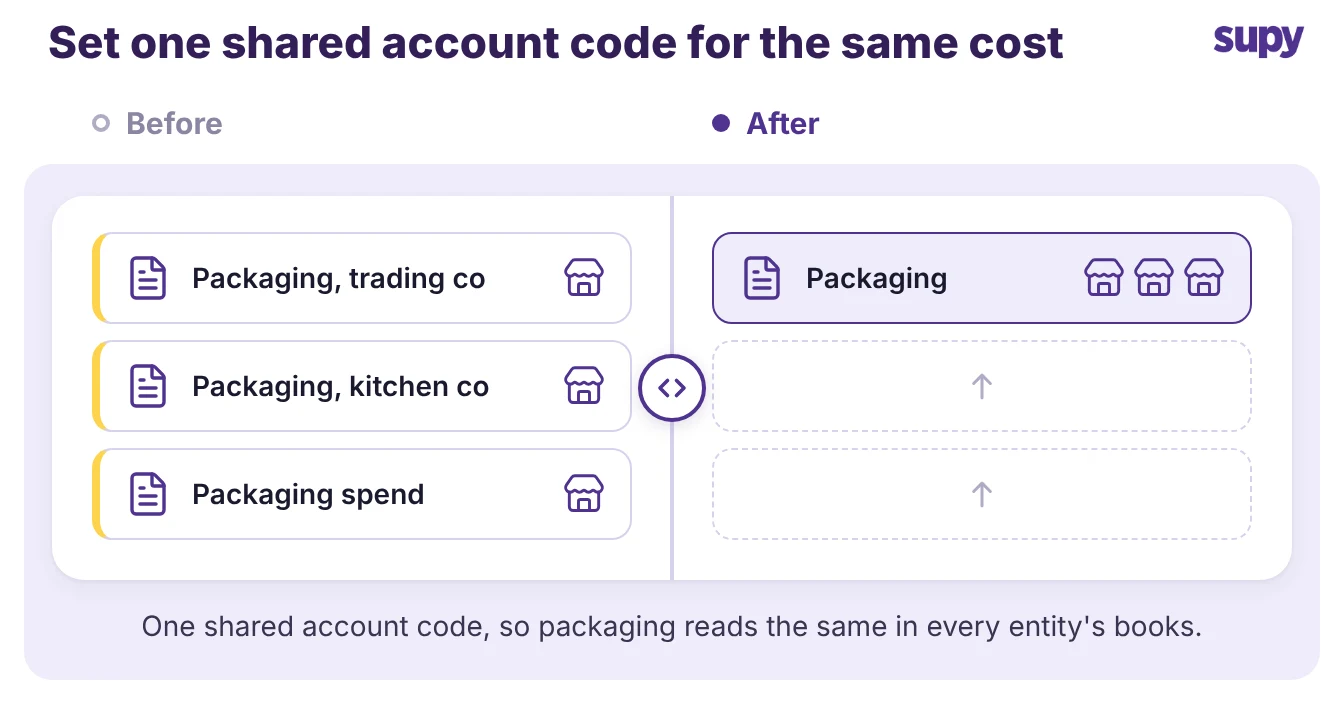
Two entity records for the same packaging cost folding into one shared account code

When a Stock Transfer Becomes a Recharge Invoice

Move stock from the central kitchen to an outlet in a separate company and you have created an intercompany transaction. It needs a recharge invoice: a cost in the receiving entity, a sale in the sending one, each on its own nominal code. A group doing dozens of these a month, re-keyed by hand, loses days of finance time and still posts errors.

In Supy, a transfer between two sites runs through three stages, raised, submitted and received, and the destination accepts it before any stock or cost moves. Because each location already maps to an entity, the transfer carries the recharge with it instead of waiting for someone to write the invoice afterwards. The sending and receiving sides stay in balance by construction.

Operators can also select many documents and post them to the connected accounting system in one action, so a month of transfers and supplier invoices clears in a batch rather than one entry at a time.
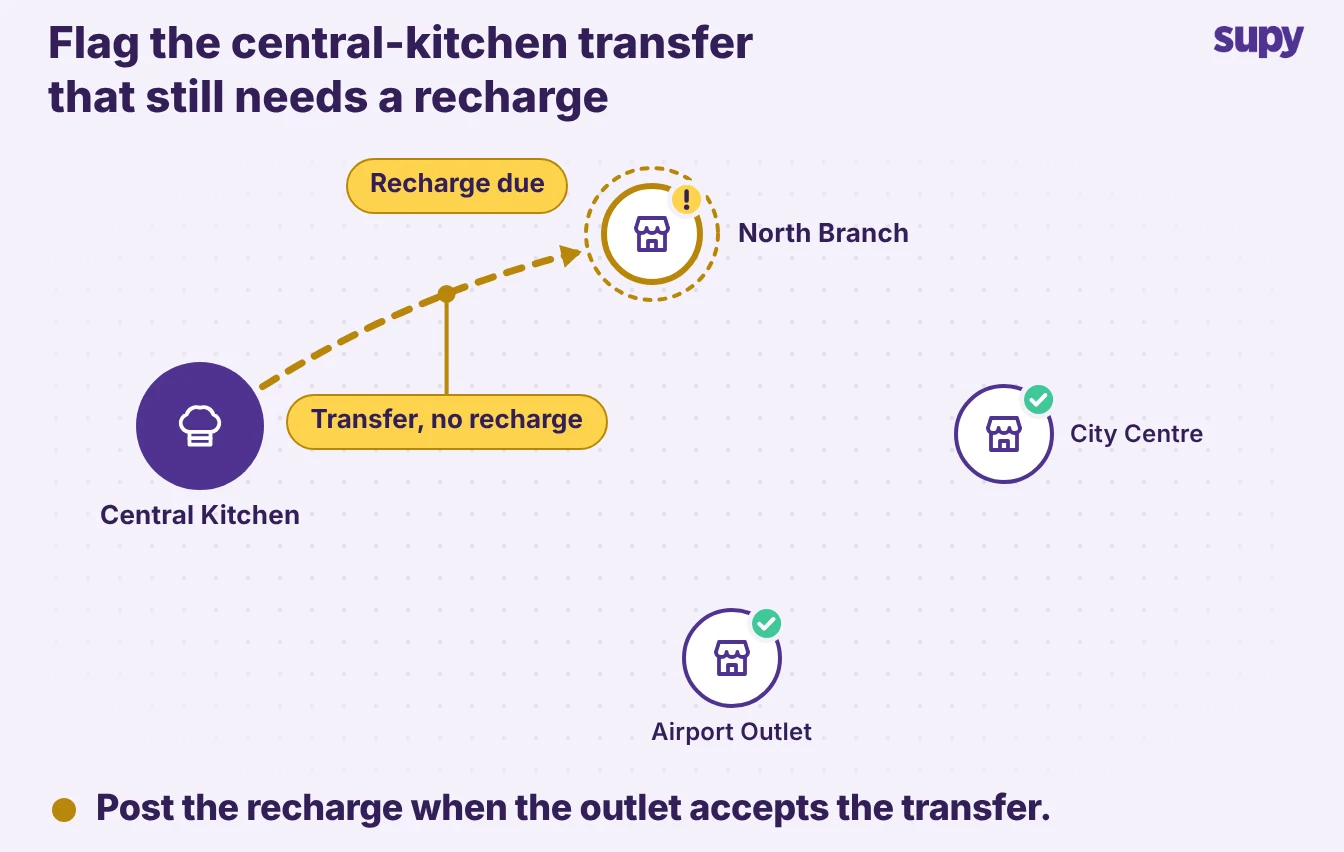
Central kitchen transfer to an outlet flagged as needing a recharge invoice

Choosing Your Structure: One Entity or Many

Not every group needs separate entities. The right structure depends on whether the legal and tax split is real or just organisational. Run the two options against your own situation before you commit, because unwinding the choice later is expensive.

CriterionSingle entity, location tagsSeparate entities, intercompany
Legal and taxOne company files onceEach entity files its own return
Transfers between sitesAn internal move, no invoiceA recharge invoice, cost and sale
Consolidation effortLow, one ledgerHigher, needs eliminations
When it fitsShared ownership, one tax registrationSeparate owners, franchises, distinct tax status

Choose a single entity with per-location tags when one company owns every site and files one return: you get per-site reporting without the intercompany overhead. Choose separate entities when the companies are genuinely distinct, by ownership, franchise, or tax registration, and accept that transfers between them are recharge invoices that have to balance and eliminate at consolidation.

Whichever branch you are in, the fix is the same first move. Map every location to its entity in the accounting system now, so invoices, transfers and sales post themselves to the right books from day one. If you already run separate entities and reconcile recharges by hand at month-end, put that mapping in place before the next close. The restaurant chart of accounts guide covers keeping the codes consistent across them. Supy connects to QuickBooks, Xero, Zoho Books, MYOB, Oracle NetSuite, Wafeq and 75+ other platforms. It shows live sync status per entity, so invoices and credit notes land where they belong without a manual pass.
Book a Demo with Supy - multi-entity accounting for restaurant groups

Ready to optimize your restaurant operations?

Blog

Our operational insights

Inventory Management Software for Restaurants: What Operators Actually Need
Inventory

Inventory Management Software for Restaurants: What Operators Actually Need

Hospitality tech

What Is Restaurant Management Software? A Full Buyer’s Guide for Multi-Site Operators

Hospitality tech
Integration
Restaurant operations

How Multi-Location Restaurants Use Software to Standardise Operations

Your questions 
answered

Everything you need to know about Supy — from setup to integrations, pricing, and daily use. If it’s not covered here, just ask.

What is multi-entity accounting for a restaurant group?
+

Multi-entity accounting keeps two or more separate legal entities on one reporting structure while each entity still files its own books. A restaurant group needs it when each site, or the central kitchen, is its own trading company with its own profit and loss and balance sheet. Stock, invoices and sales have to post to the correct entity, and the group consolidates them into one view. Without it, costs and sales land in the wrong books and group reporting stops reconciling at month-end.

When should a restaurant group run separate legal entities instead of one?
+

Run separate entities when the legal or tax split is real, not just organisational. Separate owners, franchise arrangements, or distinct tax registrations each call for an entity that files its own return. If one company owns every site and files once, a single entity with per-location tags gives you per-site reporting without the intercompany overhead. The test is whether each unit genuinely needs its own legal and tax identity. Unwinding the choice later is expensive, so decide before you set the structure up.

How do you account for stock transfers between a central kitchen and outlets in different entities?
+

Treat each transfer as an intercompany transaction: a cost in the receiving entity and a sale in the sending one, each on its own nominal code. In Supy, a transfer between two sites runs through three stages, raised, submitted and received, and the destination accepts it before any stock or cost moves. Because each location maps to an entity, the transfer carries its recharge instead of waiting for a manual invoice. The sending and receiving sides stay in balance, so month-end reconciliation shrinks.

Why does a restaurant group chart of accounts drift across entities?
+

The chart of accounts drifts because each entity codes the same cost in its own way as the group grows. One company books packaging to one account, another books it elsewhere, and a consolidated profit and loss can no longer trust its subtotals. The drift is quiet: it throws no error and shows up at month-end when two sites running the same menu report different cost structures. A shared account structure fixes it, so a category like food cost means the same thing in every entity ledger.

Can Supy post invoices and costs to the right entity automatically?
+

Yes. Supy maps each location to its matching entity in the connected accounting system, so an invoice or cost knows which books it belongs to before anyone touches it. Operators can also select many documents and post them to the accounting system in one action, clearing a month of invoices and transfers in a batch. Live sync status shows per entity whether each document has posted. That mapping is the setup step that keeps separate entities books clean without a manual pass each close.

What is an intercompany recharge invoice in a restaurant group?
+

An intercompany recharge invoice records a transaction between two legal entities in the same group. When the central kitchen in one company sends stock to an outlet in another, the kitchen raises a sale and the outlet records a cost, each on its own nominal code. The two sides must balance and then eliminate at consolidation, so the group is not double-counting. Done by hand across dozens of transfers a month, recharges cost finance days and still post errors, which is why mapping locations to entities matters.

Which accounting platforms does Supy connect to for multi-entity restaurant groups?
+

Supy connects to QuickBooks, Xero, Zoho Books, MYOB, Oracle NetSuite, Wafeq and 75+ other platforms. Each location maps to its entry in the connected system, so purchase invoices and costs push to the right entity and the group sees live sync status per entity. The connection carries documents both ways, so you post a month of invoices and transfers in one action rather than keying them in. The platform you already run usually connects, so multi-entity mapping does not mean switching your accounting software.

Ready to transform your operations?

Join 3500+ restaurant operators cutting costs, streamlining operations and making smarter decisions with Supy.