.jpg)

Using AI to Reduce Food Waste: Real Results From Multi-Site Restaurant Operators

Food waste is one of those costs that doesn’t always show up as an urgent crisis - until it silently erodes profits. For multi-site operators, this is especially true. Ingredient spoilage, over-ordering, mismatches between orders and actual covers, and disconnected inventory systems all conspire to inflate costs while teams scramble to catch up.
In 2026, five forces make food waste a strategic imperative:
- Supplier pricing volatility
- Labor limitations in executing accurate counts
- Complex menus with variable demand
- Multi-location inconsistencies
- Increased pressure on margins
Put simply: the restaurants winning in 2026 are the ones that treat food waste as a system problem, not a daily annoyance.
This guide explores how AI in restaurants, especially in forecasting, predictive ordering, and inventory automation, is transforming waste control from reactive cleanup to proactive prevention.
What “Food Waste” Really Costs: Beyond the Bin
Food waste isn’t just thrown food - it’s broken processes reflecting deeper issues:
- Over-ordering because forecasts lag actual demand
- Spoilage due to untracked par levels
- Production overshoot - especially in central kitchens
- Misalignment between recipe costing and real ingredient usage
If you'd rather not work par out by hand, the free par level calculator does it for every item on your sheet from your usage, delivery days and supplier lead times.
Each of these leaks money in a place that’s hard to see until it’s already hit the P&L.
AI-driven systems can pivot this dynamic. Instead of relying on static counts and manual judgment, AI synthesizes live data from demand signals, inventory levels, and supplier pricing to prevent waste before it happens.
Why Traditional Approaches Fail (And AI Doesn’t)
Operators have long relied on periodic inventory counts, checklists, and historical averages to anticipate waste. But in 2026, that’s no longer sufficient.
Here’s why:
- Static par levels don’t adapt to real-time demand signals.
- Manual inventory counts are slow and error-prone.
- Forecasts based on last month’s sales fail when demand shifts quickly.
- Recipe costing that isn’t live masks true usage.
By contrast, AI for restaurant forecasting and predictive ordering brings elasticity and precision to decision-making. Machine learning models can detect patterns humans miss, anticipate demand changes, and align purchasing and production accordingly.
What AI-Powered Waste Control Looks Like in Practice
In 2026, leading operators don’t treat waste as an isolated problem - they bake waste prevention into the BOH workflow:
1. Predictive Ordering
AI models interpret historical and real-time sales patterns, weather impacts, channel mix, and event calendars to forecast demand with precision.
This leads to ordering plans that minimize overstock and reduce excess inventory.
Business impact:
- Fewer perishable goods expiring before use
- Less reactive discounting or waste dumping
2. Inventory + Procurement Automation
When inventory counts are updated automatically - and tied directly to forecasts and ordering - you get discipline instead of guesswork.
Benefits include:
- Accurate stock levels by location
- Automated suggested orders based on expected covers
- Reduced manual stock counting errors
These are core functions of inventory + procurement automation and ai stock counting.
3. Recipe Costing That Matches Reality
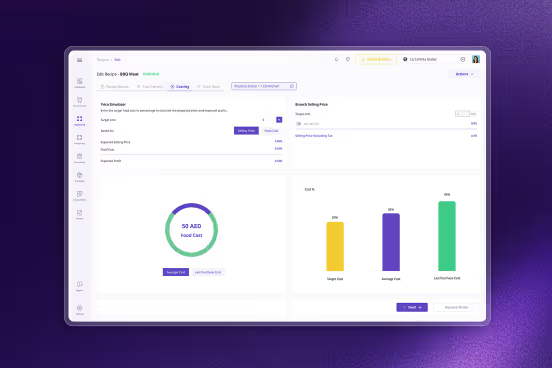
Recipe costing that updates in real time - tied to live supplier prices and usage trends - closes the loop between production and consumption.
This means you stop cooking for what you think demand will be and start cooking for what the data predicts.
A Practical AI-Driven Framework to Reduce Waste
Here’s how multi-site operators are building repeatable, scalable food-waste prevention systems.
Step 1 - Start With Clean Inputs
Too often, forecasting models are fed dirty data. Begin by ensuring:
- Invoices are digitised
- Line items are structured
- Inventory units and pack sizes are accurate
- Supplier pricing is validated
Without clean inputs, even the best AI models will mislead.
Step 2 - Build Real-Time Visibility Dashboards
Real-time reporting dashboards turn data into signals. Instead of reacting when variance shows up in a monthly report, operators see:
- live inventory disparities
- projected waste based on current stock vs forecast
- location-level demand mismatches
These dashboards are core to restaurant operations software and help teams act early.
Step 3 - Automate Forecast-to-Order Workflows
Once demand signals are clear, link forecasting to ordering:
- Predictive ordering triggers suggested POs
- Forecast accuracy reduces over-forecasting
- Par levels adapt dynamically to real demand
AI models don’t replace judgment - they augment it.
Step 4 - Close the Loop With Live Costing
Live costing feeds back actual usage and price changes into both forecasting and menu planning.
This is where ai recipe costing and ai menu engineering deliver compounded value - reducing waste and improving profit margins simultaneously.
Multi-Location and Central Kitchen Strategies
Operators with multiple outlets or central kitchens face unique waste challenges.
- Multi-Location Management Tools
Across outlets, inconsistent practices create blind spots. AI frameworks standardise:
- forecast comparisons
- inventory deviation alerts
- supply misalignment across geography
This is where multi-location management tools and franchise management tools keep leaders in control.
- Central Kitchen Software
For production kitchens feeding multiple branches, AI can:
- Predict batch quantities more accurately
- Schedule production against forecast peaks
- Reduce distribution waste
This ties directly into central kitchen software, production planning software, and batch cooking management.
Where Supy Helps Operators Reduce Waste - Without Extra Work
Supy fits naturally into every part of this waste-reduction framework - not as an add-on tool, but as a foundational system that feeds the data modern AI models depend on.
Here’s how Supy drives real results:
Clean, Structured Cost and Inventory Inputs: Supy’s invoice scanning AI and supplier invoice processing capture all costs accurately at the source.
Real-Time Visibility Across Locations: Verified cost data flows into real-time reporting dashboards, making variance visible long before it becomes waste.
Supports AI Forecasting and Ordering: When cost and inventory data are clean, AI forecasting and predictive ordering become more accurate - reducing overstock and spoilage.
Recipe Costing That Informs Waste Prevention: By keeping recipe costs linked to real usage and current pricing, Supy’s data foundation improves AI recipe costing and AI menu engineering accuracy.
See how Supy can help reduce waste and tighten cost control: https://supy.io/product-features/wastage-recording
Final Thoughts
Waste Is a Signal, Not a Symptom. In 2026, food waste isn’t an afterthought - it’s a signal that your systems aren’t aligned.
Operators who prevent waste early do so with:
- clean data inputs
- real-time visibility
- AI-augmented forecasting
- automated inventory and procurement
- live costing feedback loops
When these systems work together, waste shrinks - and margins grow.