.jpg)

Inventory Management Systems for Restaurants: When POS-Only and Generic ERP Fail Multi-Site Groups
Why POS Systems Cannot Deliver Supply Inventory Management for Multi-Site Groups
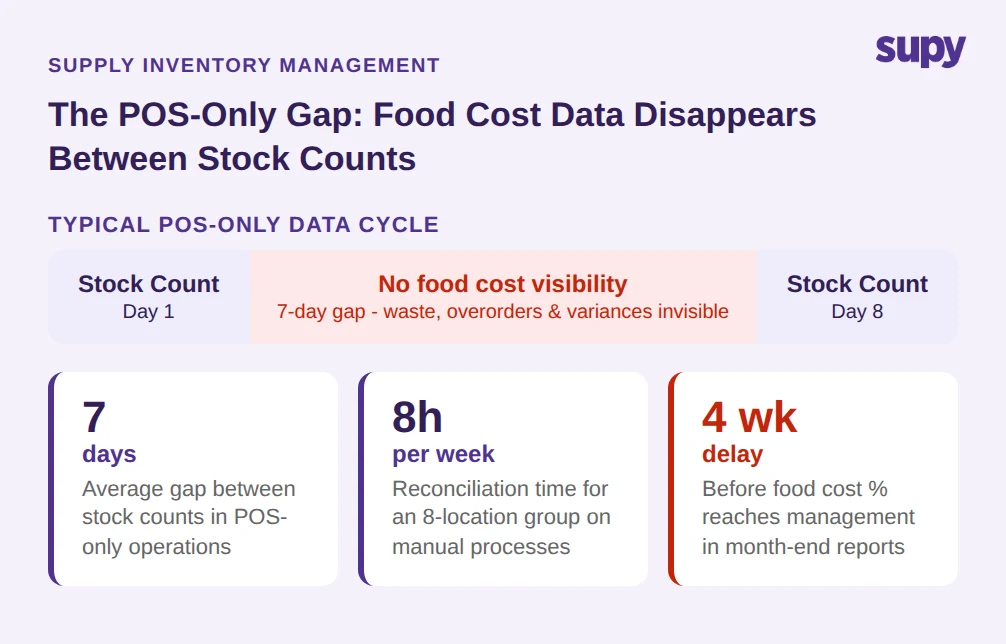
A POS system tells you what sold. It does not tell you what it cost to make, what was wasted, or how much stock remains. For a single-site operator running on tight margins, those gaps are painful. For a multi-site group, they compound per branch.
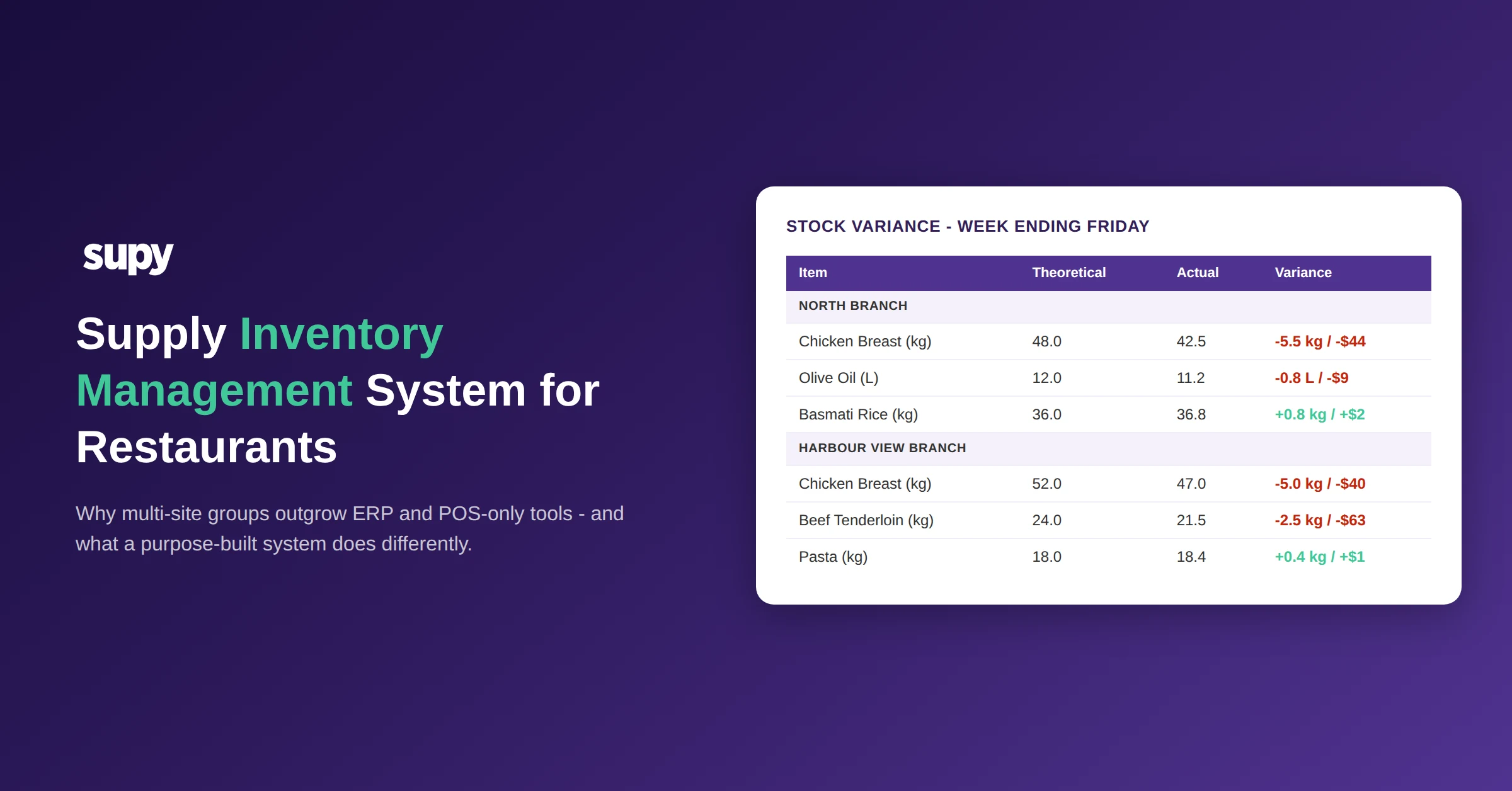
Operators using POS-only setups typically see their food cost percentage once a month, when the accounts team compiles purchase invoices against sales figures. That number is already 4 weeks old by the time anyone acts on it. The variance sitting inside it - over-ordering in one branch, spoilage in another, a recipe portion that changed - has no traceable source.
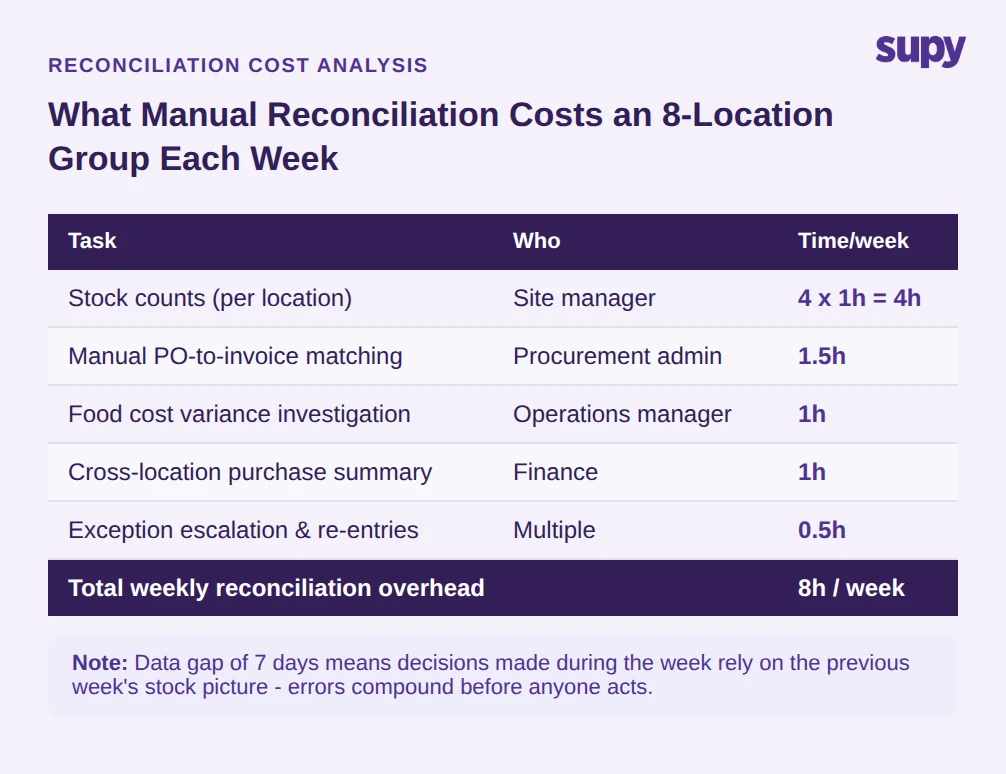
Fixing this with a POS-only stack means building manual bridges: weekly inventory counts entered into spreadsheets, purchase records exported from the supplier's portal, invoice data keyed into an accounting system. One operator managing 8 locations reported that stock counting and reconciliation alone consumed 8 hours of management time per week, with data gaps of 7 days between each count.
A supply inventory management system built for restaurants removes this gap by connecting what is ordered, what is received, what is used, and what remains into a single, real-time view.
Why Generic ERP Tools Cannot Handle F&B Inventory: The Customisation Trap
Many multi-location restaurant groups reach a point where spreadsheets clearly are not working and start looking at ERP systems. The pitch is compelling - a single system across finance, procurement, and operations. The reality for F&B operators is more complicated.
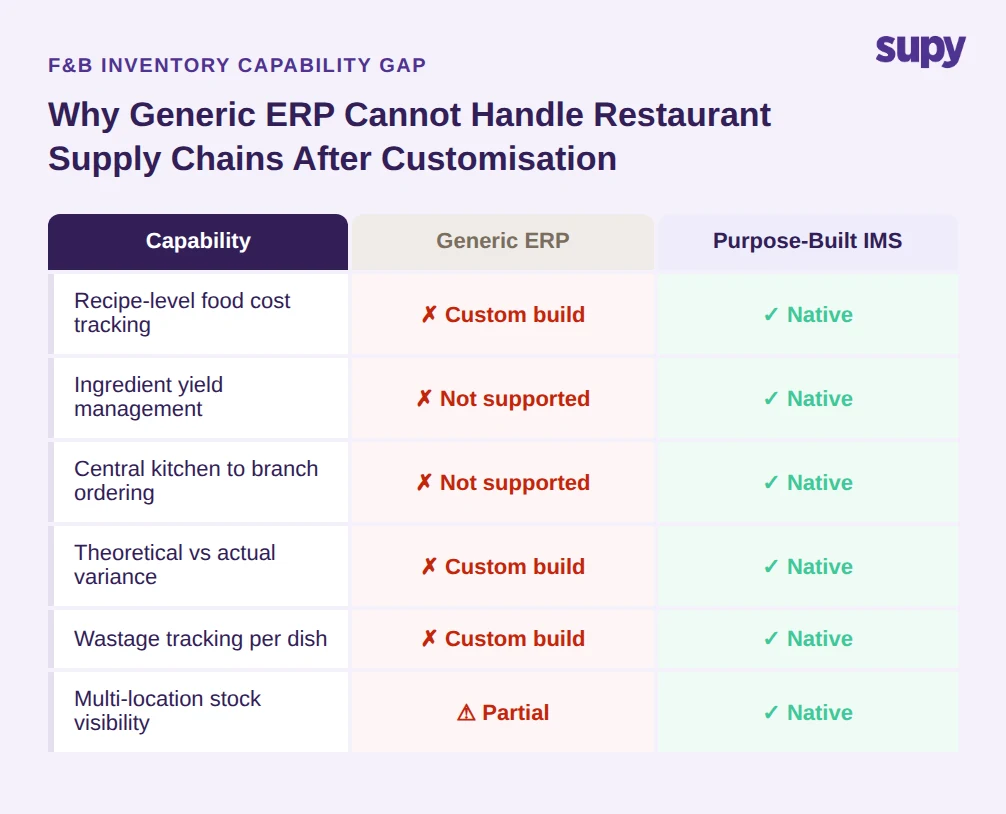
Generic ERP tools are designed for manufacturing, retail, or distribution businesses where inventory is counted in units and SKUs, not recipes, yields, and prep batches. A restaurant has sub-recipes, ingredient yields that change by supplier batch, multiple packaging formats for the same ingredient, and cost-per-dish calculations that depend on which prep recipe was used. Most ERP systems require significant customisation to handle any of these correctly.
That customisation is expensive and slow. One 8-location casual dining group found that even after extensive ERP customisation, the system still could not handle central-store-to-branch inventory tracking, food cost variances at the recipe level, or wastage management. The customisation had solved the accounting problem but not the operations problem.
The gap is not a failing of the ERP vendor. It is a category mismatch. Supply inventory management for restaurants requires logic that is native to F&B: theoretical versus actual usage, recipe-level cost tracking, POS sales integration that depletes ingredients automatically, and commissary ordering workflows. Adding that logic to a generic ERP is a customisation project that never quite finishes.
The Central Kitchen Ordering Problem: Branches That Cannot Place Internal Orders
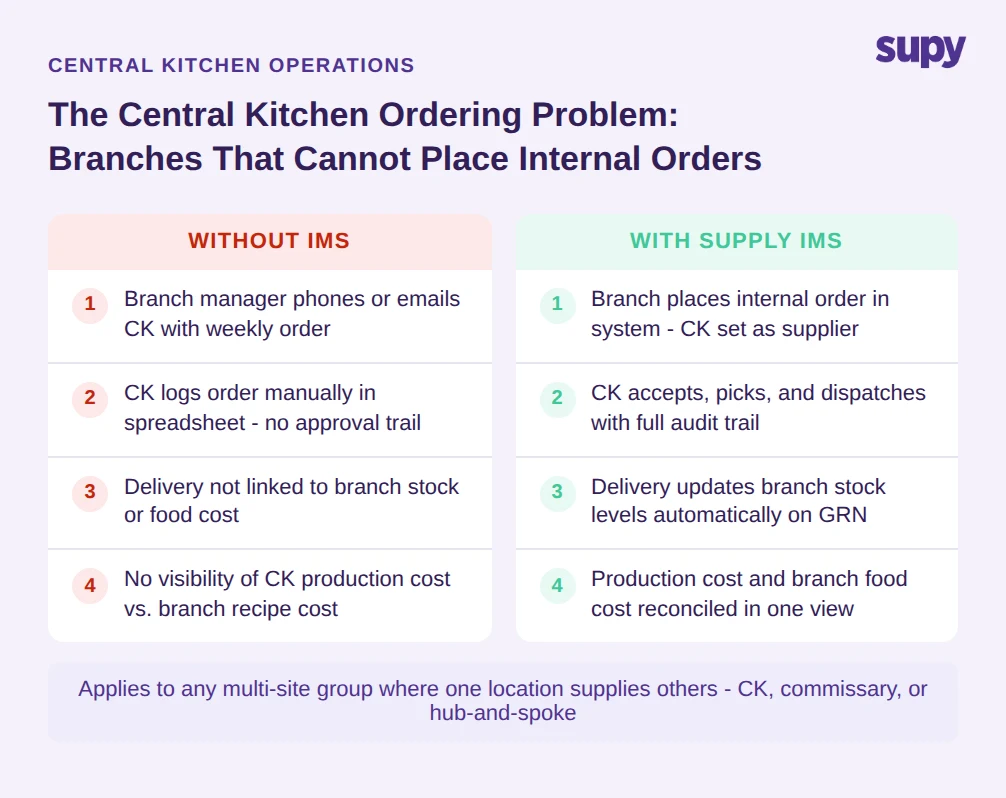
Restaurant groups that run a central kitchen or commissary as an internal supplier face a supply chain problem that most generic tools cannot handle at all.
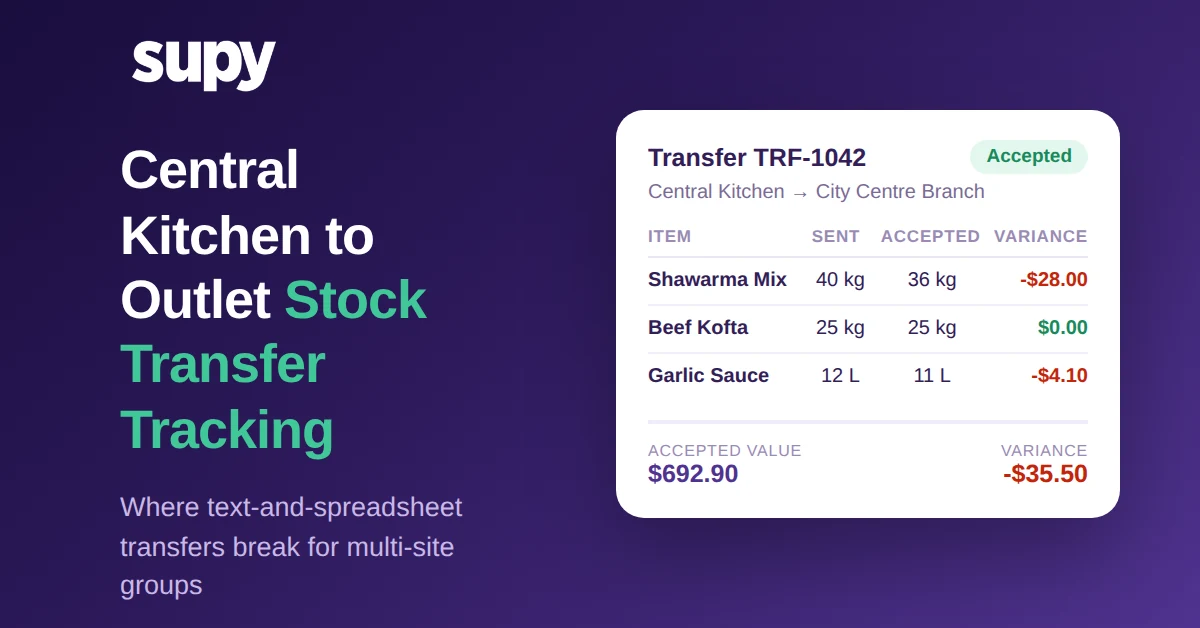
In a typical setup, branches need to order from the central kitchen the same way they order from external suppliers: specifying items, quantities, and delivery dates, then receiving those items with a delivery note and a cost allocation. The central kitchen needs to see consolidated demand across all branches before producing, to avoid batch inefficiency.
Without a purpose-built system, this flow usually happens over phone calls or shared spreadsheets. The central kitchen has no real-time view of what branches need. Branches have no reliable way to track whether their internal order has been filled. Stock movements between central kitchen and branch do not appear in either location's inventory automatically.
One multi-location restaurant and catering group found that their accounting software was not connected to their POS or inventory system, which meant that every internal transfer between commissary and branch required manual reconciliation. Procurement was happening in one system, inventory was being tracked separately, and the integration between them was a person copying numbers from one place to another.
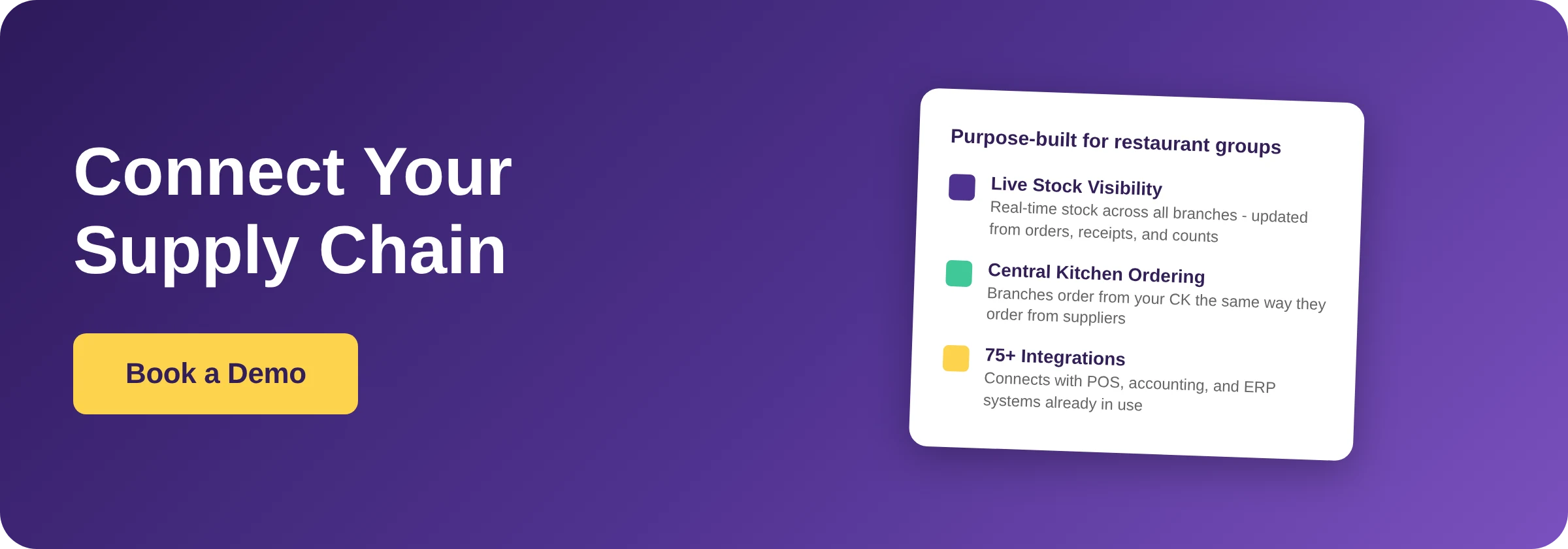
A supply inventory management system designed for this structure lets branches raise internal purchase orders to the central kitchen, lets the central kitchen confirm, ship, and generate delivery notes, and updates stock levels at both ends automatically - with full audit trail.
What Manual Reconciliation Actually Costs a Multi-Site Restaurant Group
The hidden cost of a disconnected supply chain is not just the time spent on manual reconciliation. It is the decisions that get made on data that is already wrong.
When a purchasing manager places next week's orders using a stock count from last Tuesday, they are working with 7 days of consumption, waste, and transfers that are not reflected in the number they are looking at. In a multi-site operation, this uncertainty compounds: 8 hours of management time per week spent reconciling purchase records against physical counts, with no guarantee that the count itself was accurate.
The cost shows up in over-ordering (cash tied up in excess stock), under-ordering (lost revenue from 86'd dishes), and in food cost percentages that can only be investigated after month-end close. By then, the purchasing decisions that caused the variance are already 30 days in the past.
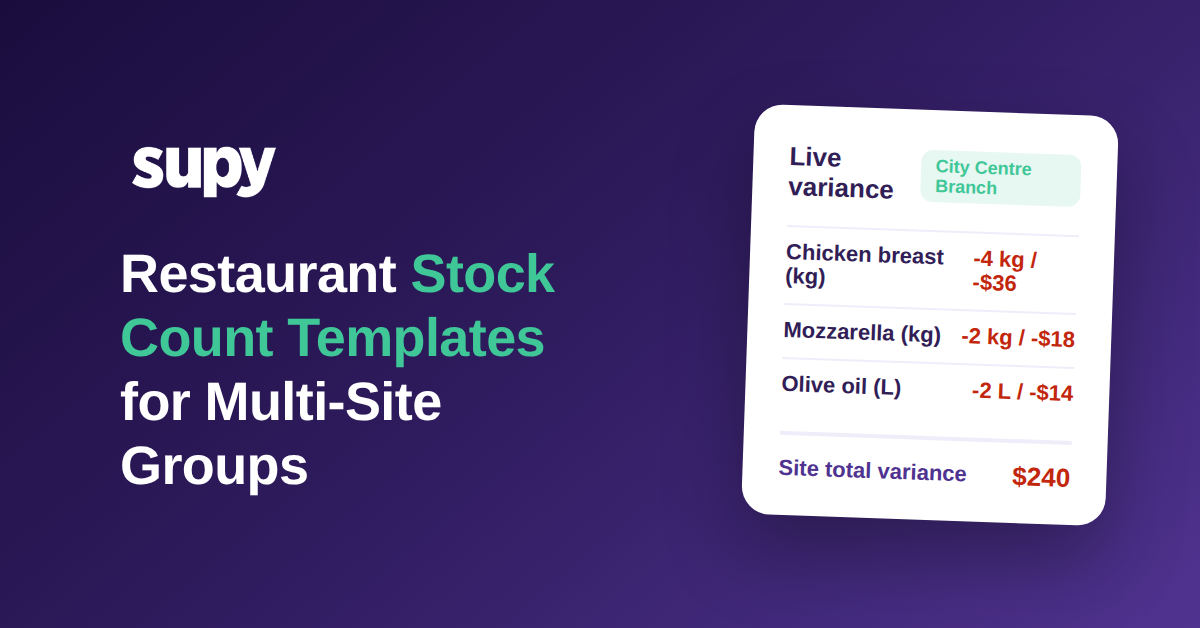
The numbers do not resolve until a system links procurement, receiving, recipe-level usage, and physical counts into one continuous ledger. At that point, reconciliation stops being a weekly management task. Stock counts take more than 50% less time, and variances are visible within hours of a count rather than weeks after.
What a Purpose-Built Supply Inventory Management System Does Differently
The operational difference between a generic ERP and a purpose-built restaurant supply inventory management system is not feature count - it is native logic.
A system built for restaurant supply chains handles the workflows that generic tools require months of customisation to approximate:
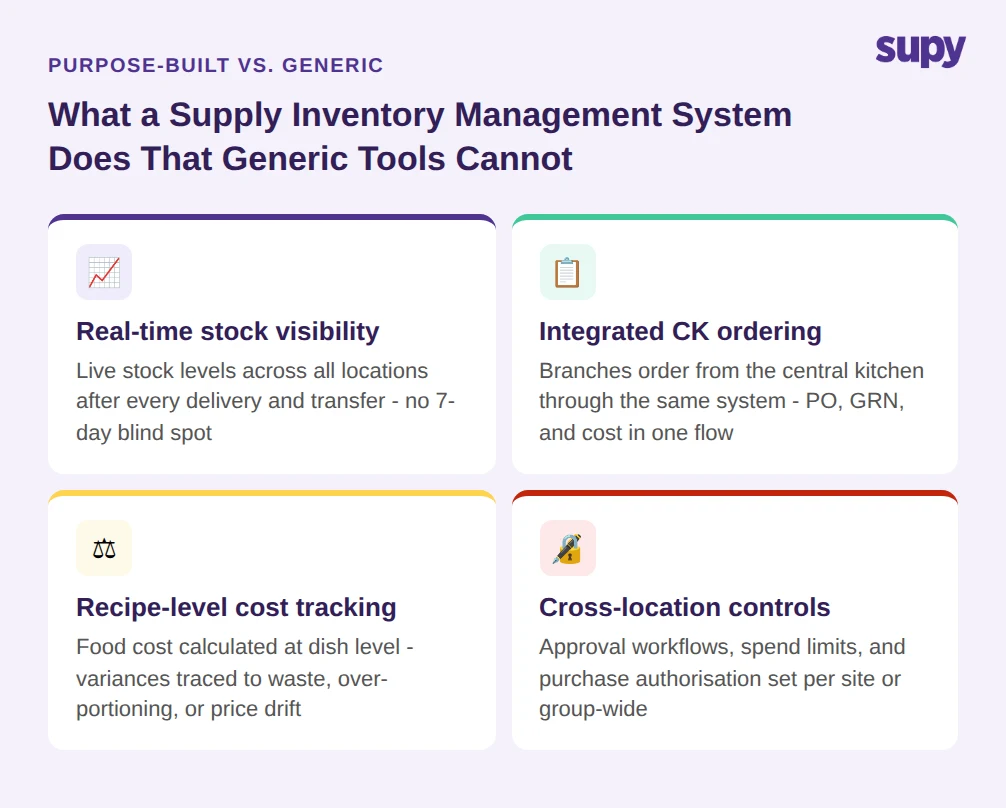
Real-time stock visibility. Live stock-on-hand by location, updated automatically when purchase orders are received, when recipes are prepared, and when wastage is logged. No waiting for a weekly count to see what each branch actually has.
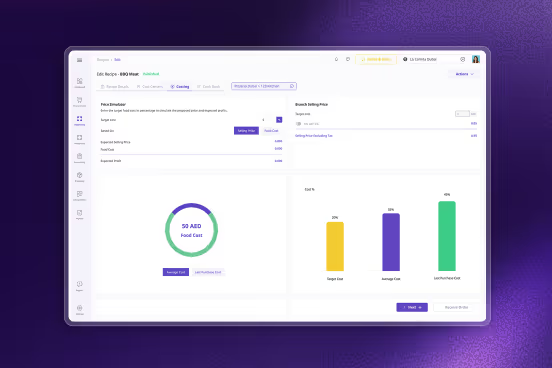
Recipe-level cost tracking. Food cost calculated at the dish level, not just the purchase invoice level. When an ingredient price changes on a goods received note, the recipe cost updates immediately.
Central kitchen as internal supplier. Branches raise purchase orders to the central kitchen, which can confirm, ship, and generate delivery notes. Stock moves between locations with automatic cost allocation and audit trail. For groups with external B2B clients, a dedicated supplier-facing ordering portal keeps internal and external flows separate.
Integrated ordering and receiving. Purchase orders sent directly to suppliers by email or via integration; delivery matching against the purchase order; price discrepancy flags raised at the point of receiving rather than discovered at month-end.
Cross-location procurement controls. Orders approved through sequential approver chains - up to 5 levels - triggered by value thresholds. Spending policies enforce per-branch, per-supplier, or per-category limits automatically, with 200+ customisable permission settings.
This is what more than 50% reduction in stock counting time and real-time food cost visibility looks like in practice - not as a feature list, but as a change in what a management team can actually see and act on.
For a broader look at the software category, see the guide to restaurant inventory software.
How to tell if your current setup is failing
Three questions that surface a supply inventory management gap in any multi-site restaurant group:
1. How many days between a stock count and seeing its results in a food cost report? If the answer is more than 24 hours, the reporting loop is broken.
2. Can a branch manager place an internal order to the central kitchen through the same system used for external suppliers? If the answer is no, commissary ordering is happening outside the system.
3. When a goods received note price differs from the purchase order price, how is that discrepancy flagged? If the answer is "at month-end" or "it is not," price variances are accumulating undetected.
If two or three of these are true, the gap is not a process problem - it is a system problem. A purpose-built supply inventory management system closes all three gaps by design.
Supy is a back-of-house operations platform built for multi-site restaurant groups, with a supply inventory management system that connects procurement, receiving, stock counting, recipe costing, and central kitchen workflows in one place. It connects with 75+ POS, accounting, and ERP systems - including the ones most multi-location groups already run.