.jpg)


Standing Orders vs Predictive Ordering: When Fixed Weekly Orders Stop Matching Your Restaurant's Demand
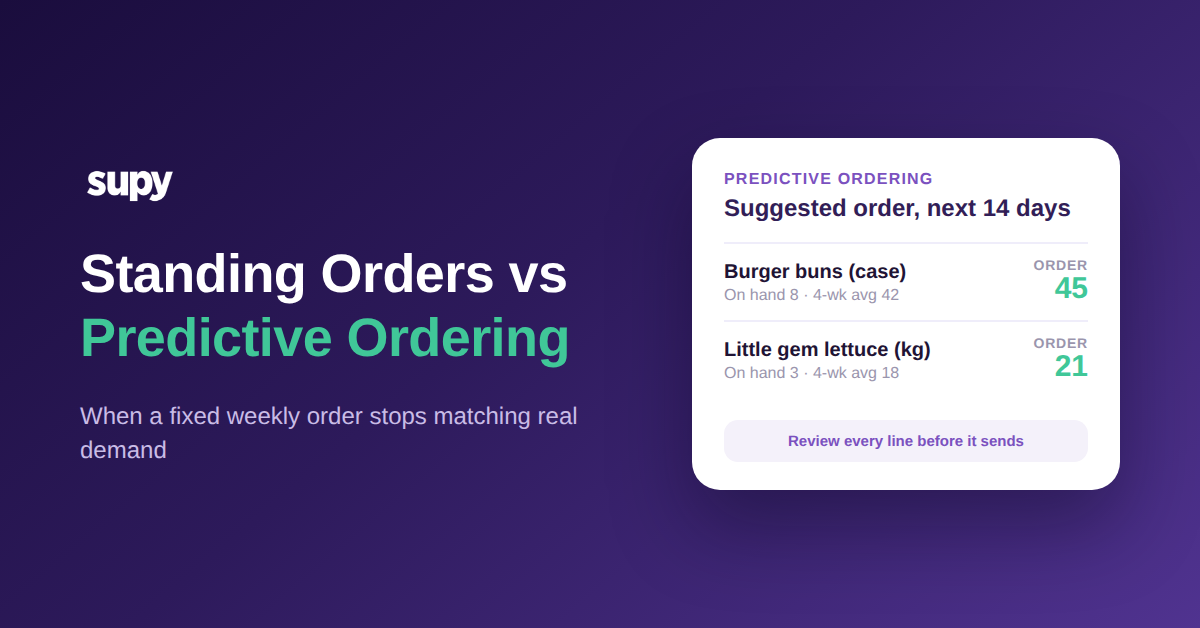
Standing Orders vs Predictive Ordering: The Core Trade-Off
A standing order is a fixed, recurring purchase: the same items and quantities sent to a supplier on a set schedule, week after week. Predictive or demand-based ordering matches each order to a forecast of what you will actually sell. Standing orders trade accuracy for speed and predictability; predictive ordering trades a little setup work for orders that flex with real demand.

Neither one is the right answer for a whole order guide. The mistake most groups make is picking a side. A busy multi-site operation runs both at once: standing orders on the items where demand barely moves, and forecast-driven ordering on the items where it swings. The decision is not which tool, it is which items belong on which model, and that is what the rest of this comparison works through.
The reason the choice matters is money and labour. Get it wrong toward standing orders and you over-buy in slow weeks and run short in busy ones. Get it wrong toward predictive ordering and you spend effort forecasting items that never needed it. The two approaches fail in opposite directions, so the point is to match each item to the model that fits how its demand behaves.
Where a Fixed Weekly Order Stops Matching Demand
A standing order stops matching demand the moment this week's sales stop looking like last week's. The order was set once and keeps firing the same quantity regardless of the forecast, so the gap between what you ordered and what you sold widens every time demand moves.
One five-site burger group locked its patty and bun quantities every Friday for the following week, regardless of that week's sales outlook. The order never flexed. Take a single branch with a locked weekly order of 40 cases of buns. Over a month, real demand came in at 38, 29, 45, and 54 cases. In the slow week the branch was 11 cases over: at $18 a case that is $198 of buns tied up or thrown out in one week, at one branch. In the promo week it was 14 cases short and staff scrambled to source substitutes.

That fragility gets worse when supply is unreliable. In one multi-site fine-dining group, roughly half of supplier deliveries arrived late, which makes a purely fixed cadence harder to plan around: when a scheduled delivery slips, a locked order gives you no room to adjust. A fixed quantity assumes a stable world, and a multi-site operation rarely has one.
When a Standing Order Is Still the Right Call
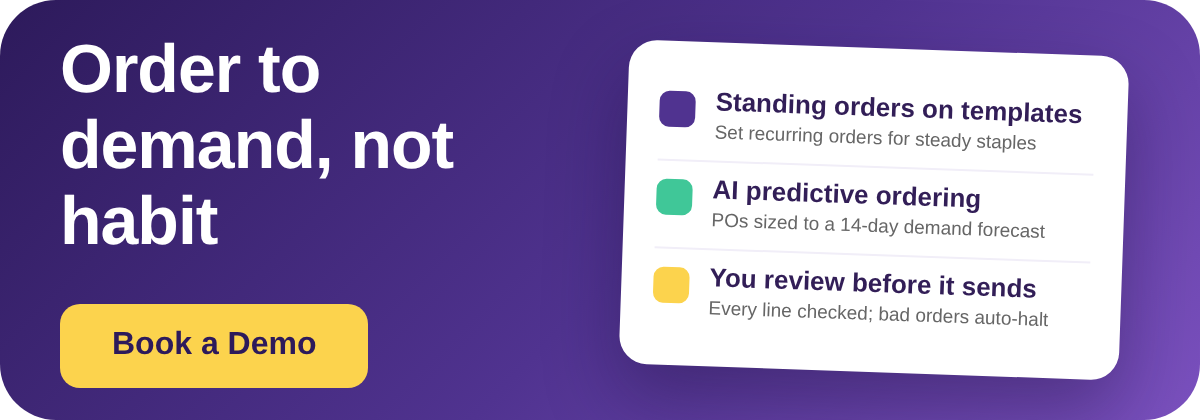
For the right items, a standing order is the better tool, not a compromise. High-frequency staples with steady, predictable demand are exactly where a fixed recurring order earns its place. Operators repeatedly ask for order templates that go to suppliers automatically on a set schedule for these items, because forecasting something that barely moves is wasted effort.
Think of the items whose weekly volume is close to flat: buns and napkins at a burger counter, house cooking oil, takeaway packaging, cleaning chemicals. Demand for these tracks covers, not menu mix or promotions, so a fixed weekly or fortnightly order is both accurate enough and far faster to run than a forecast. Supy's standing orders are built on templates that repeat on a weekly, monthly, or every-few-days schedule for precisely this pattern.

A fixed cadence does carry one risk: firing an order that no longer makes sense. Supy guards against the worst version of it. If a scheduled standing order cannot be fulfilled, for example because there are no active items for that supplier, it is automatically halted rather than sending a bad order, and you can pause and resume a standing order without losing the setup. That keeps the time-saving of a fixed schedule without the classic failure of a recurring order quietly sending the wrong thing.
What Predictive Ordering Needs Before It Works
Predictive ordering is not a switch you flip on day one. It needs history and structure first, and being honest about that is the difference between a forecast you trust and one you override every morning. Supy's AI predictive ordering builds ready-to-submit purchase orders from a sales forecast run through your recipes, minus current stock, and it depends on AI sales forecasting underneath it.
The prerequisites are concrete. The forecast needs at least 6 months of uninterrupted POS data, with every menu item mapped to a recipe so the model can translate predicted dishes into predicted ingredients. It runs on a daily POS sync (Supy connects to 75+ integrations for this), forecasts daily sales per branch 14 days out, and shows each prediction against an 8-week historical average so you can see when it is drifting. With that foundation in place, one multi-site QSR brand reached under 10% forecast-vs-actual variance.

The payoff is an order sized to demand instead of habit: for each line you see current stock, projected stock on delivery, the last order quantity, and the 4-week average, then a recommended quantity. It never auto-sends. You review every line before it goes to the supplier, which is the safeguard that keeps a forecast from becoming an expensive mistake at scale. Predictive ordering wins where demand is variable or seasonal and where items are fresh or perishable, the exact conditions that break a fixed order.
How to Split Your Order Guide Between the Two
The clean way to decide is to sort each item on two questions: how predictable is its demand, and how forgiving is its shelf life. Stable demand plus a long shelf life is standing-order territory. Volatile demand plus a short shelf life is where forecast-driven ordering pays for itself. The two axes sort most order guides in an afternoon.
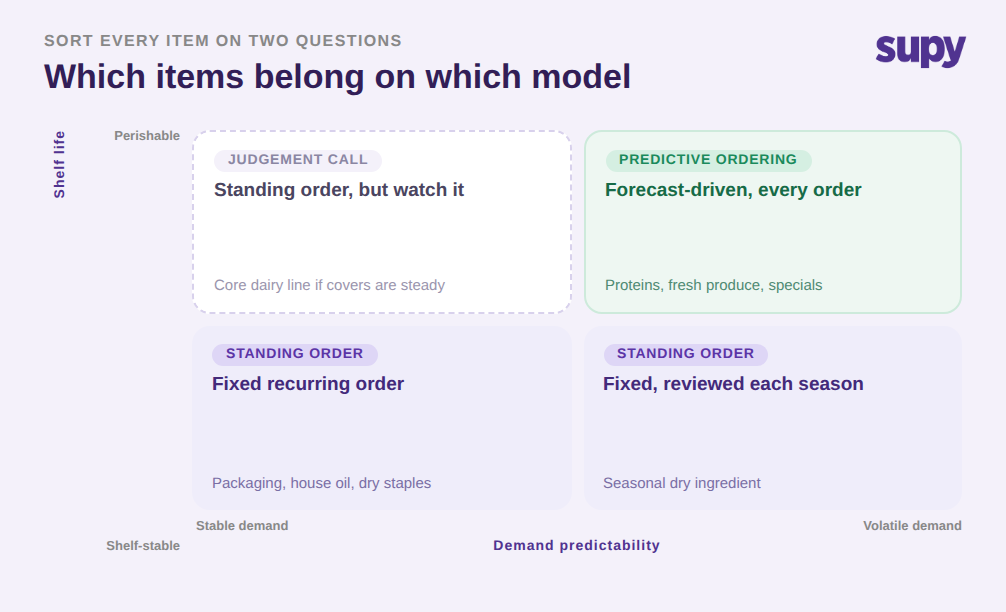
Stable and shelf-stable, such as packaging, oil, and dry staples, goes on standing orders: the demand does not move enough to forecast, and nothing spoils if you are slightly over. Volatile but shelf-stable, such as a seasonal dry ingredient, can stay on a standing order that you review each season rather than each week. Stable but perishable, such as a core dairy line, is a judgement call: a standing order works if your covers are steady, but watch it. Volatile and perishable, such as proteins, produce, and specials ingredients, belongs on predictive ordering, because that is exactly where a locked quantity leaks the most money.
So the rule is simple. Choose a standing order when demand is steady and the item forgives a small surplus, because the speed is worth more than the last few percent of accuracy. Choose predictive ordering when demand swings or the item is perishable, because the cost of being wrong, either surplus waste or a stockout mid-service, is higher than the effort of forecasting. Run both, review your standing orders whenever your menu or covers shift, and move any item that starts drifting onto the forecast. Start by pulling your top 20 items by spend and sorting them on those two axes: the ones in the volatile-and-perishable corner are where fixing the model pays back first.