.jpg)


Restaurant Group Consolidated Purchase Orders: How Multi-Location Operators Replace Site-by-Site Ordering
What Consolidated Purchase Orders Mean for a Restaurant Group
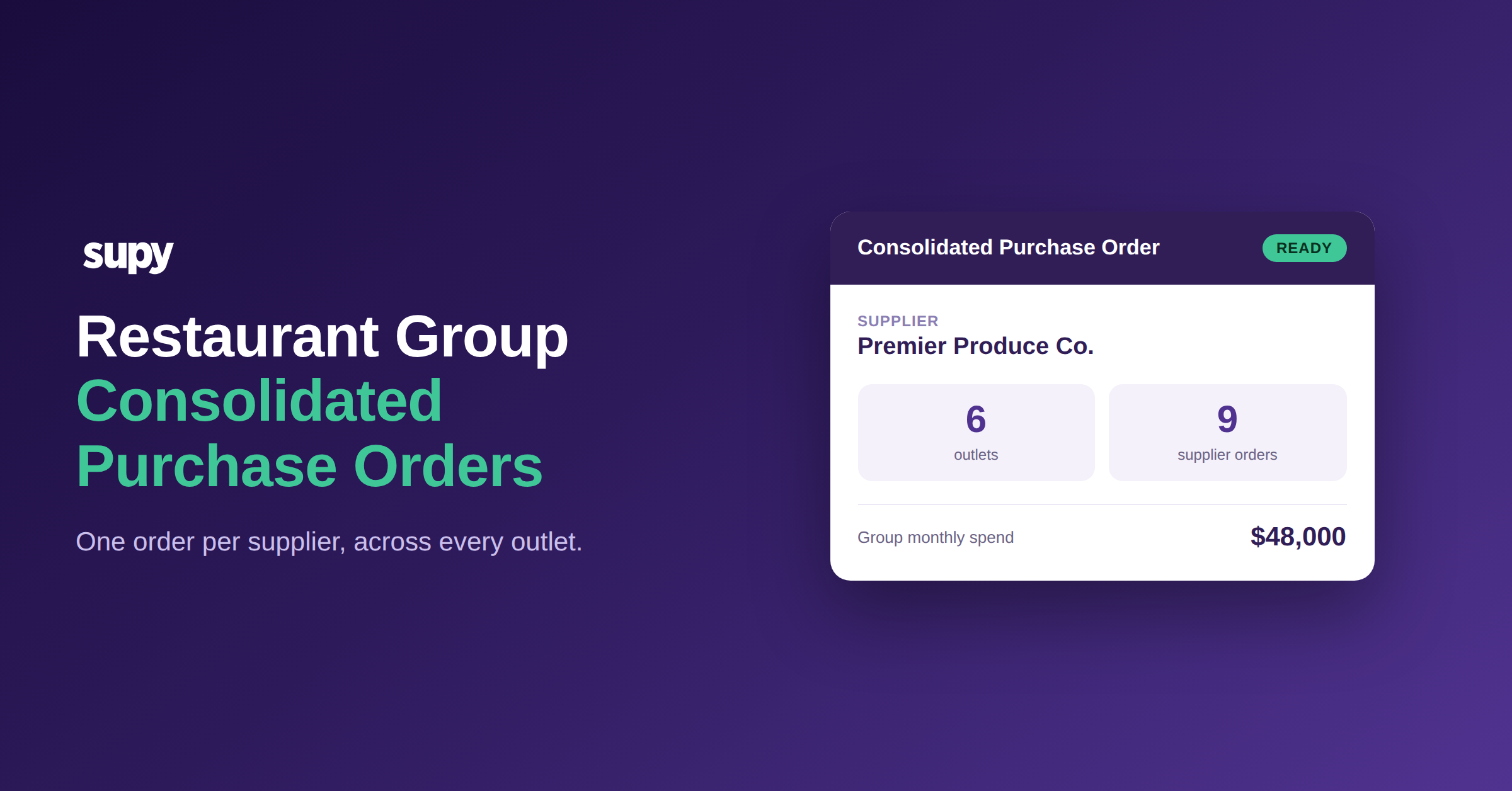
A restaurant group that runs consolidated purchase orders can do something a single-site operation never has to think about: it can see what every outlet needs before a single order goes out, then turn that combined demand into one clean order per supplier. Instead of each branch logging in, building its own basket, and sending its own purchase order, a procurement manager works from one consolidated procurement view that already holds the pending demand from all 6 outlets in the group.
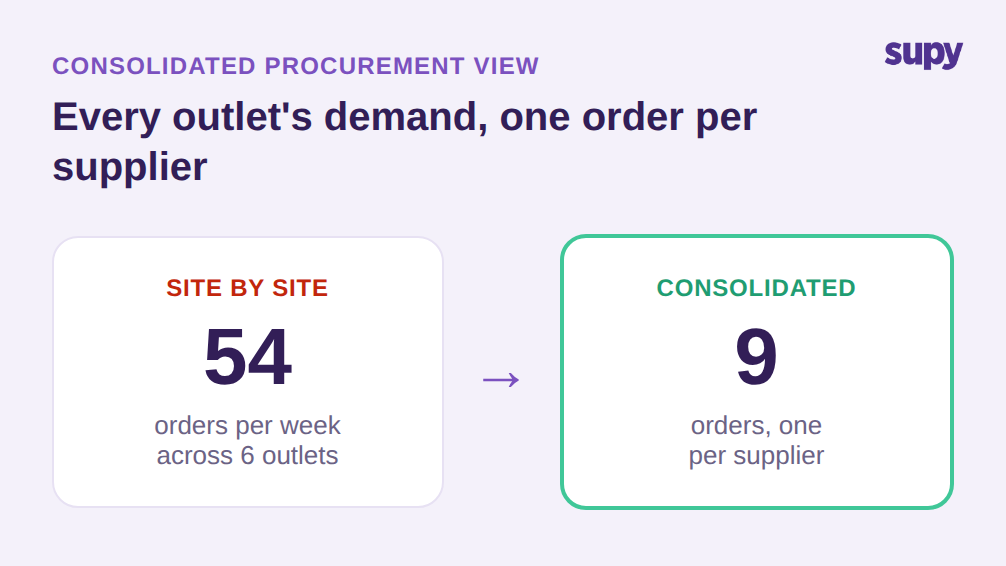
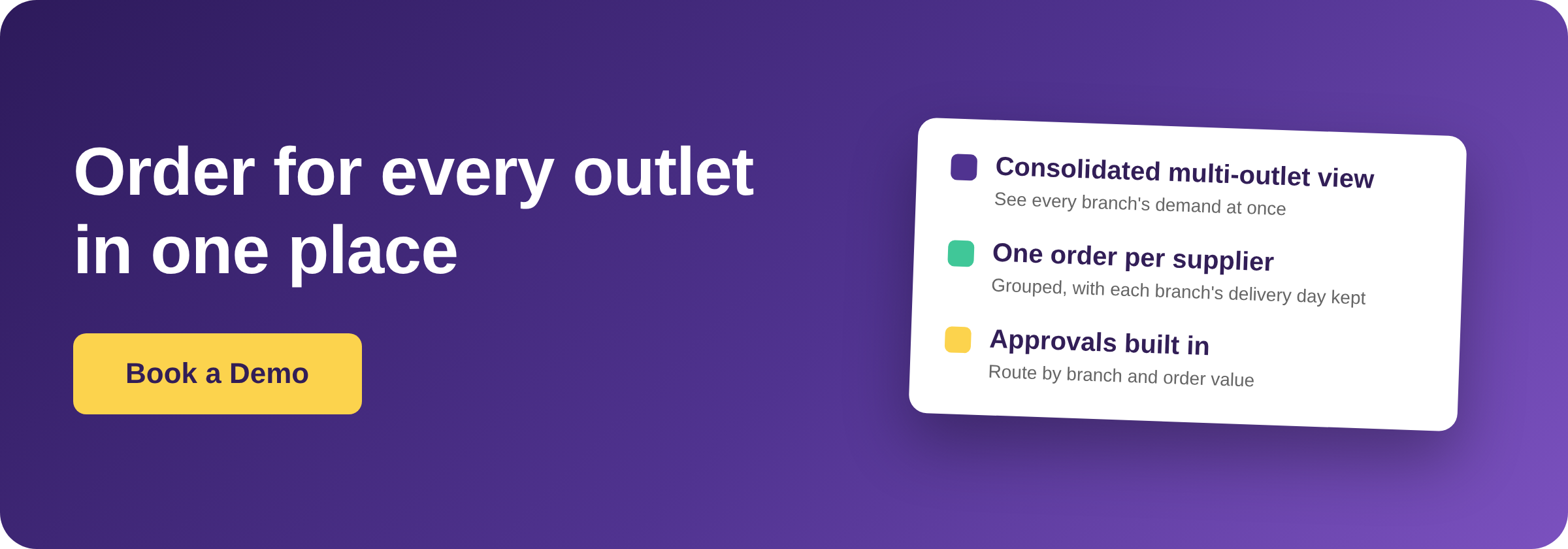
That is the whole point of restaurant group consolidated purchase orders. The system aggregates pending demand from every location into a single view, then converts it into supplier purchase orders in bulk, with no site-by-site login required. The group still buys what each branch needs. It just stops doing it 6 separate times.
This matters more as a group grows. With 6 outlets each ordering from 9 suppliers in a week, a group raises 54 separate purchase orders before consolidation, every one of them built, checked, and sent by hand. Consolidation collapses that into 9 orders, one per supplier, covering the same demand. The work that used to scale with every new branch starts to scale with the number of suppliers instead.
If you are setting up group purchasing for restaurants for the first time, the question to ask is simple: does the order start from a combined view of every outlet's demand, or does someone still have to open each branch one at a time? Everything else in consolidation depends on that answer. For the wider picture of how ordering, approvals, and receiving fit together, see our purchase order management system guide.
The Hidden Cost of Site-by-Site Ordering
The before-state is familiar to anyone running a multi-location group. A 6-location hospitality group's procurement manager described wanting to get off WhatsApp and phone-based supplier ordering and move to digital purchase orders with a full audit trail. The orders were going out, but no one could reconstruct who ordered what, at which branch, at which price, a week later.
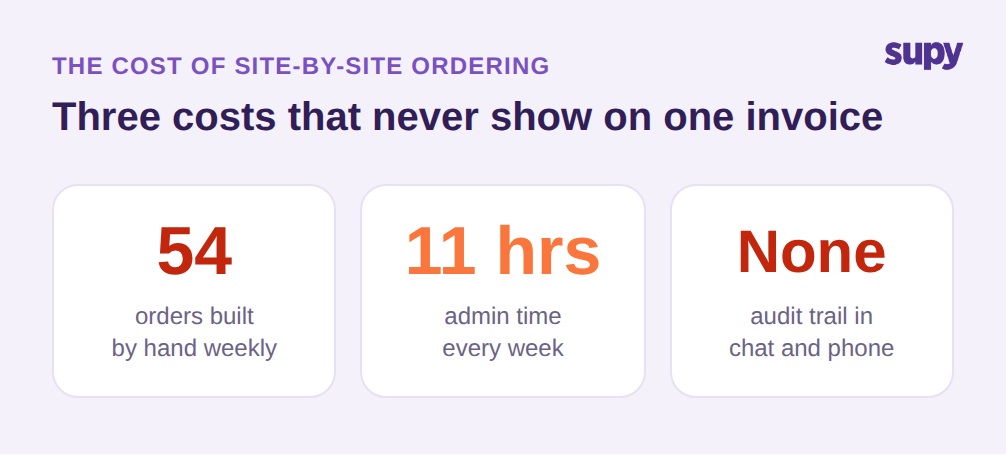
Site-by-site ordering carries three costs that rarely show up on a single invoice. The first is time: building and sending 54 orders a week by hand is an illustrative 11 hrs of admin that consolidation cuts to roughly 3 hrs. The second is lost volume. When each branch orders on its own, the group never presents a single number to a supplier, so it negotiates as 6 small accounts instead of one large one. The third is the missing trail. Orders placed over chat and phone leave nothing to audit, so price creep and off-contract buying go unnoticed until month-end.
A 6-location catering group's procurement manager named the same gap from the other side: their existing procurement tool could not aggregate demand across multiple suppliers into a single view. The tool digitised each branch's order but never combined them, so the group got digital paperwork without any of the buying power that consolidation is supposed to create. That is the trap many groups fall into: they buy software to fix the chat-ordering problem, then discover it only moved the same fragmented orders onto a screen. Digitising 54 separate orders is still 54 orders.
The decision frame here: if you removed your current ordering tool tomorrow, could you still answer "what did the whole group order from this supplier last month, and at what price?" If the answer lives in someone's chat history, site-by-site ordering is already costing you more than the admin time.
Grouping Orders by Supplier Without Breaking Each Branch's Delivery Schedule
The objection operators raise first is the right one: a group cannot simply merge every branch's order into one delivery. Each outlet has its own delivery days, its own cut-off window, and its own receiving bay. A blunt merge would send one truck to one address and strand five other kitchens.
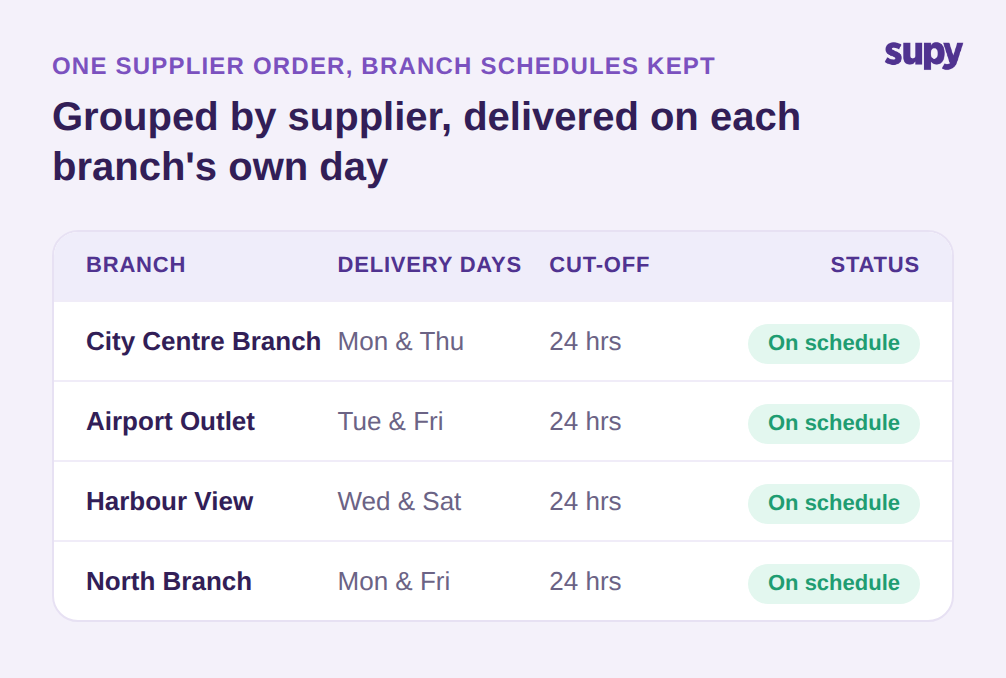
Good consolidation is supplier-aware and branch-aware, not a blunt merge. The system converts a multi-outlet requisition batch into individual purchase orders per supplier in one step, grouping line items by supplier while still respecting each location's contracted delivery schedules, per-branch contacts, and cut-off rules. The group gets one order per supplier for buying purposes, but each branch keeps its own delivery day and its own 24 hrs cut-off window.
This is the detail most competitor content skips. A 5-location fine dining group's financial controller described a complex multi-room, multi-category procurement setup spanning several selling and buying locations. For a group like that, consolidation only works if it preserves every branch's delivery rules while still presenting one combined number to the supplier. Lose the per-branch rules and the orders arrive on the wrong days; lose the grouping and you are back to site-by-site buying.
Before you trust any consolidation flow, ask the vendor to show it: build a single supplier order across three branches with different delivery days, and confirm each branch still receives on its own schedule.
Keeping Consolidated Purchase Orders Safe: From Requisition to Approval to PO
Consolidation concentrates spending, so it has to concentrate control too. The safe pattern is a full demand-to-PO cycle: branch staff raise requisitions as demand signals, those signals travel through a configurable multi-level approval ladder, and only then are they converted automatically into purchase orders grouped by supplier. Governance is built into the flow, not bolted on after the order is sent.
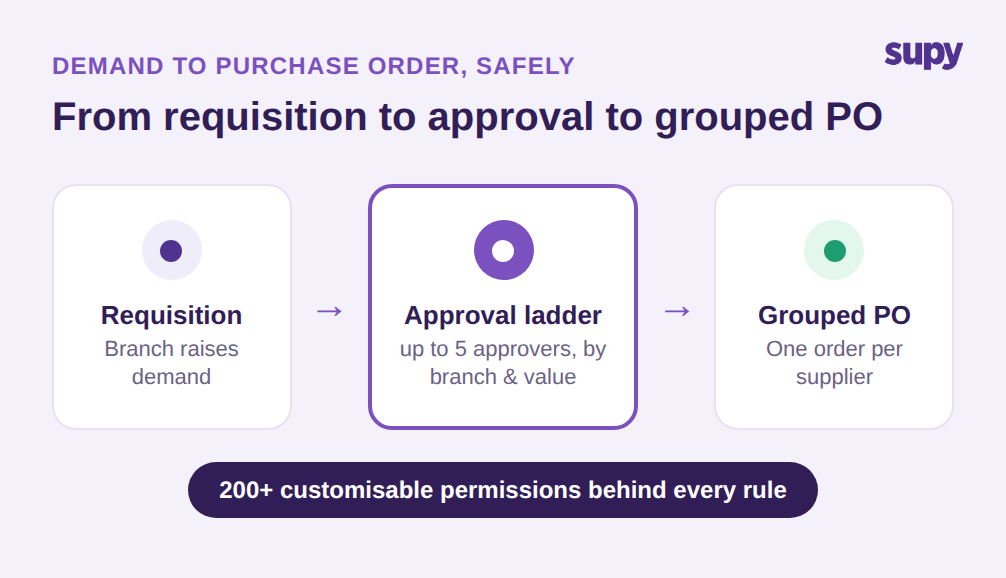
This is where a group's structure shows up in the workflow. Approvals can run through up to 5 sequential approvers, triggered by the branch and the order value, so a small produce top-up at one outlet and a large group-wide dry-goods order do not follow the same path. With 200+ customisable permissions behind it, an area manager can be allowed to approve for their region without ever touching another region's spend.
The requisition-to-approval-to-PO cycle is also what restores the audit trail that chat-based ordering destroys. Every requisition, every approval, and every resulting order is recorded, so the month-end question about who ordered what has an answer that does not depend on anyone's memory.
The question to ask: when a branch raises a requisition, can the approval rules change based on which branch and how large the order is, or does every order follow one rigid path? A single path either slows down small orders or waves through large ones.
Turning Group Volume Into Better Supplier Terms
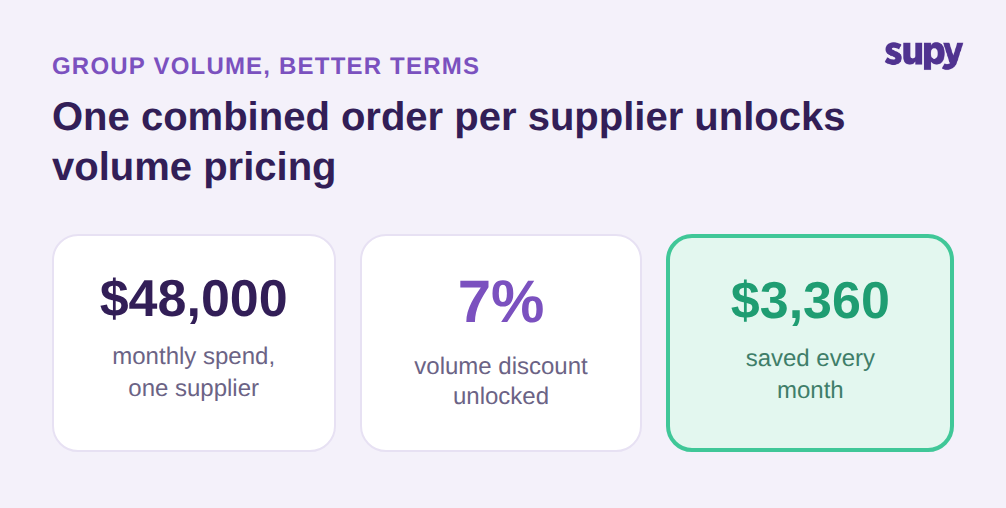
Once demand is consolidated, the group can finally buy like a group. Presenting one combined order per supplier instead of 6 fragmented ones is what unlocks volume pricing, and the numbers move quickly. On an illustrative $48,000 of monthly spend with a single supplier, a 7% volume discount is $3,360 saved every month, on purchases the group was already making.
The same combined view helps on the demand side, not just the price side. When pending demand from every outlet sits in one place, a central kitchen or a lead buyer can see consolidated cross-branch demand per SKU and order on behalf of any branch, which smooths out the small, expensive top-up orders that individual outlets place when they run short. Consolidation turns reactive per-branch buying into one planned group order.
Better terms are not only about headline price. A group that orders as one account can negotiate consistent credit terms, minimum order values, and fees across every branch, instead of inheriting whatever each outlet agreed to on its own. The same supplier record then applies to all 6 outlets, so a price change is updated once rather than chased branch by branch. Over a quarter, that consistency is often worth as much as the volume discount itself, because it stops the slow drift where the same item costs a different amount at each location.
The decision frame for this stage: take your three largest suppliers and add up what the whole group spent with each one last quarter. If those totals would put you in a higher discount tier than any single branch reaches alone, consolidation is leaving money on the table every week you delay it.
How to Tell If Consolidation Will Pay Off in Your Group
Restaurant group consolidated purchase orders are not only for the largest operators. The test is structural, not just size. Run these three checks against your own group before you choose a system.
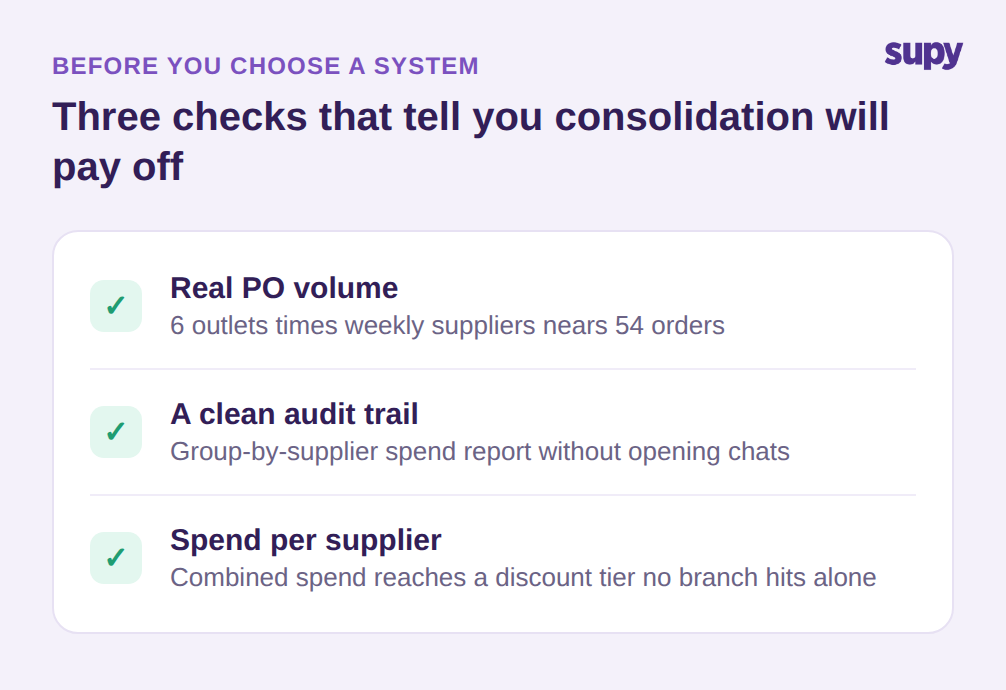
First, count your real PO volume. Multiply your outlets by the suppliers each one orders from in a typical week. If that number looks anything like 54 orders, the admin saving alone (from an illustrative 11 hrs toward 3 hrs a week) justifies the move. Second, check your trail: if you cannot pull a clean group-by-supplier spend report for last month without opening chat threads, you are buying the audit trail as much as the consolidation. Third, total your spend per supplier across the group. Where the combined number reaches a discount tier no single branch hits, the volume saving is the real prize.
A purpose-built platform like Supy is built around exactly this flow: a consolidated multi-outlet view, one-tap purchase order generation grouped by supplier, per-branch delivery schedules and cut-offs preserved, approvals through up to 5 levels with 200+ customisable permissions, and a full audit trail, connected to your existing systems through 75+ integrations. If your group already shows two of the three signals above, the next step is to see the demand-to-PO cycle run on your own supplier list. You can explore how the orders and requisitions flow handles multi-outlet ordering, then book a walkthrough with your own numbers.