.jpg)


Restaurant Software Consolidation: One Platform or Best-of-Breed?
One Platform or Best-of-Breed: What the Choice Comes Down To
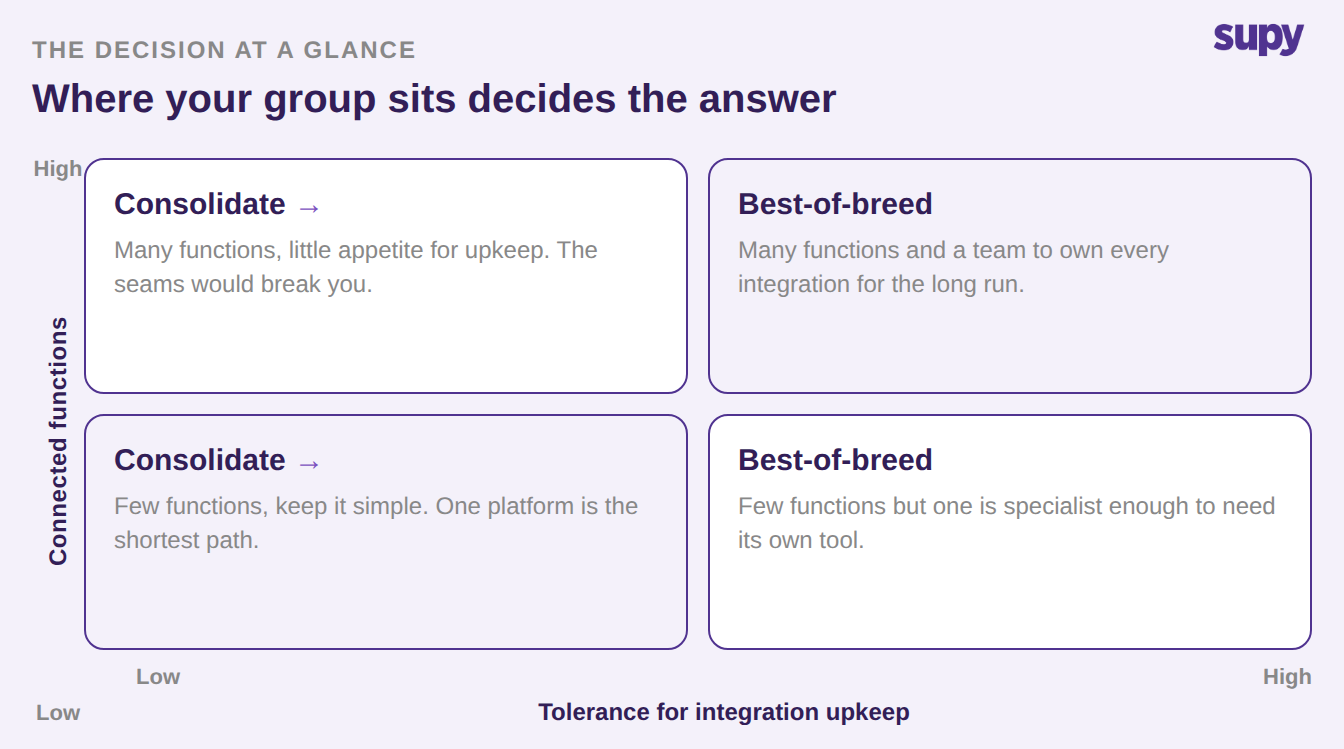
Restaurant software consolidation means running inventory, procurement, recipe costing, and central-kitchen transfers on one platform instead of stitching together separate best-of-breed tools. A best-of-breed stack picks the strongest tool for each job and connects them with integrations. Consolidation trades some specialist depth for one shared data set and no seams to maintain.
Neither approach is right for every group. The choice comes down to how big your estate is, how much integration upkeep you can absorb, and how much you value one number over the best-in-class version of each number. The quadrant below is a quick way to place your own group before the detail.
Where Best-of-Breed Stacks Break at the Seams
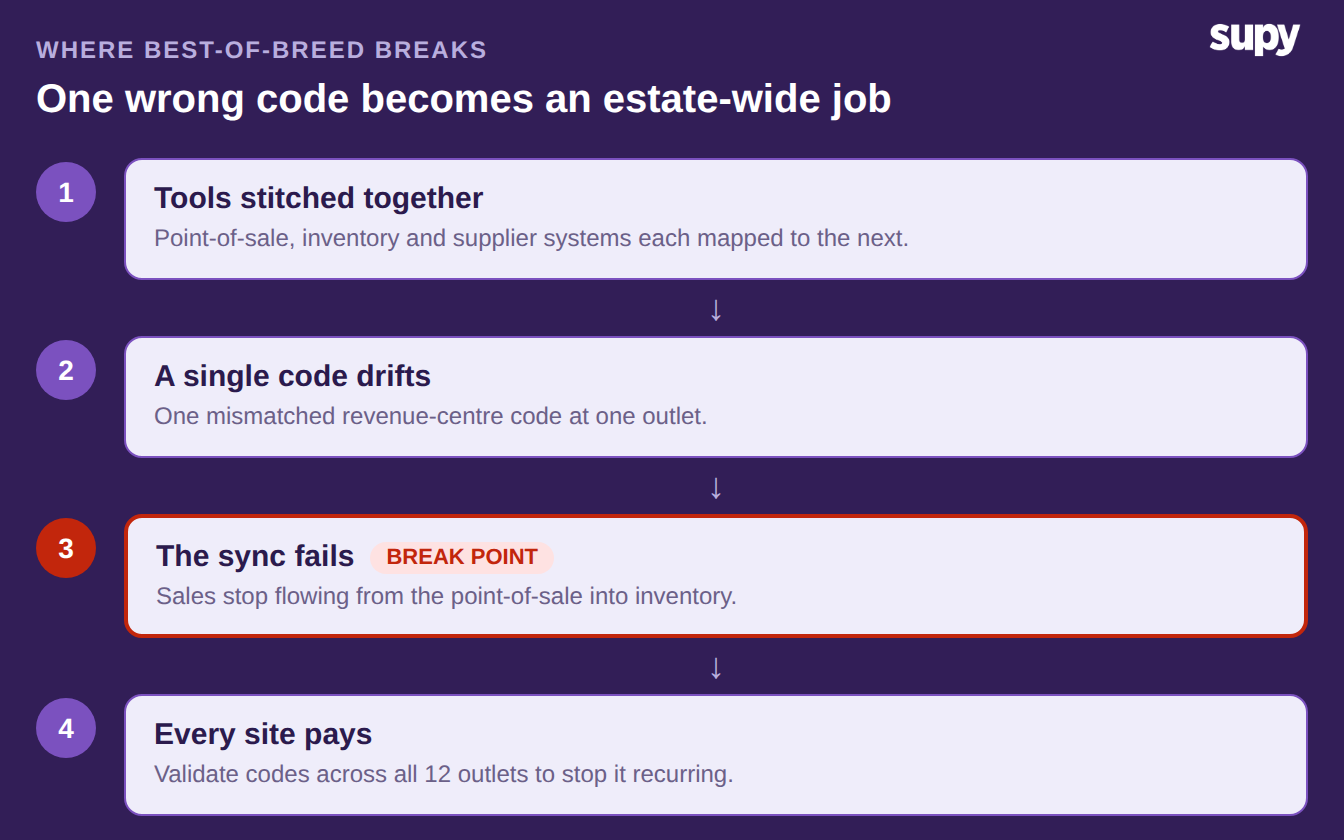
A best-of-breed stack is only as strong as the mappings between its tools. The tools themselves rarely fail. The seams do, and the seams are where multi-site groups lose their time.
The failures follow a pattern. One bar venue we saw had moved its ordering off a third-party supplier tool that kept throwing supplier code conflicts. In another group, a single mismatched revenue-centre code broke the sales sync between the point-of-sale system and inventory at one outlet. Fixing it was not the hard part. Validating every outlet's codes to stop it recurring meant an audit across all sites.
That is the hidden cost of stitching tools together. Each integration is a mapping someone has to own, and one wrong code turns a local glitch into an estate-wide job. Groups that live with this often patch each location on its own, so the same variance keeps coming back for weeks. Does your team keep reconciling numbers that two systems should already agree on? Two related reads go deeper: unified cost visibility when every location runs a different point-of-sale and accounting system and standardizing point-of-sale item and ingredient mapping across sites.
What One Platform Does That Separate Tools Cannot
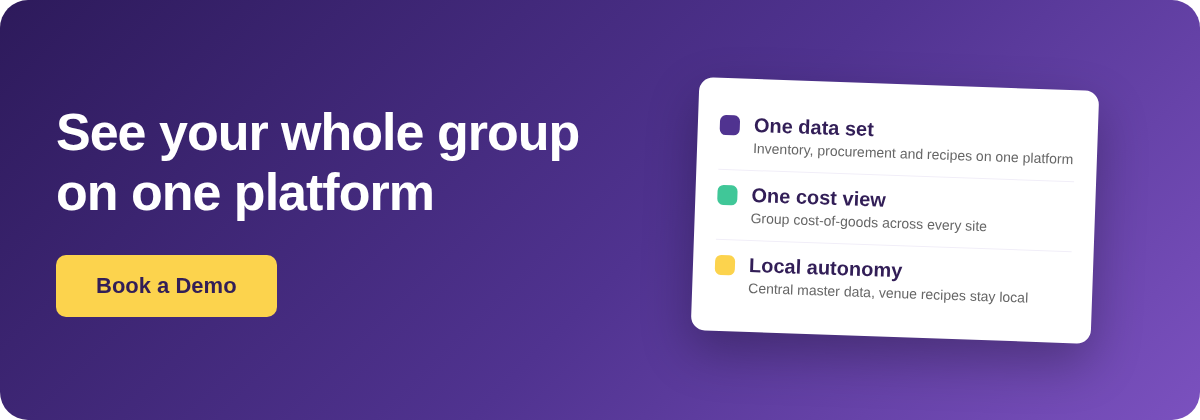
Consolidation removes the seams because there is nothing to map. One group weighing the move asked a sharp question. Could a single account hold centralised master data, products, suppliers, and recipes, across every branch? And could it still track internal transfers from the production site to each location? That combination is exactly what a stitched stack cannot do without extra glue.
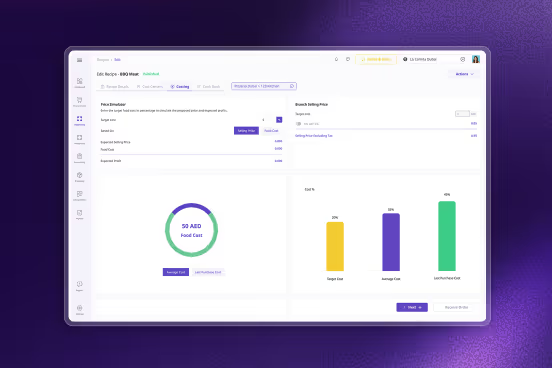
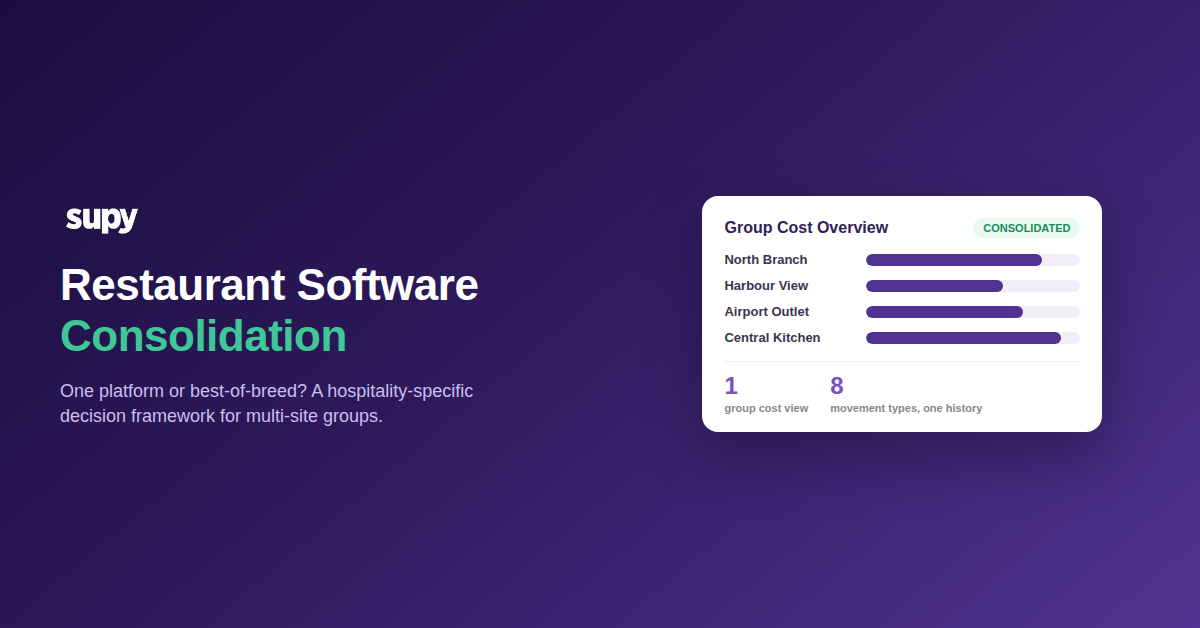
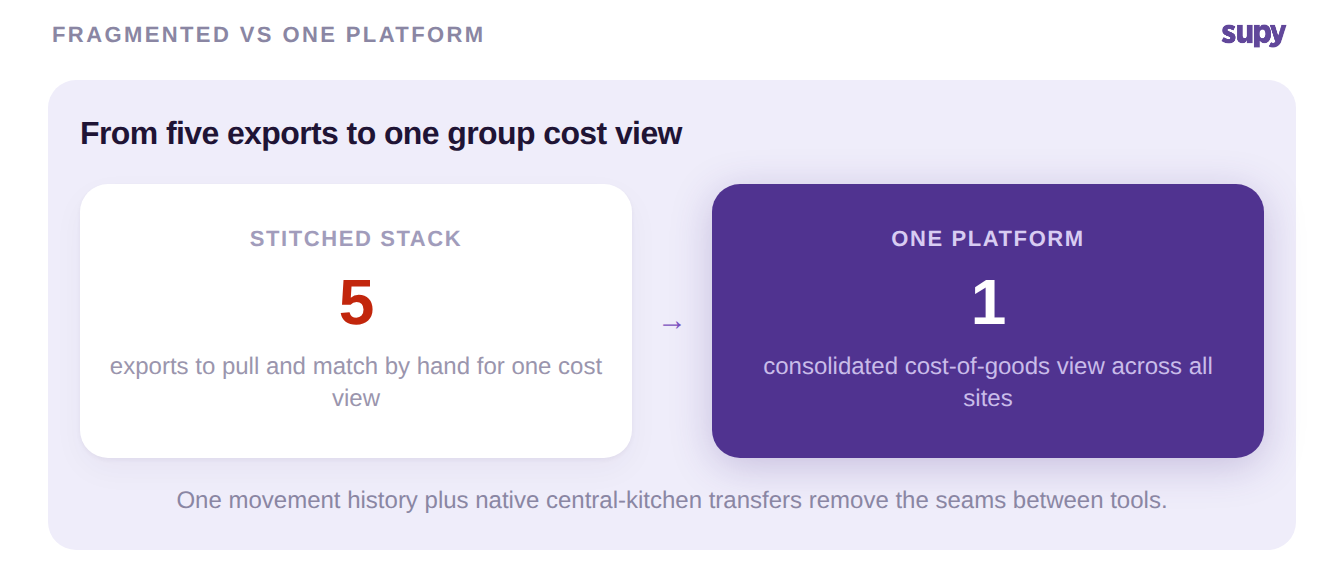
On one platform, every stock movement lands in a single history: goods received, counts, wastage, productions, transfers, point-of-sale sales, supplier returns, and central-kitchen orders. Group finance then reads one consolidated cost-of-goods view across all selected sites for a period, rather than exporting from several tools and reconciling by hand. Supy's restaurant inventory management platform is built around that one movement history, and its reporting rolls the group up into a single view. If you want the same picture by site and category, restaurant cost centre reporting across sites covers how that is set up.
Best-of-breed can reach a similar place, but only by buying and maintaining the connections. A platform with 75+ native integrations still expects you to own each mapping you switch on. The question is whether that upkeep is worth the specialist depth each separate tool gives you.
Does One Platform Mean Losing Local Control?
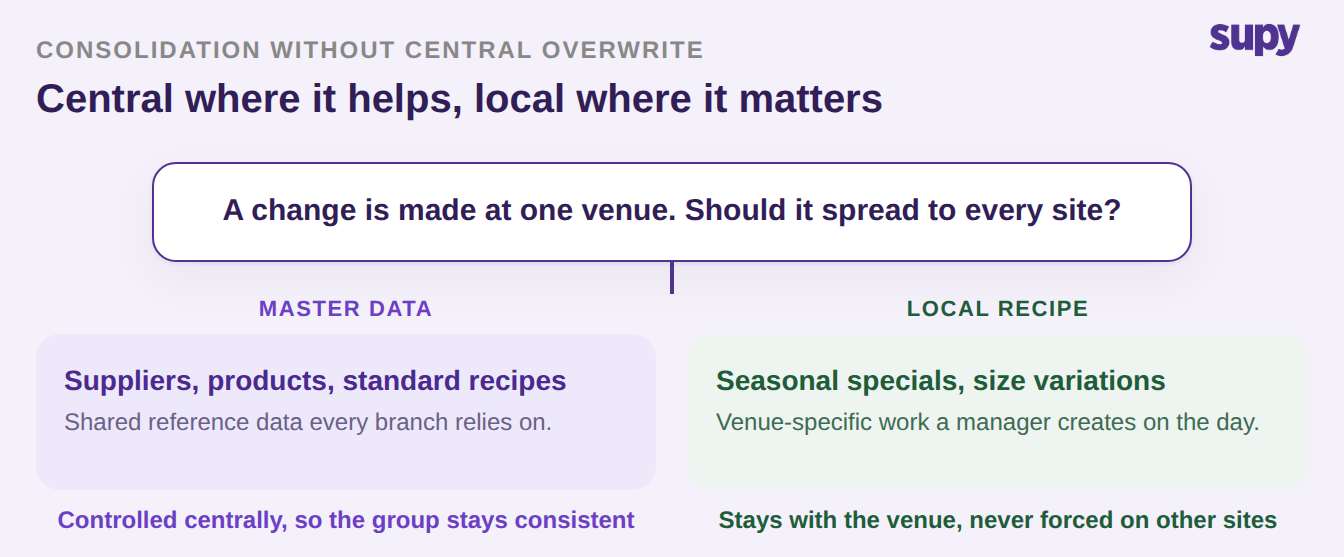
This is the fear that stops most consolidation decisions. One eleven-venue group had used a platform that applied every change centrally. A manager could not create a seasonal special or a size variation without it propagating to every other site. They wanted one platform, but not central overwrite.
Consolidation does not have to mean that. The distinction is between master data and local work. Shared reference data, the supplier list, the product catalogue, the standard recipes, is controlled centrally so the group stays consistent. Local recipes and venue-specific specials stay with the venue that created them. A platform that keeps those two things separate gives you group control and local autonomy at once, which is the combination operators assume they have to choose between.
Consolidate or Integrate: A Side-by-Side for Multi-Site Groups
The trade-offs line up cleanly once you stop comparing feature lists and start comparing how each approach behaves at scale. The table sets the two side by side on the criteria that decide the outcome for a multi-site group.
| Criterion | One platform | Best-of-breed stack |
|---|---|---|
| Data consistency | One shared data set, no reconciliation | Depends on every mapping staying correct |
| Integration upkeep | None between core modules | Ongoing, one owner per connection |
| Specialist depth | Strong across the core, not deepest in each | Best-in-class tool for each job |
| Central-kitchen transfers | Native, in the same movement history | Needs custom integration |
| Group cost view | One consolidated report across sites | Export and reconcile by hand |
| Local autonomy | Kept if master data and local recipes are separated | Varies by tool |
So the rule is simple. Choose consolidation when your pain is at the seams: recurring reconciliation, broken syncs, and code audits that eat days. It also wins when central-kitchen transfers and a single group cost view matter more than the deepest version of any one tool. Choose best-of-breed when one function is so specialised that no platform matches it, and when you have the people to own each integration for the long run.
Before you decide, run three checks on your current stack. Count the mappings someone has to maintain and ask what breaks estate-wide when one is wrong. Time how long a single group cost-of-goods view actually takes to produce this month. Then confirm any platform you shortlist keeps local recipes local while master data stays central, so consolidation never costs you venue autonomy. If you would like to see one movement history and one group cost view on your own data, book a demo.