.jpg)


Central vs Per-Site Restaurant Purchasing: Where Each Model Wins
Why the Central-or-Per-Site Question Comes Up When You Scale
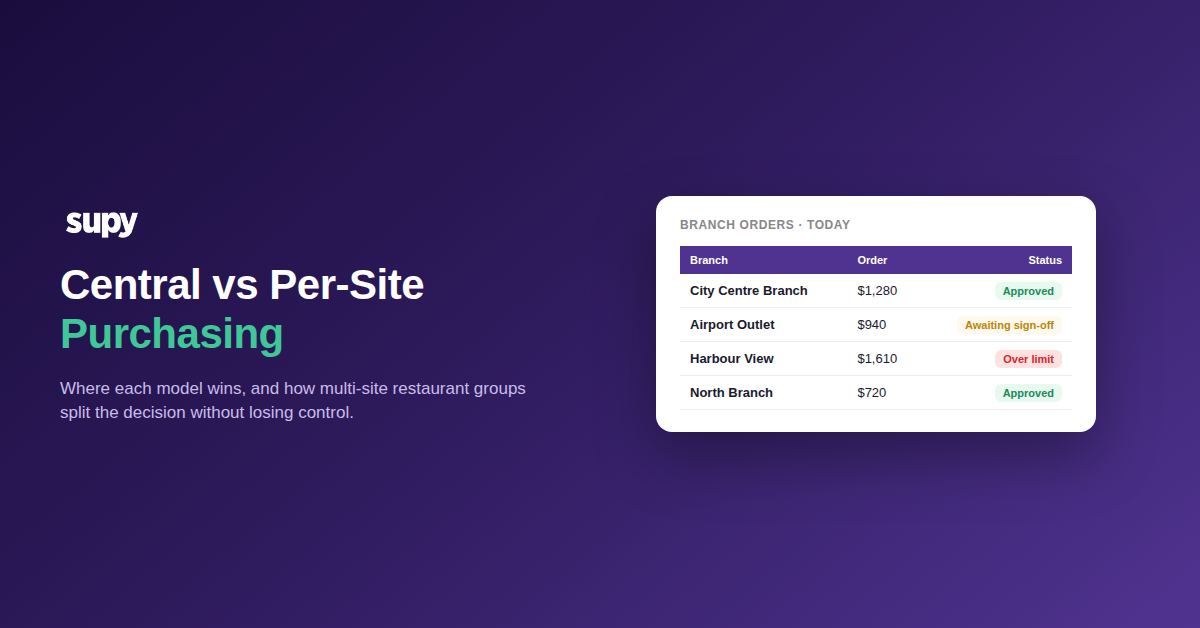
Central purchasing means one team negotiates contracts, sets prices and places orders on behalf of every site. Per-site ordering means each branch runs its own suppliers and raises its own orders. Most restaurant groups start fully per-site and only face the question when they grow, because a single site runs fine on local relationships that stop scaling the moment there is more than one of them.
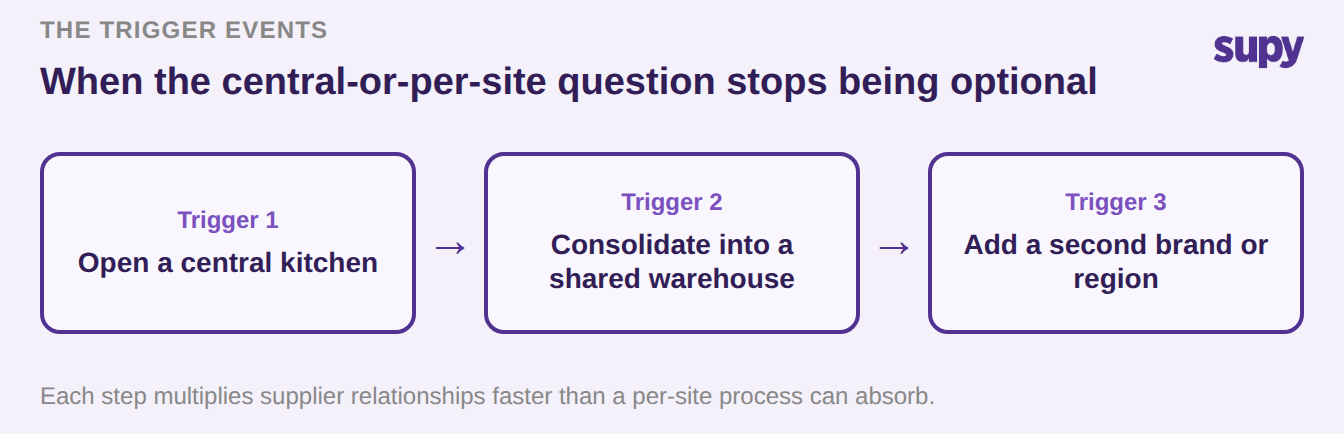
The shift is usually a trigger event, not a slow drift. Operators running a workable setup rarely change it for its own sake. The question becomes urgent at a specific moment: opening a central kitchen that needs to consolidate demand across branches, moving stock through a shared warehouse, or adding a second brand or region that multiplies the number of supplier relationships to manage. That is the point where a group discovers it has as many purchasing processes as it has locations, and no single view of what any of them is spending.
Where Pure Central Purchasing Slows a Restaurant Down
A fully central model is built for leverage: one contract, one price, one order. That works cleanly for the stable half of the basket. It struggles with the half that moves daily. Produce, dairy, bread and anything with a short shelf life are ordered against tomorrow's covers, not a monthly plan, and they are often best sourced locally.
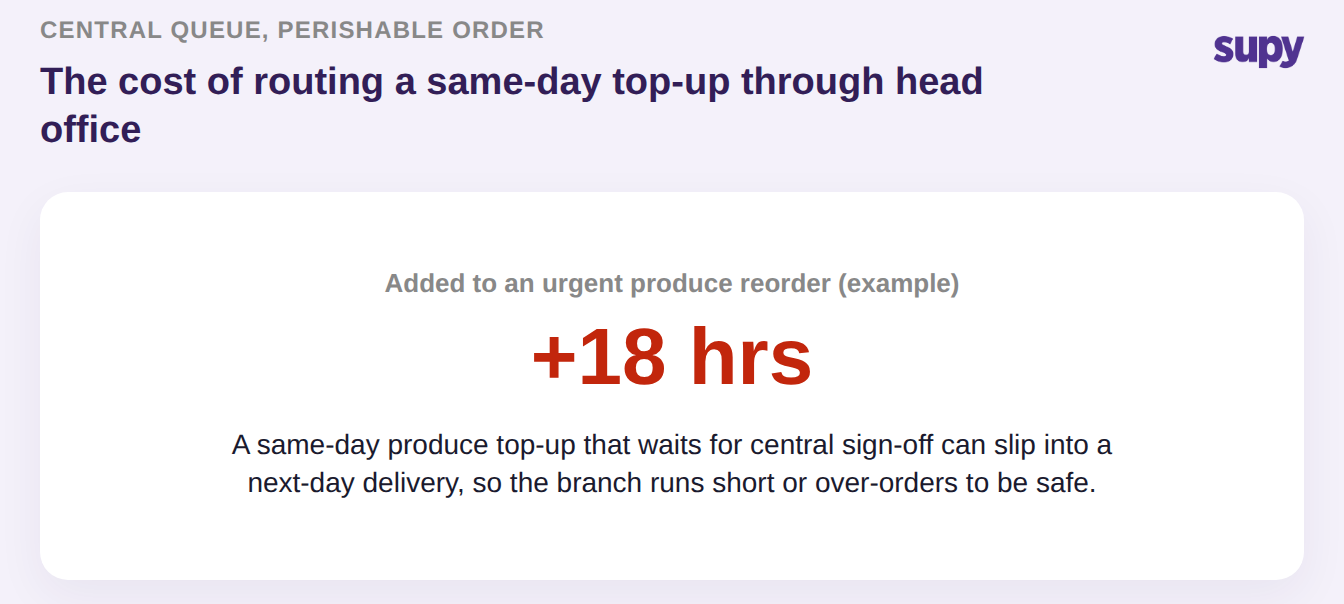
When every top-up has to clear a head-office queue, a same-day produce reorder can slip into a next-day delivery. The branch is left with two bad options: run short and disappoint guests, or over-order to be safe and carry the waste. Central buyers also sit too far from the floor to catch a local supply gap, a regional price swing, or a one-off need for a weekend special. Centralise the wrong categories and you trade responsiveness for a discount you did not need on items that were never the problem.
Where Per-Site Ordering Quietly Loses Control
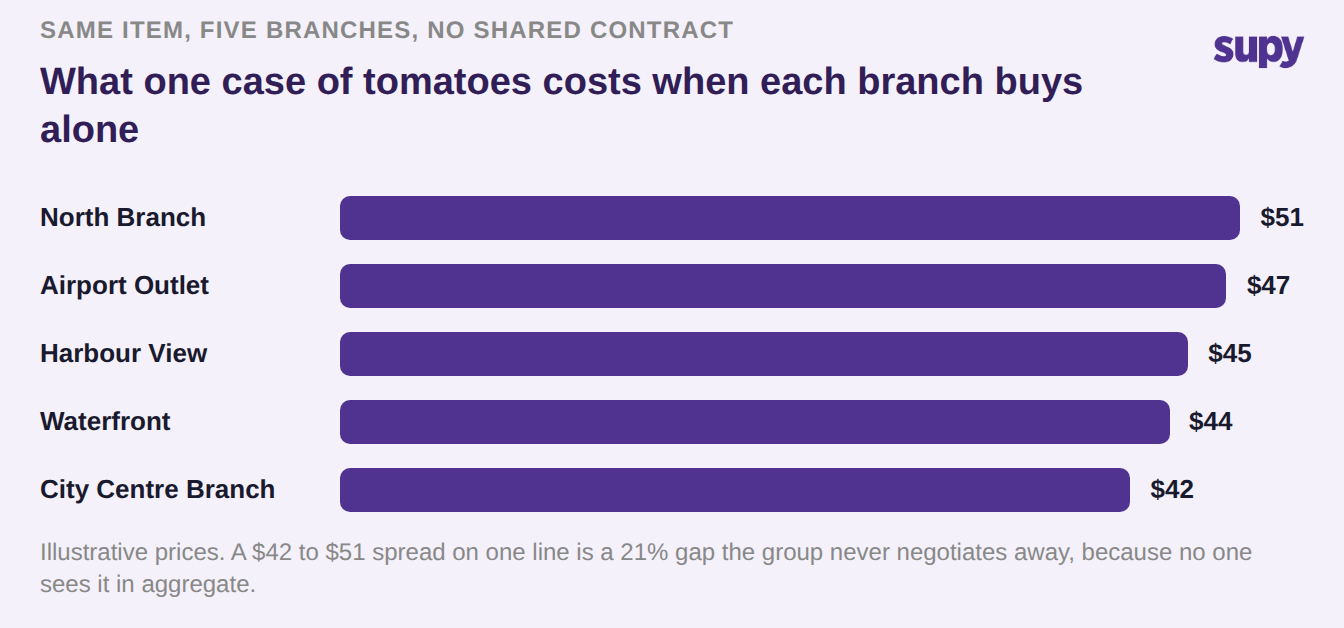
Per-site ordering keeps branches fast, and for a small group that is often enough. The cost shows up later, as scale, and it is quiet because no single order looks wrong. The same case of tomatoes is bought at a different price at every branch. Nobody is watching the aggregate, so the group never negotiates from its real combined volume. Purchasing runs through email, phone calls, spreadsheets and messaging apps, which means there is no structured record to reconcile against invoices.
The sharper risk is control. A branch member can place an order that goes straight to a supplier with no manager sign-off, simply because permissions were set per user across the whole group. A group-wide permission is either too loose for the branches or too tight for the people who actually need to order. Left unmanaged, per-site purchasing drifts off-contract, above par, and out of view, and the finance team only finds out when the invoices land.
The Hybrid Most Groups Land On: Central Contracts, Guardrailed Site Ordering
Most multi-site groups end up somewhere in the middle, and it is not a compromise so much as a division of labour. The centre owns what benefits from scale and consistency: supplier contracts, negotiated pricing, credit terms, the approved supplier list and a single view of spend. The branch owns what benefits from being close to the floor: what to order, how much, and when, inside limits the centre has set.
The table below sets out where each pure model wins and where the hybrid takes the best of both.
| What you are weighing | Fully central | Fully per-site | Hybrid |
|---|---|---|---|
| Pricing power | Strong | Weak | Strong |
| Ordering speed | Slow for perishables | Fast | Fast at the branch |
| Spend visibility | Full | Poor | Full |
| Local flexibility | Low | High | High, within limits |
| Control and compliance | High | Low | High |
In practice this looks like central restaurant procurement software holding the supplier terms and prices, per-branch contacts and delivery schedules attached to each site, and a central kitchen consolidating cross-branch demand where one exists, while each branch still raises its own requisitions against par. If you have already decided to centralise and want the rollout detail, our guide to centralising procurement for multi-location chains covers that path in depth. The point here is the decision that comes first: which levers move to the centre, and which stay at the branch.
How the Guardrails Actually Work
A hybrid only holds if the guardrails are real, and this is the part most advice skips. Naming the model is easy; enforcing it is where groups either keep control or lose it. The controls that make guardrailed site ordering work are specific.
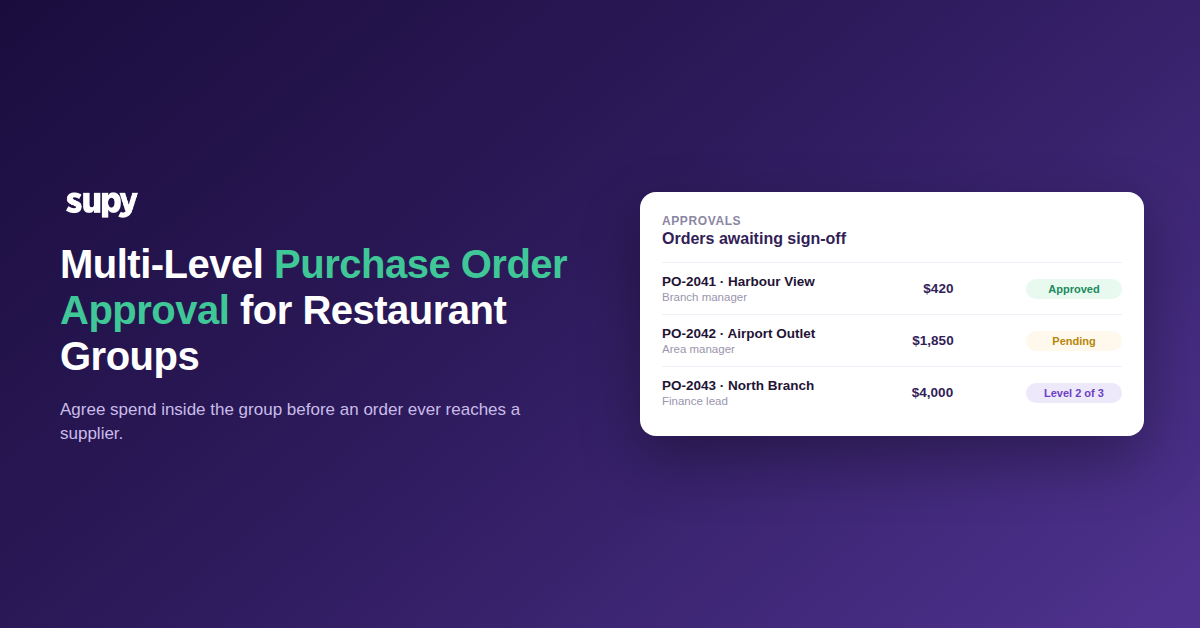
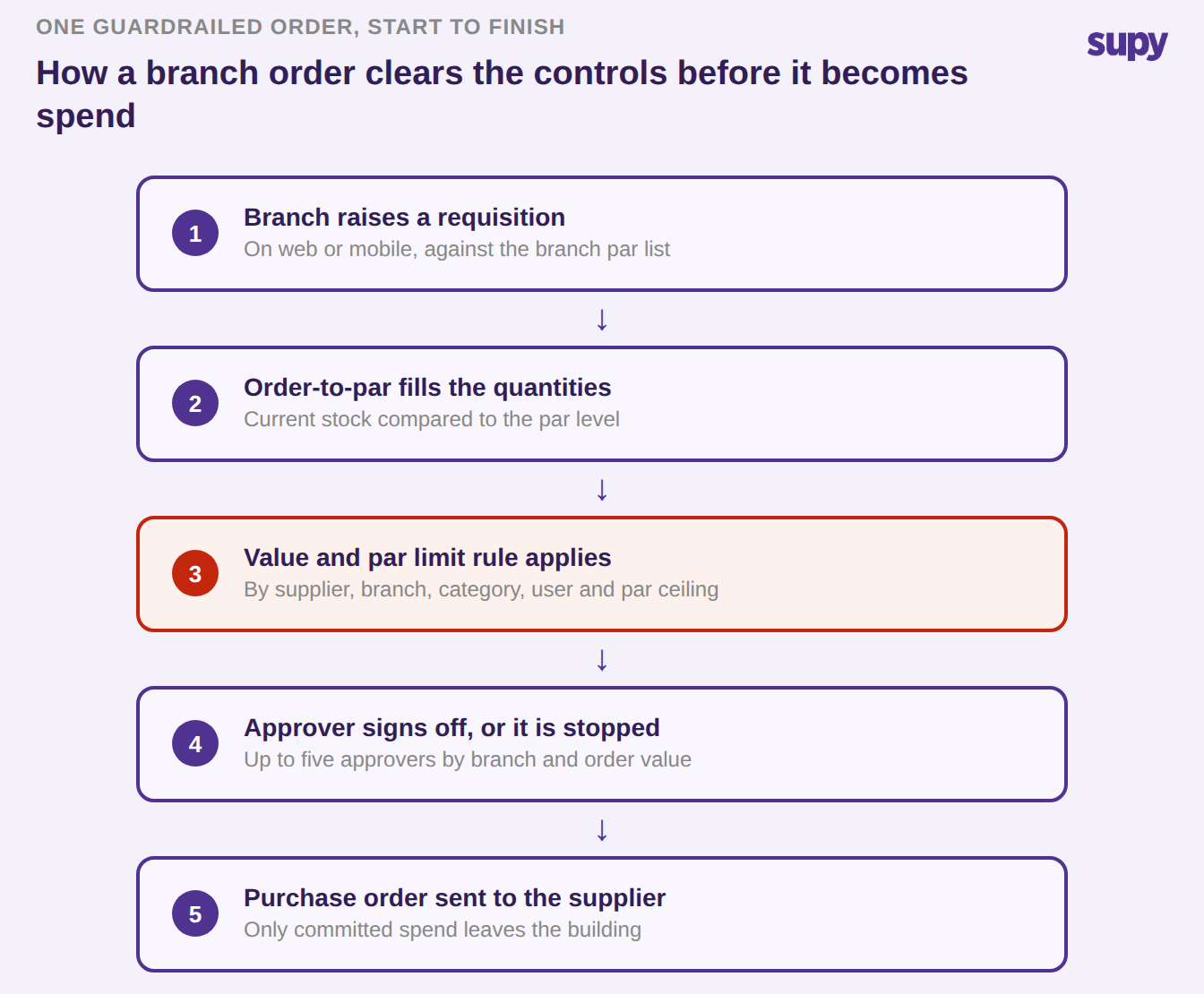
Approvals are triggered by the branch and the order value together, with a sequence of up to five approvers, so a small top-up clears instantly while a large or unusual order routes to the right person. Value limits can be set by supplier, branch, category, user and par level, so an order that exceeds what a site should reasonably need is stopped before it becomes a purchase order. Requisitions and purchase orders run as separate flows, so raising a request is not the same as committing spend. Order templates can be locked so that a branch orders only from an approved list, and a multi-location template shows only the items available across all the sites it covers.
If you'd rather not work par out by hand, the free par level calculator does it for every item on your sheet from your usage, delivery days and supplier lead times.
Par levels do double duty here. Beyond triggering reorders, a par or maximum acts as a ceiling: order-to-par fills quantities from current stock, and ordering above par can require sign-off rather than going through automatically. The single most useful move is to scope who may submit an order by cost centre rather than per user across the group, so branch autonomy and central control stop fighting each other. The flow below shows how one guardrailed order actually moves from a branch requisition to a supplier.
Choosing Where Each Lever Sits
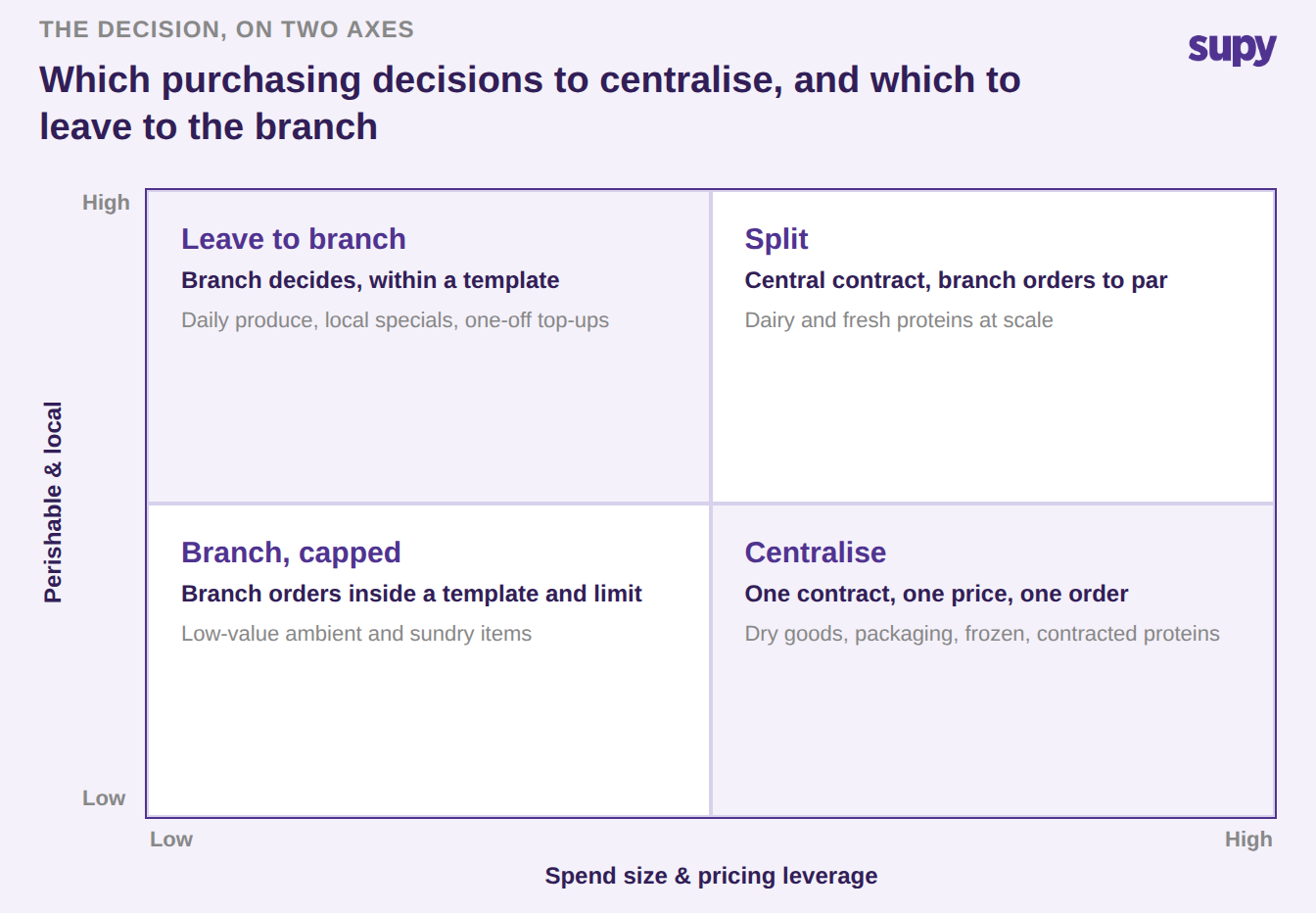
Choose central for a category when the spend is large, the item is stable, and pricing power matters more than speed: dry goods, packaging, frozen lines and contracted proteins. Choose per-site when the item is perishable, local and time-sensitive, or when a branch genuinely knows something the centre cannot: daily produce, local specials and one-off top-ups. For everything in between, keep the contract central and let the branch order against it inside a par ceiling and an approval limit. The map below plots the four cases against how perishable an item is and how much pricing leverage its spend carries.
Off-contract price drift shows up in your food cost before it shows up anywhere else, so if you want a quick sense of what it is costing you, a free food cost calculator is a fast first check. The real question was never central or per-site. It is which lever sits where, and what stops it drifting back.