.jpg)


Restaurant Inventory Software Business Case: Get the Board to Yes
What a restaurant inventory software business case must prove
A restaurant inventory software business case is a short, numbers-led argument that the rollout pays for itself. It names the savings the platform unlocks, answers the cost objections finance will raise, and proposes a phased plan that lowers the risk of the spend. Get those three parts right and the approval usually follows.
Most buyers walk into the finance meeting with a feature list. That is the wrong document. A board does not approve features. It approves a return, minus a risk it can live with.
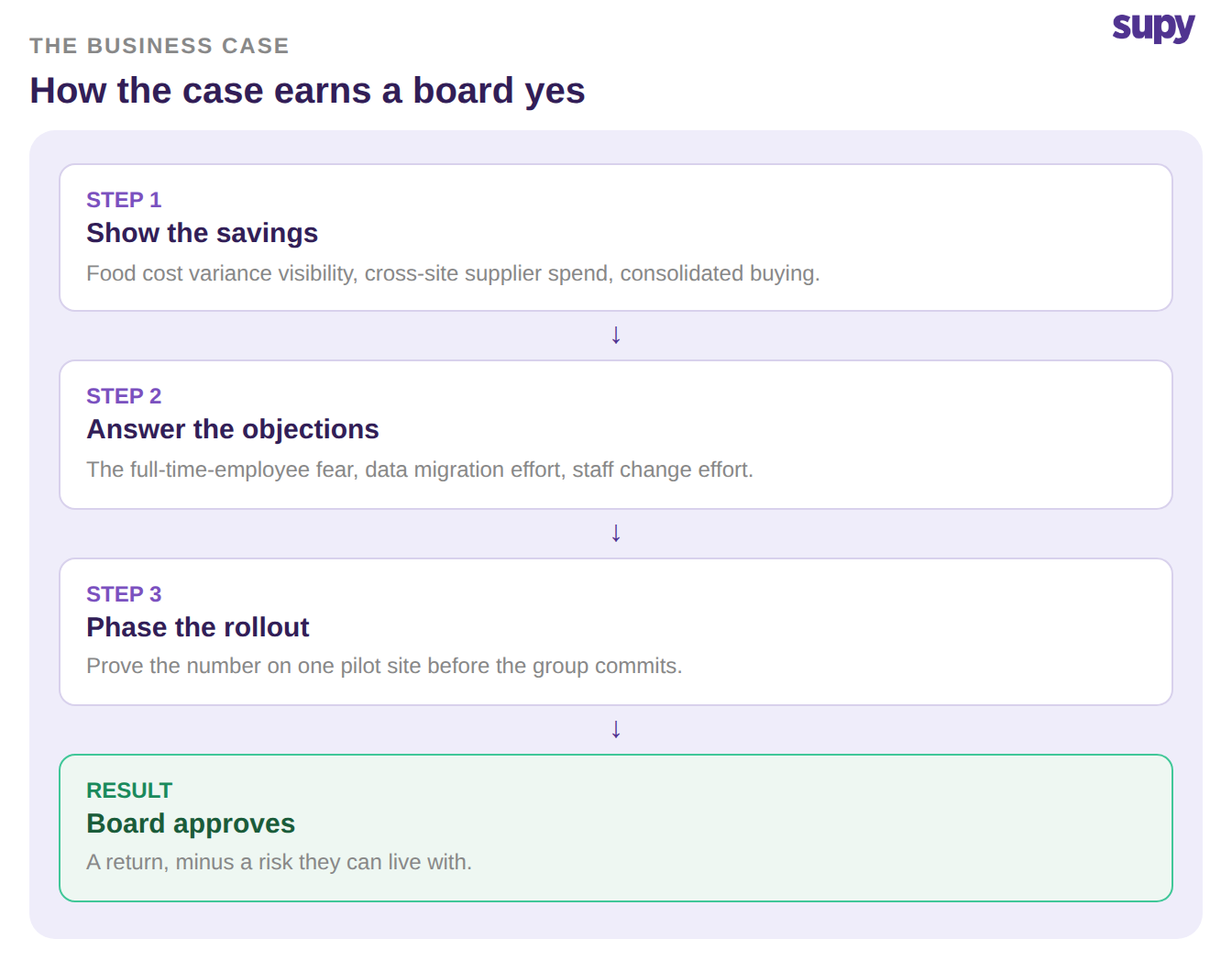
So the case has three jobs. It has to show the hard savings the software creates. It has to meet the objections finance already has half-formed. And it has to propose a way in that proves the number before the group commits every site. The rest of this guide works through each one.
The savings that pay for the rollout
The strongest lines in the case are the ones finance can later check. Vague "efficiency" claims get discounted in the room. Named savings, tied to a report the group already wants, survive scrutiny.
Three savings carry most business cases for a multi-site group. The first is food cost variance visibility. You see where theoretical cost and actual cost diverge, by site and by item, so managers act on the gap instead of finding it a month late.
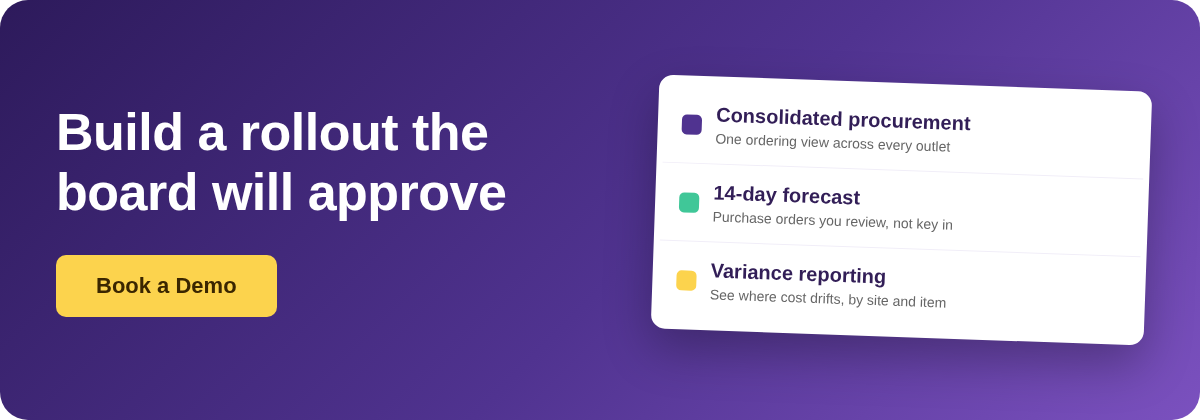
The second is supplier spend analytics across the estate: per-item purchasing history by ingredient across every location. That is the data you need to consolidate volume and negotiate. The third is consolidated procurement: aggregating demand from all outlets into one ordering view and raising supplier orders in bulk, with no site-by-site login.
Each of these maps to a measurable line, not a feeling. That is what makes them defensible.
| Savings line | What it removes | How to measure it |
|---|---|---|
| Food cost variance visibility | Discovering cost gaps a month late | Theoretical vs actual variance by site and item |
| Supplier spend analytics | Blind, site-by-site negotiation | Per-item purchasing spend across all locations |
| Consolidated procurement | Duplicate orders and site-by-site logins | Orders raised in bulk from one demand view |
The objections finance will raise, and how to answer them
Finance rarely argues with the savings. It argues with the cost of getting there. Three objections come up in almost every rollout meeting, and each has an honest answer.
The loudest is that the system will need a dedicated full-time employee to run. It is a fair fear, usually born from a past rollout that did need one. The answer is not to dispute it. The answer is to show the capabilities that remove manual load. Think consolidated ordering across outlets, a 14-day demand forecast that builds ready-to-review purchase orders, and reports that assemble themselves. The load shifts from data entry to review.
The second objection is migration effort: months of supplier invoices and data to pull together across dozens of outlets. The third is change effort, the staff time and buy-in a new way of working costs. Both are real, and both shrink under a phased plan rather than a big-bang cutover. Name them in the case before finance does.
| Objection | The reality | What to show finance |
|---|---|---|
| It needs a full-time employee | Manual load was real on the old system | Consolidated ordering, 14-day forecast, auto-built POs |
| Migrating our data is too much | Effort is front-loaded, not ongoing | A pilot needs one site's data, not the estate's |
| Staff will not adopt it | Change effort is real but scoped | One team trained first, then rolled out |
Phase the inventory software rollout so the number is proven first
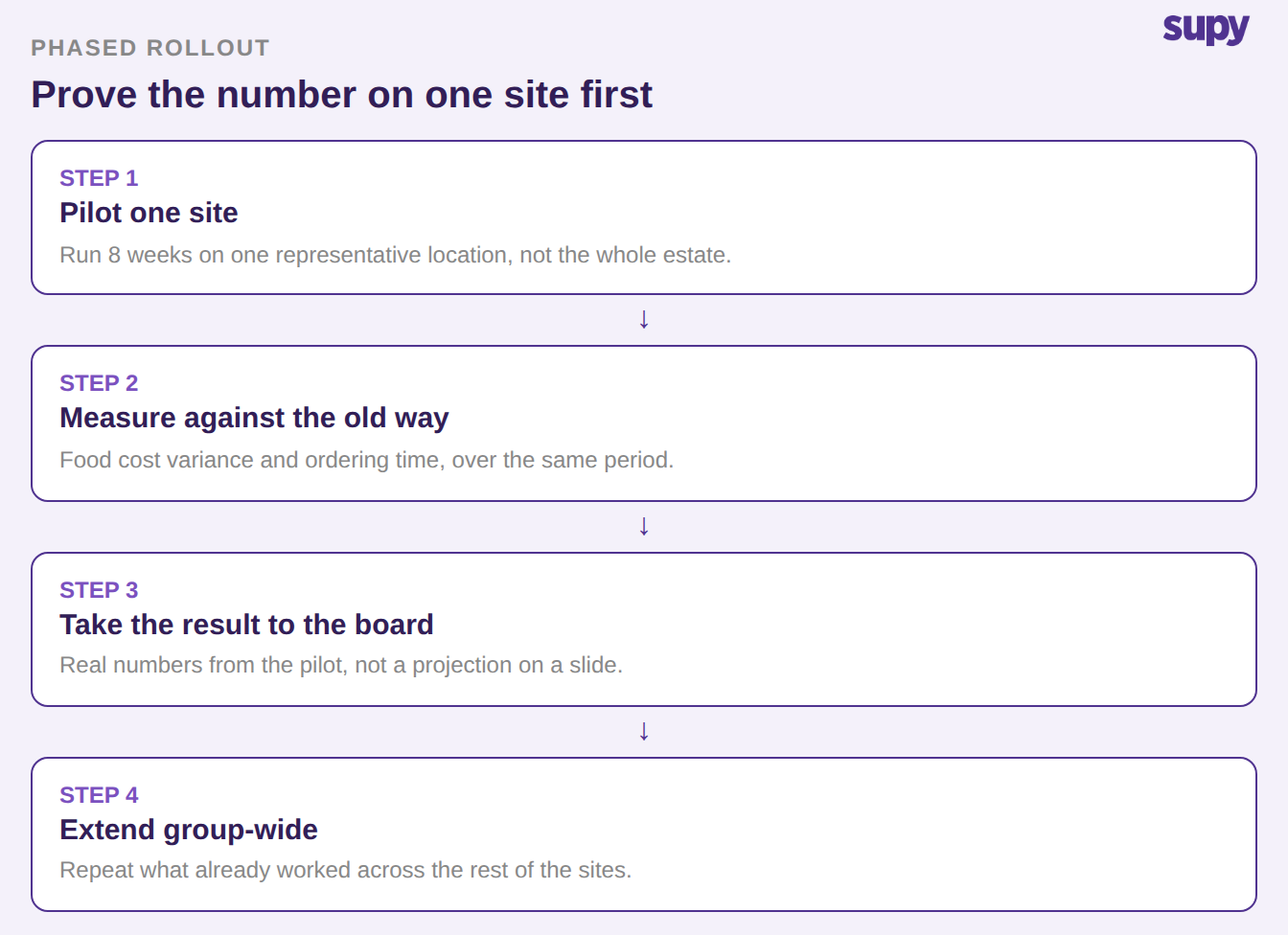
The safest business case does not ask the board to bet the estate. It asks for one site. Prove the savings on a single pilot, then extend group-wide once the number is real rather than projected.
A phased plan reads as low risk because it is. You run the pilot on one representative site, measure the food cost variance and ordering time against the old way, and bring that result back to the board. Say a 12-site group pilots on one site for 8 weeks. If the pilot moves the number, the group-wide rollout is no longer a leap of faith. It is a repeat of something that already worked.
This is also the honest way to handle the migration and change objections. A pilot needs one site's data, not the whole estate's, and it trains one team before the rest. Still weighing whether the group has outgrown its current setup? The signs a restaurant group has outgrown spreadsheet inventory are worth reading before you build the case.
Four criteria to judge before you commit
Before you put a platform in the case, test it against four criteria, and test each one in a live demo rather than on a sales deck. This is what separates a tool that will deliver the savings from one that will not.
Judge multi-site consolidation: can it aggregate demand and spend across every outlet in one view, or does it make you log in site by site? Judge integration fit: does it connect to your actual POS and accounting stack, given that a modern restaurant inventory management platform supports 75+ integrations? Judge reporting depth: does it produce the variance and movement reports finance will ask for, tied to your trading calendar? And judge the review load: does forecasting and predictive ordering cut the manual work, or just move it around?
Score each criterion in the demo, on your own data. A platform that clears all four is the one whose business case will hold up after approval, not just during it.
| Criterion | What good looks like | How to test it in a demo |
|---|---|---|
| Multi-site consolidation | One view across every outlet | Ask to see demand from several sites in one order |
| Integration fit | Connects your POS and accounting | Name your stack; watch it connect live |
| Reporting depth | Variance and movement reports | Open a variance report on the trading calendar |
| Review load | Forecasting cuts manual entry | Watch a purchase order build itself from a forecast |
Building the case is mostly about discipline. Show the savings finance can verify. Answer the cost objections before they are raised. And prove the number on one site before you commit the group.
Do that, and the rollout stops being a risk the board has to take on faith.