.jpg)

What Is Central Kitchen Software? A Complete Guide for Multi-Site Restaurant Groups
.png)
Running a multi-site restaurant group changes everything. What works for one kitchen breaks when you're producing sauces for ten. What feels manageable at two branches becomes chaotic at eight. Purchasing, prep, production, dispatch, costing - these are no longer back-of-house tasks. They are supply chain operations. This guide covers what central kitchen software is, how it works in practice, and what it actually takes to make a centralized model perform.
The Problem With Scaling Without a System
The shift toward central kitchen operations is accelerating across Dubai, the UK, APAC, and KSA. The reasons are consistent: rising labour costs, supply chain pressure, consistency demands, and margin compression that makes it impossible to run every outlet as its own independent kitchen.
Centralizing production into a commissary makes obvious sense. Bulk purchasing. Standardized prep. One quality-controlled output distributed across all your sites. The logic is clean.
But here's what most groups discover when they try to run this model on spreadsheets, WhatsApp order threads, and disconnected POS reports: centralization without the right software doesn't reduce complexity. It moves it. Procurement data sits in one place, production in another, outlet consumption in a third. Nobody has real-time visibility. Variance accumulates before anyone can catch it. And the operation that was supposed to simplify your life ends up running you.
That's the gap central kitchen software exists to close.
What Is Central Kitchen Software?
Central kitchen software - sometimes called central kitchen management software, commissary kitchen software, or CPU (central production unit) software - is a system built to manage production, inventory, procurement, and distribution from a central facility to multiple restaurant outlets, in real time.
It's not a standard inventory tool with an extra tab. The architecture is fundamentally different. Where a single-site restaurant system manages what's in the fridges at one location, central kitchen software tracks stock movement across an entire network: raw materials arriving at the central kitchen, work-in-progress batches mid-production, finished goods dispatched to outlets, stock received at branch level, and consumption against theoretical usage at every stage.
At its core, a central kitchen management system does three things:
It standardizes production - so every outlet receives the same product, prepared to the same spec, every time. It controls cost across locations - so recipe costing updates automatically when ingredient prices change, and margin is visible at both batch level and outlet level. And it synchronizes the supply chain - connecting the central kitchen to every branch through structured ordering, dispatch, and receiving workflows rather than informal communication.
"Before Supy, there wasn't a system out there where you could say, 'Here's your actual COGS for this period and here's your theoretical COGS.' Now we have excellent transparency on line items and can identify individual variances, saving us significant costs." - Tamer El Khayat, Founder, Kokoro
What Does Central Kitchen Software Actually Do? The 6 Modules That Matter
1. Production Planning
Production planning is where the data earns its keep for larger operations. Instead of estimating what to prep from experience and gut feel, a production manager works from real numbers: the 14-day sales forecast per branch, what every outlet has actually ordered, and current stock on hand. The quantities are still the manager's call, taken against evidence rather than memory.
If outlet A typically orders 15kg of marinated chicken on a Thursday and outlet B orders 20kg, the system consolidates that demand into one figure per item across every branch that has ordered, and nets it against what the central kitchen already holds. The prep team decides the run from a demand number it can see, rather than from a guess, which is where overproduction usually starts.
2. Recipe and Yield Management
In a commissary model, recipe management isn't just about standardization - it's about protecting margin across every batch, every outlet, every week. Central kitchen software stores master recipes, tracks actual versus theoretical yield, and links raw material costs directly to finished goods.
When ingredient prices move - and they do, constantly - every recipe that uses that ingredient updates automatically. Your kitchen team doesn't discover six weeks later that a sauce has been running at a 4% cost overrun. They know immediately, and they can act.
This is why recipe management is one of the highest-leverage capabilities in any central kitchen software stack. Static spreadsheet recipes create a false sense of control. Dynamic, live-costed recipes create real visibility.
3. Central Kitchen Inventory Management
Inventory tracking becomes significantly more complex in a commissary structure because you're not just counting one storeroom. You're tracking raw materials at the central kitchen, work-in-progress batches mid-production, finished goods ready for dispatch, stock in transit, and branch-level stock post-receipt.
Modern central kitchen inventory management software tracks movement across every one of these stages. It connects purchasing to production and production to dispatch, closing the loop so that every unit of stock is accounted for from the moment it enters the central kitchen to the moment it's consumed at an outlet.
4. Outlet Ordering Portal
The ordering portal replaces every informal communication channel - the WhatsApp groups, the phone calls, the emails that get buried - with a structured, auditable system. Each branch places internal orders through the platform. The software checks order quantities against par levels, consolidates demand per item across all outlets, and issues delivery notes when the central kitchen confirms and ships.
For the central kitchen team, this means going into each day knowing exactly what needs to be produced and for whom. For outlet managers, it means ordering in thirty seconds from a mobile device rather than calling head office and hoping someone picks up.
5. Dispatch and Distribution Tracking
Distribution is where many central kitchen models lose visibility - and where stock discrepancies quietly compound. Central kitchen software tracks dispatch quantities, delivery routes, receiving confirmations, and crucially, variance between what was sent and what was received.
That last point matters more than it might appear. Unconfirmed deliveries, short shipments, and receiving errors are a consistent source of unexplained variance in multi-site operations. A dispatch and receiving module that requires branch teams to confirm receipt - and flags discrepancies in real time - eliminates an entire category of invisible cost.
6. Cost and Margin Visibility
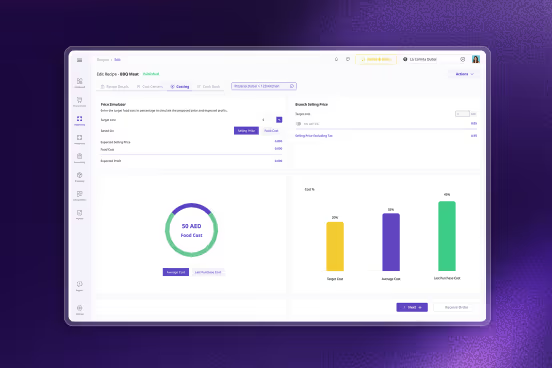
All of the above feeds into the thing operators care about most: knowing, in real time, whether the operation is making money. Central kitchen software generates cost-per-batch data, cost-per-finished-SKU data, outlet-level COGS, and group-level margin reports - without waiting for month-end reconciliation.
When a supplier increases chicken breast prices by 8%, the system shows immediately which recipes are affected, how much the batch cost has moved, and what that means for each outlet's food cost percentage. Decision-makers can act on that information while it's still actionable - not weeks later when it's already hit the P&L.
How Central Kitchen Software Differs From Regular Restaurant Inventory Software
This is a question that comes up often, and it's worth being direct about. Standard restaurant inventory software is built for single-site operations. It tracks what comes in, what gets used, and what's left. That's genuinely useful - but it's a different problem from what a multi-site group with a central production model is trying to solve.
Central kitchen software adds layers that single-site tools simply don't have: multi-location inventory synchronization, batch production tracking, internal transfer pricing between the central kitchen and branches, production-demand forecasting tied to outlet sales data, and distribution management with receiving confirmation and variance detection.
The distinction matters operationally. A group running a six-outlet commissary model on a single-site inventory tool is essentially running their supply chain on a tool designed for one shop. The data exists, but the architecture isn't designed to connect it. That's where the invisible cost hides.
Real-World Example: How Coffee Address Used Centralized Operations to Scale to 140+ Locations
Coffee Address, Saudi Arabia's leading specialty coffee chain, operates more than 140 locations across the Kingdom. At that scale, the difference between a tight back-of-house operation and a loose one isn't a margin point - it's millions.
Before bringing their operations onto a unified platform, the group faced a familiar set of problems at the central kitchen and branch level: discrepancies between actual and theoretical stock, lost sales and overstocking happening simultaneously at different sites, and lead times that were too long because the internal ordering process between branches, central warehouses, and the central kitchen wasn't structured.
By implementing a centralized system connecting their central kitchen to all branches, they reduced lead times and improved fulfillment rates through a structured internal ordering process. Recipe-building tools that linked directly to ingredient costs gave the team real-time visibility into COGS per item. A mobile-first approach meant every branch could manage stock counts, wastage recording, transfers, and deliveries without additional admin overhead at head office.
"Supy runs our back-of-house end to end, giving us real-time control and delivering measurable savings across the group." - Ahmad Azmi, Managing Director, Sophia Cafe (5 locations)
The principle holds regardless of scale: a centralized kitchen model only performs if the data flows cleanly through the entire chain. Software is what makes that possible.
When Does a Restaurant Group Actually Need Central Kitchen Software?
Not every operator needs it on day one. But the signal is usually clear when you do.
If you operate three or more locations with shared SKUs or centrally produced items - sauces, dough, marinades, pre-portioned proteins, dessert bases - you are already running a supply chain whether you think of it that way or not. The question is whether that supply chain has the visibility and control it needs to be reliable and cost-efficient.
Other clear signals: food cost variance increases as you add locations, even though individual outlets seem to be managed well. Procurement is fragmented, with outlets ordering independently from the same suppliers at different prices. Production mismatches mean you're either running out of centrally produced items or throwing them away. Recipe consistency is drifting across sites because there's no single enforced standard.
A useful test: if your central kitchen manager couldn't tell you today what the yield was on yesterday's batch of braised short rib, what it cost per kilo, and how much went to which outlet - your central kitchen is running on faith rather than data. That's a solvable problem, and central kitchen software solves it.
The Role of AI in Central Kitchen Operations
In 2026, AI has moved from experiment to embedded infrastructure in the most operationally sophisticated restaurant groups. In central kitchen operations specifically, it changes a few things significantly.
Demand forecasting starts at the branch. Supy predicts daily sales for each branch 14 days out, down to the menu item, and sets that against an 8-week historical average so a manager can override any day or item without retraining the model. Branches order against that forecast instead of last month's rough averages, and the central kitchen sees consolidated demand per item across every branch that has ordered. Turning that demand into a production schedule stays with the production manager.
Variance visibility is the second shift. When a batch yields below spec, or one outlet's usage runs ahead of its order pattern, theoretical-versus-actual variance exposes the gap by site and by item, with drill-down to the movements behind it, instead of leaving it buried in a monthly summary. One group using Supy traced an Aperol Spritz variance at branch level back to free-pouring a 75ml measure during busy service. The fix was a £5 jigger.
Supplier price monitoring rounds out the picture. When suppliers quietly increase prices on specific ingredients - a common practice across the industry - AI-powered invoice scanning flags unauthorized price changes instantly, giving procurement teams the data to challenge them before they compound across multiple invoices and batches.
What to Look for in a Central Kitchen Management System
When evaluating platforms, the temptation is to focus on feature lists. A better approach is to ask whether the system is built for multi-site from the ground up - or whether it's a single-site tool with a multi-location module bolted on. The architecture makes a significant difference in how well the data flows, especially at scale.
The capabilities that matter most for central kitchen operations, based on how groups at 5 to 200+ locations actually use this software: real-time inventory sync across the central kitchen and all outlets, integrated procurement with AI-powered invoice receiving, dynamic recipe costing that updates automatically with ingredient price changes, an outlet ordering portal that consolidates demand and manages approvals, production planning tools linked to outlet sales data, dispatch and receiving confirmation with variance tracking, multi-location dashboards accessible on mobile, and scalable permissions so branch teams can execute without full system access.
Integration with your POS system is non-negotiable. Sales data flowing directly from POS into the central kitchen software is what makes demand forecasting and COGS reporting accurate. Without it, you're making decisions from incomplete information.
How Supy Supports Central Kitchen Operations
Supy's Central Kitchen module is built for multi-site groups operating a commissary or central production unit model. Branches send purchase orders directly to the central kitchen through the platform. The central kitchen team sees consolidated demand across all outlets on a single screen, manages production, and dispatches with full documentation. Receiving is confirmed at branch level, and variance between sent and received is flagged in real time.
This sits within a broader back-of-house platform that connects invoice capture, recipe costing, inventory movement, wastage recording, and multi-location dashboards. The result is a single system that gives both the central kitchen team and head office genuine, real-time visibility - from the moment a supplier delivers raw materials to the moment that ingredient appears in a guest's dish at a branch 40 kilometres away.
For groups scaling beyond four or five locations, that end-to-end visibility is the difference between running the operation and being run by it.
Final Thought: Centralization Only Works When the Data Flows
The central kitchen model is one of the most powerful structural moves a growing restaurant group can make. It creates purchasing leverage, quality consistency, labour efficiency, and a production foundation that can scale without proportional cost increase.
But the model has a hard dependency: the data has to flow cleanly from end to end. Procurement to production, production to dispatch, dispatch to receiving, receiving to consumption, consumption to COGS. Break any link in that chain - with a manual process, a disconnected system, or a gap in accountability - and the cost advantage erodes.
Central kitchen software is what keeps that chain intact. It's not a nice-to-have for groups that are serious about scaling. It's the infrastructure that makes scaling possible without losing margin.
Book a demo to see how Supy's central kitchen module works in practice.