.jpg)


What Back-of-House Excellence Looks Like in 2026: AI, Automation, and Food Cost Control

Running a profitable restaurant in 2026 isn’t about working harder - it’s about operating with clarity.
Supplier pricing volatility, tighter margins, labor pressure, and multi-location complexity have permanently altered how restaurants must operate their back-of-house operations. The operators who win are not the ones reacting faster at month-end - they’re the ones detecting issues early, validating costs automatically, and using AI to guide decisions before margins slip.
This guide lays out what true back-of-house excellence looks like in 2026 - and how AI-powered systems make it achievable without adding admin or chaos.
In This Guide, You’ll Learn
- The core BOH failure points quietly inflate food cost in 2026
- A practical reset framework for invoice processing, inventory + procurement automation, and recipe margin control
- Where restaurant automation and machine learning for restaurants deliver real ROI - and where they don’t
- The modern AI stack operators rely on: restaurant POS integrations, forecasting, reporting, and invoice matching
- How to design scalable workflows for multi-location groups and central kitchen software models
Why 2026 Demands a BOH Reset - Not Another Efficiency Push
Most operators are not failing because they lack effort or experience. They’re failing because their systems reveal problems too late.
Invoices are still processed days after delivery. Inventory counts lag reality. Recipe costs are reviewed periodically, while supplier prices change weekly. By the time finance closes reports, decisions have already been made on outdated data.
A BOH reset in 2026 is not about speed for its own sake - it’s about timing.
When inputs are clean and timely, automation reduces noise, and machine learning adds clarity. When inputs are delayed or inconsistent, automation simply accelerates mistakes.
The reset follows a simple logic:
clean inputs → automated controls → real-time visibility → predictive decisions.
What Year-End Reflection Actually Reveals About Your BOH
Year-end reviews shouldn’t be post-mortems. They should reveal patterns. Across restaurant groups, four BOH truth checks surface again and again:
1. Food Cost Creep Starts at the Invoice Level
Price drift rarely shows up as a dramatic increase. It arrives quietly through:
- Pack-size changes
- Substitutions
- Minor line-item price shifts
Without invoice scanning AI and line-item validation, these changes flow straight into COGS unnoticed. Reset signal: “We only spot increases when the P&L is reviewed.”
2. Waste and Variance Are Symptoms of Weak Visibility
Waste isn’t just spoilage. It includes:
- Over-ordering
- Inconsistent prep
- Untracked transfers
- Receiving inaccuracies
If theoretical vs actual usage isn’t visible, food cost control systems aren’t in place - observation is. Reset signal: “We don’t fully trust inventory counts.”
3. Ordering Becomes Guesswork Without Forecasting
Disconnected inventory and demand signals lead to:
- Inflated pars
- “Just in case” ordering
- Overstocking the wrong items
This is where AI demand prediction and predictive ordering stop being theoretical and start becoming operational necessities. Reset signal: “Ordering depends on who’s on shift.”
4. Menu Profitability Fails When Recipe Costing Isn’t Live
Most restaurants cost recipes periodically, while supplier prices change weekly.
Without AI recipe costing, menu decisions are made using outdated data, especially across multiple locations. Reset signal: “We engineer menus quarterly, but costs move weekly.”
What “Good BOH Operations” Look Like in 2026
High-performing BOH operations in 2026 aren’t complex - they’re consistent.
Invoice processing is automated and validated at the line-item level. Inventory is counted with discipline, not panic. Procurement follows structured catalogs instead of tribal knowledge. Recipe costs update automatically when supplier prices change. Reporting surfaces variance signals in real time, not after the fact.
For multi-site groups, systems must scale without breaking. For central kitchens, production planning and distribution must reflect real demand, not forecasts built on outdated inputs.
The difference today is that AI can handle the mechanical work - capturing, extracting, validating, and flagging - allowing teams to focus on decisions instead of data entry.
The 2026 BOH Reset Framework: Build a System That Holds Up at Scale
Step 1: Fix Invoices First - Your Source of Truth
Manual invoice workflows guarantee: Delayed cost visibility, line-item errors, and missed credits.
A modern BOH starts with invoice digitisation and line-item extraction:
- Supplier details
- Pack sizes and units
- Pricing and quantity validation
This is the foundation of supplier invoice processing and automated AP workflows.
Step 2: Add Controls Without Slowing Operations
Control doesn’t mean more approvals - it means better matching. Modern systems rely on:
- 2-way / 3-way invoice matching
- Purchase order reconciliation
- Exception-based workflows
Finance stays comfortable. Ops stay fast.
Step 3: Make Inventory a Discipline - Not a Monthly Event
Inventory control is the core of food cost control systems. This means:
- Consistent storage mapping
- Accurate units and pack sizes
- Receiving and transfer discipline
- AI stock counting and variance tracking
Real-time reporting dashboards replace end-of-month surprises.
Step 4: Use AI for Restaurant Forecasting to Prevent Waste
Forecasting becomes useful only when it informs ordering and prep. With clean inputs:
- Ordering aligns with expected demand
- Waste drops
- Stock-outs decline
This is where machine learning for restaurants quietly delivers ROI.
Step 5: Make Recipe Costing Live
Menu engineering fails when costs are stale; 2026 menu engineering requires:
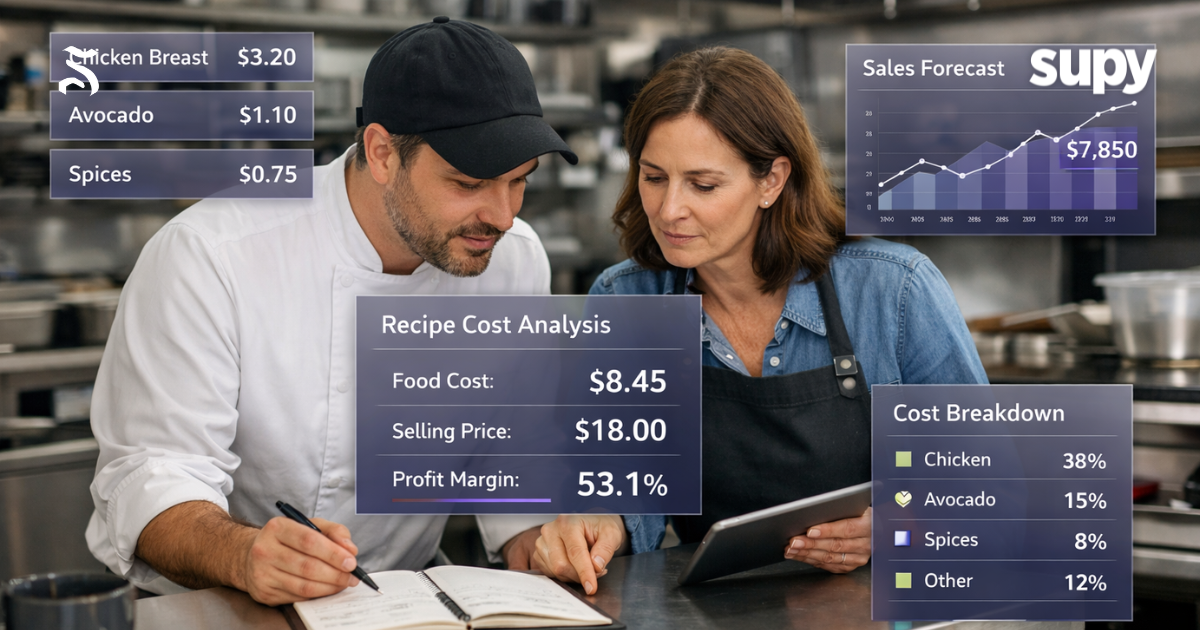
- Live recipe costing tied to supplier pricing
- Margin alerts when ingredients shift
- Continuous profitability visibility
This turns menu management into an operational system - not a quarterly exercise.
Scaling BOH Systems for Multi-Location Groups and Central Kitchens
Scaling introduces complexity - but it shouldn’t introduce chaos.
Multi-location management tools must enforce standard catalogs, consistent workflows, and centralized reporting. Without that, every new site multiplies blind spots.
Central kitchen software adds another layer: consolidated demand, production planning, internal ordering, and distribution to branches. Production forecasting and bill-of-materials accuracy become just as important as purchasing discipline.
When systems are built on clean inputs, scale becomes predictable instead of fragile.
Scaling BOH Systems for Multi-Location Groups and Central Kitchens
Scaling introduces complexity - but it shouldn’t introduce chaos.
Multi-location management tools must enforce standard catalogs, consistent workflows, and centralized reporting. Without that, every new site multiplies blind spots.
Central kitchen software adds another layer: consolidated demand, production planning, internal ordering, and distribution to branches. Production forecasting and bill-of-materials accuracy become just as important as purchasing discipline.
When systems are built on clean inputs, scale becomes predictable instead of fragile.
Final Thoughts:
In 2026, strong back-of-house operations aren’t defined by effort - they’re defined by visibility. The operators protecting margins are the ones catching cost issues early, validating data automatically, and running on real-time inputs instead of delayed reports.
Supy supports this shift by acting as the cost data foundation behind modern BOH workflows. By digitizing invoices, validating line-item pricing and quantities, and syncing verified costs into inventory, recipes, and reporting, Supy helps operators move from reactive control to real-time decision-making - without adding admin work.
To see how Supy helps restaurants run tighter, more predictable BOH operations, explore Supy’s invoice receiving capabilities here: https://supy.io/product-features/invoice-receiving